
Dannah Gresh: As Elizabeth Urbanowicz was babysitting her pastor’s children, a teaching moment happened.
Elizabeth Urbanowicz: So as I was getting the kids ready for bed, I was reading in John, and was reading Jesus' high-priestly prayer. And their three-year-old goes, “Jesus is praying to Himself?” (laughter).
Dannah: We’ll hear how Elizabeth responded today on the Revive Our Hearts podcast with Nancy DeMoss Wolgemuth, author of Incomparable, for April 23, 2026. I’m Dannah Gresh.
Any parent who truly loves Jesus is going to want that same love to grow in his or her child. Right? Even the older and fatherly apostle John said in his third letter, “I have no greater joy than this: to hear that my children are walking in truth.”
Yesterday we heard the first part of a conversation from a recent True Woman conference, and one of the points the panelists …
Dannah Gresh: As Elizabeth Urbanowicz was babysitting her pastor’s children, a teaching moment happened.
Elizabeth Urbanowicz: So as I was getting the kids ready for bed, I was reading in John, and was reading Jesus' high-priestly prayer. And their three-year-old goes, “Jesus is praying to Himself?” (laughter).
Dannah: We’ll hear how Elizabeth responded today on the Revive Our Hearts podcast with Nancy DeMoss Wolgemuth, author of Incomparable, for April 23, 2026. I’m Dannah Gresh.
Any parent who truly loves Jesus is going to want that same love to grow in his or her child. Right? Even the older and fatherly apostle John said in his third letter, “I have no greater joy than this: to hear that my children are walking in truth.”
Yesterday we heard the first part of a conversation from a recent True Woman conference, and one of the points the panelists made was that there’s no iron-clad guarantee—there’s nothing parents can do to cause their children to love God’s Word. That’s a heart change only God can bring about.
However, they went on to say, there are things parents can do that will help bring their children into greater contact with Scriptural concepts . . . giving greater opportunity for the Lord to work in kids’ hearts.
Before we head into part two of that panel discussion, I’d like to again have Nancy DeMoss Wolgemuth set us up with a struggle parents and grandparents often face with kids.
Nancy DeMoss Wolgemuth: A grandmom said, “The struggle today as we’re talking about teaching children is that the kids today say, ‘Don’t preach to me.’”
Well, I think it’s important that you ask God to show you how to teach your children in ways that don’t sound like preaching, how to use everyday real life circumstances and situations to help make connections.
That’s why the Proverbs uses so many word pictures. That’s why Jesus taught in parables, in stories. You see the grass over there? You see that sower over there sowing seed? There’s a lesson here.
So as you’re living life with your kids, as you’re just experiencing life together—you hear something on the news or something happens to a friend—ask God to help you connect the dots.
Where is wisdom or foolishness involved here? And then to help you be able to point those connections out to your children, particularly at teachable moments, when your children are open, when they’re tender.
Ask God to show you how to weave truth into the context of everyday life so your kids won’t feel like the Christian life is a category—it’s something we do on Sunday morning; it’s something we do during devotions. But you want them to feel it’s part of the warp and woof of everyday life.
Now, having said that and you trying to weave an understanding of your faith into everyday life, there will still be times when your kids will say, “Don’t preach to me.” When it comes down to it, God will show you there may be some times that you should just be quiet and back off. There are different ages, different stages of development.
But there will probably be some times when you need to have the courage to say, "I'm going to preach whether you want to hear it or not."
Dannah: That’s the host of Revive Our Hearts, Nancy DeMoss Wolgemuth, with wonderful wisdom for parents and grandparents.
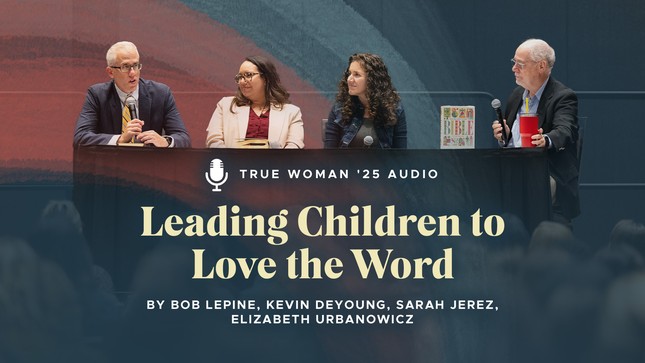
Let’s head now to part two of that discussion from a recent True Woman conference, on leading children to love the Word of God. The panel participants are:
- Kevin DeYoung, Pastor of Christ Covenant Church near Charlotte, North Carolina
- Bob Lepine, Pastor of Redeemer Community Church in Little Rock, Arkansas, and Revive Our Hearts board Chairman
- Elizabeth Urbanowicz, CEO of Foundation Worldview
- Sarah Jerez, a wife and mom who ministers to many through worship, especially in the Hispanic community
Bob Lepine served as the moderator. We’re picking up where he’s interacting with Sarah.
Bob Lepine: So how old is your oldest now?
Sarah Jerez: Fourteen.
Bob: Okay, let’s say your oldest gets to sixteen and says, “I don’t want to go to church. Do I have to go? I want to go to a different church.” What are you going to tell him or her at sixteen?
Sarah: “You’re gonna go anyway. You’re coming with us. And when you are of age and want to be out from under our roof and make your own decisions, then you’re free to.
Bob: When you start paying the cell phone bill, the car insurance—you can go.
Sarah: Totally, totally.
Bob: Kevin, is that the right answer? (laughter)
Sarah: I’m gonna do it anyway.
Kevin: Yes, we have . . . I’m not as good as my parents were. Maybe it’s more complicated. We have twice as many kids—that’s my excuse. But, you know, to get all the kids to youth group, to Sunday school, morning, evening, every week
But there are some non-negotiables, and certainly Sunday is one of those. And they just know. Please, please hear . . . the Lord is probably not going to send a lightning bolt the first time you skip church for the baseball tournament.
If you want to talk about idolatry in our churches, this is really where the rubber meets the road. And I get it. I have kids. I love sports. They have the weekend stuff. And you try, like, “Well, maybe you could do this one. It’s at one o’clock and you could do this.” But you’re going to have to draw the line somewhere.
If you expect your kids to value church when you are telling them now that you don’t value church, they won’t value church. You are giving them the pattern. So, yeah, you make decisions based on—is this a once-in-a-lifetime thing? Okay, maybe. But you just see parents who are sowing these seeds two weekends out of the month, ten weekends a year.
Really, if you tell me, “Well, we’re going to church, or we’re listening to your sermon,” it’s not the same. I’m glad it’s better than nothing, but it’s not the same. And so, yeah, my kids if you know they’re going to be out of the house someday, I hope they’ll make those decisions.
I told one of my kids . . . Now, I’m sure we have people with tattoos in the room, so I’m not making an absolute statement about you and your tattoo. I’m just giving you my convictions and what I told my kids. One of my sons was talking about how his friends were getting a tattoo. I said, “Well, I can’t even give you a foolproof, absolute answer, but I can just tell you that this dad does not pay for college for children with tattoos.” (laughter)
That’s just my rule. When you’re done, suppose you can do it and show off your little fish or somewhere on your back. I’m not making an absolute judgment. But parents can be afraid. I know you have all those questions—how are you going to fight on every article of clothing and that thing? But church is one of those things you say, “In this family, we go to church. You’re a part of this family, and as long as you’re a part of this family under our roof, we’re all going to church.”
Once you start negotiating . . . The first rule of negotiating with terrorists is: don’t do it.
Bob: You know, the concern on the part of these moms is, “They’re going to harden their hearts toward God. If I make them go, that’s going to turn them bitter toward God’s Word. If they’re sixteen and they’re sitting there with their arms folded and teeth clenched, hating being there, I’m somehow sowing seeds of rebellion and future deconstruction. Should we not worry about that?”
Sarah: I think it’s all about the way you do it as well. It’s not like, “You’re gonna go because I said so.” Hopefully not, though that might happen sometimes. But if you have a conversation with your kids. Maybe you haven’t been doing this in the past, and now you’re going to correct and start going more often. They’re going to struggle with that.
It’s having a conversation where they’re going to say, “You know what? I apologize to you, because I have not been faithful in putting God, His Word, and His people first in our family. And because I love you so much I know this is what is good for your soul, eternally. Because I love you so much, you’re going to come with me on Sunday morning, sit with me there.” You can be praying for the heart of your child as they’re sitting there with their serious face. But I think it’s all about the way and the explanation behind it.
When they’re younger, I’m just like, “You’re part of the Jerez family. We love Jesus, and go to church.” I love what Pastor Kevin was saying about idolatry. As families, our kids know our idols, and those idols in our homes. It might be sports. It might be academics. Or it might be the happiness and success of our kids.
I think, in general—I know it’s not a rule—but our kids usually end up loving what we love. Usually you don’t have to convince a family of diehard football fans or soccer fans to have their kids love playing soccer. I know it’s different. There’s sin involved when it comes to spiritual things and spiritual blindness, but when there is a joy in following the Lord and embracing His ways, even when it’s hard, telling your kids, “Jesus is better.” When they see that you’re willing to tear down idols out of love for Jesus, it makes a huge difference when it is an overflow.
I love curriculum, I love books. I think it’s because ultimately, in my heart, I believe that that is what’s going to do it. You know, if I pick the right book, if I pick the right curriculum, that’s what’s going to finally reach my child. But really—and we see it in Deuteronomy 6—it’s: “You shall love the Lord your God with all your heart, mind, soul, and strength. The word shall be written on your heart, and then you teach them diligently.” It makes a huge difference when it’s an overflow.
I asked my daughter when I was coming here, “What would help you love the Word?”
And she said, “You know, I like when we do devotionals or things like that. But honestly, my favorite thing, and what I think really helps me, is when we just have conversations.” So I do believe that it’s both intentional, but the organic is probably even more important.
Bob: When you walk—by the way—when you rise up . . .
Sarah: Exactly. The earlier you start, the better. But even as they’re older, a lot of times they really do want to talk about things. You might not feel like it. You might not tell right away. But even starting little by little, talking. If the Word is in your heart, that’s what’s coming out. It’s not nagging. It’s not just catechizing—although we do catechize our kids—it’s really an overflow of, “This is what’s true, this is what’s good, this is what’s beautiful.” That’s why I give it to you—not because I have to, not because this is just what we do, but because I really know that this is what’s best and most wonderful for you.
So maybe to simplify things, I think it was Elisabeth Elliot who said, “It’s simple, but it’s not easy.” I think things are a lot simpler than we think, and we kind of overcomplicate it to avoid doing them. I think the simplest things are the things that impact our kids: just talking before bed and being able to bring God’s truth to the things they’re struggling with.
Kevin: Let me say real quick about the heart: if your child is seventeen and their heart’s already not in a good place, having them go to church is not the cause of their heart. Now, it’s possible that we can sin in response to their sin, and we want to avoid that. We, as parents, need to be wise to try to discern what the issues of the heart are. Because there can be that sort of, “I hate everything about this. I’m already rebelling in my heart.” Or maybe they just don’t go to bed on time on Saturday and in the morning they’re dead tired.
Or your son loves basketball, and all of his friends are doing the basketball league, and they have their tournaments on Sunday morning. If you storm at your son and say, “Don’t you love Jesus more than you love basketball? We go to church in this family,” that’s not the way to do it. You want to try to understand and let your children understand that you understand you’re asking them to do something hard.
“I understand all your friends are doing this."
"Their parents are Christians, and they let them skip church."
"I know we’re doing something a different way. I know how much you love basketball, so we are asking you to do something that is difficult. And that’s part of being a Christian—you do things that are difficult.”
Now, does that solve all of it? No, but sometimes, just to help our kids realize there are trade-offs in life. We’re asking them to do something that’s going to have a cost. We shouldn’t pretend that it’s all just great, and that we’re not asking them to do anything difficult.
Bob: This is Elizabeth Urbanowicz. And Elizabeth gives leadership to a ministry called Foundation Worldview. And rather than me explaining it, I'll let you explain what you're doing.
Elizabeth Urbanowicz: Yes, so Foundation Worldview is a ministry that's designed to equip Christian parents, Christian educators, and Christian church leaders with practical tools to get children between the ages of four and twelve to think critically and biblically. Because in one year of our kids' lives, they're going to be faced with more competing ideas than most people throughout human history have faced in their entire lives.
So from the earliest of ages, we want to equip them with transferable skills to carefully evaluate every idea that comes their way and understand that Scripture is true.
Bob: And Elizabeth has a book that's down in the Resource Center that's called Helping Your Kids Know God's Good Design: 40 Questions and Answers on Gender and Sexuality. So she's dealing with an issue that is coming up here and there in the culture these days, right?
I mean, this is the flashpoint. In fact, as young adults are deconstructing, this is the issue that is leading to deconstruction. So getting our kids to understand God's good design on these issues is a part of that foundation that has got to be poured to protect them, because they're going to get pulled in a lot of directions. So that's available in the Resource Center as well.
Elizabeth, is there a problem reading Bible stories to a five-year-old?
Elizabeth: I would say no, there is not a problem reading Bible stories to a five-year-old. But what I see a lot of times in our ministry at Foundation Worldview is a lot of parents take children’s Bibles, and that’s the only thing they immerse their kids in. There are a lot of great children’s Bibles out there, and they can be very helpful, but our children are not too young to be immersed in God’s Word.
What we want to do is, even from the youngest of ages, read Scripture with them. It doesn’t have to be a whole chapter, but just so they’re getting used to hearing Scripture. Another thing that we hear a lot of times from parents who write into our ministry is that their kids don’t really understand what the Bible is. We want to help them understand the Bible as one continuous story. Pastor Kevin did a great job last night going through nine different themes that help us understand the Bible as a unified story.
We don’t just want to teach our children “David and Goliath” or “Daniel in the Lion’s Den.” A lot of times, if we’re reading those in a children’s Bible—and not all children’s Bibles, but many—those Bibles lead kids to put themselves in the story. When we read the story of David and Goliath in 1 Samuel 17, that narrative is not in the Bible to teach us how to slay our giants. That narrative is in the Bible to show us that God is the faithful covenant keeper.
God was being faithful to the covenants He made on Mount Sinai with His people, and David trusted Him. God was fulfilling His promise from the Garden in Genesis 3:15 to eventually usher in the One who would crush the serpent’s head. God was setting David up to be on the throne, to eventually usher in the Davidic kingdom, which was going to be the line of Jesus.
So it’s so important that as we are reading Scripture with our kids, we are helping them understand it as one big story of God’s grand plan to rescue us from our sin. It’s not just these little isolated narratives where we learn moral lessons. Do we learn how to live as moral people from Scripture? Yes. God has given us His moral law. But we want to help our kids understand the entire narrative of Scripture.
Part of that involves even teaching our kids how to soundly read, interpret, and apply Scripture. For example, think about how you were taught to read. When your teachers or your parents were teaching you how to read, they could have given you a list of words to memorize, and you would have memorized those words. Could you have read after that? Yes—you could read anything that contained the words you had memorized.
But what would have been the weakness with that? Any time you wanted to know a new word, you would have had to go to somebody else to learn what that new word was.
So instead, what your teachers or your parents—whoever taught you how to read—did is they taught you twenty-six different letters. They showed you the shape of those letters, told you the associated sounds, and then they taught you to put those letters together. Eventually, you could read any word you encountere.
We think about immersing our kids in God’s Word the same way. We want to make sure we’re giving them some tools, some transferable skills, so that one day they can read the Bible on their own. We don’t want them to be dependent on us for their spiritual nourishment. We need to get in Scripture with them and model how to soundly read, interpret, and apply Scripture so that, Lord willing, by God’s grace, they might become self-feeders who actively seek God through His Word.
Bob: Okay, what you’re describing sounds like what you do with high school kids, not with four-year-olds. I mean, four-year-olds want to learn about slingshots, rocks, and chopping off giants’ heads, right? They want to act that out in the living room. How do you teach them the hermeneutical principles you’re talking about with a four- or five-year-old? What do you do?
Elizabeth: Yeah, so there’s this special vitamin that you give your kids to make them super—no, I’m just kidding.
No. So obviously, God has designed our children according to a certain pattern, and we have to look at God’s design. Your four-year-old doesn’t know how to read yet, so you’re not going to teach your four-year-old to read God’s Word on their own. But you can still read Scripture with them at that young age.
I still remember back when I lived in Chicago. I was babysitting for my pastor’s kids one night. They had asked me to just pick up where they were that night in John. So as I was getting the kids ready for bed, I was reading in John—Jesus’ high priestly prayer—and their three-year-old goes, “Jesus is praying to Himself?”
That question never would have come up if we weren’t actually reading that portion of Scripture. I knew they had taken—or were taking—their kids through the New City Catechism, so I asked one of the questions: “How many persons are there in God?” Their five-year-old chimed in right away: “There are three persons—the one true and living God: God the Father, God the Son, and God the Holy Spirit.”
I said, “Exactly. So who is Jesus in that?”
“That’s right, He’s God the Son.”
“And who is He praying to?”
“God the Father.”
Even when they’re little, it’s just really developmentally appropriate things. Once your kids get older, though, you can do simple things that you notice in culture.
For example, how many of you have ever seen a mug, a T-shirt, or maybe a tote bag that says “God is within her; she will not fail?” How many of you have seen that? Yeah, that’s like the faux girl-power verse.
So I recommend—once your kids are old enough to read—you can say, “Oh, look at that jacket over there that says “God is within her; she will not fail.” You know what? When we get home, let’s read that Bible verse in context.” Context means reading some verses before it and some verses after it.
Then, when you’re at home, you can read through that passage. I think it’s Psalm 46. As you read through it, you learn that the “her” and the “she” in that verse is a city of God—it’s not any individual female. That psalm is about God being faithful and keeping His covenant with Israel.
And so even from young ages, we can just do little things here and there. It’s not sitting them down for an hour a day and having Bible class with them, but just little things as you’re tucking them into bed, as you encounter different things in culture—teaching them the skills so that they are slowly learning how to approach God’s Word.
Dannah: Great advice from Elizabeth Urbanowicz, who was part of a True Woman panel discussion that also featured Bob Lepine, Kevin DeYoung, and Sarah Jerez. I loved it when Sarah said, “It’s simple, but it’s not easy.” Isn’t that true of so many of our responsibilities?
You’ll find a list of the resources they’ve produced linked in the transcript of today’s program at ReviveOurHearts.com.
By the way, if you’re in ministry leadership, did you know that we make it easy to hold your own mini-True Woman conference with the women in your own church or Bible study? Using the Event Kit from Revive Our Hearts, you can basically build your own conference. You stream the messages from our website, and we provide discussion questions and other great tools to go with them. We break it down for you into easy steps to follow. And get this— it’s completely free! The Event toolkit is maybe one of our best-kept secrets here at Revive Our Hearts. Find out more and review the various packages available when you go to ReviveOurHearts.com/toolkit.
And this week we’re offering you Blair Linne’s riveting book Made to Tremble as an expression of our gratitude to you for your donation of any amount to support the ministry of Revive Our Hearts. Made to Tremble helps you sort through the various emotions related to anxiety and panic attacks, and takes you to passages of Scripture that give you peace. Ask for the book by Blair Linne when you contact us with your gift at ReviveOurHearts.com, or when you call us at 1-800-569-5959. Thanks so much!
Tomorrow our panel discussion continues. How can parents and grandparents encourage their children to love the Bible more? We’ll talk about some important tools anyone who works with children can use.
Please be back for Revive Our Hearts.
This program is a listener-supported production of Revive Our Hearts in Niles, Michigan, calling women to freedom, fullness, and fruitfulness in Christ.
*Offers available only during the broadcast of the podcast season.
Available Now for Your Donation
Additional Resources
- Music by Sarah Jerez
- Listen to Kevin's podcast "Clearly Reformed."
- "What Is Truth" by Elizabeth Urbanowicz
- "Are Feelings Truth" by Elizabeth Urbanowicz
- "Helping Your Kids Know God's Good Design" by Elizabeth Urbanowicz
- "The Biggest Story Bible Storybook" by Pastor Kevin DeYoung
- Check out Foundation Worldview.
- Check out "New City Catechism.