
Dannah Gresh: If you’re a parent, have you ever tried to lead your child / your children in devotions and immediately felt overwhelmed? Pastor Kevin DeYoung says, “Don’t give up!”
Kevin DeYoung: Doing something is better than nothing. Doing two minutes is better than no minutes. Some small thing whenever you can is better than grand plans that don't materialize.
Dannah: This is the Revive Our Hearts podcast with Nancy DeMoss Wolgemuth, author of A Place of Quiet Rest, for April 22, 2026. I’m Dannah Gresh.
This week we’re talking about our need to renew our minds. And we’re never going to rightly renew our minds apart from God’s Spirit working God’s Word into us.
If you’re reading through the Bible with us this year, following the schedule you’ll find at ReviveOurHearts.com/Bible2026, you know that right now we’re reading about the kings of Judah. …
Dannah Gresh: If you’re a parent, have you ever tried to lead your child / your children in devotions and immediately felt overwhelmed? Pastor Kevin DeYoung says, “Don’t give up!”
Kevin DeYoung: Doing something is better than nothing. Doing two minutes is better than no minutes. Some small thing whenever you can is better than grand plans that don't materialize.
Dannah: This is the Revive Our Hearts podcast with Nancy DeMoss Wolgemuth, author of A Place of Quiet Rest, for April 22, 2026. I’m Dannah Gresh.
This week we’re talking about our need to renew our minds. And we’re never going to rightly renew our minds apart from God’s Spirit working God’s Word into us.
If you’re reading through the Bible with us this year, following the schedule you’ll find at ReviveOurHearts.com/Bible2026, you know that right now we’re reading about the kings of Judah. If you think about it, much of the success or failure of Judah and Israel hinged on how well the truth about God was passed on from one generation to the next.
How can you lead children to love God’s Word? That’s the question we’re tackling today through Friday, as we listen to a panel discussion from a recent True Woman conference.
Before we go there, here’s how Nancy responded to a busy mom of middle schoolers who’s working on getting into God’s Word with her children.
Nancy DeMoss Wolgemuth: The investment you’re making in your children—it’s priceless! And you don’t have long to do it.
Let me just reiterate that there are no magic formulas. If you take six hours a day to do that, there’s no guarantee that your children will have a heart and a hunger for the Lord.
That’s why the wise parent is a praying parent, because it takes God’s grace and sovereign intervention in their lives to turn on the lights, to make it click. You cannot make it click. You can’t do everything right, and if you could do everything right, you still couldn’t make it click. But God is the one who can turn their hearts.
You just want to make sure as a mom that you are investing in their lives in the way God wants you to. Don’t let the way God has led some other mother to do it put you in bondage. There may be another time of day or a different way of doing it that God puts on your heart as a mother.
There are different seasons of life. Your children are different; you’re different. So ask the Lord, “Here am I; here are these children. How do you want me as a mom to be investing in their lives?”
Dannah: Again, that’s our host, Nancy DeMoss Wolgemuth, offering encouragement to a mom with a full schedule. Ultimately the love for God’s Word is something God has to do in your child.
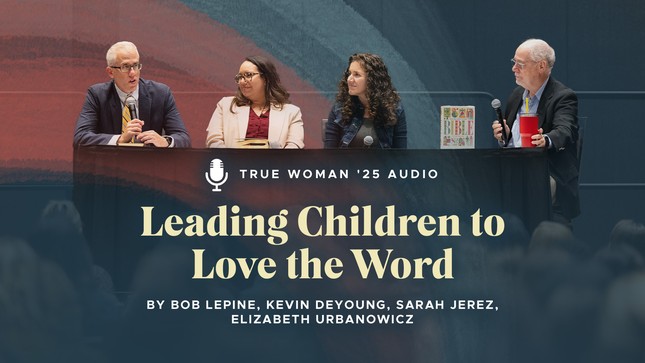
And that’s where the panel discussion we’re about to listen to started, as well. Revive Our Hearts board chairman and radio veteran Bob Lepine moderated a conversation at a recent True Woman conference. Today we’ll be hearing from Kevin DeYoung and Sarah Jerez. Here’s Bob.
Bob Lepine: Let me introduce our panelists to you. We are going to talk about how we help children and grandchildren—for those of you who are in that category—develop a love for God’s Word.
So I think you all know Pastor Kevin DeYoung. Kevin is a pastor in Charlotte, North Carolina. Christ Covenant Church is where he pastors. He’s an author of many books and has podcasts and has a ministry called Clearly Reformed that I would commend to you. You can find it online, and it’s kind of the repository for Kevin’s collected works—sermons and writing.
When I am looking for theological clarity expressed in grace and winsomeness, I turn to Kevin DeYoung as a source for that, and would commend that to you as well. When you want to know what does the Bible say, and you want it expressed in a way that demonstrates grace and winsomeness—although winsomeness has kind of become a dirty word in the culture today—but do you own that word “winsomeness” for yourself?
Kevin: Yeah, I was using it before it became a bad word.
Bob: Before it became a curse word.
Kevin: I understand the danger, just like empathy.
Bob: Yeah, there we go. We could do that too.
Kevin: That can be used badly, but sure.
Bob: This is Sarah Jerez, who is in the middle. Sarah is a mother of six. She and her husband Jonathan live in suburban Chicago. He is the worship pastor at Wheaton Bible Church, and Sarah is also a songwriter, recording artist, and sings with her husband and is a part of the worship ministry. You have CDs available, right?
Sarah Jerez: Yes, probably not here, but online.
Bob: And all in Español?
Sarah: Yes.
Bob: So when you minister at Wheaton Bible, your husband sings English, you sing in English, but in the Dominican Republic, other places you go, much of your ministry is in Spanish.
You’ve also written a children’s book, right?
Sarah: Yes.
Bob: What is that?
Sarah: It’s called El Dios que adoramos, which is The God We Worship. It’s based on one of our songs that’s known in Spanish. We wrote a children’s book from it to teach children, because the song goes through the history of redemption and talks a lot about the character of God. So, we use it as a tool to teach children the truth behind the song.
Bob: And you’ve got songs for kids or just songs for grown-ups?
Sarah: They’re for adults, but we get a lot of videos from kids’ choirs. We do have a version of that song for children when we released the book.
Bob: Kevin, I want to start with you. As we talk about helping our kids cultivate a love for God's Word, we have to start with the acknowledgment that that is a work of the Spirit in a child's life. And until the Spirit does that work, none of us love God's Word—until the Spirit causes us to love God's Word, right?
Kevin: Yeah. I was planning on saying that, so I’m glad that you said it. The one good insight I was going to bring here was to say, the simple answer to the topic of this seminar is: you can’t. What can you do to make your child love the Word of God? You can’t.
But the longer answer—why we're here—is there are patterns, and there are things that you can do to put your children in the way of God’s Word, that God might, by His Spirit, move, because His Word never returns empty. But it is really important—not just as a theological plank, but really in our hearts. It’s both hopeful, humbling, and helpful to remember: we cannot cause our children to be born again.
It’s one of the things that God is always teaching us as parents. Especially the older they get, you realize how many things you really can’t control. Any of us with multiple kids have had the experience of saying, “Wait, you had the same mom and dad. You’re exactly the opposite. How did this happen?”
You realize there’s genes, and there’s lots of nature, and then there’s mysterious things. So you’re right—we’re going to talk about some of the good things we can do, maybe some of the bad things we can avoid. But only God can really help any of us to love His Word.
Bob: How many of you have boys? Moms, you have boys? Okay, lots of moms. How many of you would like for your boys to grow up loving God’s Word the way Kevin DeYoung loves God’s Word?
So what did your parents do to help you?
Kevin: I like that question, because I'd rather talk about what my parents did than what I’m doing—or not doing. So I was telling my kids that I get to do this seminar. They were saying, “Do you want to have a conversation with us about the Bible before you go, so you have something you can share with everyone?”
So yeah, that would be helpful to give you some good examples. You know, my parents are both still living. They still live in the same house we grew up in since 1985, in Grand Rapids. They’re both in their seventies, and I’m very thankful for them. Like many of you, I have that wonderful, boring testimony that we want our kids to have—that they never knew a day when they didn’t know Jesus.
And so, yeah, there are some clear things. Like, they brought us to church—morning, evening. We went to Wednesday, we went to Sunday school. I always say, I'm glad church wasn't open other days, because we would have had to be there too.
And most days, not every day for sure, but a lot of days, we read the Bible after a meal. This was before the great proliferation of wonderful books and devotionals and things. I mean, I just remember it was a chapter that Dad read: “Any questions? Let’s pray.” But it was a chapter.
And, you know, over many, many years, even though you miss some days, you get to the whole Bible. Were there a lot of times I was sitting there thinking, This is so boring? Yes. Was I staring at my peas or my meatloaf that I wasn’t eating? Yes. But it was there.
So, we have to always be careful not to reverse-engineer parenting theories based on the way that we parent, which I think is what a lot of books end up doing. I think it was Alistair Begg I heard say one time—he was talking to a man who had no kids, he had six theories. And once he had six kids, now he has no theories of parenting.
So with nine kids, I want to be careful not just to tell you what we’re doing, because there’s a lot of different ways to do things. But here’s one of the things I do believe: being a parent who raises kids to love the Lord and love the Word is, like most things in our Christian life, a lot easier and a lot harder than you think.
If there’s one big idea in a lot of my books, I think that’s probably it—Crazy Busy; Just Do Something; Hole in Our Holiness; Impossible Christianity—it’s all kind of the same thing. Now, you just get one of them and you don’t need to get any of the others.
I saw this thing one time about all the Pixar movies. It was like: A Bug’s Life—what if bugs had feelings? Cars—what if cars had feelings? Monsters, Inc.—what if monsters had feelings? Inside Out—what if feelings had feelings?
So my books kind of have that big idea of “being a Christian is easier and harder than you think.” It’s harder, because dying to yourself and following God is the work of a lifetime, and you won’t finish it. And yet it’s easier, because God doesn’t give us impossibilities. I mean, He wants us to follow Him.
So all of this is landing here on your answer. I think—What did my parents do well? I would say this if they were in the room. There’s lots of things they didn’t. I don’t remember my dad sitting me down and having “the talk.” Now, you probably should—I’m really glad he didn’t—but there’s different things you have to be aware of. I mean, we didn’t have any of the Paul Tripp . . . I love Paul Tripp. But we didn’t have any Paul Tripp conversations about “What’s the gospel moment in this?”
I didn’t realize this, but looking back, I think: it wasn’t a lesson, but you just picked it up.
I knew my mom and dad loved each other. They loved us. They loved Jesus. They loved the church. That doesn’t guarantee your kids are going to do the same, but I think . . . hopefully they have a lifetime to read all the good books. I want them to read now. I want them to get Worldview. I want them to do Foundations. But hopefully they can do that for a lifetime.
You get however many years you have with them in the house. You are teaching them. You are catechizing them, whether you have family devotions or not. They are picking something up from you. And what our kids learn is what normal is. They just grow—they think that’s normal.
If my wife and I love each other, and the kids know that, and they know we love them, and they know we love Jesus and the Bible and we love church . . . I don’t know that guarantees they’re all going to follow the Lord, but I think those are the most important planks that the Lord will use to get them on a lifetime of faithfulness and loving the Word.
Bob: You talked about family devotions, and I want to just mention, I remember a conversation with Don Whitney, who has written extensively on this subject and is good on this. But he said, as he was leading his kids, most often he felt like, “This is going nowhere. I’m failing. They’re bored.” But he persisted.
I gave up—I just thought, This isn’t working, so why try? But he persisted. When his daughter graduated from high school and was a commencement speaker, she started weeping at commencement about the faithfulness of her father to lead them in family devotions. And he was sitting in the audience going, “Wait, what? You never wept when we were doing this! You were rolling your eyes and yawning and your head back like this.” But that faithfulness made a statement even louder than whatever the daily devotion was.
So there’s something to what we’re patterning and the repetitive nature of that.
I want to ask you about a lot of these women who may be going, “I wish my husband would take more leadership in this area of spiritual training and development than he’s doing. I’ve tried nagging, and that doesn’t work.” Do you have other strategies you recommend to me?
Kevin: You’re right, nagging does not work. And it goes both ways, because sometimes when I talk to men who will say, “Well, my wife doesn’t respect me,” or “She doesn’t follow my lead.” I’ll say to those men, “You’re not going to get it by saying, ‘Honey, respect me. Follow my lead. Submit to me.’” Keep leading, keep being loving. And even if she says, “Well, I don’t want this spiritual leader,” show her what kind of spiritual leader you are.
So conversely, many men—I'm sure not your husbands, but some I’ve encountered—they can just tear it up on their weekend warrior soccer games, or be super ambitious at their workplace, and they may have lots of ideas and feel totally confident to get under the hood of the car (I don’t do that myself). But then, when it comes to this, it feels very uncomfortable.
None of us like to—well, very rarely do we like to—do things we don’t feel good at. I think especially as men, we don’t like to be embarrassed—especially if we feel like our wives are better at it. So you’re right, nagging is not going to work.
You know, encouraging other sorts of habits where maybe others could speak into a husband’s life—but even then, there’s only so much you can do. If you nag every week about going to church or going to a small group or a Bible study? . . . I think a well-placed, “I’d be happy to watch the kids if it enables you to do this,” can go a long way.
Because really, a man needs other men to speak into his life. He can learn things, and he should listen to you as well, but he needs other men to challenge him in this area.
So, if you have a husband who is just very passive in this area and unwilling even to open the Bible or one of these many good devotionals and read it, then perhaps ask if he would be willing to pray or open in a word of prayer.
It’s really important—especially for young boys as they grow up—if they sense that this is something “for women,” that this is not something manly men do, it just has a very, very deleterious effect on young boys and young men in particular.
You think of 1 Peter 3—it’s about one won over, often without words. Won over by prayer. Won over by the steadfastness of your attitude and your grace and your humility and leading in what ways you can. Offering some low-hanging fruit to a husband to participate, hopefully, in some way.
I’m sure you’re thinking this already, but absolutely do not embarrass him or shame him when he does not know something, or when he gets something wrong, or when you’re frustrated by how little he knows or how obvious that was to you. Because that’s just the quickest way to make him think, I tried this once. I’m not trying this again. I don’t need to be put in my place and feel embarrassed. I already feel like a little boy, and I don’t know all these things that you know.
Encourage whatever small little efforts are there. And because there are so many good resources it really has never been easier than now to have some good resource that’s going to explain the Bible, do a devotion on the Bible, or even have a prayer.
So when I did with The Biggest Story Bible Storybook . . . It was a friend of mine—who’s much better at family devotions than I am—who said, “Please include a one or two-sentence prayer at the end, because I have talked to a lot of men who feel very uncomfortable praying. It feels too intimate. They don’t know how to do it. Include two sentences for someone to pray.” So I put that there.
There are lots of resources that can help take those baby steps and encourage whatever small steps your husband might be taking.
Bob: And that could just be, “Honey, would you read the story from this one—you know, The Biggest Story Bible Storybook? Just read it to the kids tonight and have them pray the prayer at the end.” And it’s simple. All he has to do is read the story. You can’t fail at that.
Kevin: And before you move on, I just want to encourage you—this is not false humility—we are not family devotion warriors at our house. I wish we were. There are people who are better at it. You should know my good friend Jason Helopoulos. He has books on family worship. I know he does it every single night.
We are your poster family for struggling. I don’t know that I will ever write a children’s book, but I always tell people I have the title. The title: The Inmates Are Running the Asylum. That’s the title.
So our problem is, like many of you, it’s very hard to get around the table and all sit down. We have kids ages five to twenty-two. It’s very difficult. When we do, we do something. Doing something is better than nothing. Doing two minutes is better than no minutes. Doing thirty seconds is better than a plan that you do once every six months, when you pull out the book and try to do a half-hour service and realize that didn’t work. Some small thing, whenever you can, is better than grand plans that don’t materialize.
Bob: I see you moving the mic toward your mouth. Go ahead.
Sarah: My parents are actually in the room, and it might be encouraging to you, too, to hear from someone who didn’t grow up with parents who were believers from the time I was born. They were born again when I was in high school.
To encourage you, that even if you didn’t start when your children were very young, your faith can still have a huge impact on your children. For me personally, what impacted me was seeing the before and after in my parents’ lives.
They were people—talking about loving the Word—who would take God at His Word. They would see something in Scripture and immediately submit their life to it. They would change what needed to be changed. They would obey what needed to be obeyed.
That was of huge impact in my life—to see how they used to live and how the Word of God coming into their lives, embracing Jesus Christ, came with submitting, loving, trusting, and taking God at His Word.
My mom is here; she’s the director of Revive Our Hearts in Spanish. The Lord has done so many things in and through them. It’s really been through their embrace of God’s Word. I think that your kids seeing you submitting to His Word—not just reading it, not just teaching it to them, or reading verses with them—but seeing that you really believe what this says, and that your life follows suit; that will have a huge impact.
Kids smell hypocrisy from a mile away. It’s not about being perfect, it’s not about never making mistakes. It’s about being open with them about those things because they already know them. That’s already clear to them. So just being able to say, “Even in my sin, even in my struggles, I love Jesus and I love His Word. I’m willing to submit, embrace, and do what He says—even when it’s hard.”
Bob: Your mom, by the way, came to the very first True Woman event in Schaumburg, Illinois, seventeen years ago—with you, and with a number of women from the Dominican Republic. She came away from that saying, “We must have this in Spanish.” God birthed that at that event, and she’s given leadership to it for the last seventeen years. In fact, in some ways, what’s going on in the Spanish-speaking world is growing bigger and faster than what’s going on in the English-speaking world. Your mom’s commitment to that has allowed God to use her in a great way, and you can acknowledge that here.
Sarah: Thank you for that.
Bob: And I’m just curious about when you saw your parents’ conversion. . . I’ve said for years that your kids may do what you tell them, but they will become what they see. So make sure that what they see matches what you’re telling them. In fact, if what they see doesn’t match what you’re telling them, those are seeds for deconversion or deconstruction later on. The authenticity of what they see needs to match up with what’s going on.
How did you get introduced to God’s Word being part of the family structure? Or was it part of the family structure?
Sarah: Yes, obviously, being new believers, they were so excited about everything. They really dove into being part of a community. I remember the church we were attending at the time, when they were born again, had a class introducing you to the whole Bible and walking you through it. It was kind of like hermeneutics for beginners—for people who had no clue even what to do with this book. They took me to it as well.
They did try to do some family devotionals. I actually attribute my conversion to one of those nights. They did very few—it barely happened. I think we did it like a few times, and on one of those nights, I was born again. So even with the “Loaves and Fishes” approach—the one time you do it—who knows what can happen? But it was mainly through their involvement in the local church as well. They always brought me to everything. They forced me. It was not optional. Thankfully, we were in a church that had a really high view of Scripture.
Dannah: Leading your children to love God’s Word is ultimately something only God can do in their hearts, but parents and grandparents can help bring kids into the light of the Scriptures.
We’ve been listening to the first part of a conversation that took place at a recent True Woman conference. Today we heard from Bob Lepine, Kevin DeYoung, and Sarah Jerez. Tomorrow and Friday, Elizabeth Urbanowicz hops in with ideas, too. Kevin, Sarah, and Elizabeth have all authored resources designed to help expose children to the riches of God’s Word.
You’ll find links to their books and websites in the transcript of this program, at ReviveOurHearts.com, or on the Revive Our Hearts app. Be sure to check them out.
We want to help you revive your heart and renew your mind. To that end, let me tell you about Blair Linne’s book Made to Tremble. As we heard earlier this week, Blair experienced debilitating anxiety attacks as a result of striking a deer while she was driving. The Lord helped calm her anxious mind through a variety of means, and it led her to write Made to Tremble.
You can receive a copy as our thanks for your donation of any amount to Revive Our Hearts. Request it when you contact us with your gift at ReviveOurHearts.com or call 1-800-569-5959.
Well, the panel discussion is just getting going. Tomorrow on our program, Bob Lepine, Sarah Jerez, Elizabeth Urbanowicz, and Kevin DeYoung offer more wisdom. They’ll help parents develop more of an appetite for the Word of God in their children. I hope you’ll join us for that.
Please be back for Revive Our Hearts.
This program is a listener-supported production of Revive Our Hearts in Niles, Michigan, calling women to freedom, fullness, and fruitfulness in Christ.
*Offers available only during the broadcast of the podcast season.
Available Now for Your Donation
Additional Resources
- Music by Sarah Jerez
- Listen to Kevin's podcast "Clearly Reformed."
- "The Biggest Story Bible Storybook" by Pastor Kevin DeYoung
- "What Is Truth" by Elizabeth Urbanowicz
- "Are Feelings Truth" by Elizabeth Urbanowicz
- "Helping Your Kids Know God's Good Design" by Elizabeth Urbanowicz
- Check out Foundation Worldview.
- Check out "New City Catechism.