Let Your Work Be Worship
Dannah Gresh: Ruth walked with God, and it made her beautiful. Here’s Nancy DeMoss Wolgemuth.
Nancy DeMoss Wolgemuth: Ladies, if you and I have been truly converted, if we have been born again, if we are regenerated, if we have the Spirit of Christ living in us, there will be fruit. There will be evidence. There will be results.
Dannah: Turns out walking with God can make you beautiful, too.
This is the Revive Our Hearts podcast with Nancy DeMoss Wolgemuth, coauthor of You Can Trust God to Write Your Story, for February 13, 2026. I’m Dannah Gresh.
If you’re walking through the 2026 Bible reading plan with us, today we’re reading Numbers 20–21.
What kind of work has the Lord given you today? Do you know that by engaging in that work, you can be worshipping Him? Nancy will explain, as she …
Dannah Gresh: Ruth walked with God, and it made her beautiful. Here’s Nancy DeMoss Wolgemuth.
Nancy DeMoss Wolgemuth: Ladies, if you and I have been truly converted, if we have been born again, if we are regenerated, if we have the Spirit of Christ living in us, there will be fruit. There will be evidence. There will be results.
Dannah: Turns out walking with God can make you beautiful, too.
This is the Revive Our Hearts podcast with Nancy DeMoss Wolgemuth, coauthor of You Can Trust God to Write Your Story, for February 13, 2026. I’m Dannah Gresh.
If you’re walking through the 2026 Bible reading plan with us, today we’re reading Numbers 20–21.
What kind of work has the Lord given you today? Do you know that by engaging in that work, you can be worshipping Him? Nancy will explain, as she continues in the series "Ruth: The Transforming Power of Redeeming Love."
Nancy: We come today again to chapter 2 in our study of the book of Ruth. The word that stands out to me from this chapter is the word "refuge." We’re going to see that Ruth finds a refuge. The grace of God becomes her refuge even though she’s a widow—she’s a foreigner now living in the land of Israel. She’s returned with her mother-in-law, Naomi, to Bethlehem from the land of Moab.
But she is very lonely. She has just this bitter, frustrated mother-in-law that she’s living with. And she’s very alone as a widow and a foreigner in this culture. The Scripture gives us a little glimpse of what’s coming and tells us that “Naomi had a relative on her husband’s side, from the clan of Elimelech [Elimelech was her husband] a man of standing, whose name was Boaz” (v. 1).
We’re reminded of the law of the kinsman redeemer: God’s provision where a relative would help his impoverished relatives. We’re going to come to more of that as we move into these remaining chapters of the book of Ruth.
But we’re told something here, as the readers, that Ruth and Naomi know nothing of at this point. Although they are among the poorest people in the land, they have a wealthy relative—Naomi does—who is actually going to become their redeemer.
And how often in the circumstances of life—when we feel trapped and alone and poverty-stricken, whether literally or in our spirit—we feel like there’s no place to turn. What we don’t know is what God knows, and that is the rest of the picture, the rest of the story: that God has a provision in place, and that in His way and in His time He will bring that provision to bear in our lives.
Now, as we begin in chapter 2, I see some things in Ruth in this chapter. We haven’t heard a lot about Ruth in chapter 1; we focused a little bit more on Naomi. But Ruth, to me, becomes a real contrast to Naomi in a number of respects. We’re going to see that Ruth had a very different view of God than Naomi did.
We saw that Naomi viewed God as being her enemy. She said repeatedly in chapter 1, “The Almighty has brought affliction on me. He has brought misfortune into my life.” There’s a sense that God has not been fair to me, that the circumstances that have come into my life are God’s fault. If He had really been alert, He would not have let these things come into my life.
Now, we’d never say those words, but at times we’re tempted to feel that way and to think that could be true. But we’ll see in Ruth a totally different view of God that will unfold over these next days as we look at chapter 2.
As a result of her view of God, she had a very different spirit from Naomi. You never see in Ruth a hint of the bitterness and resentment that we saw over these last days coming out of Naomi’s life. It’s just not there. There’s a freedom, a sweetness, a wholeness, and a release in her life. There’s a beauty there.
Remember, Naomi said, "Don't call me pleasant; call me bitter." You get the feeling as she's saying that . . . There is no physical description given of either of these women. We don't know that either was physically beautiful or physically unattractive. We do see a lot about their attitudes, a lot about their spirits.
I see Naomi kind of as this shriveled, wrinkled, bitter woman. And I envision Ruth as a beautiful woman. Now, why do I think of her that way? There's no physical description given here. But I think of it that way for the same reason you and I can be seen as beautiful, regardless of physical characteristics, is that, she had a spirit that is beautiful. That’s what makes a woman truly beautiful.
We’re going to see in this woman the qualities of virtue. In fact, many of the qualities we’ll see in Ruth’s life are the very same qualities that are listed in Proverbs 31 of a virtuous woman.
The Jews have a tradition that King Solomon wrote Proverbs 31 after being told as a young man by his mother—and who was Solomon’s mother? Bathsheba—about his ancestress Ruth, who would have been Solomon’s great-great-grandmother. Perhaps she was describing this woman to her son, teaching her son what kind of wife he ought to look for—what qualities he should look for in a wife.
So you’ll see a portrait in this book of beautiful, godly womanhood. She is a lovely woman. In fact, I have to tell you that Ruth is one of my heroes, my heroine of the faith. I never read this book without being challenged afresh what my spirit should look like.
As you see this woman's spirit, we'll see she had many hardships in her life. She could have been an extremely dysfunctional woman, her view of God is what made her whole and radiant. We see in her the fruit of conversion.
We saw in the first chapter that her conversion had been complete to the God of Israel and to the people of that God. And here we see the fruit of that conversion. Ladies, if you and I have been really converted, if we have been born again, if we have been regenerated, if we have the Spirit of Christ living in us, there will be fruit. There will be evidence. There will be results.
Now, that doesn’t mean that the day after we’re converted, all of a sudden we look like Jesus. There’s a process. It’s called sanctification. I’m so thrilled for some of the high school girls who have been able to join us today to be hearing as students what it is that some of us as older women wish we had understood years ago—I see a lot of heads nodding here—and to be able to learn these things as young women.
I want to encourage you, young women. Make this kind of woman your hero. Don’t get your view of womanhood from the women on TV, the women who are the heroes of our culture. What you’ll see in the world is just the opposite of what you’ll see in this woman. My prayer for you young women is that you will become “Ruths,” that you’ll have this kind of spirit. This is the fruit of the Spirit produced in Ruth’s life.
I can read this story and start to feel so far behind, so unlike the spirit I see in Ruth. And then I’m reminded that the same Spirit that came upon Ruth in an Old Testament sense lives in me. Christ in me is my hope of glory. He’s the One who’s making me and transforming me, and He is going to produce these qualities, this fruit, in my life.
Now, let’s just walk through the chapter. This will take us the next few days. We’re going to pick out some of the qualities that we see in Ruth’s life that we want to be true in our lives as women of God.
Ruth the Moabitess said to Naomi, "Let me go to the fields and pick up the leftover grain behind anyone in whose eyes I find favor." Naomi said to her, "Go ahead, my daughter." So she went out and began to glean in the fields behind the harvesters. (2:2–3)
Many of you are familiar with the Old Testament concept of gleaning. But for those of you who may not be, let’s be reminded that this is an Old Testament provision for the poor. It was God’s welfare system. It was God’s provision for the needs of the poor and the helpless. It reflected a concern for those who were without.
The law required that reapers, when it came to harvest time, not try to get all of the grain on every corner of the field. They were to let some of it go, to leave some leftovers. Then the poor in the land were able to come and pick up what had been left behind by the reapers.
Notice that the poor had to work. The leftover grain wasn't just given to them; they had to come and work. It was backbreaking, difficult, and for a woman, dangerous work to be out in the fields with these male harvesters. But it was God's care and God's provosion. And really, it was an opportunity for those who were wealthy landowners to show the heart of God and generosity and kindness to those who were poor.
We see here that Ruth takes initiative. When she and Naomi arrived back in Bethlehem, it was the time of the harvest, so it was too late to plant their own grain and harvest it. Here they came as two very needy, poor widows—alone in the world, as far as they knew, with no men to provide for them.
Many people in times of need expect others to provide for them: “Somebody is supposed to meet my needs right now.” But it’s interesting that Ruth here, and throughout the rest of the chapter, never claims rights. She realizes she has none. She is a poor Moabite widow. She was willing to take the initiative and to go to work and do what was considered menial and lowly work.
But you never see her whining, complaining, or griping. I know we’re not told the whole story, but I’ve read this story many, many times over the years. And I see here a woman who is at rest, who is at peace, who is willing to work hard—and, I think, a woman who saw work as a privilege.
Work is holy if it’s work that God has given you to do. We don’t glean today. We don’t go out into the fields, most of us, and do this very hard manual labor. But in our homes there is manual labor to be done. When that work may be done out of a heart of love. Ruth wasn’t doing this just for herself; she was also caring for her widowed mother-in-law. She was not unwilling to work, but I think she probably considered work a privilege. Work can become an act of worship.
There are aspects of my work that I love. Sitting here and having these kinds of sessions—I love doing this. What I don’t love is the back-breaking work that goes into the preparation. That’s the challenging part, sometimes the menial, the difficult, and the strenuous.
I love having a home where I can show hospitality and use that home to minister to others. What I don’t love, truthfully, is what you have to do to make a home presentable for company. I don’t love cleaning and washing dishes and cutting up vegetables and fruit to have people over for a meal. That’s the strenuous part. That’s the part that you don’t get a lot of thanks for. That’s the part that maybe no one else sees.
But I see in Ruth a woman who sees work as a privilege because it’s done for love. It becomes an act of worship and devotion.
She says that she wants to go in the fields and glean behind “anyone in whose eyes I find favor.” This says to me that Ruth realized this provision in the law was not a right but a provision of grace. This was not owed to her. We see a woman who is not clinging to her rights, but feels that she is indebted, and as a result, she is willing to humble herself and go out and do this very lowly work as an expression of love and devotion and commitment.
We talked earlier in this series about the two pathways that we can choose. One is the pathway of convenience and comfort, and the other is the way of commitment and compassion. Here in her willingness to do this kind of labor, I see a woman who is taking the pathway of commitment and compassion.
Thank You, Lord, for giving us real heroes and for showing us what a beautiful woman really looks like and that a beautiful woman is a godly woman—and a godly woman is a beautiful woman. We pray that as we continue in this study of this woman of God, that You will challenge our hearts. And may we look in the mirror and see ways that we don't fit this portrait. And may we allow You, allow Your spirit to transform us. I pray for Jesus' sake. Amen.
Dannah: That’s Nancy DeMoss Wolgemuth helping us approach our work as worship. We’ll hear more on that topic in just a minute.
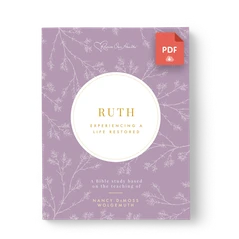
As you’ve heard today, our study in the book of Ruth is very practical. You’ll benefit even more when you get our six-week study, Ruth: Experiencing a Life Restored. You can request that resource when you make a donation of any amount at ReviveOurHearts.com, or you can call 1-800-569-5959.
We’re going to continue this topic of work as worship. In our Women of the Bible podcast season on Ruth; Erin Davis, Portia Collins, and Kristen Clark have such a practical conversation on this very topic. Let’s start with something that struck Kristen about Ruth’s character.
Kristen Clark: She’s a hard worker. This girl gets to work. She’s, like, “All right. We’ve got to eat. We need some food. I’m going to go out, and I’m going to find food for Naomi and for me.” And she goes out, and she works hard. Wow!
Erin Davis: She does. Maybe it’s the farm girl in me, but I just so admire the quality of hard work. I want to be the hardest working person in every room. I have a saying that I say, “Some people are work horses. Some people are war horses. Some people are show ponies.” (laughter) I want to be a work horse who just works so hard. And so I super admire that in the character of Ruth.
Listen, this harvesting business—that is hard work. And she just gets after it, kind of with a happy heart. She just gets to work.
I’m going to read us Ruth 2:8–16.
Then Boaz said to Ruth, “Now, listen, my daughter, do not go to glean in another field or leave this one, but keep close to my young women. Let your eyes be on the field that they are reaping, and go after them. Have I not charged the young men not to touch you? And when you are thirsty, go to the vessels and drink what the young men have drawn.”
Then she fell on her face, bowing to the ground, and said to him, “Why have I found favor in your eyes, that you should take notice of me, since I am a foreigner?” But Boaz answered her, “All that you have done for your mother-in-law since the death of your husband has been fully told to me, and how you left your father and mother and your native land and came to a people that you did not know before. The Lord repay you for what you have done, and a full reward be given you by the Lord, the God of Israel, under whose wings you have come to take refuge!” [Oh, if you write in your Bible, I’d circle that “wings.”]
Then she said, “I have found favor in your eyes, my lord, for you have comforted me and spoken kindly to your servant, though I am not one of your servants.”
And at mealtime Boaz said to her, “Come here and eat some bread and dip your morsel in the wine.” So she sat beside the reapers, and he passed to her roasted grain. And she ate until she was satisfied, and she had some left over. When she rose to glean, Boaz instructed his young men, saying, “Let her glean even among the sheaves, and do not reproach her. And also pull out some from the bundles for her and leave it for her to glean, and do not rebuke her.” (ESV)
Listen, if you read the story of Ruth and kind of thought she was working in the garden, you should pay attention to these verses again. It’s, like, “She might get attacked by young men. We’ve got to make sure that we protect her because if she’s not here, she will be attacked in another field.”
I think that’s important. What does that reveal about her character, Portia, that she was willing to go to work without knowing Boaz’s protection was going to be there for her? Does that show you anything?
Portia Collins: She’s fearless. Like, “I’m going to do this.” And, once again, I’m using this imagination, but I really would like to think that it’s because she’s trusting in the Lord. Like, “I’m not going to worry about my life. I know that I have to go out here and try to get food for myself and my mother-in-law, so I’m just going to do it and trust that everything is going to be all right.”
Erin: Yes, there’s a fearlessness in her. I like her more and more the more we read.
Kristen: Yes.
Erin: Fearless. Hard worker. Faith-filled. A woman who speaks grace.
Portia: Yes.
Erin: That’s where I want to reframe Ruth. It’s not in the beginning she was this destitute woman with nothing to offer, and at the end she has somehow transformed. Some of that’s true. But right here in these early verses, we see a woman of virtue. And her reputation had preceded her—all the way from Moab to Judah.
Kristen: The word is getting out!
Erin: Yes. What had Boaz heard about our girl Ruth? What does it say?
Kristen: He had seen that she’s a woman of great character, really, in going with her mother-in-law, leaving behind everything. I mean, that really impressed him. That was, like, “Wow! Okay! This woman is serious.”
Erin: She’s willing to make sacrifices.
Kristen: Yes—willing to follow the Lord no matter the cost. I think He really saw that in her character.
Erin: There is never a point in this story there we don’t see humility in Ruth.
Isn’t humility tricky? The second you think you’ve got humility, it slips right out of your hand. (laughter) Either the Lord builds it in you, or He doesn’t. You either have it, or you don’t. It’s not something you can drum up in a tough situation. It’s so attractive in the character of Ruth.
And part of what Boaz must have been drawn to, I think, is her willingness to sacrifice. It takes humility, I think, to glean on the edge of somebody else’s field.
Kristen: Right.
Portia: And to ask, “Hey, if I’ve found favor, and if you care, can I please just get some of your wheat?”
Kristen: Your leftovers.
Portia: Your leftovers. Right.
Erin: That takes humility.
Portia: Right.
Erin: Have you ever stepped into a room of women where you don’t know a soul and felt that feeling?
Kristen: Oh, yes.
Erin: And that’s what she did. She didn’t know anybody there. She kind of joins this female work crew she doesn’t know, and is probably not immediately accepted, because everybody is saying how she’s a Moabitess.
So, yes, a ton of humility, and just such obvious hard work.
I want to drill down on this concept of work. How would you assess or describe our culture’s view of work? Kristen?
Kristen: Oh, I don’t know. I feel like there’s two-fold. It’s, like, “Work like crazy—hustle, hustle, hustle.”
Erin: Work is everything.
Kristen: Work is everything. It’s all of your success. It’s your identity. Your worth. Just do it like crazy.
And then there’s this kind of other side, like, work is a burden. “I don’t want to work, so I’m just going to be lazy and do my own thing and do what makes me happy.”
Portia: I always go back to Genesis. I think we missed the fact that we were given work before the Fall.
Erin: Sister! Are you looking at my notes?! (laughter) That’s something I wanted to talk about because it’s so important.
Portia: Yes.
Erin: Take us there.
Portia: So in my mind, I’m, like, “We were created to work, to do work.”
Erin: Right.
Portia: But the thing is: Our work should not consume us. That’s not where the glory goes. The glory goes to God. So anytime we’re working and we make an idol of that work, we’re in dangerous territory.
And then on the flip side of it, when we are just totally against working and just want to sit back and kick our feet up, once again, we’re in some dangerous territory.
I think that there’s a healthy balance that God intentionally put in place. He created us to work. He worked six days, and He rested on the seventh. So He models everything that we’re supposed to be doing. I think we just need to go back to the beginning and take some notes.
Erin: Well, I think part of the reason the three of us are such close friends is because we’re all a little Type A. (laughter)
Kristen: Just a little bit.
Erin: I like saying, “I’m not Type A, I’m Type Double-A.” Like: “Get . . . the . . . job . . . done . . . all . . . the . . . time.” I have a sign in my office that says, “People over projects” because I have to remember not to just think that my to-do list is my be-all, end-all. I think I gravitate most into “work is my identity.” But I can see the other camp gravitating towards, “Work is a waste of my time.” I think Ruth is going to give us some healthy perspectives on work.
They were going to go hungry. So you do hear that in her response. Like, “I’m so grateful I can glean in this field. I’m so grateful for my job. I’m so grateful that I can serve the Lord through working.”
I don’t know that I always have that heart attitude toward work.
Kristen: You don’t see her complaining. “Could I get a better field? Maybe one in the shade? Maybe some A/C.” (laughter)
Erin: Sure! And, “Why isn’t Naomi working? Why am I the only one out here?” None of that in her.
Kristen: She just praises the work the Lord has given to her.
Erin: Yes, she does.
Portia: She works to the glory of the Lord.
Erin: So, Portia, I’m so glad you mentioned Genesis. We see God doing the work of creation in Genesis 1. But, Kristen, could you read us Genesis 2:15?
Kristen: “The Lord God took the man and put him in the Garden of Eden to work it and keep it.”
Erin: This is before the fall, which we know happens in Genesis 3.
I can’t take any credit for this, this actually comes from my pastor. He said this in a sermon recently. He reminded us that, “Work is not a fruit of the curse.” Sometimes it can feel like it, “Oh, I wouldn’t have to work if the world wasn’t so broken.”
But actually, what is a part of the curse is fruitless work. You know, the Lord’s talking to Adam and Eve and the serpent, and He’s handing down those curses. He tells Adam, “You’re going to work the land, and it’s not going to produce the fruit that you want.”
Work is part of God’s plan. And, let’s be honest, most of our work is gleaning. Right? Most of it feels pretty redundant, pretty tedious.
Erin: Okay, Portia, could you read us Ecclesiastes 9:10?
Portia: Yes.
Whatever your hand finds to do, do it with your might, for there is no work or thought or knowledge or wisdom in Sheol, to which you are going. (ESV)
Erin: Whatever your hand finds to do.” Both of these verses, they start with that, “Whatever.”
Portia: “Whatever.”
Erin: “Whatever.” All of it. Can’t there be an “except”?
Kristen: Except for this!
Erin: Everything is worship. All work becomes holy work.
Dannah: That’s the Women of the Bible podcast. You can hear more (and watch it, too!) at ReviveOurHearts.com. We’ll link to the episode you were just hearing in today’s transcript.
On Monday, we’re hitting two important topics—self-control and biblical womanhood according to God's design! Both come up in Ruth chapter 2. Please be back for Revive Our Hearts.
This program is a listener-supported production of Revive Our Hearts in Niles, Michigan, calling women to freedom, fullness, and fruitfulness in Christ.
All Scripture is taken from the New International Version unless otherwise noted.
*Offers available only during the broadcast of the podcast season.