Dear Wandering Woman—Come Home
Dannah Gresh: What does genuine repentance look like? Here’s Kristen Clark from the ministry Girl Defined.
Kristen Clark: I met a girl at an event, and she just shared that she was living in a lot of sin, a really unhealthy relationship with her boyfriend—sexual impurity. She didn’t really understand God’s design but knew He had something to say. It’s just amazing—God’s story!
She came across one of our videos on YouTube and started to see this vision of God’s design for her life as a woman, for her purity, and just for honoring Him with her life. That led her to repentance. She broke off this unhealthy relationship with her boyfriend and turned back to the Lord.
She cried out to Him and said, “God, help me to live in a way that honors You!” She said that for the first time, she felt like …
Dannah Gresh: What does genuine repentance look like? Here’s Kristen Clark from the ministry Girl Defined.
Kristen Clark: I met a girl at an event, and she just shared that she was living in a lot of sin, a really unhealthy relationship with her boyfriend—sexual impurity. She didn’t really understand God’s design but knew He had something to say. It’s just amazing—God’s story!
She came across one of our videos on YouTube and started to see this vision of God’s design for her life as a woman, for her purity, and just for honoring Him with her life. That led her to repentance. She broke off this unhealthy relationship with her boyfriend and turned back to the Lord.
She cried out to Him and said, “God, help me to live in a way that honors You!” She said that for the first time, she felt like a weight was lifted! There was so much freedom, forgiveness, grace. She was forgiven of the shame.
Dannah: This is the Revive Our Hearts podcast with Nancy DeMoss Wolgemuth, author of Adorned, for February 6, 2026. I’m Dannah Gresh.
If you’re walking through the 2026 Bible reading plan with us, today we’re reading Numbers 5–6.
Over the last several episodes, Nancy’s been telling us the story of one family in Israel during the time of the Old Testament judges.
Elimelech and Naomi were married with two sons. They left their homeland in Bethlehem and traveled sixty miles to Moab. There was a famine at home, and they thought they’d have a better life outside the land God had given them. And Nancy’s been reminding us that we can be like this family, wandering from God’s plan for us.
Well, Naomi’s two sons got married, but then both of them died . . . and their father did, too!
This would have been unbelievably painful, and yet we’ve begun to see God’s mercy toward Naomi. He’s intervening in her life to bring her back home. Here’s Nancy.
Nancy: We’re in chapter one of the book of Ruth. Let me read verses 6 and 7.
When [Naomi] heard in Moab that the LORD had come to the aid of his people by providing food for them, Naomi and her daughters-in-law prepared to return home from there. With her two daughters-in-law she left the place where she had been living and set out on the road that would take them back to the land of Judah.
Now, we said that God used two things to bring Naomi back home. The first one we've looked at for the last couple of days, and that was His hand of discipline, affliction, chastening. This was intended to bring Naomi to the place where Moab didn't look so attractive anymore, where she would want to come back home. But we see in this passage that God used something else to get Naomi back home, and that was the news of what was happening back home.
She heard in Moab that the LORD had come to the aid of his people by providing food for them.
Remember, when she and her husband left, ten years earlier, there was a famine in Bethlehem, but now she hears a report. God has visited His people. God has turned back our hard times. God has sent plenty. If you will, she heard that there was a revival back home.
I say that because I think there must have been some people praying and repenting. The famine was an expression of God’s displeasure with His disobedient people, and I believe there must have been a turning in their hearts that they began to repent under the pressure of the famine and to call out to God. As they did, God had mercy.
Naomi hears this news, and she’s motivated to return.
It reminds me of the prodigal son. God used the same two things in his life. Remember, he came to the place where he was so down and out. He said, "What am I doing here." It was a desperate situation that ultimately drove him back home to his father. But it was also the thought of what he was missing back home. He said, "My father has servants who have more than enough eat, and here I am, the son, the heir, and I'm starving out here" (see Luke 15:11–32).
As we share with one another the reports of what God is doing in our lives, of how God is changing us and reviving us and delivering us from our famines and restoring our lives, those testimonies become powerful means of drawing other people who may still be in the far country to come back to a place of repentance, to return.
What we see described here is really a picture of repentance. Naomi begins the journey back home. It says she prepared with her daughters-in-law to return home. She left the place where she had been living, and she set out on the road that would take them back to the land of Judah.
Like the prodigal son who said as he was sitting there in his pigpen, "I will arise and I will go back to my father. I will return home."
What we’re seeing described here is repentance. It’s the acknowledgement that I’m in a place I don’t belong, and the point is not so much “How did I get here? Was this my sin? Was this my husband’s sin?”
That’s not the point so much anymore. The point is: I’m not where I belong, and I’m going to make a choice to get up out of the place where I’ve been living and go back to the place that I left, the place of God’s blessing, the place of obedience.
She actually had to take a step out of the place where she had become, I think, probably comfortable after ten years of living in Moab. That was now home to her. Your “Moab” may have become comfortable to you.
I find that a lot of women have been living for a lot of years with the consequences of sinful and wrong choices, but they’ve gotten comfortable with those consequences. They’re comfortable having to have their therapist and their pills and their counselors and their alcohol and their illicit relationships because that’s what has become familiar to them.
You have to come to the place where you’re willing to get up out of the place where you’ve been living and come back home, to get on a different road. It’s the step of repentance. Now, repentance is just the beginning of the process of restoration. We’re going to see that there was a long road back.
There was no quick fix, just as there is no quick fix for you and for me when we’ve gone into that Moab. We’ve escaped from the will of God. We’ve gone into our running from pressure and problems, and we don’t just wake up one morning and say, “God can you just fix all this for me?” He may not do that.
There’s a road back home from Moab to Bethlehem, and we’ve got to be willing to walk that road. Repentance is the getting on the road. It’s leaving the place where we’ve been, where we should not have been, and it’s getting on the road to go back home.
I find that some women come to a Revive Our Hearts conference, for example, that we may host, and they make a major decision. There’s a major breakthrough in some area of their life, and there’s a real point of surrender, a real point of repentance.
Then they have to go back home, and they’re still dealing with that same husband, those same children, those same in-laws, that same circumstance at work, that same circumstance in their church. Nothing may have changed back home.
They have to go from that conference back into the real circumstances of life and walk the long road to restoration. It’s a process of healing, a process of developing a repentant way of living and thinking.
I’m so thankful that Naomi gives us an illustration of getting on that road and staying on that road of restoration. Imagine if she had stopped halfway and said, “This road is too long. I’m too old. I don’t think I want to make this trek.” She could have begun to wonder if the people back home would accept her and what would it be like after all these years? Fear could have kept her from the journey. Her attachment to people in Moab could have made her go halfway and say, “I think I’m going home to my Moab.”
A lot of people repent that way. It’s not really repentance. It seems like they’re repenting, but they get on the road, then they turn back. The truth is that you and I will never find our Redeemer, who restores the brokenness of our lives, until we are willing to return to the place where we left the will of God, where we ran from our circumstances.
There is no restoration, there is no redemption, there is no revival without repentance—getting up from the place where we are, leaving that place, and returning to God. You see, our Moab is those places, those things, those people that we may have turned to in an effort to get our needs met, substitutes for God in our lives.
As you look back on your life, you may be able to point to a time of spiritual famine, hardship, where you tried to fill the emptiness with something that was manmade, rather than looking to God. You settled for substitutes.
Your Moab may have been your job—a place you've looked to for fulfillment and affirmation. It may have been things, shopping, possessions. It may have been relationships. You've looked to your husband, your friends to provide for your needs. It may have been illicit relationships. Whatever it was . . . busyness, church work can become our Moab. We're running from having to face the true reality of our situation in our lives.
These things aren't all wrong, but these things can't satisfy us. They don't bring us happiness. In some cases, they've brought us even greater heartache, grief, and sorrow. So what do we do? We’ve spent some time in the last week cknowledging that we have our "Moabs," acknowledging that we have been running. So how do we get back home? One word: repentance. We repent.
We say, “I’m not going to live in this Moab any longer. I’m not going to stay here. Yes, it’s become comfortable. Yes, it’s become more familiar. I’m not sure what I’m going to face when I get back to that place of obedience. I’m afraid of what may be required of me. I’m afraid of what challenges I may face. It doesn’t matter. God has provided bread back home, and I’m going back to the place of God’s blessing. I’m willing to repent, to get on that road, to return to God, to return to His will for my life."
That message, return, is throughout this book—that word "return" and "return to me." Throughout the Old Testament, God says to His people, “Yes, you’ve wandered, but I want you to return.”
When you return, you’re not just returning to your old life. You’re returning to Him. You’re returning to a place where there’s a Redeemer waiting for you. We’re going to see that in Naomi’s story and in Ruth how they find in Bethlehem, is really a picture of Christ.
Through repentance what we’re really doing is saying, “Lord Jesus, I’m coming home to You. I’m coming to a place of obedience, surrender, and to find that You are the One who satisfies me and meets my needs.”
Dannah: Nancy DeMoss Wolgemuth has been giving us a picture of repentance from the book of Ruth. Nancy will be right back with part two of that teaching.
But let’s stay on this topic of repentance for a minute. Revive Our Hearts has produced a podcast called Women of the Bible, and one season is devoted to the book of Ruth.
In that season, Kristen Clark, Portia Collins, and Erin Davis responded to this passage by calling women to turn from their sin and come home to the Lord. Let’s listen.
Kristen Clark: To the woman who is going to church and doing all the Christian things on the outside, but has lost her true love for the Lord: come back to Him. He loves you!
Portia Collins: To the woman who has lost her joy in serving her family, her husband, and her children: come home!
Erin Davis: To the woman who is so bitter toward another woman at church that she can’t stand the sight of her: come home! Who else?
Kristen: To the woman who is in a struggling marriage, looking to her husband to fulfill her, to change: come back to the Lord! Serve Him wholeheartedly.
Portia: To the woman who has not been engaging in the kindest conversation, or who has been using her words for ill: come home!
Erin: To the woman who is deep in sexual sin and she has no idea how she got there. It might be what she’s looking at, it might be who she’s sharing a bed with, it might be who she’s fantasizing about. It’s time to come home! Anybody else come to mind?
Portia: To the woman who just feels lost, like she has lost her way, and she doesn’t know what to do: come home! God knows and He will take care of you!
Kristen: Yes.
Dannah: You can hear more by listening to the podcast, Women of the Bible, or watch that conversation on video. For more information visit ReviveOurHearts.com.
Also, before we hop back into our teaching today, I want to remind you that we love prayer here at Revive Our Hearts. If you resonated with any of the women described a moment ago—the one who’s lost her joy, the one who’s struggling in her marriage, the one who’s wandered far from God through sin, would you let us pray for you? You have a God who is eager to welcome you home. And we’d love to go to Him on your behalf! To submit a prayer request, visit ReviveOurHearts.com/prayer.
Let’s get back to Nancy DeMoss Wolgemuth. She’s continuing the series, "Ruth: The Transforming Power of Redeeming Love."
Nancy: Have you found it to be true that sometimes when you make the decision to repent, to return back to God’s way of thinking and living, that there are often voices that come into your life, people that come into your life, telling you all the reasons you shouldn’t, all the reasons that you should turn back?
We’re looking in Ruth chapter 1, beginning in verse e8. "Naomi said to her two daughters-in-law," Ruth and Orpah, two women who had married Naomi’s sons, who were now deceased . . .
[She] said to her two daughters-in-law, "Go back, each of you, to your mother’s home. May the LORD show kindness to you, as you have shown to your dead and to me. May the LORD grant that each of you will find rest in the home of another husband.” (vv. 8–9)
Notice what Naomi is seeking here. The word "rest" is found in the book of Ruth several times, and you can see that Naomi is seeking rest, not only for her soul, but for her bereaved family members. She, mistakenly at this point, thinks that they’re going to find that rest in the home, under the shelter, of another husband.
She’s looking for security. In that day, that was not surprising because widows were truly alone in that culture. It was very often that they would be destitute. Now, God did make provisions for widows. We’re going to see that, but often widows were very neglected women.
She is saying, “The only way you’re really going to have your needs met, the only way you’ll have rest for your heart, the only way you’ll be secure in this life is if you can find another husband.” She’s thinking, There’s no way, as Moabite women, that you’re going to find another husband in Bethlehem, so maybe you’d better just stay here in Moab.
Now, what we’re going to learn as the story unfolds, is that then and now, true rest for our hearts is not found in any person. It’s not found in a husband. It’s not found in a house. It’s found under the wings of God, taking our shelter, our place in Him, but Naomi hasn’t discovered that yet.
She kissed them and they wept aloud and said to her, "We will go back with you to your people." ["We’re going to stay with you.”] Naomi said, "Return home, my daughters. Why would you come with me? Am I going to have any more sons, who could become your husbands? Return home, my daughters; I am too old to have another husband. Even if I thought there was still hope for me—even if I had a husband tonight and then gave birth to sons—would you wait until they grew up? Would you remain unmarried for them? No, my daughters. It is more bitter for me than for you, because the LORD’s hand has gone out against me!" (vv. 9–13)
Now, that paragraph probably seems a little strange if you’re not familiar with an Old Testament law called the law of the levir. It’s a law found in the book of Deuteronomy. It's a provision that God made for widows. In the Jewish culture, it was very important that they preserve the family name and the family inheritance, the family lands. In the loss of a mate, where there was no more potential for a son to be born for the family line to continue to another generation, or in the loss of the family lands in the case of poverty, God put in place some laws that made provision.
You'll see in the Old Testament laws, which we so often think of being harsh and prohibitive, they are really laws of mercy and grace. They are God's ways of providing for people in need.
This particular law, the Old Testament law of the levir, that is a Latin word that means "husband's brother." Here’s what it refers to. When a man died without children, the brother of the deceased had the responsibility to marry the widow and to take the widow on as his wife. Then the first son that they would have as a result of that union, would actually carry the name of the deceased man so that his family line, his family name, could be continued on into the next generation.
That seed, that child, raised up for the brother, would have the brother’s name and would inherit the brother’s lands. This is God’s provision. Naomi is saying, “If I had another son or more sons who could take you on as his widows—I’m past my child bearing years. I’m not going to have another son, and even if I had a son tonight, would you want to wait until that son was old enough—grew up to become your husband?”
She’s saying, “This situation is hopeless.” That’s the bottom line of that paragraph. There’s no hope for this situation, so just go back to Moab.
At this they wept again. Then Orpah kissed her mother-in-law good-by, but Ruth clung to her. "Look," said Naomi, "your sister-in-law is going back to her people and her gods. Go back with her." But Ruth replied [one of the most famous verses in the Old Testament, one often heard in weddings]
"Don’t urge me to leave you or to turn back from you. Where you go I will go, and where you stay I will stay. Your people will be my people and your God my God. Where you die I will die, and there I will be buried. May the LORD deal with me, be it ever so severely, if anything but death separates you and me." When Naomi realized that Ruth was determined to go with her, she stopped urging her. (vv. 14–18)
Notice, by the way, that when people see that you are determined to walk with God and to obey Him, to be morally pure, to keep God’s Word and God’s ways, you’ll often find that that’s when they stop trying to entice you to go the way of the world.
I think a lot of temptation comes in our lives because people sense we’re not fully persuaded about which way we’re going. If they sense that your life is based on convictions about the Word of God, you may find they stop trying to persuade you to stay back in the world.
Now, I want us to see in this paragraph a very important contrast between these two sisters-in-law, Orpah who stays in Moab, and Ruth, who decides to go with her mother-in-law to Bethlehem. Orpah initially indicated that she, too, was going to Bethlehem. They’d both said it first to Naomi, “We’re going with you,” but notice that Orpah’s decision was an emotional decision rather than a true commitment.
Notice in verse 9 that this is a time for weeping, and the girls said to her with tears, “We’re going to Bethlehem with you.” This seemed like a pretty sure thing, but Orpah, once she realized the cost, was easily talked out of her decision. It wasn’t a true commitment.
She realized that if she went to Bethlehem, that would likely mean that she would never have a husband, that she would not have children, and she started realizing, “This is going to cost me a lot.”
She decided to go back to her people, to her gods, to her ways. Why? Because that’s where her heart was. That’s what she was familiar with. That’s what she had an appetite and a heart for.
I see in Orpah a picture of so many people today who go forward at an invitation in a church service or at a special meeting. They go through some class at their church. They sign on the dotted line, and they say, “Yes, I’m going to follow Christ.”
It may even be one that they make with tears and emotions. It looks like a very genuine decision, but at some point, they’re persuaded to turn back. They go back to the world, and they never do really live for Christ. They never come into the family of God. Ruth is a picture to me of the meaning of true conversion, true conversion, not just an emotional decision, but a total change of heart and life and direction.
Ruth counted the cost, as did Orpah, and in Ruth’s mind—now we know the end of the story. We know how she gets a husband there. Boaz is waiting in the field, but Ruth didn’t know that part of the story. In her mind, when she decided to stay with Naomi and go to Bethlehem, that probably meant she would never have a husband. She’d never have children.
She was making a commitment that was a total conversion. It was a total surrender. It was a complete break with her past. And with that she's saying, "I'm willing to forsake my old life, and with that I'm forsaking all the false gods, my pagan heritage. I'm leaving that all behind in order to take on a new life, a new home, a new people, a new god, a new family, a new Lord of my life. I'm taking on the laws of Yahweh as my laws. He is going to be my Lord, my King. These will be my people. I will have a new family. I will have new allegiance. I will have new loyalties." She’s really saying, “I’m a new creature,” and isn’t that what conversion is all about?
Paul says in 2 Corinthians chapter 5, “If any man is in Christ he is a new creation. Old things have passed away. All things have become new" (v. 17 KJV). She’s saying, “I’m going the way of the cross. I’m going the way of Christ.”
Now she didn’t know Christ. Of course, the cross hadn’t happened, but she’s a picture of someone who makes a break with their old life and is converted to a new way of thinking and living.
It’s not just an external change. Walking into church or walking down a church aisle doesn’t change you on the inside. It may make you look more religious, but it doesn’t make you a Christian.
So many people who have had the external appearance of religion have never had an internal heart conversion. That’s why, though they look like Christians, they talk like Christians, they know the language, they know when to sit and when to stand and what to do, there’s no real heart for the things of God. Their heart is for this world because they belong to this world. They’ve never made the decision to really go with Christ.
Even when her sister-in-law turned back, Ruth wasn't persuaded to change her mind. She had been converted. She was going to Bethlehem. She was going God's way. She said in effect, "The world behind me, the cross before me, no turning back. Though no one join me, still I will follow. No turning back."
As we look through the Word of God, this permanent lifetime commitment to Christ is really an evidence of genuine conversion. Included in the New Testament is the assurance that once we have become Christ's, we will persevere in our faith.
God promised in the Old Testament book of Jeremiah, "I will put my fear in their hearts so they will not depart from me." And He affirms that in the New Testament, that perseverance is an evidence of true conversion. In Hebrews 3 the writer says, "We have come to share Christ if we hold firmly to the end the confidence we had at first."
The New Testament calls us to examine ourselves, to see if we are in the faith, and one of the tests is: have we persevered in our allegiance and our loyalty to the way that we said we were going to choose? Have we really turned from Moab, from the world, toward God, toward His ways? Is He running our lives? Are we a new person? Do we have a new loyalty? A new allegiance? A new Lord? Are we submitting ourselves to Him? Are we in His kingdom? Have we been transferred from the kingdom of darkness into the kingdom of light? One evidence that we have been is that we persevere.
Now, that doesn’t mean that having come into the kingdom of light, we never sin. It doesn’t mean we never make momentary choices to go back into our old ways, but once you have come into the kingdom of God, once you’ve come into the kingdom of light, there’s always something in your heart that will never be totally satisfied to go back and live in the world because you don’t belong there anymore.
You’re a new creature; you’re a new person. You don’t have a heart for that anymore. You may give in to your flesh, as we all do at times, but there’s always that tug, that conviction, that drawing.
I’ll tell you this: if you’re a child of God, you can’t go back into the world and stay there and enjoy it. You can’t because you don’t belong there. You’re a pilgrim. You’re an alien. You’re a stranger in this world’s system.
The Scripture says examine yourselves. See if you really are in the faith.
Dannah: Nancy DeMoss Wolgemuth will be right back to pray. She’s been showing us a powerful example of repentance from the book of Ruth.
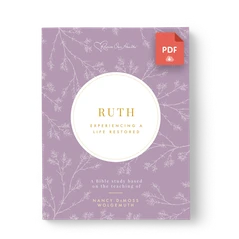
If this teaching is resonating with you and you’d like to take your study to another level, we’ve got the perfect resource for you! Our six-week Bible study, Ruth: Experiencing a Life Restored, goes right along with what Nancy’s been sharing. But it also offers daily guidance, Scripture memory, and rich discussion prompts to help you process what you’re learning and hide it in your heart. For a donation of any amount, we’d love to send it your way! To give and request Ruth: Experiencing a Life Restored, visit ReviveOurHearts.com, or call us at 1-800-569-5959.
Real quick, I want to remind you about our relationships page. If you’re seeking wisdom for your marriage, for loving your kids, navigating singleness, or being a faithful friend, we’ve got you covered. Our curated list of Revive Our Hearts favorites has something for everyone. I hope you’ll check out those resources at ReviveOurHearts.com/relationships.
Next week, we’re continuing our journey through the book of Ruth. The climax of this story is still to come. You won’t want to miss it! Before we go, here’s Nancy to pray.
Nancy: Father, thank You for giving us, in Ruth, an example of what it means to forsake the world and to follow Christ. I believe there are people listening to this story today who have given external evidence of religion, who’ve said, maybe with an emotional decision, “I’m going to follow Christ,” but their heart is still in the world.
They are not a new person. They have never really repented and come to follow Jesus Christ with all of their heart. They have not turned from their old ways. They’ve not forsaken their past. They’re still old creatures who look religious.
I pray, O God, that this might be the day, the moment of salvation for someone, some ones—that they might say with Ruth, “I’m going God’s way, whatever that means I have to leave behind, whatever the cost. He is drawing my heart, and I want to go with Him.”
May this be the day of true conversion for many who have been, to this point, just religious. For Jesus’ sake we pray it, amen.
This program is a listener-supported production of Revive Our Hearts in Niles, Michigan, calling women to freedom, fullness, and fruitfulness in Christ.
All Scriptures are from the New International Version unless otherwise noted.
*Offers available only during the broadcast of the podcast season.