Will My Faithfulness Go Unnoticed?
Dannah Gresh: Nancy DeMoss Wolgemuth has a question for you.
Nancy DeMoss Wolgemuth: Do you ever feel like nobody notices all the little things you do to serve around your house? You feel like you don’t get a lot of appreciation and that you do a lot of little things that people don’t even realize that you did. And it’s easy to start to feel that it doesn’t really matter if we serve others.
Dannah: Today, we’ll look at the book of Ruth and be reminded that everything we do matters to God.
This is the Revive Our Hearts podcast with Nancy DeMoss Wolgemuth, author of Lies Women Believe: And the Truth That Sets Them Free, for February 17, 2026. I’m Dannah Gresh.
Nancy’s leading us through the book of Ruth. So far we’ve seen God’s sovereign hand all over Ruth’s story. She’s been gleaning …
Dannah Gresh: Nancy DeMoss Wolgemuth has a question for you.
Nancy DeMoss Wolgemuth: Do you ever feel like nobody notices all the little things you do to serve around your house? You feel like you don’t get a lot of appreciation and that you do a lot of little things that people don’t even realize that you did. And it’s easy to start to feel that it doesn’t really matter if we serve others.
Dannah: Today, we’ll look at the book of Ruth and be reminded that everything we do matters to God.
This is the Revive Our Hearts podcast with Nancy DeMoss Wolgemuth, author of Lies Women Believe: And the Truth That Sets Them Free, for February 17, 2026. I’m Dannah Gresh.
Nancy’s leading us through the book of Ruth. So far we’ve seen God’s sovereign hand all over Ruth’s story. She’s been gleaning wheat in the field of a man named Boaz, which turns out to be a pretty significant blessing. Nancy’s going to share more about that today.
Nancy: We’re in chapter 2, verse 8:
So Boaz said to Ruth, “My daughter, listen to me. Don’t go and glean in another field and don’t go away from here. Stay here with my servant girls. Watch the field where the men are harvesting, and follow along after the girls. I have told the men not to touch you. And whenever you are thirsty, go and get a drink from the water jars the men have filled.” (Ruth 2:8–9)
Now when Boaz says to Ruth, “Don’t go and glean in another field,” keep in mind, he doesn’t know the end of the story. She doesn’t know the end of this story. This is not high romance here. This is just faithfulness and generosity and kindness—kindness given and kindness received.
He says to her, “I want my field to be a place where your needs can be met.” He’s going beyond the letter of the law which said that he had to leave enough at the corners of the field for poor gleaners to harvest.
He’s saying, “I want the heart of God for strangers, for widows, for the poor and needy, and I’m going to go above the letter of the law to extend grace.”
All the way through this passage, Boaz emerges as a major character now. You’ll see that Boaz is a beautiful picture of the heart of Christ.
He says to her, “Don’t go and glean in another field.” If we think of this field as a field of grace, he’s saying to her, “Don’t go somewhere else to get your needs met. God will provide for you right here.”
It’s a picture of God’s grace. There are temptations sometimes in life to look for alternatives to the way of grace, but he’s saying, “There’s provision here for you. There’s abundance. I will be generous with you, so why should you go to another field?”
And yet, Satan is always telling us to go to another field, to go to another place to try and get our needs met. We come to the field of Christ and His grace and His provision for us, and then the enemy tells us there are things we need to do, rules we need to keep, performance standards we need to meet in order to be accepted by God.
Invariably, when we leave the field of grace where God has provided for our needs, then we find ourselves in a works-oriented sort of religion, having to jump through all kinds of spiritual hoops to perform and trying to live by the law, which cannot save us and ultimately meet our needs.
In this field, Boaz’s field, he’s saying, “I know you’re poor. I know you can’t meet your own needs, so stay here, and all your needs will be met.” It’s in the field of grace, at the foot of Christ’s cross in our lives that everything we need is made available to us as a gift.
It’s not a gift for those who qualify in some way. It’s a gift for poor people who know their spiritual poverty and who know that they never could afford what’s offered in that field, that they never could pay what’s offered.
Ruth wasn’t paying for that barley that she was harvesting there. He said this was a gift; receive it. How often does God extend His grace, His provision to us in our walk with Him, in our daily lives and we say, “No, I feel like I’ve got to go work for this. I feel like I’ve got to do something to deserve it or earn it.” He’s saying, “Don’t go into the field of the law; don’t go into the field of human effort. You stay right here in this field where I will meet your needs.”
Boaz offers Ruth protection, and what a picture this is of what we have in Christ. He says to her, “Watch the field where the men are harvesting and follow along after the girls.”
“I’ve told the men not to touch you, not to bother you.” In a work environment that could have been dangerous for a woman who was destitute, who was a widow, who was from another land, he says, “I’m going to make sure that you’re protected.”
He offers her provision. He ministers to her thirst. He says, “Whenever you’re thirsty, go and get a drink from the water jars the men have filled.” He knows the time will come when she will be hungry. Verse 14 says:
Boaz said to her at mealtime, “Come over here. Have some bread. Dip it in the wine vinegar,” when she sat down with the harvesters, he offered her some roasted grain.
So he’s saying, “All your needs are going to be met. Just stay here. Let me take care of your needs.”
We’re so prone to try to do it on our own, to try to live this Christian life in our own effort, our own steam, our own abilities, and you just have to try to know you can’t.
I think one of the first steps to really walking in freedom in your relationship with Christ is to realize that this is a life I cannot live. I cannot meet my own needs. I cannot protect myself. I cannot provide for my own needs. Ultimately, I’m totally dependent—we all are—on the grace of God to live the Christian life in and through us.
Now, her response to Boaz and his offer and his generosity I think is really challenging to all of us. Verse 10 says:
At this, she bowed down with her face to the ground. She exclaimed, “Why have I found such favor in your eyes that you notice me—a foreigner?”
Later on in the conversation, move down to verse 13, you see the same spirit in this woman. She says, :
“May I continue to find favor in your eyes, my lord. . . . You have given me comfort and have spoken kindly to your servant—though I do not have the standing of one of your servant girls.”
Here is a woman with a humble heart, and a woman who has a humble heart will have a grateful spirit. She doesn’t claim her rights. She knows she doesn’t have any rights. She doesn’t insist that he owes her a living, that he owes her this privilege to glean in his field.
I think so many of us today, even in our Christian culture, live with a chip on our shoulder. The world owes us something, and we don’t have what I see in this woman that is so beautiful—especially in a woman—a humble heart to say, “I don’t deserve this.”
She had no expectations. She just went to serve, and as a result, God made sure that her needs were met. As a result of relinquishing her expectations, when she did receive a blessing, she was thankful.
She considered it a great privilege. I think so often how we have expectations of one another, especially in our homes. "You ought to do this for me. You ought to serve me. You ought to meet my needs."
What if we would begin to have within our homes a grateful spirit. The humble heart says, “I don’t deserve this, and it’s amazing grace that you should minister to my needs.”
That’s an expression of a woman who has the heart of God. Ruth never forgot that she was a foreigner, that she was undeserving of the least favor.
I think of my dad in this way. He was a man who never got over the wonder of the fact that God would have saved him. It never ceased to amaze him. He knew his background, and he told us about it growing up.
He did not have a heart for God. He was a rebel, a wild, young man, very involved in gambling and in a lot of rebellion. On Friday, October the 13th, 1950, God opened his eyes, showed him Christ, brought him to repentance and to faith.
He was a young man in his mid-twenties at the time. He had not started our family at that time, but as we were growing up, he would tell us the story of where God found him and what God had done for him. It would bring tears to his eyes.
I mean, it just amazed him, even years later, that God would do this for him. When you asked my dad, “How are you doing?” He would often be heard to answer, “Better than I deserve.”
That’s the heart attitude he always had. “Better than I deserve.” He knew that God didn’t owe him anything. Nobody else owed him anything, that if he got what he deserved, he would be always in desperate trouble, but that God had extended grace to him. There was a spirit of humility and gratitude in his life.
I think about my own life. I realize that growing up in that home, I’ve never known anything but the kindness and the favor and the grace and mercy of God. Sometimes it’s easy subconsciously to start to feel I deserve God’s favor, that He owes me these blessings. I wouldn’t say it that way, but I can sometimes start to act as if I felt that.
I wrote in my journal some years ago as I was studying the book of Ruth. When I came to this passage, here’s the prayer I wrote, and perhaps you would want to make it your prayer as well. I wrote:
Oh God, please take me back to see where You found me and where I would be today apart from You. Please strip me of my proud, demanding ways, and clothe me in meekness, humility, and gratitude. Empty me of myself and fill me with the sweet, gracious nature of the Lord Jesus.
Lord, we do pray that You would take us back to remember where we were when You found us and where we would be today if it weren’t for Your grace.
Would You strip us of our proud, demanding, self-centered ways? And would You clothe us instead in meekness, humility, and gratitude? Empty us of ourselves and fill us with the sweet, gracious nature of the Lord Jesus. Amen.
Dannah: You know, I’m sure we all have lots and lots to do today. Laundry, meal prep, emails, meetings—our checklists get long, don’t they? But as Nancy DeMoss Wolgemuth has been encouraging us, it’s in the middle of these to-do lists that we find God’s grace. It’s all an opportunity to glorify Him.
Nancy will be right back. But before she continues today’s teaching, I want to remind you about our relationships page. Find Revive Our Hearts’ favorite resources on marriage, motherhood, friendship, singleness, and more! We’ve got podcast episodes, videos, blog articles, and challenges—all designed to equip you in these areas. Like Ruth, you can be a faithful steward of the relationships in your life. Visit ReviveOurHearts.com/relationships to learn and grow!
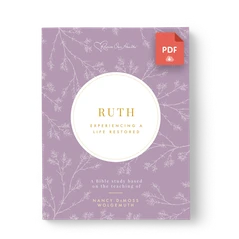
And don’t forget, you can get the six-week study, Ruth: Experiencing a Life Restored, when you make a donation of any amount to support Revive Our Hearts. To give, visit ReviveOurHearts.com, or call us at 1-800-569-5959, and be sure to request a copy of the Ruth study when you do.
Let’s get back to today’s teaching. Ruth is in the field that belongs to Boaz, and she’s amazed at his kindness. Here’s Nancy to pick up the story.
Nancy: She says in chapter 2, verse 10, “Why have I found such favor in your eyes that you notice me—a foreigner?”
She’s astounded. She knows she doesn’t deserve this kind of attention and care. Let me just say again that none of us deserves the grace of God. That’s what makes it grace—it’s free; it’s unmerited; it’s undeserved. We can’t work for it. We don’t deserve it. We can’t earn it.
I find so many women in their walk with God today really frustrated because they’re trying to make themselves acceptable to God. The only way you and I can ever be acceptable to God, find favor in His eyes, is through Jesus Christ. He’s the One who makes us acceptable through His death on the cross.
Well, back to Boaz and Ruth. “Boaz replied,” verse 11:
“I’ve been told all about what you have done for your mother-in-law since the death of your husband—how you left your father and mother and your homeland and came to live with a people you did not know before.”
Boaz says I’ve been told. I’ve heard. The word is out. People are talking. Do you think Ruth realized this? I don’t think she did. I think she was just going about doing what she was supposed to be doing and not doing it for reputation. I’m sure she had no idea there would be a book in the Bible by her name and that there would be that kind of credit; that we’d be sitting studying her life today.
She was just a humble servant doing what she was supposed to be doing. Yet Boaz says, "You’ve got a reputation. People know. People are talking about what it is that you’ve done." I don’t think Ruth thought it was any big deal.
Once you've been converted to Christ and received His grace, if you stop and think about it, it isn't a big deal that we should do acts of love and goodness and service. Sometimes we make it a big deal. But I don't think Ruth did. I think she was just being faithful. But Boaz said, "I’ve been told." People have noticed.
I noticed that Ruth did not exalt or promote herself. I tell you one of the things that really grieves me when I look at my own life is the extent to which I so often, truth be known, am trying to get credit or recognition for acts of obedience and service. You might never know it about me.
When God turns on the light inside my own heart, I find that there is this huge issue of motives. Why do I do what I do? Do I do it to be seen? Do I do it to be recognized? Do I do it to be appreciated? Or do I do it out of a heart of faithfulness and obedience and true love and service?
Ruth didn’t exalt herself. She didn’t promote herself. She wasn’t drawing attention to herself. She allowed God to promote her and exalt her in His time and that wasn’t what she was seeking. The verse that comes to mind is from Proverbs 27:2, which says, “Let another praise you, and not your own mouth; someone else, and not your own lips.”
I can still hear my dad telling us that verse as we were growing up. How important it was to allow God to make your reputation a good one, to live a holy life and a loving life, but not to be self-exalting or self-promoting.
He says in verse 11 of chapter 3, “All the city knows that you are a virtuous woman” (paraphrased). You see, a good reputation will travel. A woman who does right in the eyes of God will be known as a woman of virtue and a woman of kindness. That’s what Proverbs 31 says.
We’ve said that Ruth is really perhaps the woman who sat for the painting of Proverbs chapter 31. Solomon, who wrote that Proverb, was her great, great grandson. It’s possible that he had heard tell of his ancestress Ruth and that was what was being described in that passage.
In that chapter, he says that a woman who fears the Lord will be praised. Her children will rise up and call her blessed. Her husband will brag about her with his friends in the place of commerce.
So Boaz says to Ruth, "All the city knows that you are a virtuous woman." You may think that no one notices. You may think that no one cares. But people do notice. When you are a kind and giving and sacrificial and serving woman, people will know.
We don’t have to draw attention to ourselves. No behavior goes unnoticed. Her boss had watched. The whole city had watched. The whole city knew what Ruth’s character and her heart was like.
I’ll tell you something else they knew and that was Naomi’s spirit. They knew Naomi’s bitterness. Remember that back in chapter 1 when all the women looked at her and said, "Is this Naomi?" Now, I’m speculating a little bit, but in the context there, it appears that they were astounded that this woman looked so sad, so beat down, so weary from all that she’d been through.
She goes on to say, "Don’t call me pleasant. Call me bitter." They knew about her bitterness. She talked about it. They knew what kind of woman she was. What kind of woman we are on the inside invariably will come out on the outside and people will know.
That’s why what we need to do is not so much guard our reputation as guard our hearts. Because if we’re guarding our hearts and letting them be filled with Jesus, then the reputation will be a right kind of reputation.
I think that Boaz was drawn to Ruth not primarily because of any natural beauty, though she may or may not have been a physically attractive woman, but I’m convinced that what drew Boaz to Ruth was her servant’s heart, her spirit, her humility, her character, her trust, her relationship with God.
So he says to her in verse 12:
“May the LORD repay you for what you have done. May you be richly rewarded by the LORD, the God of Israel, under whose wings you have come to take refuge.”
He’s saying to her, "You will be repaid. This is thankless work right now, but there’s a reward coming." The Scripture promises a reward for faithful work, for faithful labor. All through the New Testament we’re promised that if we are faithful to obey God, to serve Him, that there will be rewards.
I think of that passage in Colossians chapter 3, that says,
Whatever you do, work at it with all your heart, as working for the Lord, not for men, since you know that you will receive an inheritance from the Lord as a reward. It is the Lord Christ you are serving. (Col. 3:23–24)
So when you clean your house and when you cook meals and when you wash your kids’ clothes and when you pick up after your family, who are you serving? If you’re doing it primarily for the appreciation and gratitude of others, there’s a selfishness there.
But if you’re doing it as a servant with a heart of love and serving Christ in your daily work—if I’m serving Christ in my daily work, in the monotony, in the routine, in the long, lonely hours sometimes in a study, reading, studying, meditating, and preparing. That’s not glamorous work.
But if you will remember that you are serving Christ—if I will remember I am serving Christ—He says in Colossians you know that you will receive an inheritance from the Lord as a reward. There’s a promise that there will be recompense.
That’s what Boaz says to Ruth. "May the Lord repay you for what you have done." If you’re seeking the response and the gratitude and repayment from the world, then the thanks of men may be all that you get.
I don’t know about you, but I would much rather have the thanks of the Lord, repayment and reward from Him. If need be to forfeit all gratitude and thanks and appreciation that I might receive from people here on this earth, if I could just know that the Lord has been pleased, if I can have His reward.
Now Boaz says to Ruth:
“May you be richly rewarded by the LORD, the God of Israel, under whose wings you have come to take refuge.” (v. 12)
The wings of God. Ruth had come to find security and protection under God’s wings. It happened in her life long before she found refuge under the wings of a husband.
You see, Naomi had said to her daughters-in-law in the first chapter, "Go back to Moab. Stay there. That’s where you’ll find rest. That’s where you’ll find a husband. That’s where you’ll find a home."
But Ruth had been willing to forfeit the possibility of ever having a husband, ever having children because she knew that ultimately security is not found in any man, any person, any thing, any experience, or any place on the face of this earth. Ultimately, security is found under God’s covering and His protection, under His wings.
A woman who has come to find her resting place in God, whether she’s married or single, whether she has children or no children, will be a woman who is protected and cared for. She will be a woman with a refuge.
As I think about Ruth’s life, I see in her the result of a woman who takes refuge in God. She was a contented woman.
As you read through the book of Ruth—and I hope you are doing that during these days. Someone told me this morning that they had read it in their quiet time, and I'm so glad to hear that. As you read through that story, you find a woman who’s got a free spirit. She’s free because she’s not controlled by her circumstances because her ultimate circumstance is God.
She can trust God to work through others. She still has this bitter mother-in-law but she can trust God to give direction through that mother-in-law even if the person giving direction may not be all that spiritually mature or sensitive, because her trust isn’t in her mother-in-law or her husband—he has none—her trust is in God.
As a result of taking refuge under the wings of God, she has a quiet spirit. She doesn’t need to strive, to manipulate her circumstances. There’s a restfulness in the spirit of this woman. There’s no sense of being frantic, of being in turmoil, but there’s a quietness.
I think much of the moodiness and the rowdiness that sometimes characterizes us as women is a result of insecurity and lack of trust in God. As a result of finding her refuge under the wings of God, she put herself in a position where God could bless her. The blessing begins in her life and God begins now to turn her circumstances. He’s been planning this all along. Her circumstances didn't catch God off-guard. Now God shows her how her circumstances are going to mature.
It was extemely difficult for a widow to find a husband in those days. Let me say, by the way, this is speculation. But I think that, I have no doubt that, God could have provided a husband for Naomi. Why He didn't, we don't know. God did redeem her situation, her circumstance as well. But all I do know is that the woman who found refuge under the wings of God was the woman God brought a kinsman redeemer—Boaz—who was going to become her protector.
When you and I try to take matters into our own hands, to control our circumstances, to be manipulative rather than trusting, we may never see all it is that God wants to do and would do to bless us, if we would just let Him.
Dannah: That’s Nancy DeMoss Wolgemuth in a series called "Ruth: The Transforming Power of Redeeming Love." If you’ve missed any episodes so far, you can find those at ReviveOurHearts.com or on the Revive Our Hearts app. Tomorrow, Nancy will invite you to experience renewed wonder in redemption. It’s more than just a theological word you hear at church all the time. It’s the answer to your deepest needs. Nancy’s back to pray.
Nancy: Thank You, Lord, for the assurance that all work that is done for You will be blessed, will be repaid, will be rewarded. Help us to serve You as we serve others. Give us a humble spirit as we serve. May we be women that find refuge under Your wings.
Grant us that spirit of contentment and rest and peacefulness and trust that comes from knowing that You are God, that You are covering us and sheltering and protecting us and providing for all our needs. I pray in Jesus' name. Amen.
This program is a listener-supported production of Revive Our Hearts in Niles, Michigan, calling women to freedom, fullness, and fruitfulness in Christ.
All Scripture is taken from the New International Version unless otherwise noted.
*Offers available only during the broadcast of the podcast season.