
Spiritual Disciplines We Forget About
This episode contains portions from the following programs:
"Saturate Your Mind with Scripture"
-----------------------
Dannah Gresh: Let’s play a little game together. Hmm, shall we call it Spiritual Disciplines Showdown? Yeah, I like that!
(Music: Game show dramatic)
Dannah: I’m your game show host, Dannah Gresh, and you’re listening to Spiritual Disciplines Showdown, on Revive Our Hearts Weekend.
Okay, here’s how it works. I name a spiritual discipline, and you rate how often you remember that discipline on a scale of 1–10. If you choose number one, you’re thinking, What?Is that even a spiritual discipline?! If you choose ten, you’re all in on that holy habit. It’s always on your mind, and everyone around you knows it!
Okay first up. Bible reading! Choose …
This episode contains portions from the following programs:
"Saturate Your Mind with Scripture"
-----------------------
Dannah Gresh: Let’s play a little game together. Hmm, shall we call it Spiritual Disciplines Showdown? Yeah, I like that!
(Music: Game show dramatic)
Dannah: I’m your game show host, Dannah Gresh, and you’re listening to Spiritual Disciplines Showdown, on Revive Our Hearts Weekend.
Okay, here’s how it works. I name a spiritual discipline, and you rate how often you remember that discipline on a scale of 1–10. If you choose number one, you’re thinking, What?Is that even a spiritual discipline?! If you choose ten, you’re all in on that holy habit. It’s always on your mind, and everyone around you knows it!
Okay first up. Bible reading! Choose your number. I’d say I’m a nine. What about you? Odds are, if you’ve been listening in to Revive Our Hearts this month, reading God’s Word is pretty much on the top of mind for you. We’ve been chatting about it non-stop over here!
Alright, next up we’ve got . . . prayer! On a scale of 1–10, lately God has been pressing me. I think I’m probably a good solid ten on that. What about you? Yeah, we’ve been talking about prayer a ton around here, too!
Okay, ready for another? Fasting! [crickets] No? Okay, what about Scripture memorization! [more crickets] Aha, I don’t know about you, but I don’t think about fasting as often as I should, and I feel like a newbie with Scripture memorization. Lucky for us, today’s episode is titled "Spiritual Disciplines We Forget About." That’s right, we’re breaking the silence. No more pesky crickets for us!
To kick us off, Glenna Marshall is encouraging us in the area of Scripture memorization. Glenna is a pastor’s wife, a mom, and an author. We were so blessed to have her lead a breakout session at our True Woman conference in 2022, where she shared a message about hiding God’s Word in our hearts. She made us think, and at times, she made us laugh. Let’s listen to part of that message now. Here's Glenna.
Glenna Marshall: I just turned in a book on memorizing Scripture, and I did some brain research, some brain science (about the most I will nerd out about anything), and I was fascinated by the way that the brain can hold onto memories. Like, why you remember certain experiences better than others. The more senses that are involved in an experience, the more likely you are to remember those details.
So, if you are memorizing Scripture while doing something that you always do, you are more likely to have success in recalling those passages.
So, what does this like for me? I will give you an example: I memorized the entire book of James in the shower—in the shower. And I’m going to tell you, this is my number one tip for Scripture memorization: Print off your text. Put it in a zip-lock bag upside down, with the seal on the bottom. (laughter) Tape that thing to the shower wall.
Now, here’s the thing: If you decide to memorize a whole book of the Bible, you do not have to wash that shower wall because it’s covered in Scripture. (laughter) It’s a win-win! (laughter) What could be better than not having to scrub the shower wall? (laughter)
All right. So, you’re going to memorize Scripture in the shower. Here’s what this looks like. I should say, to get started, choose a chapter or a book—don’t be scared. Choose a book you’ve recently studied. Like, if in the summer you studied 1 John, choose 1 John.
- Print out 1 John 1.
- Type it out, write it out.
- Put it in a zip-lock bag.
- Tape it to the shower.
You’re familiar with the flow of the book because you’ve studied it recently.
Or a psalm that you’re familiar with.
Put it in the shower. And every time you get in the shower, you’re going to read the first phrase aloud ten times. Let the commas and the punctuation—the semicolons, periods—let those be a guide for phrases. Okay? So, pick a phrase, and say it out loud ten times.
Then, while you’re rinsing the shampoo out of your hair, you’re going to close your eyes, and you’re going to recite that line ten times. You can always check to see.
Now, do it out loud because mumbling aloud is far more effective than saying it in your head. If you’re just saying it in your head, you’re going to get distracted. You’re going to make your grocery list. You’re going to have an argument with someone in your head. (laughter) It’s just what’s going to happen. So, mumble it aloud to yourself like Psalm 1 tells us.
And then the next day you get in the shower—hopefully you’re not skipping too many showers (laughter)—and you’re going to review that first phrase. If you need to look at it, fine.
- Look at it once.
- Say it out loud once.
- Review it—say it ten times aloud.
- Go to the next phrase.
- And you’re going to do the exact same thing:
- Read it out loud ten times.
- Close your eyes; mumble it out loud ten times.
And it may take you a week to get through two phrases. It may take you two weeks. There is no race. This is not a race. The blessing of memorization is the journey. And I know that sounds cliché to say. It just is. Some things are clichés for a reason. The journey here is the blessing because it is the work of rehearsing those words over and over that will bless you the most.
The blessing of memorization is the journey.
I was memorizing the book of Colossians. I think I started at the end of 2020—I can’t really remember. But I was standing in the shower, washing my hair. I’m working on Colossians, and I am on this phrase in the very first chapter, and I noticed, just in pausing on this little phrase, noticing how Paul calls God Jesus’ Father, and he calls God our Father.
And as I’m standing there rehearsing these words, it’s hitting me. It’s like the Lord is preaching a sermon in one phrase. I’m thinking, God, our Father. Jesus our Father. I’m trying to get the words down, and it dawns on me: “This is spiritual adoption. You have been grafted into the family of God. Jesus is your Brother.”
And I’m like, “This is such good news!” and I’m washing my hair! (laughter) It’s great news! So, I’m just meditating on this one phrase, and it is giving my heart so much joy. That’s the beauty.
Memorization is slow. It is such a slow process, and I am so glad that it is because, when I’m reading my Bible (which is a habit I will never give up—I love studying deeply and reading whole books), when I pause to memorize, it forces me to slow down. It forces me to think through every word. “Why was this word placed in this order? Why did Paul use this qualifier? Why did David say it like this? Why did he use this word picture?”
And when you think about it while you’re mumbling it, the Lord is just burying that Word in your heart. In the crevices and folds of your brain, it is there. It slowly just changes the way you think, which will change the way you live and change the way you speak and change the way you respond.
So, shower Scripture memorization. I really do recommend it.
If that’s not your jam, print out the text somewhere else and put it where you will see it regularly. (I also keep a copy on the windowsill of my kitchen where I’m standing at the sink washing dishes multiple times a day.) So it’s there, somewhere that you’re going to see it regularly. Maybe that’s the bathroom mirror.
Or, I don’t know, if you take a train to work. (I live very rurally, so that’s a weird idea to me.) But if you’re a city person, and you ride a bus . . . I mean, I don’t know if I’d recommend doing this while you’re driving. Your brain should be engaged while you’re driving. But if you have a specific mental down time, where it’s regular—whatever is regular for you—pair Scripture memorization with that task and do it every day.
So, rehearse, rehearse, rehearse.
And I want you to keep in mind that reciting it is not the goal. Recitation, standing up before a group of people and reciting God’s Word is not the goal here. Saturation is the goal. Soaking your heart with God’s Word is the goal because you can be the little six-year-old Glenna, Pharisee that she was, and you can stand and recite verses and say, “Look how good my memory is.” Or you can day in and day out, quietly and slowly, meditate on Scripture and watch the Lord change your life because that’s the goal. Right?
We meditate on God’s Word to delight in it. To delight in Him. To love Him more deeply. To stay far from sin. That’s our goal in Scripture meditation.
Dannah: That’s Glenna Marshall . . . and what a genius she is! Shower memorization. Are you gonna try it? I’d sure love to! You can listen to Glenna’s full message at ReviveOurHearts.com/weekend. We’ll link it in the transcript of today’s program.
Well, Scripture memorization isn’t the only spiritual discipline we tend to forget. My good friend Erin Davis and I sat down not too long ago to talk about fasting. Now, to go back to our game show analogy here, you're probably thinking, Can I phone a friend? Well, Erin is that friend. She's written a devotional book called Fasting and Feasting, and she’s made these spiritual rhythms a normal part of her walk with the Lord. I’m excited to share part of our conversation with you.
Dannah: Erin, take us to a passage that wherever we are fasting might help with our “strength training” in this area of spiritual discipline.
Erin Davis: Well, there are so many passages that we could go to, but I think if you are looking for the foundational passage on fasting—especially if you are a Christian who’s wrestling with is this for me or is it not for me? Should I be fasting, should I not be fasting?—the place to go is Matthew chapter 4. This is where we see Jesus—the King of kings, the Lord of lords, the Messiah! We see Him enter into a forty-day fast. I won’t read you the whole passage. You can read it yourself; it’s Matthew 4:1–11.
I do want to just pull out some things that jump out at me regarding Jesus’ fast. This is a famous fast. He heads out into the wilderness, but I think there are some really interesting things. First, Jesus’ fast followed a moment of victory.
So, if you just go a little bit before this happened in Matthew 3, what was going on in Matthew 3 was Jesus’ baptism. And that is, of course, that moment where the Father booms from heaven, “This is my Son with whom I am well pleased.” And the Holy Spirit descends like a dove.
Jesus moved from that moment, which had to be such a powerful moment of affirming what Jesus had come to earth to do, to enter into this fast. So, there was a gap between that moment in the river, which really was a commissioning, and when His ministry actually began. He spent that moment fasting.
Which reminds me, Dannah, of my forty-day fast that we mentioned and my other forty-day fast that I talked about. Both of those preceded really intense seasons of ministry. I’m so grateful for what God did to prepare me during the “wilderness” fasting times. And He did the same thing for Jesus.
Second, this fast preceded—or was actually in the midst of—a really intense battle with the devil. You know the story. The devil kept coming to Jesus and tempting Him, and the first thing he tempted Him with was food.
So, I think that when we are in an intense spiritual battle, it feels like maybe the battle has ramped up. We can look at this and say, “Fasting is a Christ-like response to spiritual battles.”
The third was that Jesus fasted for forty days and forty nights. Not all fasts have to be for forty days and forty nights, but there’s a lot about forty in Scripture, so I think that’s an interesting connection.
Dannah: You mentioned that Jesus was tempted by food; that was the first thing the enemy tempted Him with. So He’s out there. He’s in the wilderness, and there wasn’t a grocery store around the corner . . . or a Sheetz.
Erin likes to come to Pennsylvania to visit me because they have these amazing convenience stores where you get gas and food. For some reason, Erin likes them.
Erin: You can do the MTO sandwich!—Made to Order! I love ’em!
Dannah: Yep, there was no MTO in the wilderness where Jesus was. In fact, Matthew 4:2 says, “And after fasting forty days and forty nights, he was hungry.” Our sweet Jesus was hungry. He had hunger pangs in His belly.
But that first temptation was the tempter saying, “If you are the Son of God, command these stones to become loaves of bread” (v. 3). I think this is really important, because when we fast we are going to feel tempted, we are going to feel tempted by the apple, the banana, if you’re doing a juice fast.
If you’re doing a Daniel fast, you’re going to be tempted by the potato chips. I’m just saying, not from experience or anything! Maybe you would not be tempted by the potato chips, that would be me being tempted by the potato chips with a nice slab of cheddar cheese on the top!
Erin: You’d be tempted by the “peach-ios!’
Dannah: The peachy rings, right! How does Jesus respond to that temptation, because it’s not how I am accustomed to responding. I am learning to respond this way. But what does Jesus do when Satan says, “Just make the rocks bread and eat them; just do that.”
Erin: Yes. Let’s read the whole passage.
Then Jesus was led up by the Spirit [which is, again, that walking in the Spirit that we talked about] into the wilderness to be tempted by the devil.
And after fasting forty days and forty nights, he was hungry. [Which I love, you’re right, it shows His humanity.] And the tempter came and said to him, "If you are the Son of God, command these stones to become loaves of bread." (Matt. 4:1–3)
And I have written in my Bible that temptation number one was food and comfort—which we see in other places in Scripture. Was it Jacob and Esau? Esau gave up his birthright for a bowl of stew! (see Gen. 25:30 34)
Dannah: Stew, oh stew!
Erin: I mean, when we’re hungry, yeah, we forget what’s at stake.
Dannah: “Forget my future, forget all my needs. Just give me food!”
Erin: Yes, that’s right! “Give me the food,” was really what Satan was tempting Jesus here with. You know, “Give up Your self-control! Take the comfort. Let me give you comfort right now.”
But [Jesus] answered, “It is written, ‘Man shall not live by bread alone, but by every word that comes from the mouth of God.” (v. 4)
That “It is written,” is really important.
Dannah: Very important!
Erin: Jesus was quoting Scripture back to the tempter. Jesus knew the Word, He knew who God was before He went into the wilderness of course, because He is Himself God, but then He quotes Scripture back to the enemy. He isn’t denying that He could turn rocks to bread any time He wants to.
He could turn rocks into Pop Tarts, which wouldn’t be invented for thousands of years. He’s Jesus, He could do whatever He wanted. But He’s saying, “I am more than food. I am more than my cravings. I am more than what I put into my mouth.” We say that all the time, “You are what you eat.”
And Jesus is saying, “No, I am not what I eat or don’t eat, I AM the Son of God, and I will live by what God feeds me.” Which is truth, and in this case God was asking Him to come and be the Messiah.
So there is a whole lot wrapped up in this interaction here. There are many, many layers of what’s happening, but I also think there is a lot of application for us to just say the same, “No, I’m not defined by what I eat or don’t eat. I’m defined by God’s Word, His truth.”
Dannah: The thing for me in that passage is just really that, Jesus runs to the Word. I’m afraid to say that a lot of times when I am facing that temptation, when I fast, I don’t run to the Word.
I said yesterday when I’m fasting and feeling discomfort, I’m tempted to run to my screens and start scrolling, to distract myself. I find numbness or medication in another place. And this just reminds me, “Hey, if Jesus needed to run to the Word when He was tempted to break His fast, you can expect that Satan is going to put some stones in front of you and say, ‘Turn this into a loaf of bread.’” Now, for me, that’s almost always potato chips. That’s why you won’t find potato chips in my house when I’m fasting!
But whatever your “loaves of bread” is, let me encourage you: the next time you’re tempted to break that fast and miss out on what God is pressing you to learn and experience, to miss out on the hunger being directed at Him and for Him, run to the Scripture, run to the Word!
Jesus had it memorized; He knew the Word. Maybe you do, and maybe you don’t. If you don’t, just open your Bible. But, run to the Word!
Dannah: That was me talking to my friend, Erin Davis. I just love Erin her! What a great chat that was. We talked about so much more during our conversation on fasting and feasting. If you want to listen to all of it, you know where to find the link! It’s ReviveOurHearts.com/weekend, and find today’s episode, “Spiritual Disciplines We Forget About.”
Now to take us home, Nancy DeMoss Wolgemuth is going to talk about what I think must be one of the most beautiful spiritual disciplines of all: singing! Maybe you haven’t thought of singing as a spiritual discipline before. But it can be if we choose to do it with all our hearts. You know what? I think we’d all be a little more joyful if we did. Here’s Nancy.
Nancy DeMoss Wolgemuth: I’m thinking of my longtime, lifelong friend, Dr. Bill Bright. He went to be with the Lord a number of years ago of pulmonary fibrosis, so his last hours and days he was not able to breathe easily at all. But right up to the very end, as deoxygenated as he was, he was speaking and, when he could, singing the praise of the Lord. He wanted with his dying breath to be praising the Lord.
I think about that when I read that verse. As long as I live . . . while I have being—while I have breath, I will sing praise to the Lord.
How are we to sing to the Lord? Psalm 95:1 says, “Let us sing to the Lord, let us make a joyful noise to the rock of our salvation.” I’m so glad that verse is in the Bible, because when I sing, it is more noise than music.
My mother had a wonderful singing voice. I did not inherit that. I got my dad’s genes when it comes to singing, but I can make a joyful noise to the Lord.
Psalm 147:7 says, “Sing to the Lord with thanksgiving; make melody to our God on the lyre!”—a stringed instrument. So we sing praise to the Lord. We do it with thanksgiving, and we do it with other musical instruments.
Where should we sing to the Lord? Psalm 149:1 says, “Praise the Lord! Sing to the Lord a new song, his praise in the assembly of the godly!” Where are we to praise the Lord? With other believers, with other redeemed saints—those who have been set free—in the assembly of the godly, you’re to sing to the Lord.
We’re not just to watch others sing or listen to others sing in the assembly of the godly. We’re to join in with them in singing to the Lord.
What are we to sing? Again, “Oh sing to the Lord a new song. Sing to the Lord all the earth.” What is a new song? Well, I think it’s a fresh song. It’s even old songs you’re singing with fresh meaning in your heart.
I love to go back to some of the old songs and sing them as new songs. They’re fresh to me. I’ve had opportunity within the past few days to be singing out of my hymnal to the Lord, and I go back and look at the date. You probably don’t know anybody else who does this, but when I sing hymns in my hymnal, I put the date.
I can go back and see hymns that I sang in 2000 and 2001. When we were starting Revive Our Hearts, there were hymns that were special to me. Now there are hymns, some of them, I’m going back and singing again.
They’re not “new” new, but they’re new because I’m singing them fresh to the Lord. They’re songs of His redemption and His fresh mercies and grace in our lives. Those are new songs.
As New Testament believers, we have a special privilege and calling to sing to the Lord. I think about that passage in Ephesians 5:18—you’re familiar with it. It talks about being filled with the Holy Spirit.
We’re not to be "drunk with wine, for that is debauchery, but we are to be filled with the Spirit." Every believer, every child of God, every day, all the time, is to be filled with the Holy Spirit of God. And what will be the expression of that? How will we know if we’re filled with the Holy Spirit?
Ephesians 5 goes on to tell us in verses 19–20: “Speaking to one another in psalms and hymns and spiritual songs, singing and making melody to the Lord with your heart, giving thanks always and for everything to God the Father in the name of our Lord Jesus Christ.”
How can we know that we're filled with the Spirit? Are we singing to the Lord? Are we speaking to one another in psalms and hymns and spiritual songs, rehearsing the deliverance of the Lord, rehearsing His goodness and faithfulness, singing to one another, singing to the Lord?
I received an email not too long ago after one of our Revive Our Hearts conferences, and it really blessed me. This woman says,
I was blessed to be a part of the ROH conference last weekend. I don’t fully have the words to describe how I was impacted by the weekend. God invited me and designed every aspect of the sessions just for me.
I came knowing that I was hungry, thirsty, tired, and desperate, but I left with fresh strength to seek Him with all of my heart, to surrender fully, to let Him use my brokenness for my good, and, more importantly, for His glory.
Then she said what I thought was just a wonderful PS:
I will be singing with my WHOLE HEART in worship next Sunday—just one of the ways He has used the events of the weekend.
Isn’t that a great picture? She said:
- I was thirsty.
- I was hungry.
- I was needy.
- I was tired.
- I was desperate.
But God invited me; He designed the weekend for me.
- He filled my cup.
- He gave me joy.
- He gave me fresh strength.
- He brought me to a place of fresh surrender.
She met Yeshua Christ—she encountered Him in a fresh way, even as a believer. And what was the outcome? She was filled with the Holy Spirit of God.
How can you know if you’re filled with the Holy Spirit of God? One of the first evidences, she said, “I will be singing with my whole heart in worship next Sunday.”
Can you imagine how the worship in our churches might be different if we were singing and worshiping in spirit and in truth, conscious of what God has done for us and in us through the power of the cross, the power of the gospel, the great news of God’s salvation?
If we really believed it, if we really understood a fraction of it, if we treasured it and cherished it, wouldn’t we be singing with our whole hearts in worship?
I don’t know when the next time may be when you will be in a public worship service—I hope that you are with God’s people each weekend worshiping the Lord—but I hope that when you do, you will be singing to the Lord with a whole heart.
Dannah: Amen! Nancy just wrapped us up beautifully. I hope you’ll pull up to church this weekend ready to sing with your whole heart.
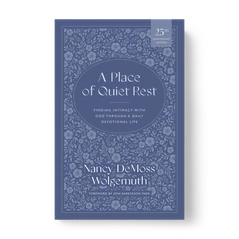
And if you’d like to learn more about making spiritual rhythms central in your daily life, I hope you’ll pick up Nancy’s book, A Place of Quiet Rest. In this resource, you’ll find practical encouragement for the daily devotional life and be invited to rest in the Lord’s presence. When you make a donation of any amount, we’d love to send you a copy as our way of saying “thank you.” To give, visit ReviveOurHearts.com/donate. When you do, be sure to ask for A Place of Quiet Rest.
Well, next weekend we're welcoming November with a conversation about cultivating hospitable character. That's right. We're seeking to be warm and welcoming women together. It's just in time for our cozy season ahead. I hope you’ll come back for that!
Thanks for listening today. I’m Dannah Gresh. We’ll see you next time for Revive Our Hearts Weekend.
This program is a listener-supported production of Revive Our Hearts in Niles, Michigan, calling women to freedom, fullness, and fruitfulness in Christ.
*Offers available only during the broadcast of the podcast season.