Your Uncertainty and God’s Good Story
Dannah Gresh: If it ever seems like important events come together by chance, remember this from Nancy DeMoss Wolgemuth.
Nancy DeMoss Wolgemuth: There’s no such thing as chance. It’s all under providence. God's providential knowledge and decrees and love and care, is all under His control.
Dannah: This is the Revive Our Hearts podcast with Nancy DeMoss Wolgemuth, coauthor of You Can Trust God to Write Your Story, for February 12, 2026. I’m Dannah Gresh.
So far in the book of Ruth, we’ve seen how Naomi left Israel during a famine. Her husband and sons died, and then she traveled back to her home as a bitter woman. And, her daughter-in-law, a Moabite woman named Ruth, came with her. If you’ve missed any of that, you can find past episodes at ReviveOurHearts.com. Nancy’s back to pick up our study in Ruth.
Nancy: One of …
Dannah Gresh: If it ever seems like important events come together by chance, remember this from Nancy DeMoss Wolgemuth.
Nancy DeMoss Wolgemuth: There’s no such thing as chance. It’s all under providence. God's providential knowledge and decrees and love and care, is all under His control.
Dannah: This is the Revive Our Hearts podcast with Nancy DeMoss Wolgemuth, coauthor of You Can Trust God to Write Your Story, for February 12, 2026. I’m Dannah Gresh.
So far in the book of Ruth, we’ve seen how Naomi left Israel during a famine. Her husband and sons died, and then she traveled back to her home as a bitter woman. And, her daughter-in-law, a Moabite woman named Ruth, came with her. If you’ve missed any of that, you can find past episodes at ReviveOurHearts.com. Nancy’s back to pick up our study in Ruth.
Nancy: One of the things I love about the Lord and His ways is that He always has a provision in place to meet us at our point of need.
A lot of times we can't see what that provision is or where it is. We can't imagine that it's coming. We may feel like we are really caught between a rock and a hard place. We may get to a point of great desperation. But God never gets desperate. Do you ever think about that? God always has a plan. He always has a provision. In His way and in His time, He will reveal that provision to us.
Let me encourage you if you've been following along, or even if you haven't and are just joining us for this session, to open your Bible to the book of Ruth. And when you have a chance, read it for yourself. Now, we're going very slowly through the book. I would encourage you to sit down and read it in one setting, if possible. It won't take you long, just a few minutes, four short chapters, so that you'll get an idea of the whole story.
In fact, some Bible teachers have suggested that a great way to study the Bible is to take a shorter book of the Bible, like Ruth, and read it every day repeatedly for a week, or even for thirty days. You'll find that you get fresh insights.
In fact, as I've been reading the book of Ruth over and over again this past week, I have found things hidden in that book that I've never seen before, and I've been reading and studying it for years. But God's Spirit has a way of making it fresh to our hearts. So I would encourage you to not to let me do all the work, but you open your Bible, you get into the book of Ruth, and let God show you things that maybe I'm not pointing out, or maybe that I've not seen at all. His Holy Spirit lives inside of you to help give you insight and understanding. So I encourage you to do that.
We come to chapter 2 of the book of Ruth, and we're going to look today just at the first verse.
"Now, Naomi had a relative on her husband's side from the clan of Elimelech, a man of standing whose name was Boaz."
Now, just to recap here a little: remember that Naomi is the wife. Elimelech is her husband who led her and her two sons into the land of Moab during a time of famine in Bethlehem. Now her husband has died, Elimelech has died. Their two sons who married Moabite women have died. Naomi is left as a widow. She's lost her two sons.
It's just hard for me to even imagine the pain and the agony, the anguish that this woman must have gone through. But God has brought her to the place of coming back to Bethlehem, and she is now accompanied by her daughter-in-law, Ruth who said, "I want to follow you. I want to follow your God and your people." Her daughter-in-law has been converted.
The two women have come back to Bethlehem, and it's the time of the barley harvest. And then the Scripture, which is inspired of God, as we know, inserts just this little note that tells us something as observers, as readers, that Naomi doesn't know yet. It gives us a little clue into what's happening behind the scenes.
Sometimes, if you go to see a play, you only know what's going on on the stage, but you don't know what's going on behind the scenes, behind the curtain. We have a God who does know everything that's going on—not only on the front stage, not only what we can see and understand, but who knows all the parts and the pieces that are behind the scenes. God gives us this glimpse.
It says that Naomi had a relative on her husband's side from the clan of Elimelech—her husband, her deceased husband. It's a man of standing. He was a wealthy man, a landowner, a man of standing, whose name was Boaz.
And actually, we'll get into chapter the rest of chapter 2 tomorrow. But the chapter goes on and doesn't say anything else for the moment about Boaz. It just puts this little verse here to tell us that God has a plan in mind.
Now, before we move into the rest of the chapter, we need to go back and get a little bit of understanding about the culture and the Jewish laws to help us understand why it's significant that there was a wealthy relative of Naomi and her husband who was in Bethlehem.
This takes us to a law in the Old Testament that's very important to understanding our own faith. It's the law of the kinsman redeemer. That phrase kinsman redeemer translates a Hebrew word, the little word goel—g, o, e, l. It's the word that means, essentially, protector. This is a provision of protection.
Now, as we've said in the past couple of weeks, there were two vital things that needed to be protected in Jewish culture, two things that God told His people were very important. One was the family name. The second was the family land—the family inheritance or possessions. A goel was a man who would redeem his relative from trouble or from loss, would provide protection and restoration either of the family name or the family lands.
Let me show you how this worked. According to the law of Moses, the next of kin had both a responsibility and a right with regard to a needy or an impoverished relative. Now, in order to have a kinsman redeemer, a goel, you had to have a need. You had to be poverty stricken. If everything in your life was going fine, you had your mate and your children and your lands, you didn't need a redeemer. But if you lost some of these things that were important to protect, then God made a provision for a redeemer, as it related to the family lands.
If a man had to sell his family lands because of poverty, the next of kin, the closest living male relative, had the right to redeem those lands, to buy them back, and to restore them to the one who had lost the land. He was the goel. He was the kinsman redeemer when it came to the family name.
We saw this in chapter 1. A man had the duty, when his brother died without children, to take on the widow as his wife and to raise up seed, or children, for his brother, who would then bear his brother's name. The children would bear the brother's name and would inherit the brother's land. So, it was a sacrifice to be a goel. You had to be willing to pay for this land. You had to be able to pay for the land. You had to be willing to take on this widow as your wife and to not have the children be your children. They would be really your brother's children.
This was God's means, a gracious provision of helping impoverished or needy Jews keep their family lands and keep their family name. Now, God did this not just for their own sakes, but remember, God had a bigger thing going here. God had a bigger plan, a bigger picture. There was a Messiah coming. There was a Redeemer coming, a Savior of the world. This redeemer of the family lands and the family name just made it possible for that godly Jewish heritage to continue right up till the time of Christ. This goel became an incredible picture of Christ, who came to earth to redeem us from our losses. As the story unfolds, we'll see how he did that.
But as we look at this first verse in chapter 2, all we're told is that Naomi had a relative on her husband's side, a man of standing, whose name was Boaz. Here's Naomi who's poverty stricken. She's lost her family. There's no hope of a family line being continued. She's about to lose her lands.
She comes back, and out of her poverty she's going to have to sell her lands just to exist. And yet, she has a relative who's one of the wealthiest men in the land, although at this point she doesn't even know she has that relative. She sees no connection between this wealthy relative and her great need.
And isn't that often the way it is? God has a provision. God's made a provision for us through Christ. God makes provision through His grace for our lives every single day to meet us at our point of need. He has the provision in place, but so often we can't see it. We don't know that it's there. So what do we do? We have to trust. And that's the point God was trying to bring Naomi to, to where she would trust that God did have a provision and a plan.
As I read this story, the story of Ruth, it really has an incredible plot. It's a great story, and the thing I love about it is the reminder that God sees all the pieces, that God knows where all those puzzle pieces are. I love doing puzzles, jigsaw puzzles. When I'm trying to assemble them, invariably I get part way through, and I think there's got to be some pieces missing from this puzzle. And invariably, they're all there. But when they're spread out on the table in disarray and disorder, I can't see how they all fit together.
We have a God who's already assembled the puzzle. In fact, it was never disassembled in his mind. He knows how it all fits together. He sees all the pieces. There are no mysteries in heaven. Now, this side of heaven, there are tons of mysteries. I believe we have to come to the point where we're willing to live with mystery, to live with some things that can't be explained.
Jenny [woman in the studio audience], I don't know why the Lord took your husband and left you with four little boys. I know that you've embraced the will of God, and your heart has trusted God, but I dare say that you don't have all the answers to that, and you won't this side of heaven.
But I also have watched in Jenny, a woman who is trusting in a God who's made provision, that doesn't make it easy. That doesn't mean there aren't tears. That doesn't mean there's not a lot of loneliness and a sense of loss. But I've seen from a distance here, a woman who is drawing upon the resources of God to meet her at her point of need.
I think we're told about Boaz in this first verse of chapter 2 so that later in the chapter, when Ruth actually meets Boaz, we're going to see that she thinks it's a purely coincidental meeting, but the reader is going to know there's no coincidence here. She didn't just happen to land in that field of Boaz. God directed her there. God put that man there, and God sent her to that field.
It's an encouragement to me to know that behind what seems to be chance in our day to day encounters, our day to day experiences and lives, that there's no such thing as chance. It's all under providence—God's providential knowledge and decree and love and care. It's all under His control.
I often say, and the older I get, the more I mean it; I love living under Providence. I do now. I don't always love everything that that means for me. I don't always love not knowing what God's doing. But when I step back and I worship and I reflect on who God is, and I see what He's done, I'm given faith to believe that for the mysteries that I'm now living with, for the things I now cannot comprehend or understand; that He is providential, that He is sovereign, that He is caring, that He is overruling, that He is orchestrating and weaving together the pieces of my life to make a great, redemptive story.
We can't see the end of the story. We don't know how it's all going to fit together, but it will. And God gives us just these little glimpses, just these little teases, if you will. "Naomi had a relative on her husband's side from the clan of Elimelech, a man of standing, whose name was Boaz." We don't know any more than that yet, but as the story unfolds, we'll see that that chance comment, seemingly chance comment, is really full of meaning, full of providence and part of God's plan.
So if you're needy today, or you're living in mystery, you're living in the confusion or the hurt or the uncertainty of the circumstances that are going on in your life, take heart and be encouraged. There stands nearby a Redeemer—a man of standing, a man of wealth, a man of influence, a man who has the right, the power and the willingness to redeem you and your losses. He knows your need. He loves you. He's committed to you, and He intends to restore you.
Thank You, Father, for giving us just little glimpses into the intricacies of your plan. We see so little. We understand so little, but we trust that you are in control. You are sovereign. You are weaving together an incredible, redemptive story. It's not about us. It's about You and Your plan to redeem this world.
Thank You for that plan. And when we cannot see, help us to trust and thank You for the promise that when we one day see You face to face, that we will look back, and we will say You have done all things well. We thank you in Jesus name. Amen.
Dannah: Now, for a little sweet encouragement, we’re gonna take a break from teaching to tell you the story of Nancy’s own love story. Nancy was single until she was fifty-seven years old. That’s when she married Robert Wolgemuth. You could say he was her very own Beau-az. Just last month, Robert went home to be with the Lord, which makes this story all the more precious to remember. Here’s Nancy.
Nancy: As the Lord would have it in His providence, the very week that Robert and I had our first date, I came in my normal Bible reading to the book of Ruth. I found myself parking there over the next several weeks and just soaking in this story and seeing it through a different lens than I had in the past.
And one of the verses that's come to have incredible meaning for me in this journey is Ruth chapter 2, verse 10. If you were to go back and read through our extensive text exchanges over the months, one of the things you'll see often in those texts is I will many times just write the reference Ruth 2:10.
Now, most people don't know off the top of their head what Ruth 2:10 says, and I can't actually quote it myself, but let me read it to you here. The context here is that Ruth has come as an outcast, as a Moabitis woman, as a widow. She's destitute; she's poverty stricken. She's now come to Israel with her widowed mother-in-law, and they're trying to eke out an existence.
She's taken the place of a humble gleaner. The lowest place on the socioeconomic ladder in the culture was to be a gleaner. You're basically trying to pick up leftovers from the harvest. And she stumbles onto, the King James says, she happened to light upon a field belonging to a man named Boaz.
Well, it wasn't happenstance at all. It was God's providence. But what she didn't know, and what Boaz didn't know, was that they were related to each other by marriage. Ruth's husband's family was a relative of Boaz's family. In the Old Testament law, Boaz could be the one to be a kinsman redeemer, to redeem her out of her poverty, out of her destitution.
But, she didn't know that. She's just being faithful. She's just doing what she's supposed to do to try and feed herself and her mother-in-law. And then Boaz finds her. He takes an interest in her. There are lots of other gleaners, lots of other workers, but he comes and singles her out and and expresses to her that he's going to give her provision and protection and that she's not going to be harmed in any way by the men who are the reapers. She is in awe of this. She's amazed. She has no idea why this man would take an interest in her.
Now, Ruth 2:10. It says, "She fell on her face, bowing to the ground, and said to him, 'Why have I found favor in your eyes that you should take notice of me, since I am a foreigner.'" And then just down a few verses, verse 13, she says to him, "I have found favor in your eyes, my Lord, for you have comforted me and spoken kindly to your servant, though I am not one of your servants."
Well, as I read that passage over and over again, I began to feel like this Ruth character in this story. I'm going through life, minding my business, trying to do what God's called me to do. And then I stumble onto this field of grace, which is what Boaz's field became to Ruth. It's a place where I'm now experiencing lavish grace and love in a different way than I've ever experienced it before.
Now, let me say, I never felt like an impoverished widow or destitute in any sense, because God's grace in my life has always been lavish. But I began to experience through this man, Robert Wolgemuth, the love of God and the grace of God in an abundant and different and sweet and precious way.
I was in awe of this. I just found myself thinking again and again, and my way of saying this to Robert was just to write that reference Ruth 2:10 on a text. "Why would you have taken notice of me that you would pour out your love and your grace and your kindness to me?"
I haven't gotten over it. I'm not sure I ever will. I hope I never do because I think in our relationship with the Lord, it's appropriate that we should always humbly feel, "Lord, why should You have saved me? Why should You have given your life for me? Why should You have brought me into your field of grace?"
This is not a false humility on my part. This is a genuine sense of wonder and awe that this man would have chosen me to be his. That led to an affectionate name for Robert. My mother actually kind of started this. She loves Robert, and she is so thrilled that God has brought us together. She started calling him my beau—b, e, a, u. I liked that term. It seemed appropriate, and so I shared that with Robert.
And then there came a day when he sent a text to me that was signed, "Your Beau-az." But it wasn't spelled B, O, A, Z, like it is in Ruth. It was spelled B, E, A, U, hyphen, A, Z—your Beau-az. He knew I was loving the book of Ruth. We were talking about Boaz and Ruth a lot, so he signed off as your Beau-az. I love that! It stuck.
I have often called him "my very precious Beau-az." I've seen him take that role in the way that Boaz did in this passage, in some beautiful ways.
There was one very touching moment. It was before our engagement, but it's a moment at which I almost said, "I want to marry you," before he ever asked me to marry him. We were talking about a hard situation in my life, in my world. It's been a hard thing for me. It's been a difficult situation, and I felt he needed to be aware of it.
And so as I shared this with him, he could tell it was a real tender spot for me, and some soreness there, some wounds from the past. We talked about Ruth and Boaz, and I said, "You know, in this story, when Boaz said, 'I'll take Ruth to be my bride as the kinsman redeemer,' he was saying, 'I will take on all your liabilities, your debts, your obligations, your family, your widowed mother-in-law.'" You get the whole package when you get Ruth. And Boaz, as a kinsman redeemer, came along and said, "I'm willing to take all of this."
As we were talking about my difficult situation, Robert looked at me and said, "If the Lord lets us be married, I want to be a Boaz to you. I want to take on your burdens and your concerns. And this burden that's been yours for so many years, it's not going to be yours anymore. It's going to be mine."
I can't even tell you what happened in my heart at that moment, because it is a burden I've carried for a long time, and I know will still carry, because God gives grace to the person who's going through this. But to see a man saying that part of my vision for marriage is that you no longer own this by yourself . . .
Remember when Ruth kind-of proposed to Boaz in chapter 3 of Ruth? She says, "Spread the corner of your mantle over me. Spread your garment over me." It's an Old Testament picture of coming under the wings, coming under the protection, the garment of the kinsman redeemer. It's such a beautiful picture for marriage.
And so my Beau-az, my Robert, is saying, "As we prepare for marriage, if you let me, if you'll come under my covering, my protection, my wings, my garment, I'm going to cover you as God covers us with His grace, His wings, His love." And again, it's such a beautiful earthly picture of the relationship I have—and we have—with the Lord as we trust Him as we're willing to come under that.
If we're going to resist it, if we're going to be two people just butting heads and picking at each other and not trusting each other, that's no way to have a marriage. It's no way to have a relationship with the Lord. But I see in this man the potential, the possibility of a very joyful oneness, as I'm willing to say, "I trust you. I trust the Lord." And to say, "Thank you," humbly, "I thank you for being willing to come and take that role, to invite me into your field of grace. To say, 'I will provide for you. I will protect you.'"
This is like this is so old-fashioned. We don't have this paradigm today, sadly, in manhood and womanhood and marriage. It's just assumed that the two have totally the same role in provision and protection. But to me, this is the beauty of God's picture of manhood and womanhood and marriage. It's not that we're not totally equal, that we're heirs together of the grace of life. We are both created in the image of God. One is not superior to the other. But we are different.
And it's a joyful thing for me to now be experiencing what I've said to women over the years as married women, let your husband protect you, let him take the responsibility for provision. Does that mean you don't earn any income? No. Does that mean you don't have a job outside your home? No. But it's a heart attitude. It's a way of thinking that he says, "I'll care for you. I'll protect you. I'll provide for you. I'll cover you, and you can find a place of refuge in me."
And in experiencing that even to this point in this relationship with my precious Beau-az, I'm coming again to understand and experience a bit more of that sweet covenant relationship with the Lord, and what it is to come under His covering, under His protection, and to have Him be my ultimate Kinsman Redeemer.
Dannah: I love that story.What a testimony to God’s gracious providence in the life of my sweet friend, Nancy. Praise God for the ten joy-filled years she had with her Beau-az! I hope you’re encouraged to see that God still writes stories like Ruth’s today.
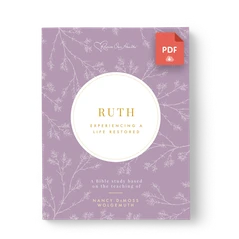
Here’s your reminder that you can get our six-week study, Ruth: Experiencing a Life Restored, when you make a donation of any amount to support Revive Our Hearts. To give, just visit ReviveOurHearts.com, or call us at 1-800-569-5959. And be sure to request your copy of the Ruth study when you do.
Reminder, if Ruth and Nancy’s stories have you thinking about your own relationships—marriage, motherhood, friendship . . . the list could go on!—we have a helpful collection of resources for you. Visit ReviveOurHearts.com/relationships to find our best podcast episodes, blog articles, videos, and challenges on the various relationships God has called you to steward.
Tomorrow, Nancy’s continuing in this series, and she’s talking about how work can become worship. Please be back for Revive Our Hearts.
This program is a listener-supported production of Revive Our Hearts in Niles, Michigan, calling women to freedom, fullness, and fruitfulness in Christ.
All Scripture is taken from the NIV.
*Offers available only during the broadcast of the podcast season.