When Waiting Is Best
Dannah Gresh: Nancy DeMoss Wolgemuth wants to remind you—if you’ve come to faith in Jesus, He is always working on your behalf.
Nancy DeMoss Wolgemuth: He is in heaven interceding for us; He's at the right hand of God taking up our case, taking up our cause. He is orchestrating the events of our lives providentially, sovereignly, to fulfill His holy purposes. So, we can wait.
Dannah: This is the Revive Our Hearts podcast with Nancy DeMoss Wolgemuth, author of Heaven Rules, for February 20, 2026. I’m Dannah Gresh.
If you’re reading through the Bible with us, you’re in Deuteronomy 3 and 4.
Let’s continue in the teaching series, "Ruth: The Transforming Power of Redeeming Love."
Nancy: What kind of reputation do you have as a woman? If I were to go ask the people where you work, the people in your church, your …
Dannah Gresh: Nancy DeMoss Wolgemuth wants to remind you—if you’ve come to faith in Jesus, He is always working on your behalf.
Nancy DeMoss Wolgemuth: He is in heaven interceding for us; He's at the right hand of God taking up our case, taking up our cause. He is orchestrating the events of our lives providentially, sovereignly, to fulfill His holy purposes. So, we can wait.
Dannah: This is the Revive Our Hearts podcast with Nancy DeMoss Wolgemuth, author of Heaven Rules, for February 20, 2026. I’m Dannah Gresh.
If you’re reading through the Bible with us, you’re in Deuteronomy 3 and 4.
Let’s continue in the teaching series, "Ruth: The Transforming Power of Redeeming Love."
Nancy: What kind of reputation do you have as a woman? If I were to go ask the people where you work, the people in your church, your neighbors . . . how about your husband and children? If I were to ask them what kind of person is Martha? Susan? Linda? How would they describe you?
Reputation is a powerful thing—for better or for worse. As we come to Ruth 3, we see that she had a reputation that I think all of us would like to have. We left Ruth yesterday in the middle of a conversation with Boaz. She's asked him to be her kinsman redeemer, to rescue and redeem her from her situation of poverty and widowhood. And Boaz has said to her that he's delighted that she came and asked him to be her kinsman redeemer. He says to her, "Don't be afraid. I will do for you all that you ask."
Let’s pick up in verse 11 of chapter 3 where Boaz says to Ruth, “All my fellow townsmen know that you are a woman of noble character.” Another translation puts it this way: “All the people of my town know that you are a virtuous woman” (NKJV).
Wouldn’t that be an incredible reputation to have? “All the people in my town know that you are a virtuous woman.” Remember earlier, in chapter 2, when Boaz first met Ruth, he said, “It has been told me all that you’ve done for your widowed mother-in-law” (v. 11 paraphrase). Her reputation had gone before her. He says, “Now when the people think about you, they know that you are a virtuous woman.”
That is the same word, by the way, that’s used in Proverbs 31:10, where the Scripture says, “A wife of noble character [or a virtuous wife], who can find? She is worth far more than rubies. The heart of her husband does safely trust in her. She will do him good and not evil all the days of her life.” A woman of noble character, a virtuous woman.
I want to live the kind of life that if a negative rumor were to start spreading about me, the people who know me best would be quick to say, “There is no way that that could be true of her.” I want to live the kind of life that has a reputation, that is a true reputation for being a woman of noble character, a virtuous woman.
Let me ask you. Are you known as a woman of virtue? Are you known as a woman of virtuous heart and attitude and values and behavior and dress and speech? Do people know that you are a woman of noble character—that you’re a woman of virtue?
The character of women, in large measure I believe, determines the character of a nation, the character of our culture. As we look at some of the issues of our culture today with families, with youth, with rebellion, with violence and crime; I really believe that in large measure, we as women have to take responsibility for many of the problems of the character of our nation. That's not to say that men don't have responsibility. But there is a sense in which a nation will sink to the level of the character of its women. It's true in our churches. It's true in the ministry where I serve.
I really believe that my character, my spirit, my values, and my attitude has a determining effect on the whole spirit of the ministry where I serve. You’ve heard it said, perhaps, that the spirit of the woman determines the climate of the home. Ask yourself, “What is the climate like in our home? What is the temperature like in our home?”
Then, before you’re quick to say, “Well it wouldn’t be that way if it weren’t for this person who lives in my home,” you may want to go take a look in the mirror and say, “Lord, is there something in my character or something in my spirit that is pulling down the tone, the climate, or the temperature of this home?"
One of the burdens that God has put on my heart for the whole ministry of Revive Our Hearts is that He would raise up a movement of women—Christian women, in our generation, in our churches, and in our homes—who would be women of virtue. There are so many corrupt, rebellious, independent-spirited women in our culture today—in our churches even!
I believe one of the great things we need, if we’re going to see a revival in our churches, is a revival of women of virtue, women who have godly, Christlike characters. It’s not going to be a movement of hundreds of thousands or millions of women all at once. It’s really going to be one woman at a time—Linda, Wanda, Edie, and me, Nancy. We can become the kind of women who together really shape and mold the character of our homes, our churches, and even our nation.
Boaz brings up to Ruth at this point, in verse 12, a situation that apparently she was not aware of. He says, “I’m willing to be your kinsman redeemer.” But he says, “Although it is true that I’m near of kin, there is a kinsman redeemer who is nearer than I.” He is saying that “there is someone who has a prior right to redeem your situation and we’re going to have to take this matter up with him before I can serve as your kinsman redeemer.”
This may explain why Boaz hadn’t taken the initiative earlier to redeem Ruth and Naomi in their situation. We are reminded that Naomi and Ruth could not expect anything from Boaz as their right. He was not a brother of the deceased, so he was not obligated to fulfill the role of the goel or the kinsman redeemer. They were dependent on his compassion and his generosity and his grace to choose to be their kinsman redeemer.
Boaz says to Ruth, verse 13
“Stay here for the night, and in the morning if he wants to redeem [this nearer kinsman], good; let him redeem. But if he is not willing, as surely as the Lord lives I will do it. Lie here until morning.” So she lay at his feet until morning, but got up before anyone could be recognized; and he said, “Don’t let it be known that a woman came to the threshing floor.”
Let me just insert here that I see in Ruth and Boaz a discreet spirit—a purity of heart that leads them to be careful in the appearances of their relationship and of their behavior. In every way they are trying to be discreet so as to not to bring reproach or blame upon themselves or their reputation. That is how Ruth got a reputation for being a virtuous woman—by being careful not to leave an impression of something otherwise.
I think as women, it’s so important that we be careful not to leave opportunity for others to give an evil report or to suggest that we have something other than virtuous intentions.
Now verse 15, Boaz says to Ruth,
“Bring me the shawl you are wearing and hold it out.” When she did so, he poured into it six measures of barley and put it on her. Then he went back to town.
This is the kinsman redeemer showing generosity. He’s been extending grace to her all along, and now he’s saying again, “Here’s an abundance out of the harvest. Take it back to your mother-in-law. I want your needs to be met.”
I see this gift as a kind of a down-payment that Boaz is giving to Ruth in anticipation of all the good things that he intends to pour upon her; to share with her and with her widowed mother-in-law in the future.
Ruth goes back to her mother-in-law. When she gets back, verse 16, Naomi says,
“How did it go, my daughter?” Then she told her everything Boaz had done for her and added, “He gave me six measures of barley, saying, ‘Don’t go back to your mother-in-law empty-handed.’”
When I see that word "empty-handed" it brings back a word that we read in verse 21 of chapter 1, where Ruth and Naomi came back to Bethlehem and Naomi said, “The Lord has brought me back empty.” She had gone out to Moab. She had lost her husband and her two sons. Now, she came back as a destitute, poverty-stricken widow. At that point, the end of chapter 1, she says, “I’m empty. I have nothing.”
She did have Ruth, but from her distraught vantage point at that moment, she was empty-handed; she had nothing. Now we see as the story is unfolding that her emptiness is beginning to be filled. Boaz said, “Don’t go back to her empty-handed. Take her a gift. Take her an expression of love and commitment and concern. Let her know that her needs are going to be met. She’s going to be filled. Her empty days are over.”
Let me say again—it’s all, all, all because of a redeemer—a man of grace who has the right and the willingness and the power to meet her needs! Then verse 18,
Naomi said, “Wait, my daughter, until you find out what happens. For the man will not rest until the matter is settled today.”
That verse has encouraged my heart many times when I’ve been in the midst of a process where God is working things out, but I can’t see exactly how. I can’t see how He’s going to bring a matter to a conclusion. I don’t know how He’s going to resolve the issue.
The Word says to my heart, “Wait. You can rest. You can be still. You don’t need to contend. You don’t need to manipulate. You don’t need to strive. You don’t need to fret. You don’t need to try and figure this out. You don’t need to try and control your circumstances. Wait. Wait on the Lord. Be still. Rest, because your Redeemer is not going to rest until He has resolved the matter.”
As women, if we could only remember that we always have a Redeemer who is working on our behalf! He is in heaven interceding for us. He’s at the right hand of the throne of God. He’s taking up our case, taking up our cause. He is orchestrating the events of our lives providentially, sovereignly, to fulfill His holy purposes—so we can wait.
There is a moment to act; there are times to take action or to do something. But there are far more moments than most of us realize when we just need to be still. Wait and watch God work in the heart of that teenager. Watch God work in the heart of that husband. Wait for God to work in the heart of that employer.
Don’t take matters into your own hands. Don’t go and try and fix all the things that you think are wrong with your pastor or your church. Wait on the Lord. Make it a matter of prayer. Take it to him and then be still. Be at rest because your Kinsman Redeemer is always working, and He will not rest until the matter is settled.
It may not be settled today, but in God’s books in heaven, it is settled. We’re just waiting to see what He has already determined. In His time God will surely bring it to pass.
Just before this session someone handed me a poem. I don't know who the author is. It reflects on Naomi’s words to Ruth.
Be still; wait and rest.
Sit still my daughter, just sit calmly still.
Nor deem these days, these waiting days as ill.
The One who loves thee best, who plans the way,
Hath not forgotten thy great need today.
And if He waits, 'tis sure He waits to prove to thee,
His tender children, His heart’s deep love.Sit still my daughter, just sit calmly still.
Thou longest much to know thy dear Lord’s will.
While anxious thoughts would almost steal their way
Within because of His delay,
Persuade thyself in simple faith to rest
That He who knows and loves will do the best.Just sit still my daughter, just sit calmly still.
Nor move one step, not even one until His way hath opened.
By inner being then, I’ll then how strong
And waiting days not counted then too long.
'Tis hard, oh yes; 'tis hard, 'tis true.
But then He giveth grace
To count the hardest spot the sweetest place.1
As we look at the end of Ruth’s life at the end of the story of Ruth as we have it recorded in the Scripture, I think about that passage at the end of Job that says the Lord blessed the latter end of Job’s life more than the first. The first part of Ruth’s story has seemed to have so many troubles, so many problems. Isn’t that true of the first part of all of our stories? Born into sin. Born enemies of God. Separated from God. Yet the grace of God always has a happy ending.
Now the problem is: we’d like the ending to be sooner sometimes than what God intends it should be. We’re going to see the grace of God at work in Ruth’s situation and be encouraged about how His grace is at work in our situations.
Ruth chapter 4, let me read the first portion of this chapter, and then we’ll break it apart verse by verse. When we finished chapter three, Ruth had just returned back to Naomi from asking Boaz to be her kinsman redeemer, and Naomi had said wait and see what happens because Boaz is going to be at work today fixing this situation.
What was the situation that needed to be fixed? Well, Boaz said to Ruth, "I’m willing to redeem you, but there is a kinsmanredeemer who has a prior right, so I’m going to have to go talk with him first." That’s where we are when we come to chapter 4.
Meanwhile Boaz went up to the town gate and sat there. When the kinsman redeemer he had mentioned came along, Boaz said, "Come over here, my friend, and sit down." So he went over and sat down.
Boaz took ten of the elders of the town and said, "Sit here," and they did so. Then he said to the kinsman redeemer, "Naomi, who has come back from Moab, is selling the piece of land that belonged to our brother Elimelech. I thought I should bring the matter to your attention and suggest that you buy it in the presence of these seated here and in the presence of the elders of my people. If you will redeem it, do so. But if you will not, tell me, so I will know. For no one has the right to do it except you, and I am next in line."
"I will redeem it," he said.
Then Boaz said, "On the day you buy the land from Naomi and from Ruth the Moabitess, you acquire the dead man’s widow, in order to maintain the name of the dead with his property." At this, the kinsman redeemer said, "Then I cannot redeem it [in other words, that’s another story] because I might endanger my own estate. You redeem it yourself. I cannot do it."
(Now in earlier times in Israel, for the redemption and transfer of property to become final, one party took off his sandal and gave it to the other. This was the method of legalizing transactions in Israel.) So the kinsman redeemer said to Boaz, "Buy it yourself." And he removed his sandal. (Ruth 4:1–8)
So we see Boaz going to the town gate to deal with this situation of the other kinsman redeemer. The town gate, as some of you know, was the center of city life. That’s where people would transact business. That’s where justice would be administered. That’s where the elders of the town would gather to have deliberations. It’s just a large open space near the entrance of the city where business and legal matters were conducted.
Now this nearer kinsman who had a prior right came along and Boaz got his attention and said we have something to discuss. As I think about this other kinsman who is not named, he has a prior right. He is a closer male relative than Boaz to the deceased man, Elimelech. I think that other kinsman redeemer is a picture of the law of God and the right that it had to condemn us as sinners.
Before Jesus could save us from our sin as our Kinsman Redeemer, He had to go and do business with the law of God. You see the law of God had a prior right on us. It could not redeem us, but it had the right to condemn us because we had not kept the law. So Jesus first had to settle things with the law even as Boaz had to settle things with this other kinsman who was a nearer kinsman.
As we see Boaz taking this nearer kinsman to the city gate where these kinds of things were dealt with, I’m reminded of how in order to deal with the law and its claims against us. Jesus had to go outside the city to a place of disgrace, a place called Calvary. He had to die on a cross between two thieves. There as He laid down His life, He not only paid the purchase price for our redemption, for our salvation, but He also robbed sin and the law of its power to condemn us, of its power to rule over us.
How’d He do that? He did it by Himself bearing the curse that was attached to the broken law. We had broken God’s law. There was a curse attached to that. In order to redeem us, Jesus had to go and Himself bear the curse, pay the price. That was the ransom for our redemption.
So Boaz took the elders of the town and said, "Come here. I want you to be witnesses of this exchange, of this transaction." We’re gong to see a transaction between Boaz and this other contender to be the redeemer. So he says to the kinsman redeemer, "Naomi who has just come back from Moab is selling the piece of land that belonged to our brother Elimelech."
Remember we said all along that in Jewish culture there were two important things that needed to be protected. From one generation to the next they had to keep the family lands within the family and the family name. If there were no male heir to carry on the family line, if somebody had to sell their lands because of poverty, God had made provision for those lands and that family name to be able to be retained.
He says that Naomi, because she’s poverty stricken, is being forced to sell her family lands. These are the lands of her husband, Elimelech. They’re now going to leave the family. This was a serious thing to Jews. So Boaz offers this nearer kinsman the right to redeem the land and therefore to rescue Naomi from poverty, to redeem her, to protect her. That’s what a goel, a kinsman redeemer was to do.
When the nearer kinsman, the other man whose name we don’t know, heard that this was an opportunity to acquire some land, at first he was eager. He said, "Yes, I will redeem the land. I’m willing to redeem it."
I imagine he was thinking to himself, This is a chance for me to make some money. He looked at Naomi. He realized that she was past child-bearing years. She was never going to have another son who would become the heir to her husband, so this nearer kinsman said to himself, I think I can keep this property for myself. He saw it as a way to add to his net worth without a great expense to himself. He knew that this property would revert to his own possession once Naomi died, so he saw some profit here.
Then Boaz throws in this little caveat, which he didn’t mention at first. He said, "By the way, on the day when you get the land from Naomi, you also get with the land Ruth the Moabitess, the dead man’s widow, in order to maintain the name of the dead with his property."
So not only do you get this land, when you get the land, with it comes a wife, a widow, a Moabitess, a foreign woman. At this, verse 6, the kinsman redeemer said, "Then I cannot redeem it, because if I do, I might endanger my own estate."
See, he realizes that if he takes Ruth to be his wife, she could have a son and then the property would belong to that son, would go through that family line. He would have paid for the property, but he wouldn’t have anything to show for it because it would go to the deceased family line. When he counts the cost, he says, "That’s a price I’m not willing to pay. It might endanger my own estate." Here’s a man who’s looking out for himself, so he says, "I can’t redeem it. You redeem it." He didn’t have any interest in acquiring Ruth with the land.
So we see that to act as a redeemer, to act as a goel in these circumstances was costly. It wasn’t just you pay some money, you get some extra land. It was you take on a whole, huge responsibility for the family of this deceased man, for his widow, for the mother-in-law. You take on the whole situation as your own.
To be the redeemer was going to require personal sacrifice, an act of love and sacrifice that this other man was not willing to pay. Yet Boaz—what a picture of the Lord Jesus—was willing to pay that price.
I do not believe it was because he was wildly in love with Ruth in the way that we think of being in love in our culture today. I think it was because he was a man who had the heart of God. He had the heart of Christ. He’s a picture, a type, of the Lord Jesus who was willing to endanger His own estate in order to redeem us. He was willing to pay the price to be the loser, if you will, in order to redeem us, to purchase us, to meet our need.
Aren’t you glad that when Jesus came to redeem us, He didn’t take thought for His own estate. When you think of all He left, think of all He gave up to come from heaven to earth to be our Redeemer. Think of His willingness to lay down His life to get us. I mean, what were we adding to His portfolio? Poverty and need and sin.
He said, "I want you and I’m willing. Though you don’t add anything to My net worth, I want you. I want to purchase you. I want to redeem you." He was willing to lose everything in order to acquire us for His own.
No one else is willing to pay that price for you. Satan’s not. The law wouldn’t do that. Your family can’t do that. Your mate can’t do that. Your pastor can’t do that. But Jesus can do that, and He was willing to pay the infinite price, to endanger His own estate, so that we could become His cherished possession.
Dannah: Nancy DeMoss Wolgemuth has been reminding us of the wonder of the gospel, and she’ll be right back to pray.
If you’ve been enjoying this series in Ruth and want to share it with a friend or revisit a past episode, you can find past episodes at ReviveOurHearts.com, or on the Revive Our Hearts app.
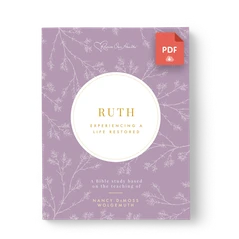
And don’t forget, we’re offering the Bible study, Ruth: Experiencing a Life Restored, when you make a donation of any amount. You’ll spend six weeks diving deeper into Ruth’s story, and you’ll find space to reflect and make it personal. To give and request your copy, visit ReviveOurHearts.com, or call us at 1-800-569-5959.
Next week, we’re wrapping up the series, "Ruth: The Transforming Power of Redeeming Love." You’re not gonna want to miss how this story ends. Now, Nancy's back to pray.
Nancy: Father, we're talking about incredible love here. What a price You have paid to make us Your own. Thank You for Jesus, who was willing to take us and our situation on as His own without thought for what it would mean to Him. He was willing to pay the infinite price.
Lord, we will always be debtors. We will love You forever because of the great, great love You have shown to us. Give us truly grateful hearts for what You have done as our Kinsman Redeemer. I pray in Jesus' name. Amen.
This program is a listener-supported production of Revive Our Hearts in Niles, Michigan, calling women to freedom, fullness, and fruitfulness in Christ.
All Scripture is taken from the New International Version unless otherwise noted.
1"On Our Father's Knee." Devotions for Times of Illness. Fredrik Wisloff.
*Offers available only during the broadcast of the podcast season.