
Tips for Bible Journaling
Dannah Gresh: Calling all Bible journaling perfectionists! Nancy DeMoss Wolgemuth wants to challenge you.
Nancy DeMoss Wolgemuth: If you’re one of those people who says, "I can’t bear to mess it up, or not to be perfect." I want to say gently, “Get over it.” Thinking we have to be perfect or stressing because we can’t be perfect, those kinds of things will keep us in bondage. Only Christ is perfect. Put your eyes on Him. He’s not looking for your sentences to be perfect…
Dannah: This is the Revive Our Hearts podcast with Nancy DeMoss Wolgemuth, author of Adorned, for December 4, 2025. I’m Dannah Gresh.
Are you afraid to write in your Bible because you might mess up? Well let me just tell you something—you will! We all make mistakes in our Bible journaling because, well, we’re human! Our handwriting is imperfect. Our sentences …
Dannah Gresh: Calling all Bible journaling perfectionists! Nancy DeMoss Wolgemuth wants to challenge you.
Nancy DeMoss Wolgemuth: If you’re one of those people who says, "I can’t bear to mess it up, or not to be perfect." I want to say gently, “Get over it.” Thinking we have to be perfect or stressing because we can’t be perfect, those kinds of things will keep us in bondage. Only Christ is perfect. Put your eyes on Him. He’s not looking for your sentences to be perfect…
Dannah: This is the Revive Our Hearts podcast with Nancy DeMoss Wolgemuth, author of Adorned, for December 4, 2025. I’m Dannah Gresh.
Are you afraid to write in your Bible because you might mess up? Well let me just tell you something—you will! We all make mistakes in our Bible journaling because, well, we’re human! Our handwriting is imperfect. Our sentences are imperfect. Our understanding is imperfect. But that doesn’t mean we shouldn’t do it.
Yesterday, Nancy shared about the “what” and “why” of Bible journaling, but today she’s getting super practical with the tips that have helped make it an engaging and delightful rhythm in her life. Let’s listen.
Nancy: Well, let's go in the remaining time we have to some tips and points about the "how." That's the thing I've heard from many women in social media posts in response to the question we asked recently. It’s summarized maybe by this woman who said, “I haven't tried yet because I don't know how to do it.” And good for her for saying that I want to try it, but I just don't know how to do it.
So I'm going to start by telling you this, and I want you to remember this. For some of you, it may be the one thing you most need to remember about this session. You ready? Write this down? There is no right way to do Bible journaling. I'm going to say that again: there is no right way to do Bible journaling. Can you say that with me? There is no right way to do Bible journaling. Believe it.
I'll give you some ideas and some suggestions, but please don't go home and try all of these at once, or all of the things that you read in the beginning of the Revive Our Hearts edition. That will overwhelm you. Pick an idea or two and try that, and then move on to a different one later. I'm actually doing Bible journaling in a very different way today than I was doing during those five years. So change it up as the season of your life dictates.
And remember, even as you're in the same Bible, the different genres of the Bible—the poetic books, the history books, the prophecies, the New Testament epistles—lend themselves to different kinds of journaling. So it doesn't all have to be the same.
Now, I mentioned a moment ago this first big hurdle for a lot of people is being afraid to write in their Bibles, and afraid of not being perfect in what they write or what it looks like. Many women said this, so I think I need to camp on it for a moment. This lady said, “I got myself a journaling Bible for Christmas, but I haven't been able to write in it yet. I just keep looking at it and think that it looks too neat and clean. I have the ROH new notetaking Bible and would love to start journaling, but honestly, I'm intimidated, and unfortunately have the need to be perfect mindset.” Probably no one else here has that.
“It's something I'm interested in,” someone said, “but the feeling of needing it to be perfect holds me back. Just got the ROH notetaking Bible. Some of my hesitation is wanting to be perfect, or fear of not being deep enough. What if I make a mistake, mess it up?” “I'm overwhelmed with the thought of messing up a beautiful Bible with my horrible handwriting.” And I could go on and on. We got so many of those.
Part of me says in response, “I get that.” I have barely legible handwriting myself, but I'm going to say, dive in anyway. Try it anyway. Get started. The joy of processing, meditating on the Word in this way will overcome those fears. But I want to say something else that may relate to other areas of your life as well. If you're one of those people who says, “I can't bear to mess it up or not to be perfect,” I want to say gently, “Get over it.” There may be a bigger issue here thinking that we have to be perfect, or thinking that we can be perfect, or thinking we should be perfect, or stressing because we can't be perfect.
Those kinds of things will keep you in bondage. There is something self-centered about that potentially, maybe not in your heart, but there may be some. Only Christ is perfect. Put your eyes on Him. He's not looking for your sentences to be perfect in the handwriting or in what it says.
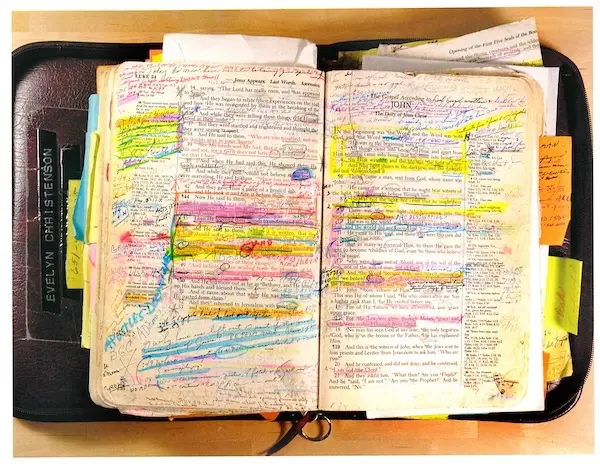
I have a picture here of a Bible of a dear friend of mine who's now in heaven, Evelyn Christensen. There weren't notetaking Bibles back in those days. She was an intercessor, a woman of prayer. She taught many thousands of women how to pray. When she went to heaven, her staff sent me a picture of a page from her Bible. I have it framed in our ministry office. I'm looking at it—what a mess. That doesn't look perfect to me. But it looks like a woman who engaged with God's Word, loved the Word and went back to it again and again. She didn't do all those notes at one time. It's from frequent repeated use. So if you're concerned about being messy, just remember Evelyn Christensen's Bible.
I don't have a picture of my Bible here to show you. There is lots of scratching out, lots of messes, lots of parts that are really hard to read. It's messy at points. But I just decided it's not going to be about my perfect penmanship or my perfect sentences. It's going to be about me meeting with the Lord. If you ever get to the point where you think what you're writing is amazing, then you've got an issue. Just remember that what we write is not the amazing thing. It's what we're writing about that is amazing.
So your journal entries in the Bible or in a journal near the Bible, they don't need to be fancy; they don't need to be neat; they don't need to be long; they don't need to be polished; they don't need to be edited. I'm an editor by trade. That's what I do, kind of for a living—editing, writing. I often have to tell myself, “Let it go” when it comes to Bible journaling. Don't think about somebody else's eyes being on this. It's not about you. It's not about your writing. Let it go. What you're writing is not intended to be published. The goal is to get to know God and to let His Word shape and change your life.
Now, as you get started, you've got this beautiful Bible. And by the way, if you could see in this one, there's lots of mess in there, because I'm grappling with things as I'm teaching through the Bible. And if you want to see some mess, you can come look at this.
But before you start writing anything, ask the Lord to speak to you by His Holy Spirit. You may want to write down a prayer along that line and then read the Word, read the text. It may be a longer portion. It may be a shorter portion. You may want to put it under a microscope and stick in one verse or paragraph or chapter for a long time. If you go over on the next page, that's okay. If you're a perfectionist, get over it. The goal is to meet with God.
Sometimes you'll take a helicopter view, which is you're looking at big portions of Scripture from up high. Sometimes you'll take a hike. When I was journaling five years through the Bible, that was more like hiking. But now, as I'm teaching through the Bible, I'm doing more of a helicopter ride. They're both beneficial. Sometimes you need the faster pace, and sometimes it’s better to slow down.
In my Bible journaling, I will put a date wherever I start writing so I can go back and remember. If I'm out of town, I will often put where I was at that point. Otherwise, I assume that it was at home. Now, as we're encouraging women to read through the Bible together next year in 2026 (which I hope you will do), that's a fairly rapid pace. It's a lot to read to get through the Bible in a year. That's kind of a helicopter ride. You can do it. If you haven't signed that banner on the wall yet, I want to encourage you to consider doing that. But I'll tell you this, if you do that with women around the world in '26 you won't have a lot of time to write a lot on each page.
So if you're taking a slower pace, you can write more. If you're taking a faster pace, you may write less, and that's fine. Just capture highlights, try to get the big picture, and you can go back another time and take a slower approach. Don't be in a hurry. There's no deadline. The goal is not to fill the empty space, but to let God fill your heart and your mind with His Word.
As you read, remember that this is a two-way conversation with the Lord. You're listening to God speak. You're reading humbly, thoughtfully, prayerfully. You're taking it in. You're digesting it. You're processing it. You're mulling it over. You're meditating. You're trying to understand. Then you're taking notes as you read about what you're reading. But you not only want to listen to what God says, you want to respond to God. And we'll see both of those in these tips.
Some woman said, “I'm not fancy with what I write, and sometimes it's just a sentence or two.” To which I say, “No problem.” Did you remember that there's no right way to do Bible journaling? Can you say that there's no right way to do Bible journaling? But as you do it in whatever means, I encourage you to keep it simple. Now, there's more simple and there's less simple. You can get more complicated if you want, but at least if you're starting or you're just needing freshness in your time with the Lord, keep it simple.
Here's some ways you could do that. Now, if you write these down, don't try and do them all. Pick one and try that. Sometimes it may be just copying Scripture in the margin or in your separate journal, just actually writing out the Scripture by hand. There's something that helps me process the Word of God as I write it out. Now, you probably won't do the whole thing, but key verses or paragraphs, you may just want to write those out. You may want to paraphrase, which is to write it in your own words. It makes you think about what you just read.
You may want to do something some people have called the SA method. It's not fancy; it just means summary and application. So summarize, what's this paragraph or this section or this chapter about could just be a sentence or two. Then an application, a takeaway, and again, that can be short. How did this chapter speak to you personally? What does God want you to do about what you just read? If you go through the whole Bible doing that, a couple sentences about each chapter, you will have a chapter by chapter overview, simple overview, of the whole Bible. That's simple. You can do that. I've challenged teenagers to do that over the years.
As a way to get started in meditating on Scripture, I would encourage you to write out prayers as you read, as you respond to what you've just read. Let me suggest that there are five different kinds of prayers. There are more than this, but five different ones that I've used in my notetaking Bible. And I'll just give them these names to help you with your memory.
First, there are thank You, Lord, prayers. That's praise; thanksgiving for something. Thank You Lord for . . . Thank You Lord for something you read. “Thank You Lord that You are holy. Thank You Lord that You are kind. Thank You Lord that You are merciful.”
Then there are yes, Lord, prayers. That's a prayer of agreement, of surrender, of obedience. “Lord, I agree with You. This is hard for me, but yes, Lord.” Get your white hanky there, and you can wave that when you write your yes, Lord, prayer.
There can be oh, Lord, prayers. That would be a prayer of confession. “Oh Lord, I haven't been obeying this. I have sinned against You in this way.” Confessing. You can write that out. Doesn't have to be long. It can be short.
There can be help, Lord, prayers. That would be a request for yourself. Help me, Lord, with something that's prompted by what you've read. Help me to forgive this person as you're reading about the importance of forgiveness. Make a request for yourself. “Help me to trust You when I am afraid.” Take the Scripture, make it into a prayer.
Then, please, Lord, prayers. That would be a request for someone else—maybe for the child or grandchild that you're doing a journaling Bible for. Prayers that you write for that person you love.
One woman said, “I struggle to consistently journal due to time. I have a Scripture memory system that I do every day, a prayer journal, Scriptures that I pray, and I'm usually doing a Bible study of some sort, along with my read through the Bible plan. I would love tips on how to fit it all in and be more consistent.” Here's my tip: you can't fit it all in. Don't try. You can't do it all at once. There are seasons, so pick the one that's on your heart at that point, or the two or three, but not four or five, unless that's all you have to do in your life, in which case that would be a great season of life.
So start it simple. Keep it simple. If you want to go a little deeper, let me give you a few thoughts about that, but could I just repeat, there's no right way to do this. So as you read, consider three things.
First is observation about the text. What does it say? You say, “Well, that's obvious.” Well, it may not be obvious. Some if you don't write it down, you may skip over it. So make observations.
- What does it say?
- How would you title this chapter or the passage?
- How would you outline it?
- Is there a key verse that captures the essence of the passage?
- Is there a key theme?
- Is there a key word?
Look for repeated words and phrases—maybe circle them or highlight them or mark them in a different way. I've done this in Psalm 119 over the last several weeks, the repeated words and phrases. So, I'm seeing what's emphasized.
Summarize what you've read. Be inquisitive. Ask questions about the text.
- Who wrote this?
- Why did they write it?
- Who's speaking here?
- To whom are they speaking?
- Who are the main characters?
- What are the major events?
- When and where did they take place?
- What happened before?
- What happened after?
I'm going to speak tomorrow, Lord willing, on Luke chapter 24. I've been meditating on that chapter over the last number of weeks. Just asking those kinds of questions about the text is so helpful. You may want to use a Bible dictionary or traditional dictionary to to define key words that may not be as familiar to you. What other Bible verses refer to something similar to what you are reading in that text? What are the things you've never realized or noticed before? Write down things you want to be sure to remember, questions you have that you still don't know the answer to. Jot down the question and maybe come back to it another time when you're going through God's Word as you read other parts of Scripture that may shed light on the question you had earlier.
Let me give you a couple of examples. One example is here in Acts. This is just out of my notetaking Bible when I came to Acts 13. Sometimes I will do little bits of poetry. When I say poetry, I mean that loosely, because they don't rhyme, but just ways of remembering or recording what that text says. So here was my summary of Acts 13:
Disciples sent
Word preached
Jesus proclaimed
Forgiveness offered
Many believed
Others opposed
Disciples persecuted
Word spreadp
Preaching continued
Disciples joy-filled
Church grew
Now, I can look at that and that can give me a summary of Acts chapter 13. So, those aren't even complete sentences, but that's the kind of thing I recorded from time to time in the Scripture. So observation . . . what does it say?
And then interpretation . . . what does it mean?
- How does it fit into the big picture of Scripture—creation, fall, redemption, and restoration.
- What did the author want his original readers to understand?
- What does this passage teach you about God? about humans? about yourself? about sin? about holiness? about Jesus? about the gospel?
- What does it teach you about the Christian life, etc?
- Are there particular insights that stand out to you?
If your hand's about to break from trying to capture all this, get a copy of the notetaking Bible, the Revive Our Hearts edition, and it will be spelled out for you.
One woman asked, “When you are journaling, do you use commentaries and dictionaries, or do you just let the Lord lead your thoughts?” Well, the answer kind of is yes. I try to read first and meditate on it prayerfully myself, taking in the text. But when there are places where I'm confused, I'm not sure I've got this right, or I'm wanting more insight into it, yes, I will use study Bibles and some commentaries. I don't use any big, fancy ones. I use pretty simple ones, sometimes Bible dictionaries.
But I'm also asking the Lord to lead my thoughts and to show me what He wants me to see. But if I'm not sure, it sometimes helps to say, “Is there a reliable, faithful student of God's Word?” Because if I'm the first person ever to see this in this text, it's probably wrong. Keep that in mind.
So observation, interpretation and application, what should I do?
- Are there any promises here for me to trust?
- Are there any commands for me to obey?
- Are there any warnings for me to heed?
- Are there any examples for me to follow or not to follow?
And as part of application, write down your response to the text. Make it personal—praise or gratitude for something you've read, an action or attitude you need to confess, a step of obedience you need to take, someone you need to forgive, a promise that you're choosing to believe, someone you could encourage with what you've read, a truth you want to share with someone else, etc. The Spirit will direct your response if you let Him.
We need Word and Spirit. The Word without the Spirit can lead to death. That’s not the Word's fault and not the Spirit's fault. This is not an academic exercise. This is wanting to know Him and respond to Him in the power and by the illumination of His Holy Spirit.
Now, let me just give you a couple of examples from my own original time journaling through the Bible. I want to read you what I wrote at the very beginning, Genesis 1, and then what I wrote at the very end, Revelation 22, just to give you an idea. I'm a writer, so you're going to write differently than I do. But I just want to give you the feel of what I was thinking and how I was responding.
So Genesis 1, this is where I started. “We stand at the beginning of a new year.” Now keep in mind, I've read Genesis 1. I've been thinking about it. So everything I wrote here is in relation to something in the text of Genesis 1.
God is here. [In the beginning God . . . that's what made me write "God is here."] He always has been. He always will be. Apart from Him, all of life and earth is shapeless, meaningless, futile, empty, and dark. But in Him is life and light. His Spirit hovers over this earth. He speaks light into the darkness of our world. He creates, He orders, He separates, He defines. It is good. What He declares happens. What He ordains comes into being. There are no obstacles to His power. Nothing can withstand His purposes. Sitting here in early morning darkness, snow covering the ground outside [that wasn't in Genesis 1] . . .
I pray for the hovering ["the Holy Spirit hovered over the face of the deep. I pray for the hovering,] creating, ordering, illuminating, defining, work of Your Spirit in my life this year. When You speak, may I respond. [“And God said,” that's all through Genesis 1, so this is my prayer. When You speak, may I respond.]Do Your good . . . [It was all good. I saw that it was good. I said] Do Your good work in and through me, bringing flourishing beauty and growth. Fulfill all your holy, eternal purposes in our world for the glory and fame of Your name.
That was my entry on Genesis 1, on January 1, 2018. Then when I got to the very end, five years later, plus a few weeks extra, the last verse of Revelation of the Bible, “The grace of the Lord Jesus be with everyone. Amen.” Here's what I wrote just about that verse.
The closing verse of the New Testament is heaven's answer to the curse found in the last verse of the Old Testament, Malachi 4:6. The grace of God has come to earth in the person of Christ, bringing salvation for all who repent and believe, overcoming sin's dreadful curse. How great is our God; we worship You. May we walk in that grace through every step of our pilgrimage on this planet until we see Him. Amen and Amen.
I've had the joy since CSB notetaking Bible, Revive Our Hearts edition came out, of sharing it with a number of friends. One thing I've loved is giving it to some teenagers. I have a picture here of one of the first teenagers I gave it to. I gave it to her mother to take it home to, I won't say her name. But she and her mom are here at the conference. This is a picture her mom sent me like an hour later. I love this . . . a teenager. She was fourteen at the time, sitting huddled over the Bible studying. I love, love, love this. That's why we did this.
I gave a notetaking Bible, not this exact one but a different one, to another young friend for her twelfth birthday a year or so ago. I wrote a letter to her and enclosed it in that Bible. And here's a part of what I said to her, which is what I would like to say to you today.
God promises a blessing to those who read His word, Revelation 1:3. As you read, ask God to give you understanding. Ask Him to reveal Himself, His heart, and His ways to you. He will do just that. I hope you will use this special edition of the Bible to write or draw things that stand out to you as you read. For example, observations about the passage, key thoughts or words from each chapter, a summary of each chapter, a summary of each chapter, things you learn, things you want to be sure to remember, prayers, praise. I pray this Bible will be a record of your journey with the Lord over these next years.
I still have Bibles I used when I was your age. It is a joy to look back over them all these years later. I look forward to seeing how God continues to work in and through your life as you seek Him in His Word. That is my prayer for you.
Lord, thank You for the wonder of Your Word. Thank you for the privilege of reading it in our own language, which millions of people in the world, hundreds of millions of people in the world can't yet do? You have spoken through Your Word, through Jesus Christ, and by Your Holy Spirit. You enliven and quicken that Word to our hearts today.
I’m just thinking about what would happen if hundreds of women seated here today would, whether it's in a notetaking Bible, or a journaling Bible, or some other instrument, would begin to engage with the Word in more meaningful ways, to meditate on it, make it personal. We become what we behold. May we become like Jesus as we behold You in Your Word. I pray in Jesus’ name, amen.
Dannah: Well, I don’t know about you, but I wanna go grab my Bible and a whole bunch of colorful pens and journal til I drop! What a helpful and practical lesson from Nancy. It’s all about getting into God’s Word and getting God’s Word into you—and Bible journaling is one great way to do that.
If you’re interested in purchasing the CSB Notetaking Bible, Revive Our Hearts Edition for yourself or someone you love, go to ReviveOurHearts.com/store. There, you can choose from our three beautiful cover options and place your order! We hope this resource enriches your devotional life and helps you behold the Lord daily in His Word. While you’re there, check out the other discounted resources in our Celebrate the Season sale.
God’s Word changes everything—and this month, your giving can too. When you give to Revive Our Hearts this December, your donation is doubled—and so is your impact as we encourage women around the world to be in God's Word. Every dollar goes to help women find freedom, fullness, and fruitfulness in Christ.
One listener named Gloribelle wrote to tell us,
I always look for ways to stay connected with God and with this ministry, as you are a fundamental part of my life and daily walk. I listen to Revive Our Hearts on Spotify, and I give thanks to the Lord Jesus for a ministry that serves women—making me feel cared for and embraced as part of a family.
When you give, you’re helping us bring women like Gloribelle into the Revive Our Hearts family, where they’ll be pointed to Jesus every single day through our radio program, podcasts, challenges, print resources, and more. To make a donation today, you can visit ReviveOurHearts.com, or call us at 1-800-569-5959. And if you’re not able to give financially right now, would you pray for us—that God would meet all our needs, equipping us for another year of Bible-based ministry? No matter how you choose to partner with us, we’re so grateful for you.
Well tomorrow, we’re kicking off the Christmas season here on Revive Our Hearts. We’ll be listening to an interview Nancy DeMoss Wolgemuth did with Kirk Cameron over on his show Takeaways. It’s all about the incomparable Christ, born for us. Please be back for Revive Our Hearts.
This program is a listener-supported production of Revive Our Hearts in Niles, Michigan, calling women to freedom, fullness, and fruitfulness in Christ.
*Offers available only during the broadcast of the podcast season.