
The Unique Ministry That Happens in Your Home
Dannah Gresh: Unbelievers may not be comfortable going to church on Sunday, but you know where they might be willing to show up? Your living room. Especially if yummy smells are emanating from your kitchen! Here’s Erin Davis.
Erin Davis: Someone said to Jeff, “Hey, do you want to come to Jason and Erin’s house tonight? They’re going to have brownies.”
Now, Jeff did not know who Jason was. Jeff did not know who Erin was. Jeff did not think to ask, “Is it a Bible study?” Jeff said, “There’s going to be brownies?” Jeff’s friend Andrew called me that afternoon and said, “Hey Erin, I need you to make brownies.” And I did!
Dannah: This is the Revive Our Hearts podcast with Nancy DeMoss Wolgemuth, author of Adorned, for March 4, 2026. I’m Dannah Gresh.
How do you use your living room? Maybe you …
Dannah Gresh: Unbelievers may not be comfortable going to church on Sunday, but you know where they might be willing to show up? Your living room. Especially if yummy smells are emanating from your kitchen! Here’s Erin Davis.
Erin Davis: Someone said to Jeff, “Hey, do you want to come to Jason and Erin’s house tonight? They’re going to have brownies.”
Now, Jeff did not know who Jason was. Jeff did not know who Erin was. Jeff did not think to ask, “Is it a Bible study?” Jeff said, “There’s going to be brownies?” Jeff’s friend Andrew called me that afternoon and said, “Hey Erin, I need you to make brownies.” And I did!
Dannah: This is the Revive Our Hearts podcast with Nancy DeMoss Wolgemuth, author of Adorned, for March 4, 2026. I’m Dannah Gresh.
How do you use your living room? Maybe you love a good movie night, social gatherings with friends, or even just a quiet nap on the sofa. These are all good things. But today, my friend Erin Davis is inviting you to dream bigger dreams for that living room of yours.
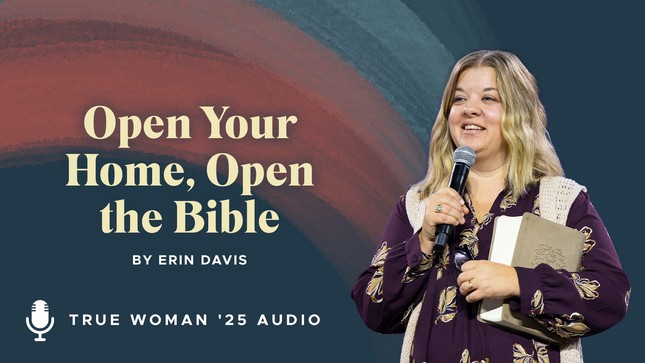
Erin is wife to Jason, mom to four boys, and an editor at Moody publishers. At a recent True Woman conference, she led a session called “Open Your Home, Open the Bible.” She wants you to know if you have a home, you have a ministry. We’ll listen to that session over the next two days. Here’s part one.
Erin Davis: Our focus in this session is the power of what I’m going to call home ministry. And you’ll notice I’m not saying hospitality. Hospitality is an important topic for another time, but I’m talking about intentionally using your home for intentional discipleship versus ministry that might happen outside, like in churches or online.
So the question for us to wrestle with is, what can happen in home ministry to advance the kingdom and winning the lost and discipling the saints that can’t happen in other settings. We’re going to look at what the Bible teaches about home ministry, and I’m asking the Spirit to give you a vision for what that might look like in you.
We have to start with the Great Commission. So, go ahead and get yourself to Matthew chapter 28. We’re going to be in our Bibles a lot, which is important, because Erin Davis says something interesting about . . . well interesting, 100 percent of the time; true and helpful, a much lower percentage of the time. And so we’re going to lean hard on the Word. And I find that we need to remind each other of the Great Commission over and over.
Okay, true woman seminarians, who is speaking in the Great Commission in Matthew 28? Jesus, right? And you know the story—He has already come to dwell with us. He has been crucified; He has been resurrected. And here, at the end of Matthew 28, He’s preparing to ascend to the Father. And so His small band of disciples are gathered around, but they’re not going to be small much longer. Pentecost is about to happen. And so He is commissioning them.
I like to say that it’s called the Great Commission because we are on co-mission with Christ for the redemption of the world. And so these really are our marching orders. So let me read to you Matthew 28 verses 16–20.
Now the eleven disciples went to Galilee, to the mountain to which Jesus had directed them. And when they saw him they worshiped him, but some doubted. And Jesus came and said to them, “All authority in heaven and on earth has been given to me. Go therefore and make disciples of all nations, baptizing them in the name of the Father and of the Son and of the Holy Spirit, teaching them to observe all that I have commanded you. And behold, I am with you always, to the end of the age.”
Now, I like to remind people that the chapters and verses in your Bible are put there by men to help you stay organized. And I’m glad they’re there, but there’s a reason why you can remember a verse and you go like, “Well, I can’t remember the address.”
That’s fine. You have Google for that. You don’t have to remember the address. But sometimes what that does is it breaks up thoughts that were not intended to be broken up. And so here, when Jesus was about to ascend to the right hand of the Father, He left us the Church, which had not quite formed but was about to be formed, to push back the darkness. And He gave us a game plan—a two-pronged attack against the darkness: make disciples and teach them the Word.
Listen to it again. It’s right there at the end: “Go therefore and make disciples of all nations, baptizing them in the name of the Father and of the Son and of the Holy Spirit”—no break—“teaching them to observe all that I have commanded you. And behold, I am with you always to the end of the age” (vv. 19–20).
Both prongs of this attack are essential to the mission of building the kingdom until Christ returns. We’re seeing this in real time. Many are coming to Christ. I believe we’re seeing revival in our day. College campuses, many are coming to Christ. Out of professional sports, many are coming to Christ.
I interviewed a woman a couple of weeks ago that has come to Christ out of the new age. She was deep into the New Age, and she said, “Erin, we are coming to Christ out of the New Age in droves.” And then she said, “Who will disciple us?” And as believers, all of us, we don’t look to the left or the right. All of us say, “We will.” That’s the Great Commission. That’s the assignment.
Now we don’t all do it the same way. What this looks like in your life is not going to be what it looks like in my life. That’s not the point. In this room alone, there are a variety of gifts. And not all of you are called to be Bible teachers. But I’m going to assume you all have a home, and you are called to use that home to fulfill the Great Commission. And what I want you to not be able to do at the end of this breakout is ignore the question of how. I want you to have to go like, “Oh yeah, the Lord’s given me a home, and He’s commissioned me into kingdom work. How do I put those two things together?”
So, the way we’re going to do that is we’re going to look at three snapshots of Jesus doing home ministry, which He did a lot of. And we’re going to see what we can learn from Him. He’s our Master.
Now, what I’m not saying is that home ministry is the only effective ministry. Don’t y’all go back to church and say, like “I went to this breakout, and this woman said we shouldn’t have church anymore.” No, of course not. We need public ministry. We need church-based ministry. We need parachurch ministry. Those things are not wrong or less than, but what we’re going to look at in the text are: what are the things that can be accomplished in our home—particularly in home Bible studies—that cannot be accomplished by those other means.
I want you to think of ministry outside of our homes, such as church service that I hope we all attend every Sunday morning, and activities and events and social media—all of those things. I want you to think of those as the top of the funnel. That’s what gets people in to hear about Jesus and His Word, to get them to want to know more. So that’s essential. But discipleship is often home ministry, and I want you to think about that as the inside of the funnel.
Now, what happens in the inside of the funnel? Things are swirly-whirly, right? And so that’s fitting. It’s fitting, as we’re going to see in the text we’re going to look at that it is in the swirly-whirly of life that home ministries can really do a lot of good.
Okay, three snapshots. First we’re going to turn to Mark chapter 2, just a little bit to the right of where we just were in Matthew 28. All right, we’re going to read Mark, chapter 2, verses 1–12, and this is how we're going to do it. This is how we do it in my home Bible study: we read it one verse at a time. Somebody reads one verse, and then somebody else picks it up.
It is the living and active Word of God. So I ask that if you read a verse, you do not read it like this, quiet and meek. That you read it with power, so everybody in the room can hear you. And part of the reason why we do this is because I am such a believer in the power of the public reading of the Word. And so since we’re pretending and we’re in my living room, we’re going to do it Erin Davis living room style.
Dannah: Okay, I’m interrupting the session for just a moment. Right here, the women in the room volunteered to read one verse at a time. It was super cute and fun, but you won’t be able to hear their voices on our audio, so you get to listen to me read the passage instead. Here we go.
And when he returned to Capernaum after some days, it was reported that he was at home. So many people gathered together that there was no more room, not even in the doorway, and he was speaking the word to them. They came to him bringing a paralytic, carried by four of them. Since they were not able to bring him to Jesus because of the crowd, they removed the roof above him, and after digging through it, they lowered the mat on which the paralytic was lying. Seeing their faith, Jesus told the paralytic, “Son, your sins are forgiven.”
But some of the scribes were sitting there, questioning in their hearts: “Why does he speak like this? He’s blaspheming! Who can forgive sins but God alone?”
Right away Jesus perceived in his spirit that they were thinking like this within themselves and said to them, “Why are you thinking these things in your hearts? Which is easier: to say to the paralytic, ‘Your sins are forgiven,’ or to say, ‘Get up, take your mat, and walk’? But so that you may know that the Son of Man has authority on earth to forgive sins”—he told the paralytic—“I tell you: get up, take your mat, and go home.”
Immediately he got up, took the mat, and went out in front of everyone. As a result, they were all astounded and gave glory to God, saying, “We have never seen anything like this!”
Okay, let's back to Erin!
Erin: All right, let’s make some observations. Where was Jesus in this passage? It tells us right there in verse 1: He was at home. What had He been doing before this? It tells us right there again in verse 1: He’d been traveling from Capernaum.
That’s enough for me. Jesus used His home for the teaching of the Word. And I want to be like Him, and so I want to use my home for the teaching of the Word. Now, to be fair, some scholars think that He might have been in Peter’s home. That’s because Mark 1 tells us that He stayed in Peter’s home, at least temporarily, and healed Peter’s mother-in-law. But either Jesus was in His home or He was in the home of a close friend, and that means that He was not in the synagogue.
Now it doesn’t mean that Jesus never taught in the synagogue. We actually find Jesus teaching in the synagogue with some frequency in the Gospels. But again, I think this gives us enough reason to at least consider the difference in value between public ministry and what I’m calling home-based ministry.
Some of you all are my age. You remember those WWJD bracelets. WWJD. One thing we get from this story is that Jesus taught the Bible at home. Now, that’s not usually the focus of this passage, right? We love this story because of those men who got their friend to Jesus by cutting a hole in the roof. But perhaps you’ve never asked whose roof. Verse 1 again: whose roof got a hole cut in it?
Jesus Himself or maybe Peter. But either way, this was not some random house. Jesus was either in His own home or the home of a friend where He was staying. And what we learn from that is that He made sacrifices to minister from His home base. He knew they were going to cut a hole in the roof because He knows all things.
So he could have been like, “Hey guys, let’s move this outside to save me on my homeowner’s insurance.” He could have chosen to teach that day when He knew the paralytic would be brought to Him in public spaces, as was His habit of doing it, and then a roof replacement would not have been needed. So, why? Why did Jesus choose to teach the Word at home in this moment?
Well, I don’t know everything about what He’s doing, but I do know some of the things He teaches us about how to relate to each other.
- He tells us to be generous toward the saints in places like 2 Corinthians 9:11.
- He tells us to build each other up in places like 1 Thessalonians 5:11.
- He tells us to be devoted to the fellowship in places like Acts 2:42.
- He gives us lots of other commands about how to live with each other.
- Galatians 6:2 kind of bottom-lines it for us: “Bear one another’s burdens, and so fulfill the law of Christ.”
So what Jesus commands, He certainly models. And so not only do we see Jesus modeling home-based ministry, even when He was likely tired. Right? He’d been traveling, and He was finite just like we were. Perhaps He would have rather hunkered down after traveling and recharged His social battery. My social battery is going to need a very long charge next week. But from this story, we get this picture of us bringing each other to Jesus in each other’s homes.
I love my church. Green Tree Christian Church, Rolla, Missouri. You ever need a church home and you want to drive a long ways if you don’t live there, you are welcome. It’s the church where I came to Christ. It’s the church where I’ve served Jesus for decades. I love my church.
I love conferences like this. I love Christian spaces online. But we simply cannot carry each other to Jesus in the same way in those spaces that we can in our homes. Burden-bearing ministry, which all of us are called to—we’re all called to burden-bearing—burden-bearing ministry, for it to be sustainable and effective has to happen in home-based ministry.
Now I have bad news for you. You cannot be at True Woman every week. You got some folks back home that are really wanting you to come back home. And the sloppy joes you put in the Crock-Pot yesterday, they are still in the Crock-Pot and they are burnt to a crisp. But you can be in each other’s homes every week. It’s sustainable that we gather in that way and that we burden-bear in that way.
Living rooms tear down barriers. You can invite someone into a living room much easier and much more effectively than you can invite them to come to church with you on Sunday morning, or you can invite them to come to something like this with you.
Two stories come to mind. One, my husband and I were in student ministry for many years. There was a student named Jeff who did not know the Lord. Knew actually almost nothing about the Lord. And some friends had been inviting him to come to church and youth group, and he was not interested. But someone said to Jeff, “Hey, do you want to come to Jason and Erin’s house tonight? They’re going to have brownies.”
Now, Jeff did not know who Jason was. Jeff did not know who Erin was. Jeff did not think to ask, “Is it a Bible study?” Jeff said, “There’s going to be brownies?” Jeff’s friend Andrew called me that afternoon, and said, “Hey, Erin, I need you to make brownies.” And I did!
It didn’t happen immediately, but Jeff eventually surrendered his life to Christ. That was many years ago. Jeff is like an adopted son to us, who loves the Lord, serves faithfully in his church, and is now the daddy of two little boys who he is raising to love the Lord. And I promise you, every time Jeff comes to visit, I make brownies. Those brownies served in our living room are having a generational impact that no church service could have accomplished.
That woman I told you about that’s coming out of the New Age has a similar story. She would not set foot in a church. She was invited into someone’s home, and she was longing for meaningful friendship with women. And she came, and she says her immediate thoughts were, This home is so welcoming. I’ve never been anywhere like this.
Now we know that was the presence of the Holy Spirit in that home, but she didn’t recognize that. And she told me, “I remember thinking, These women are so warm. I’ve been waiting for friendships like this my whole life.” And then she said someone pulled out a Bible, and she thought, I’m in a Bible study! She told me that she wanted to run—that the rest of the time together that she could feel the blood pumping in her ears and feeling like, How do I get out of this? Why do they have Bibles here?
But she didn’t run. And it took time, but she, too, came to Christ and has experienced radical transformation. She never would have set foot in a church, never. She never would have signed up for a True Woman conference. She never would have followed a believer on social media. But we all want to be in somebody’s home.
Of course, people can get saved in church, but we can bring our friends and neighbors to Christ through our homes. And through our homes, we can do the burden-bearing ministry that we’ve all been called to when we connect in smaller groups.
Listen, you can love everybody who’s in your church on a Sunday morning. I’m in a church of about 1,100 people, and I love them. And you can love everyone who claims Christ online, but active love requires knowing each other. Burden-bearing requires knowing the burdens, and we just cannot do burden-bearing ministry in groups of one hundred or one thousand. But home ministry facilitates that. Just like those friends who brought their friend to Jesus, we can carry each other to Jesus in our homes. It provides a space for us to know each other’s real needs so that we can meet them.
That group of women that meets in my home every Tuesday night, we know. We know the pain points. We know the sin struggles. We know about the prodigal children. We know in ways that the greater church body . . . mine’s a community Bible study of people from lots of different churches, and actually lots of people that don’t know the Lord. But even if we were from the same church, we know each other’s burdens in a way that the greater body could not know. And therefore we are able to do, again, effective and sustainable burden-bearing ministry in our homes.
Dannah: That’s Erin Davis from her True Woman session, “Open Your Home, Open the Bible.” I hope you’re feeling excited about how you could use your home as a center for burden-bearing and gospel-sharing.
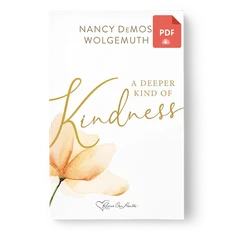
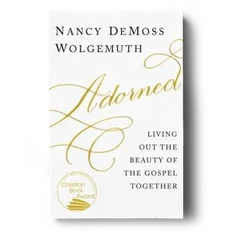
You know, as you’re loving and serving the people around you, your spirit sets the tone. In A Deeper Kind of Kindness, Nancy DeMoss Wolgemuth explores why kindness is indispensable, both in our relationships and in our gospel witness. Adapted from her book Adorned, this resource pairs biblical teaching with one hundred practical ways to live out Christlike kindness in your home, church, and community.
We’d love to send this booklet to you as a thank-you for donation of any amount. To give and request your copy, visit ReviveOurHearts.com, or call us at 1-800-569-5959.
We’ve got lots of resources for life-on-life relationships on our website. Visit ReviveOurHearts.com/relationships to find helpful podcast episodes, videos, articles, and more. We want to equip you to love people well, in your home and beyond!
Tomorrow, we’ll listen to part two of today’s message, and Erin will explain how your home can become a place of healing. You won’t want to miss it.
This program is a listener-supported production of Revive Our Hearts in Niles, Michigan, calling women to freedom, fullness, and fruitfulness in Christ.
All Scripture is taken from the CSB.
*Offers available only during the broadcast of the podcast season.