
Dannah Gresh: Hey, friend. This is Dannah Gresh from Revive Our Hearts. Before we get started today, I want to remind you tomorrow is the National Day of Prayer. Now, this is a day set aside to pray for our nation. In light of our conversations this week, it's on my heart to pray about sexuality and gender. So many are confused about their sexual identity, and so many are living in shame because they've believed the lies in this area. My prayer is that men and women, not only here in the United States but around the world, would find freedom from bondage. So make plans to set aside some time tomorrow and join hundreds of thousands of believers in prayer.
Now, this is not an endorsement, but you've probably heard of the brand of vacuum cleaners called Dustbuster. Maybe you even have a Dustbuster. I wonder, …
Dannah Gresh: Hey, friend. This is Dannah Gresh from Revive Our Hearts. Before we get started today, I want to remind you tomorrow is the National Day of Prayer. Now, this is a day set aside to pray for our nation. In light of our conversations this week, it's on my heart to pray about sexuality and gender. So many are confused about their sexual identity, and so many are living in shame because they've believed the lies in this area. My prayer is that men and women, not only here in the United States but around the world, would find freedom from bondage. So make plans to set aside some time tomorrow and join hundreds of thousands of believers in prayer.
Now, this is not an endorsement, but you've probably heard of the brand of vacuum cleaners called Dustbuster. Maybe you even have a Dustbuster. I wonder, though, have you heard of shame busters? That's what we want to be today. Sexual purity isn't about legalistic rules. It's not about doing everything perfectly. At its heart, it's all about the gospel.
Suzy Weibel and I are going to talk about it.
This is the Revive Our Hearts podcast with Nancy DeMoss Wolgemuth, author of Lies Women Believe and the Truth That Sets Them Free, for May 6, 2026. I'm Dannah Gresh.
And once again, it's my joy to welcome my friend Suzy Weibel to the studio. Suzy is theological Content Director for the Wonder app for teens, an app that encourages young women to spend time reading the Bible. Suzy, thanks for being here.
Suzy Weibel: Thank you for having me.
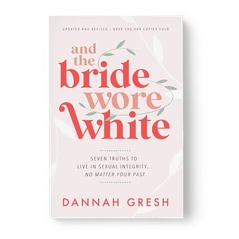
So as we kick off our conversation today, can we talk a bit about your book title? Some years back, you wrote a book called And the Bride Wore White: Seven Secrets to Sexual Purity, and now it's been revised and updated. We'll tell our listeners more about how they can receive a copy later in the program. But first, how about a little bit of history behind how you chose that title?
Dannah: Well, I wanted a title that the teen girls would read and the moms would buy. So we did lots and lots of focus groups and studies, and we landed on And the Bride Wore White. It was the title of the first chapter of the book. And the reason it was is because on my wedding day, I was still not really healed from my sexual sin, even though it had been many years. I intentionally bought off-white because I felt shame and unworthiness.
In my healing, I really came to the conclusion that the redemption of Christ qualifies all of us to wear white, because what are we wearing at the Wedding Supper of the Lamb?
Suzy: Robes that are stunningly white, blindingly white, because they've been washed by the blood of the Lamb.
Dannah: Exactly. So the title comes from the heart of that verse, that through Christ's washing, we are so pure and so clean, and by His perfection, we are allowed to be presented as spotless.
Suzy: And that's a good,
Dannah: It's meaningful title to me.
Suzy: I remember that being a cultural thing.
Dannah: Across cultures, some countries wear red, some countries wear just bright colors. It's a very western thing to wear white. I'm not quite sure where it started, but, you know, Suzy, I had to fight for that title to stay on the book as we re-released it. I'm glad that I had to fight, because I had to think through whether it was still relevant.
And the question was, do today's teen girls want to be married? Do today's Christian teen girls want to be married? And the research indicates 95 percent of teens, fifteen to nineteen, expect to get married. A survey reported in The New York Times revealed that only 5 percent of high school seniors do not want to get married.
Suzy: Oh, good, that's promising.
Dannah: That's beautiful and promising, but you don't hear that in the culture. You have to dig for that. And the assumption is that they don't want to get married, but they do have that desire. It's planted in them by God. We have to be careful not to idolize marriage to the point where we don't honor singleness as the gift from God that it can be to serve Him with freedom.
I mean, Nancy DeMoss Wolgemuth did that for fifty-plus years. She served the Lord before she met Robert with a freedom she didn't have during her years that she was married. The Bible says that's a good gift, but the Bible also says that marriage is a picture of the love of Christ, and so it is also a good gift, and today's teenagers still want that. It's planted in their hearts by God.
Suzy: That is so good. It's good to hear. So if it's something that's in the hearts of 95 percent of our teenagers, it still seems like it's something that we definitely should be discussing with our teens. When we talk about our conversations that we have with our kids about marriage and about sexuality, there's the old phrase: it's time to have “the talk.”
Dannah: Yeah.
Suzy: You see an error in that right out of the gate.
Dannah: It’s such a big error.
Suzy: What's the error?
Dannah: Well, it's such a complex issue. The temptation in our culture is happening every day, but we're going to talk to them about it one time when they're twelve? That doesn't make any sense.
Suzy: Not only that, but talk to them about something which we've never talked to them about before, so now the awkwardness is magnified, times, I don't know what, because “I've never heard my mom and dad address this topic before, so this is weird.”
Dannah: One of the things that we have to teach our girls (and our sons—but again, we're women teaching women) is that Scripture says, “Do not be unequally yoked.” This applies to marriage in that we are to marry others who love Christ and want to lay their lives down to glorify Him the way that we do. If we're fearful that we can't teach And the Bride Wore White and the beauty of marriage, then we also aren't teaching this biblical concept of being equally yoked.
One of the criticisms I've gotten for the book is that one of the steps to sexual integrity, or secrets to sexual integrity, is that purity doesn't slide, it decides. And by that, I'm inviting girls to, first and foremost, decide decisively that if God has marriage in their future one day, that they will not equivocate on being equally yoked to another believer—including during their dating years.
That includes their dating years, because if you're dating someone, your heart's going to get tangled up, and you might equivocate on that one. So, you shouldn't even date someone unless you see a thriving relationship with Christ. But what I see in the church a lot of times is what my friend Erin Davis (no stranger to the Revive Our Hearts community) calls a “broken picker outer.”
Girls are just ending up in these unhealthy relationships because nobody ever trained them how to be discerning in who they would or would not date.
There's actually a sociologist, Dr. Scott Stanley, who's done some long-term research that if you decide what you're going to do with: the marriage relationship, with children, with your career, with the purpose of your life . . . If you're deciding that as a younger person, you tend to be on a trajectory to achieve those objectives. If you don't, you go into what he calls sliding.
You just slide into, “Oh, this guy asked me out on Friday night. I think I'll go.” You just slide into this date night with an unbeliever, and then you slide into he wants to have sex because he doesn't have any convictions that are based on biblical principles, and then you slide into living together. Eighty percent of today's teens say they probably will live with someone before they get married. That's disheartening information.
Suzy: That's one of those cultural lies is that you have to try something on before you know if it's a good fit.
Dannah: That's right.
Suzy: In And the Bride Wore White, you tell a story where you had an opportunity to change your trajectory from one of sliding to one of deciding.
Dannah: Yeah.
Suzy: I remember you telling the story of being introduced to a guy who invited you to go . . . Where did you let him go? To the library? Where was it?
Dannah: Are you confusing Marion the librarian,. Was it where I was at the county fair?
Suzy: Yeah, at the Grange Fair—oh, the sheep pen.
Dannah: Yes, by the sheep pen. I was invited to walk to the sheep barns with a guy.
My mom at that point had been training my picker outer. I had a mom who sat me down when I was in my high school years and said, “Let's write a list of what would honor God in a marriage relationship, and that's going to inform who you say yes and no to when you date.
And I knew right away when my cousin introduced me to this guy, he didn't feel like a believer to me. He was fine on the eyes, Suzy. I mean, there was, and he had a great . . .
Suzy: He was sheep pen fine! (laughter)
Dannah: But I said, “No!” Yeah, like that. Decisions matter.
I've been really criticized for encouraging women to sit down with their daughters and do that. But I think at the very least, we can argue we've got to be teaching them not to be unequally yoked.
Suzy: Yeah, right. Okay, so then let's move on to your experience in high school, where you were with a boyfriend, who was a believer. And for some reason, you were still, at that time, sliding, I guess. Is that how you would describe that?
Dannah: Absolutely. At that point I hadn't really considered sex.
Suzy: Like, you weren't prepared to manage the moment.
Dannah: No, I wasn't prepared to manage the moment, and I think that's an important thing. I define sexual integrity as my sexual choices are a consistent expression of my relational spiritual commitments. So that means if I'm committed to Jesus, I'm obeying His word. So my sexual choices will, first and foremost, be a reflection of that. But also, if I'm not married to someone, my sexual expression is also confined to my commitment to save sexual expression until I'm married.
I hadn't really thought about that when I was fifteen years old. I was a baby . . . I was fifteen! I look back and I honestly . . . I was a baby, and I had never considered it. I think it's really important that we teach our daughters, what are God's boundaries? There's a whole chapter in And the Bride Wore White. There's about ten things in Scripture that God specifically forbids sexually, and they're listed in there.
One of them, for example, is prostitution. Imagine what you would think in the Roman and Greek culture. It was so normal. Yeah, prostitution was so normal.
Suzy: It's part of the worship experience in the temples—the pagan temples.
Dannah: But Suzy, today OnlyFans is a form of prostitution. It is. It's normalized. And God says no to it.
So this list of what Scripture forbids is a good list to go through and then say, “How does that show up in our culture?”
Suzy: Well, that's such a great example, because I think most moms would say if we were to ask them, “Do you think your teen daughter would agree from a biblical morality standpoint that prostitution is wrong?” I think every mom would say, “Oh, yes. My daughter knows that. My daughter would agree with that.” But I think maybe a lot of moms may not be aware of the existence of OnlyFans or the redefining of what prostitution is by maybe our culture.
Dannah: Maybe we should say what OnlyFans is for the one that's listening that doesn't know.
Suzy: Well, it’s a website, an app, where girls can offer their services, basically.
Dannah: Yeah, for pay.
Suzy: Yeah, for pay.
Dannah: So it's digital, online. It’s what used to be called cybersex. And it's for pay. So, I really believe it's important that at an age-appropriate time, we sit down with our teenagers and we examine the Scriptures, and we talk about what God's boundaries are.
And what's more important is that they make some decisions, some decisive moments of thought. Thoughts where, “This is where I'm drawing my line.” I don't want to add to God's Word, so if they feel, for some reason, that they don't want to kiss until their wedding day, that's fine. Make sure that it's their personal preference, because Scripture actually says, “Greet each other with a holy kiss”—a holy kiss, mind you. But we shouldn't make up excessive rules.
She should sit down and say, “How do I protect these boundaries in my life?” I think that's a wise thing to do. And then beyond that, what does she say or do when she's in a dating relationship and he's pushing past that boundary? Give her the skills—they're called refusal skills. Give her the skills to say, “No, I do not consent to this.” That is a good and holy thing.
I don't think we know what we need to address until we have many conversations, so maybe many five- to ten-minute conversations, as opposed to one two-hour sit-down, which isn't going to be very effective anyhow. So have many conversations! I would say (I don't know what you think about this), but I think a great skill for us to learn as parents is to ask a question and then shut our mouth and just take some time to listen to the answer to that question. This is how we know where our girls maybe are a little bit deficient in their definitions. What do they know? What don't they know? What are they curious about?
Yep, and lead them to the answer. Let them discover it. Let them be curious. Otherwise, all we're doing is telling them what we believe.
Suzy: Which never has been very effective in my household.
Dannah: No, it's not. It's not at all.
You know, yesterday you mentioned how being downtown at two o'clock in the morning at a university town could be something that raises the risk. One of the things I think we need to talk to our daughters about—and again, not politically correct—but I think we need to talk to her about how she dresses. The Bible talks about it—not a lot. The Bible talks about modesty four times in Scripture. I can find four passages that specifically relate to that topic.
But a broader topic is this: from Genesis to Revelation, I see that the Bible is a book about clothing. In the New Testament we're encouraged to clothe ourselves in Christ. And so every decision we make expresses our belief, including the way that we present ourselves. I feel like the criticism of teaching modesty with legalism—which to some degree is really warranted, because it has been taught at times with legalism—but the answer can't be just, let's not talk about it, because the Bible talks about it.
My favorite thing is, as I've taken these two years and just said, “Do I really believe what I taught twenty-six years ago?” . . . I looked at how I taught modesty, and I think that's the one thing I wish I had understood the “why?” a little bit better. Because if you look back at Genesis 3, I think this is so beautiful. You see Adam and Eve falling from grace and sinning for the first time. And then you see God coming relationally and saying, “Where are you? I miss you. I want to be with you. Where are you?” Of course He knows where they are. He's just saying, “I want to be with you.” So it's relational when His kids mess up.
And then the next thing we see is, for the first time recorded in Scripture, an animal dies. Blood is shed. Bible scholars call that the first gospel—the first time that blood was shed for the payment of sin. God takes the skin of that animal, and He makes garments of fur for Adam and Eve. And in the Hebrew language it's "tunics of fur." The word "tunic" is used throughout the Old Testament to describe garments that dignified someone—royalty or a special value—like Joseph's tunic of many colors or the tunic of the priests.
And so what does God do? He doesn't just say, “Here, throw on this t-shirt because you messed up and now you know you're naked.”
He says, “Let Me restore back upon you the dignity and worth as an image bearer of God. I'm giving you this tunic as that symbol.” It’s so beautiful. Right from the beginning, clothing has the potential to say the gospel was here. And our clothing, the reason that we dress carefully is so that we can say, “I'm clothed in Christ. The gospel is here in me and on me.”
Suzy: It's an indicator of who a person is and who that person belongs to. It is an indicator of value and worth, and yeah, it's beautiful. It's a beautiful picture.
Dannah: Suzy and I are writing you a permission slip today. If you're a mom who has been gagged by some of the undue critique of teaching on purity and modesty. We are shamelessly writing you a permission slip as a mom or a grandmom to have the conversation. Have it in a holy way. Have it in a biblical way, but have the conversation.
Suzy: And can we go back to nuance really quickly on that, Dannah, along with that permission? So, Dannah and I have laughed, not laughed at, but have enjoyed our friendship for years. One of the reasons is because we are so similar, and yet we are so different.
I'm a lifelong tomboy. I don't wear dresses. I just am not comfortable.
Dannah: I've seen you in them a few time.
Suzy: Okay, I have worn dresses to weddings, dog shows, yes.
Let's talk about nuance for just one moment here. In Deuteronomy 22:5, the law states, and again, Jesus is the fulfillment of this law. But the law states, “a woman shall not wear anything that pertains to a man, nor shall a man put on a woman's garment. For whoever does these things is an abomination to the LORD your God.”
Dannah: That's a strong word, “abomination.”
Suzy: Does this mean that I, the tomboy, cannot wear jeans and sweatshirts? What do you think, Dannah?
Dannah: Well, I think so much of that is the intention and the heart. Because if you go back to that time, I think the men and the women both would have been in tunic-type garments.
Suzy: Exactly.
Dannah: So, their garments would have been somewhat similar, and yet there was an intention of, “I know I am created by God to be a female image bearer of God. I will present as one. Or, I am created as a male image bearer of God, and I will present as one.”
The thing that I think is being addressed there is Genesis 1:27, saying you are image bearers as males or as females, biologically born males or biologically born females. The reason it's an abomination is because you are erasing the picture, the statue, the image of God when you behave in that way.
Suzy: But I think it's great to have a conversation about a verse like that with our daughters, so that we can say, “I understand that you're a girl who loves to run and play in creeks and you're comfortable in jeans and sweatshirts. That is okay, because you understand that you have been uniquely created in the image of God as a female.”
Dannah: Yeah. I think when we don't allow for that spectrum . . . There are men who are men's men—like out hunting and all that stuff. And then there are men who are completely like David. They're musicians, they're songwriters, they're creative. Maybe they're interested in being a chef. There's a spectrum, right? So that nuance is important.
Suzy, one thing I want to talk about before we go today is just how both of us have experienced the grace of God in our lives. It's not like we're sitting here talking about this because we did all of this perfectly. Most of what we're teaching is because we learned on the hot pavement of life what God's Word says is true and is good.
Suzy: There's nothing like learning the hard way.
Dannah: We want to be shame busters in your life if you have experienced sexual trauma or sexual pain or sexual shame in any way, shape, or form. We live in a culture right now where instead of saying, “God, here's my shame; here's my pain. What do you want to do with it?” We're taking our shame and our pain to TikTok.
And here's a question: “If I have a knife, a blade, is it a safe tool or an unsafe tool?”
Suzy: That's an impossible question to answer.
Dannah: I would say the answer is, “It depends on whose hands it is in.” If it's in the hands of a murderer, it's an unsafe tool. If it's in the hands of a surgeon, it's life-saving, healing tool.
I think shame is like that. When we take our shame and we put it in the hands of a holy God—kind of the way that God walks into Genesis 3 and says, “Adam, Eve, hand Me your shame. Give Me those fig leaves. I want to give you something so much better.”
We have to take our shame and our pain to Jesus—not to the internet, not to grumbling about how the church has done this or how the church has done that, because the church is imperfect. We've got to take it to Jesus and say, “Here's my shame and my pain.”
I want to say this. James 5:16 says we've got to confess our sin one to another, then you will be healed. That was a secret in my life. My healing came when I finally started talking about my sexual sin I felt unleashed by God's truth, unleashed by His healing.
Suzy: That's good.
Dannah: We've got to stop confessing our shame. We've got to stop with the trauma bonding. And we've got to start confessing our sin, first to Jesus—put our shame in His hand—and then to one another, and then we will be healed.
Suzy: Amen. That's a promise in Scripture, James 5:16. Oh, and what a hopeful promise it is.
Dannah: Isn't it? Before we go, I would love for you to hear from Nancy on this topic of healing in Christ. We played this not too long ago on Revive Our Hearts, and it was a huge comfort for many of our listeners. Here's Nancy echoing the words Jesus said to a woman only known as the sinner woman in Luke chapter 7.
Nancy DeMoss Wolgemuth: Your sins may have been many. All our sins have been many. And Jesus says to you, “Your sins have been forgiven. Go in peace.” Go into peace. Go on your way in peace. Move forward in peace. Go in peace. Move forward from this place knowing that you have peace with God.
You're no longer His enemy; you're no longer at war with Him. You can walk in and be filled with the peace of God. Go in peace.
Go in peace knowing that you now have a new identity, new relationships, a new calling.
Go in peace knowing that Jesus has paid the price for your sin.
Go in peace, knowing and believing these wonderful promises, these amazing promises that He has given you in His Word.
Let me just give you a few if you find shame and guilt, the memories, the pain, the sense you can't be released from this. You know you've been forgiven, but you don't feel forgiven, and it's hard to go forward in peace. Let me just give you some promises to cling to, to renew your mind with truth. You might want to write these references down:
Romans 5:1: “Therefore, since we have been justified by faith, we have peace with God through our Lord Jesus Christ.” You need to tell your heart that's what Scripture says is true of you if you have been justified through faith in Christ.
Romans 8:1: “There is therefore now no condemnation for those who are in Christ Jesus.” Go in peace.
Psalm 103, verses 8–12: “The Lord is merciful and gracious, slow to anger and abounding in steadfast love. . . . He does not deal with us according to our sins, nor repay us according to our iniquities. [Who could survive that?] But as high as the heavens are above the earth, so great is his steadfast love toward those who fear him; as far as the east is from the west, so far does he [what?] remove our transgressions from us?” These are verses you may want to memorize, verses you want to focus on, renew your mind with when shame and guilt threaten to take you under.
Micah 7 verses, 18 and 19, I love this passage. “Who is a God like you, pardoning iniquity and passing over transgression for the remnant of his inheritance. He does not retain his anger forever, because He delights in steadfast love. He will again have compassion on us; he will tread our iniquities underfoot. You will cast all our sins into the depths of the sea.”
Suzy: What beautiful passages to cling to. Thank you, Nancy DeMoss Wolgemuth.
If you're burdened by sexual shame today, I hope those passages set you free. There's such hope and healing in Christ. You can explore these topics we've been covering so much more deeply in Dannah's freshly released book, And the Bride Wore White. Get to know her story and get to know the God who makes all his daughters pure.
This resource is yours for a gift of any amount to Revive Our Hearts. To make a donation, visit ReviveOurHearts.com, or call 1-800-569-5959 and be sure to request And the Bride Wore White when you do.
Dannah, I think the truths that you've shared with us today have been so important. Thank you for inviting me to be here with you.
Dannah: Thank you, Suzy, it has been so fun hanging out with you. Tomorrow, we're getting a sneak peek at the Wonder of the Word series coming out in 2027. Nancy's walking us through a beautiful psalm, Psalm 107. I think it will richly encourage you. Please be back for Revive Our Hearts.
This program is a listener supported production of Revive Our Hearts in Niles, Michigan, calling women to freedom, fullness, and fruitfulness in Christ.
All Scripture is taken from the ESV.
*Offers available only during the broadcast of the podcast season.