
Dannah Gresh: They say honesty is the best policy, and so today we're getting super honest about the history of so-called purity culture, how it helped, how it hurt, and how we should navigate the sexual purity conversation now.
The truth is, sexual purity is only part of a really beautiful picture. I'm excited for us to get at some legalism-destroying, grace-saturated truths together.
Before we do, I want to let you know how you can get this kind of truth texted to you on a weekly basis. Just join our community for text encouragement to stay up-to-date on podcast episodes like the one you're about to hear, get in early on exciting event announcements, and receive encouragement from Nancy DeMoss Wolgemuth.
To sign up, visit ReviveOurHearts.com/text.
This is the Revive Our Hearts podcast with Nancy DeMoss Wolgemuth, author of Lies Women Believe and the …
Dannah Gresh: They say honesty is the best policy, and so today we're getting super honest about the history of so-called purity culture, how it helped, how it hurt, and how we should navigate the sexual purity conversation now.
The truth is, sexual purity is only part of a really beautiful picture. I'm excited for us to get at some legalism-destroying, grace-saturated truths together.
Before we do, I want to let you know how you can get this kind of truth texted to you on a weekly basis. Just join our community for text encouragement to stay up-to-date on podcast episodes like the one you're about to hear, get in early on exciting event announcements, and receive encouragement from Nancy DeMoss Wolgemuth.
To sign up, visit ReviveOurHearts.com/text.
This is the Revive Our Hearts podcast with Nancy DeMoss Wolgemuth, author of Lies Women Believe and the Truth That Sets Them Free for May 5, 2026. I'm Dannah Gresh.
Suzy Weibel: I'm Suzy Weibel.
You know, Dannah, today's a big day because your book And the Bride Wore White is being re-released into the world. We're celebrating over here. We began a conversation about this book yesterday. Go back and listen to that at ReviveOurHearts.com if you missed it. It's also available on the Revive Our Hearts app or anywhere you listen to podcasts.
Dannah: Yes, I hope you will go back and listen to that. We talked yesterday about how to address biblical sexuality with our girls, and we touched on that elephant in the room—purity culture.
It's a topic we're ready to dive into further.
Suzy: Oh, we're gonna go there.
Dannah: We're gonna go there.
Suzy: So purity culture is a time during which you and I grew up. Our own high school years were during the birth of this purity culture.
Dannah: Yep.
Suzy: And I remain confused, so I'm wondering if we can bring some clarity to the conversation today.
Yeah, I had teenage—well, they're not teenagers any longer—but I had teenage daughters of my own, as did you. And this thing that would happen between us often would leave me scratching my head at times.
We live in State College, Pennsylvania. It's the home of Penn State University. And things happen in a college town, right? Things happen.
Dannah: You're talking about . . . football? Probably talking about what happens after a football game.
Suzy: More than likely what may happen after a football game. And let's be honest, girls get hurt. And my daughters wanted to discuss this, and I would have an answer for them, not maybe not an answer, but my conversation would go the route that my mom might have had a conversation with me.
I would say, “Look, girls, no one should ever, ever be hurt. There is nothing that a person can do that deserves that kind of treatment or response. But downtown at 2 a.m. is also not wise. A girl who repeatedly stays away from downtown at 2 a.m. is probably going to be . . .”
Dannah: Less at risk.
Suzy: Be less at risk, exactly. This seemed to make so much sense to me.
Dannah: Yeah.
Suzy: And my girls would somehow hear from my lips that she deserved it.
And so let's begin first of all with, what is purity culture? And how have we come to a place where saying, “If we don't go out at 2 in the morning, we'd be safer, we'd be less at risk.” How did that become . . .?
Dannah: Well, first of all, I'm putting it as a Scripture verse that says, “He who walks with the wise grows wise, but a companion of fools suffers harm” (Prov. 13:20). That's a proverb.
Suzy: Right.
Dannah: That's from the Word of God. That's a Dannah Gresh paraphrase, but it's from the Word of God. It is a biblical concept to be wise and not put yourself at greater risk of harm, but that is what we just said right now. It’s very politically incorrect to say.
Suzy: It is.
Dannah: I learned that quickly. It is very.
So I feel like one of the things that's missing as we talk about purity culture is an accurate snapshot of the history. So, let's buckle up for a quick history lesson.
Purity culture followed about ten years after the sexual revolution met with a really screeching halt. Many people don't know that this actually happened. But you know about the sixties; you know about the seventies; you know about Woodstock and so-called sexual freedom.
But what few people know is that in August of 1982, Time Magazine ran a cover story warning that sexually transmitted infections had reached staggering dimensions, and they were (let me quote), “A serious, wholly unanticipated consequence of the sexual revolution.”
That article changed everything. The conversation of so-called sexual freedom really changed overnight. The promiscuity party really began to unravel, and it would be replaced by a counter-revolution. But it would take about ten years for that to happen.
That counter-revolution was because one of those sexually transmitted diseases was HIV/AIDS. It was the leading cause of death of men in 1992. People were terrified. I mean, doctors, educators, counselors, and parents—they all began to beg teens to abstain from sex. That was the word that was now popular overnight. It was like the favorite word.
Right about that time, about the ten-year mark, about 1992. The church decided to find its voice on sex, which this was a very good thing, Suzy, because before that—you remember before 1992—it was like once a year in youth group you heard a “thou shalt not” speech. It was taboo. You did not talk. If you talked about sex, you talked about it in hushed tones.
And the reason it was good that the church started talking is God created sex, and those who know Him best should be the ones talking about it most, so we get the definitions right.
So in the beginning of this conversation, as in with anything, we're not that great at it. Like we're learning how to have the conversation. We're learning how to teach accurately.
Meanwhile, there's fifty-two teenagers in a basement in Nashville, Tennessee who were, “Like, our peers are dying, and we have a chance to actually obey this book called the Bible. Let's sign a True Love Waits pledge.” So, these fifty-two teenagers in a basement were actually the catalyst of what we know as the purity movement.
So one of the things I like to say is, of course it was imperfect. It was started by a bunch of teenagers and with good intent.
Now, what happened next is when the church started talking about it and teenagers started signing this pledge, the natural question next was, “Well, wait a minute, how far can we go?” I mean, that's what they were really asking. The question was, how far is too far?
Suzy: Right. I remember having those conversations with kids that were in our youth group when we were . . . early in youth ministry. What they were asking was, “What can we get away with?”
So to avoid confusion, Christian leaders really sat down and said the word “abstinence” isn't enough of a word, because the word abstinence connotated not having sexual intercourse. So that's pretty PG language for Revive Our Hearts, but we're adults here, we can handle this word.
Suzy: So it wasn't really dealing with the heart.
Dannah: It wasn’t dealing with the heart. Christian leaders were trying to get us stuck outside the box that we actually got stuck in, which was equating our behavior to virginity.
And so they broadened it. They said, “Let's talk about purity instead of abstinence, to communicate God's broader vision for whole life holiness.” It was so overwhelmingly applauded that it kind of gave birth to the purity movement, or some call it purity culture.
Suzy, do you remember celebrities that had purity rings? I remember the Jonas Brothers.
The Jonas Brothers had it. Miley Cyrus brought a purity ring. Tiana Taylor. It seemed like every kid on the Disney Channel.
As a young youth leader—I remember feeling so hopeful. I would say, and this is again not very politically correct, I would say in large part, purity culture, the purity movement, was much better for women than its counter movement, the hookup culture, which was happening in parallel.
Because we started to forget about AIDS. We started to forget about those sexually transmitted diseases and hookup culture started. So these two parallel tracks—if you look at the women who've been damaged by hookup culture, a much broader segment of our population and our church than I think those who got hurt by purity culture.
Now that doesn't mean that there weren't some women and some churches that leaned toward legalism and did hurt hearts during that time. And so we do have to be honest and say, what did we do well in alignment with Scripture, and what do we need to correct so that we can keep growing?
I think that the conversation that's happening right now critiquing the culture is by and large good, if we can keep the Bible in the driver's seat of where we go with it.
I've noticed that we're not very good at nuance as a culture at all. It's very difficult for people to believe that two things can simultaneously be held and both of them be true or good. It’s called bifurcation, or the idea that one thing can be true or the other, but it's not possible that both could be of consequence. It's a false dilemma. That's what it's called.
I think that purity culture definitely got caught in this web of false dilemma. There are certainly some cultural lies that are culpable here.
Yeah, some of those things that we maybe are holding up as a false dilemma. Are there several of those that you think might be in play?
Dannah: Yeah, there's no end to the cultural lies that we could discuss today. There's also no end to disclaimers that we can put on this conversation.
But one of the little sub conversations that I've been seeing a lot in the purity culture critique is, “The Bible doesn't forbid sex before marriage.”
Suzy: Right.
Dannah: And the interesting thing is, if you look at—I want to pull up 1 Thessalonians 4. But if you look at Scripture historically, first of all, you can look at verses, let's say in Genesis, that “a man will leave his father and mother and be united to his wife, and the two will become one flesh” (see Gen. 2:24).
This is God's definition for marriage and God's definition for sex—that it would be between one man and one woman in a marriage covenant.
It is a very high and holy boundary, and all sexual intention, all sexual expression, should be reserved for within that one man, one woman—and I'm talking about a biologically born male and a biologically born female. I can't believe I have to define that, but that's where we are. That is God's boundary for sex.
I want to read to you 1 Thessalonians 4:3 and 4, because the Bible isn't obsessed with the boundaries of sex, it's obsessed with something much different.
Let me read this to you: “For this is the will of God, your sanctification, that you abstain from sexual immorality”—that would be any sex outside the marriage covenant between one biological male and one biological female—“and that each one of you know how to control his own body in holiness and honor, not in the passion of lust, like the Gentiles who do not know God.”
So there's the standard right there—holiness. Holiness is a much higher bar than virginity and sexual expression, and God wants us to be a set-apart and holy people.
God begins that on day one when we look at creation. Those first six days were all about God separating the day from the night, the sea from the land.
And as He established His nation, Israel, all of His commands, as He gave them the Promised Land, was about separating them—a people wholly unto Himself. That holiness is the underlying opinion of everything that God has established.
I said this yesterday, but all of creation is an object lesson for us to understand spiritual things. And the separation of the land and the sea and the day and the night, this was again teaching us. it's an object lesson for us to understand that the God of the universe, who is holy, wants to be in a love relationship with us, but the boundary to that is that there must be holiness in our lives to experience that intimacy.
That's what I mean by we're not very good at nuance, because it's very clear to anyone who understands Scripture that Scripture is talking about not having sex before marriage, or keeping the marriage bed holy, yes, unto God.
When you say we're not very good at nuance, do I still believe what I believed when I wrote And the Bride Wore White in 1998, 1999, leading up to its release in the year 2000? The overall answer is yes. And I want to explain this.
I wrote the book because I was concerned about the conversation in the purity movement. I didn't think it was perfect. I thought, What about . . . I mean, I was a youth leader at the time. I was in my twenties. I was like, “What about the girls in this youth group who have my story? You're telling stories, object lessons, about roses without petals and chewed up bubblegum?”
Wait a minute. God's grace and redemption is so beautiful. Why aren't we telling her that? Why aren't we telling her about His forgiveness and that we do have do-overs? Like He is the do-over God. And so I wrote it because I was like, “I don't think I'm the only one.”
I honestly wrote the book originally thinking nobody's gonna read this. Like, this is the purity movement happening right now, people are going to criticize it.
It actually was applauded because I wasn't the only woman with that pain in my life and with the healing. That's the key. I had the healing. The Lord had already begun His healing work in me, or I couldn't have written that book.
So I wrote it because I was concerned about the culture, and I was trying to be like the Bereans, Suzy. But it was before cancel culture.
So, I didn't come out and say, “Hey, everybody that said anything wrong, you have no voice anymore.”
The standard for the church should be to test what is taught against Scripture—always. And if that teacher is humble and corrected and teachable, they're still a safe teacher. But when we start to say, “Oh, that teacher made a mistake, let's cancel them,” that's not a safe environment, because what's going to happen is we're not going to own our mistakes. It disqualifies everyone? Yeah, it would just literally disqualify every human being from teaching.
I've tried to be very careful with Scripture, but when I have been approached and I haven't gotten something right, I have, with the measure with which I spoke it, corrected it.
If I made a mistake at our local Christian high school and was corrected, I would go to that audience and correct it. If I made a mistake on a blog, I would go to that blog and correct it.
Because I have made mistakes. I haven't said everything as well as I would have liked through the years. But all in all, yes, I do still believe what I believed when I originally wrote that book. I have grown, and the church has grown, and that is a good thing.
Suzy: So where would you say today the resistance is to say And the Bride Wore White and the message of grace that flows throughout the book? Why or how could there still be resistance to this message?
Dannah: Well, so it goes back to where you started. For example, if you teach a girl that making wise choices and not being out at 2 o'clock in the morning is going to reduce her risk, then you're considered to be blaming her if something inappropriate happens to her.
I don't think that is logical.
Another thing, teaching a girl to dress appropriately and with dignity . . . You know we could do a whole program on the topic of dressing with modesty and dignity and looking at what God's Word says about clothing. But we're told that if we do that, we're body shaming her.
Suzy: So, how are we missing this?
Dannah: It’s very clear for me. There's a very clear understanding that women do not hold sole responsibility. Yes, that's clear. I mean, I just don't even understand . . .
I would say the higher responsibility is higher for the men for sexual integrity and purity. I'll read the verse to you where I get that from, because I think some people may disagree with me. Again, be like the Bereans. Write me an email, follow me on Instagram and tell me if you don't agree.
But I want to look at this. It says in Ephesians 5:25–30:
Husbands, love your wives as Christ loved the church and gave himself up for her.” So it’s giving specific instruction to men about how they love their bride, “that he might sanctify her, having cleansed her by the washing of water of the word, so that he might present the church to himself in splendor, without spot or wrinkle or any such thing, that she might be holy and without blemish.
In the same way husbands should love their wives as their own bodies. He who loves his wife loves himself. For no one ever hated his own flesh, but nourishes and cherishes it, just as Christ does the church, because we are members of his body.
If you look at that verse, it's talking about the responsibility of Christ to purify the Bride, to present her to the Father clean. And the instruction is, husbands, I want you to paint a picture of this in your marriage. Which to me means that a young man of God would guard his own purity and also be vigilantly protective of every sister in Christ, because he doesn't know which one of them God may have for him to be that picture in his life. So this is placing a great responsibility on the guy, I think.
Do you think that's a reasonable argument?
Suzy: I do. Which is why I've always been so confused as to how the argument could be made, that that purity culture shifts all of the responsibility onto the woman. Because I don't see it that way at all. I mean, I am so far away from that in my thinking. You and I are longtime friends. If we start talking about the whole egalitarian / complementary (in which we don't need to have a discussion on), but you and I don't fall at the same point on that spectrum. We have the same page, different points, different places on the it.
And yet, I just completely fail to see how in any way, shape, or form, it could be construed that all of the responsibility falls to the woman when both biblically and through everything that you and I have taught together could not be further from the truth?
Dannah: Well, I think one of the ways that it gets in the water is if you look at . . . There are not many teachers from the purity movement. It's ironic that I wanted to talk back to the purity culture and make it better, but am now equated with that movement. But there aren't many of us, if any of us left, that are still saying, “I still believe what God's Word says is true. I'm still here, but the ones that are largely female, Suzy. So I guess that's a call out to our brothers to step into their responsibility, to train up men, young men.
I'm a woman. I'm not going to teach a young man to keep his way pure. It's not that I don't know how to do that. The Scriptures don't assign that task to me. The Scriptures assign the task to me to raise up the young women in my church body to live in holiness and purity.
Suzy: Yeah. Maybe another verse that would be helpful is, Philippians 2, verse 3, which says, “Do nothing out of selfish ambition or vain conceit. Rather, in humility value others above yourselves” (NIV). And for me, that just feels like an encompassing verse to meditate on. Maybe help us understand the responsibilities of each party here, it's just a thought.
Dannah: It's a good thought, because if we're going to sort out the conversation about purity culture, and we're going to do it well, that guides us closer to the truth of Scripture. It's going to require that we have humility and we hear each other, and that we listen to the women that were hurt during that time because they were under a legalistic teaching system. We also listen to the women who have beautiful stories of purity and a beautiful marriage relationship with their husband, in part because they follow God's Word and were blessed by it.
Suzy: It's okay to say, because it's biblical. There are blessings that come from living according to God's Word. We have to hear each other in humility. I'm so glad we had this conversation, and I'm so glad that your book And the Bride Wore White is being re-released today. Woo hoo. That is worth celebrating, my friend.
Dannah: Well, thank you, Suzy. I have been anticipating this day for many years as I've studied so that we can accurately handle the Word of God on this topic.
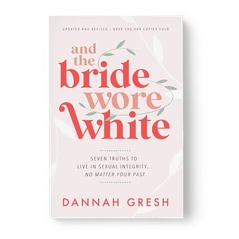
Suzy: So you can make a donation of any amount to support Revive Our Hearts today, and we're going to send you a copy of that new edition of And the Bride Wore White. The subtitle is Seven Secrets to Sexual Integrity . . . No Matter Your Past.
Yes, you're going to want this resource on your bookshelf for you, your granddaughters, your daughters. The message is just so gracious, so balanced, so needed in the chaos of our world today.
To give and request And the Bride Wore White by Dannah Gresh, visit ReviveOurHearts.com, or call 1-800-569-5959.
Dannah: Wow, you’ve really got that down.
Suzy: Thanks, Dannah. I learned from the best.
Before we go today, I want you to hear a word on this topic from Nancy DeMoss Wolgemuth. She's been a faithful communicator on this subject for decades, and she has so much wisdom to share.
Nancy DeMoss Wolgemuth: You see, the gospel is a message of hope for people who are broken in every way, including sexually. You may have sinned sexually, and I want to tell you the good news today is that the gospel can set you free from guilt and can get this—restore virtue. Yes, it can.
The enemy doesn't want you to know that.
Now, maybe you've been sinned against sexually, and I want to say to you that the gospel can set you free from shame and can bring healing and wholeness to your heart that has been busted into smithereens because you were sinned against in ways that you had no control over, no choice in. You need the gospel.
Whether you're married or single, you may be struggling to abstain from sex outside of marriage. You may feel the pull, and it may feel incredibly strong—of sexual fantasies, pornography, erotica, self-gratification. And I want to say, “You need the gospel.”
The gospel can give you the desire and the power to please God and to walk in self-control and love rather than lust. The gospel can give you the power to experience deep satisfaction in the love of Christ.
I long for every Christian woman to experience God's perspective on the good gift of sex in its time and place between a man and a woman united in covenant marriage.
I want our sex lives, whether single or married, to tell the gospel story and reflect the covenant love of Christ. Knowing God, loving God, and His ways will free you up to enjoy His gifts to the fullest in every season of your life, whatever those gifts may be—the gift of sex and marriage, the gift of abstinence as a non-married woman.
But I want us to remember that God's instructions, His limitations, are for our joy, for our freedom, for our peace, for our flourishing.
And so I want to plead with you, married or single: don't settle for less than that. Don't trade in God's good gifts for anything less.
I know I'm speaking to women with all kinds of situations. We have some college students here. We have a high school student. We have young married women. We have women who've been married forever. We have widows—people just in a lot of seasons of life.
And I'm saying don't trade in whatever God's gift is for you in this season. Don't settle for anything less than that.
Dannah: Wow. Amen. Grateful for this wisdom and encouragement from Nancy DeMoss Wolgemuth. You can listen to Nancy's whole message at ReviveOurHearts.com. You'll find it linked in today's transcript.
So far this week, we've talked about what truly makes us pure. We've addressed the purity culture elephant in the room, and tomorrow we're going to land this purity plane.
Dannah, you're going to tell us why you titled your book And the Bride Wore White, and then you're going to speak to the woman who's dwelling in shame.
Yeah, that's right. I'm really looking forward to handing out some healing tomorrow. Please be back for Revive Our Hearts.
This program is a listener-supported production of Revive Our Hearts in Niles, Michigan, calling women to freedom, fullness, and fruitfulness in Christ.
*Offers available only during the broadcast of the podcast season.