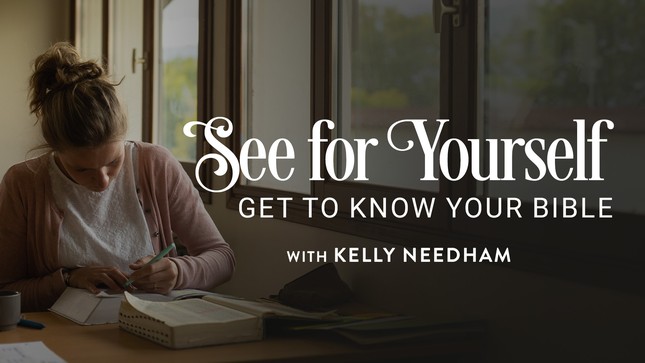

See for Yourself: Get to Know Your Bible
Dannah Gresh: Kelly Needham says your Bible is like a library . . . but not just any library.
Kelly Needham: It is a group of books put together to tell one story. But behind them, there is a proclamation from these pages. This book is breathed out by God Himself—by the Spirit of God operating through humans.
Dannah: This is the Revive Our Hearts podcast with Nancy DeMoss Wolgemuth, author of A Place of Quiet Rest for January 16, 2026. I’m Dannah Gresh.
…
Dannah Gresh: Kelly Needham says your Bible is like a library . . . but not just any library.
Kelly Needham: It is a group of books put together to tell one story. But behind them, there is a proclamation from these pages. This book is breathed out by God Himself—by the Spirit of God operating through humans.
Dannah: This is the Revive Our Hearts podcast with Nancy DeMoss Wolgemuth, author of A Place of Quiet Rest for January 16, 2026. I’m Dannah Gresh.
If you’re walking through the 2026 Bible reading plan with us, today we’re reading Exodus 5–7.
Have you ever been on Bible study autopilot? Uh, I know I have! This is when you’re cruising through your reading plan, and it just starts to feel a little routine. You begin reading mindlessly, you lose the wonder.
Today Kelly Needham is answering a question that I think will be powerful enough to snap us out of our Bible study stupor. That question is this: “What is the Bible?” It’s simple, I know, but sometimes we just need to take a step back and remember what Book we’re holding in our hands.
Kelly Needham is a pastor’s wife, a mom, and founder of Teach Equip. And this spring she’s releasing a brand-new Bible study with Lifewaycalled See for Yourself: How to Study Your Bible with Confidence and Joy.
Oh, it sounds like an amazing study! What you’re about to hear is a sneak peek from Session 2 of the accompanying video. Here’s Kelly.
Kelly: We need to talk about the structure of this Book, because if you have spent any time reading the Bible, you know it is unlike any other book on your bookshelf. It is confusing to a lot of us. We’re sometimes looking around in it and going, “What’s happening in this Book?”
And so, that’s what we’re talking about, the structure of this Book called the Bible.
Now before we talk about the Bible, I want to tell you about my writing tablet. I have a digital writing tablet that I got for Christmas from my husband probably five years ago, because I think with my hands . . . and I write.
I have notebooks upon notebooks upon notebooks in my house. I think maybe to save space, my husband was like, “Here. Let me just get you this digital one.” It’s amazing! It’s an amazing piece of technology!
And you know what the first thing I did when I got this? I got online, and I watched a few tutorials. Because amazing things that are really powerful are usually, to us, unfamiliar. We have to figure out how to use them, where things are, how to make the most of them.
We know this, right? We do this with our iPhones, we do this with new gadgets we get. We read the instructions, we figure out where things are. And what I have found is that for most of us, with this amazing Book called the Bible, no one has ever really done that for us.
No one has ever given us a tutorial to go, “What is this Book? How do I think about it? How do I understand it?” So that’s what this is. It might feel like, “Is it really needed?” I'm just telling you, it absolutely is!
I have spent time with a lot of women who are asking questions that are going to be answered by this week. Things like, “Why are there four different books in this Book called the Bible, all about Jesus and His life? And they’re telling some of the same stories, but sometimes not, and I don’t understand. Why is that needed? Which one is the most important story of His life? Which gospel do I really need to read?”
Or we learn things like:
- The book of Job is one of the oldest books in the Bible, but it’s right in the middle! Shouldn’t the oldest book go first?
- Why is this Bible not chronological?
- Why are there chronological Bibles where the order of the books is different than a traditional Bible laid out from Genesis to Revelation?
These are important questions!
And I think they show a little bit of the confusion that we have about this Book. And so this week, I’m giving you your Bible tutorial. We’re going to learn where things are, why they’re there, and how to make the most of this amazing Book you hold in your hands. It is a treasure that you have been given! It is amazing that we have access to the words of God in this Book!
And so we’re going to learn two really important things about this Book this week as we talk about the structure of the Bible, and the first is this, it’s the first thing I want you to know about your Bible.
The Bible is like a library. It’s like a library in the truest sense, it really is. This Book that you hold in your hands is made of sixty-six smaller books written by different human authors. We think there are around fort authors that represent the books that are in your Bible.
These books were probably written over a timeframe of around 1,600 years, that’s the timespan that these books represent. It’s really like a library. You have all these individual works that have been compiled for you in one Book called the Bible, the very Word of God!
And the Bible is arranged, largely, like a library. So I want you to think about your own personal library that’s in your city. I love going to our library! We just got a new one built, and it was so fun to go with our children to the grand opening of this new library that our city invested in.
And what they did was, they created a scavenger hunt for the families and people in the community coming, to make all these stops at different places in the library. That was the librarian’s way to help us all know where things are in this new library.
And so my kids and I are taking the little booklets they gave us, and we’re visiting the Children’s section and all the different shelves that are in there, and where reference books are in the Children’s section, where the novels are.
And then we’re going upstairs to the Adult section, and there’s a Reference section and there’s a Fiction section. There are all different types of books in the library, and to help us find them they group them by genre generally, by type, more than they do by chronological order.
They don’t put the oldest book in the library first, then put them all in order [by] the most recent release. That actually doesn’t help us find what we’re looking for. That’s how our libraries work. And in some ways, that’s how the Bible was set up for us.
- We see in the beginning of the Old Testament the books of Moses, or the Torah, these first five books of the Bible that we sometimes traditionally call the Law.
- Then you have all the historical books grouped together.
- You have all the Prophets grouped together.
- And even then, we have different categories for the prophets, you may have heard the Major Prophets, the Minor Prophets. They’re grouped actually by size, the Minor Prophets are just the smaller books.
- And then, in the New Testament, same thing. We have all of Paul’s letters grouped together, kind of on one shelf. . .and all the Gospels grouped together.
It’s a good system that’s meant to help us understand where things are and how to find them. But if we don’t have a librarian, so to speak, to walk us around and show us where things are, then we come to an opening and look around, and we’re kind of confused. Why are things the way they are?
Well, we need a little bit of that tutorial. So that’s the first thing I want you to know–is that this Book really is like a library. You're going to spend some time this week just getting familiar with it.
Paying attention to where we are in any library is really important, because we read books differently. I read a fiction book a lot differently than I read a nonfiction book. I read a reference book a lot differently than I read a book that’s for my kids. They’re different books, they have different ways that they’re meant to be understood.
If I pull a book of poetry off my library shelves, it’s a very different type of literature that I’m reading. And so paying attention to where we are in this Book is going to matter as we read it.
Because there are not just different books in your Bible, written by different authors. Within those books there are actually different genres of literature. There are historical accounts, stories, narratives.
You also have in some of those same books really long genealogies and lists and references.
You have allotments of land and measurements of temples, and pieces being built for the tabernacle. You have reference things in there.
But then you also have poetry. We have whole books of our Bible full of poetry, but we see poetry show up in all sorts of New Testament and Old Testament books, and those are all very different literary genres.
And in our everyday life, we do read them differently. We understand that a poem is going to have more language that is meant to be metaphorical and allegorical than a historical narrative account.
And so it’s good for us as we spend time in the library and get familiar with it, to just pay attention to where we are, to give this Book the respect that it deserves, that it’s a work of literature, assembled for us like a library.
And so paying attention to what shelf we’re on, to what type of genre we’re reading, is going to help us get the most out of it. That’s a really important part of this Book. But that’s not the only thing I want you to know about this Book, from the onset, that it’s like a library. It absolutely is!
But it is a very unusual library of books. It is a group of books put together to tell one story. Now, there is no other library in the world, at least not that I know of, that exists to do that. It’s a group of books in a library that’s really telling one story.
But that’s what this book is. It is a collection of sixty-six individual books that are telling one story, and actually are being told by one Author. Now, you might be confused because I just told you that there are probably around forty different human authors in this Book—that’s absolutely true! But, the Bible also claims that behind those human authors is one Author. We’re going to read about that in 2 Timothy chapter 3. So I want to read you this passage; 2 Timothy 3:16 says,
All Scripture is inspired by God and is profitable for teaching, for rebuking, for correcting, for training in righteousness.
This Book claims, yes, to be written by men. There are names at the beginnings of a lot of these books. They claim authorship of these books. But behind them, there is a proclamation from these pages. This Book is breathed out by God Himself, by the very Spirit of God operating through humans.
I want to show you another place that shows up. This is 2 Peter chapter, verse 21. It says,
No prophecy ever came by the will of man; instead, men spoke from God as they were carried along by the Holy Spirit.
So it is a library, but it is a highly curated library that has been assembled for you to tell you one very important Story, and it is written by one Author—God Himself! That’s why we call this Book the Word of God, if you were wondering. It is because it does claim to be the words of God!
So it’s a library, and it’s one great story told by God Himself. And so, we need both those things to understand how to read this. We need the understanding that it’s a library, where the books are, but we also need to know there’s one big Story being told here.
I need to learn what that is, because that huge one Story—or the metanarrative of the Bible, you might call it—knowing that is going to help you know as you read where it fits into that Story.
But before you get into practicing that, learning that, I want to just remind you of the implications of what we’ve just talked about—that this Book is both a library and it’s one big Story told by one Author, by God Himself. What does that mean for us as we read it?
Well, it means a couple of things: First, it means we should be reading books of the Bible primarily, not verses, because this was assembled like a library, books on a shelf. They’re individual works of literature that have been assembled for you.
You’re going to get the most out of it when you read a book of the Bible. And a lot of us haven’t done that. We haven’t maybe been trained that way, we haven’t had the opportunity, we haven’t learned that way.
But that’s really how we’re going to get the most out of it, the same way you’re going to get the most out of your library at home is going to be to pick a book off the shelf and read the book—not pulling one book off the shelf, read a sentence, put it back, pull the next off the shelf, read a sentence, put it back.
We read books of the Bible. We read the book of Romans, the book of Genesis, you read the book of Jeremiah. For all of those, pulling that book off the shelf and reading it, is actually going to help us understand it most.
So, we should read books of the Bible, primarily, not just the verses themselves. So that’s one implication of what we’re learning. But another one is this: that if this really is one big Story told by one Author, then we need to get familiar with that big Story. Because if we’re familiar with the whole, the huge arc, the huge narrative in the Scriptures, it’s going to help us understand all the other things that we’re reading. And it’s going to give us permission to start looking for where we see that narrative at work in the individual books we’re picking up and reading and studying.
So we need to be familiar with both the library and that one big Story. But there’s one other implication here that we need to talk about. I just told you that this Book is breathed out by God. Men did write it, but they were not writing from their own will. They were carried along by the very Spirit of God. And that has some really big implications!
I want you to see that in 1 Corinthians chapter 2, this is verse 14, and it says this:
But the person without the Spirit does not receive what comes from God’s Spirit, because it is foolishness to him; he is not able to understand it since it is evaluated spiritually.
This is the very Word of God—the very Word of God! We were just told that if we don’t also have the Spirit of God in us, we can’t receive His Word. It is a supernatural Book that needs supernatural help to be understood.
And really, the big implication of this is that if we have not yet trusted Christ for the forgiveness of our sins, if we have not come to Jesus for salvation from sin and been given His Spirit; then we’re really going to struggle with these words.
We may have an intellectual understanding of them, but there is a real owning and understanding that is not going to happen without the help of the Spirit. But if we are in Christ, then that means we have everything we need to understand these words.
It’s a caution for us—if we’re coming to this Book without having accepted Christ, it’s going to be a struggle. But that also means that if you are in Christ, you have the Spirit of God in you. That’s what this Book promises you!
And that means you don’t need a theology degree to understand it. It means that you don’t need some super mystical experience to understand it. You actually have within you, if you are in Christ, the Spirit of God. That means that you have the ability to understand the words on the page inspired by that same Spirit!
And so this is going to bring us back to what we talked about last week. That’s one of the reasons we read with prayer. We read to get to know God, but we also ask for His help. Because as we come alongside some of these things we’re reading in different books of the Bible and need that help, the Spirit is going to help us.
We talk to God about our confusion: “I don’t understand this,” or “This is challenging to me. God, would you help me? I want to see You and I want to connect with You, but I also want to understand and I need Your help to do that.”
And so, knowing that this Book is inspired by God means that we need His help as we read it. And that’s actually a wonderful invitation! How many other books do you own in your house where the author has come over to your house and sat next to you and said, “Hey, if you have any questions as you’re reading that, just go ahead and ask me.”
That’s probably never happened! But here in this Book that’s the promise! Sitting next to you—on your couch, at your kitchen table, in your car, at work, wherever you are, your kids’ table, down the hall in your playroom—when you open this Book the promise is, you have the very Author of the book right next you to ask for help as you read! So do that. Read with Him.
So now, what we’re doing is, we’re going to be exploring the Bible, walking through its halls, looking at the different shelves, paying attention to where things are, learning that big Story so that we feel equipped. We have that helpful tutorial for us in this Book. As we study it, as we get into books of the Bible and read, we feel more well equipped to know where things are and study it well for ourselves.
But I want to leave you with one last reminder, as we close this session. This Bible is an incredible gift to you! What I want you to feel as you getfamiliar with it and get excited to read it is that it really is all that you need! It’s truly all that you need.
That feels kind of crazy in our information age, when you can find a book about everything under the sun just with a quick Amazon search. And it feels overwhelming; we want to learn all that information. But this Book promises that it really is all that you need.
Let’s go back to that 2 Timothy verse, the very first one I read to you, where it says, “All Scripture is inspired by God . . .” Let’s read that again, and I want to read the following verse. Again, this is 2 Timothy 3:16–17.
All Scripture is inspired by God and is profitable for teaching, for rebuking, for correcting, for training in righteousness, so that the man [or woman] of God may be complete [complete!], equipped for every good work.
The promise is that all Scripture—this whole Book, all sixty-six books—have been given to you so that as you read, as you study, as you get to know God through it and build friendship with Him, it’s promise is so that you would be complete, lacking nothing, equipped for every good work set before you in your life. All of this is available to you right here in your hands!
With the help of the Spirit, you have everything that you need. So this week, have fun getting to know the Bible, walking around its pages, learning where things are. That’s going to set the stage for you to really dig in well as you continue your journey of learning God’s Word and studying it with Him.
Dannah: That’s Kelly Needham answering the question, “What is the Bible?” If you’d like to hear more from her upcoming Lifeway Study, See for Yourself, you can preorder yours at the link in today’s transcript.
Now, let’s hear some of Nancy DeMoss Wolgemuth’s thoughts on what it really means to be a woman of the Word. If you’re still on Bible-study autopilot, this might be just what you need to hear. Again, as you listen, can you also pray for comfort for Nancy? Her husband went home to be with the Lord just last week. Here’s Nancy.
Nancy: Let me just remind us that being women of the Word is far more than a duty. Think about what the Word is and what it’s likened to in the Scriptures, some of the metaphors for God’s Word that you find in the Word of God. For example, we read that the Word of God is food and it is drink. It’s bread and it’s water. It’s milk; it’s meat.
What does food do? It sustains life, it nourishes, it satisfies, it brings refreshment. The Word of God is the source of our life, it is the source of our strength. You will starve without the Word of God!
The Word of God is likened to a light. You will be lost without the Word of God. Psalm 119:105, “Your word is a lamp to my feet and a light to my path.” Psalm 119:130: “The entrance of your words gives light, it gives understanding to the simple.”
God’s Word as light gives us direction, it gives us wisdom, discernment, perspective, it’s a blueprint for life as a true woman of God. It’s a guidebook. It will give you direction. If you don’t know the Word of God, you won’t know what to say, “Yes, Lord!” to.
In fact, you may be saying “yes” to some things that are not God’s will for your life if you don't know the Word of God. The Word of God is how you get to know God. And let me say that you will never know God any better than how well you know His Word.
If you want to know God, you have to get to know His Word. It is light. God’s Word will protect you from sin. Not only will you starve without it and get lost without it, you will sin without God’s Word. Count on it!
It’s a protection, it sanctifies, it cleanses, it washes our hearts. On many, many mornings as I open God’s Word, I pray from the Psalms:
- “Open my eyes, that I may behold wonderful things in your law” (see Psalm 119:18).
- “Give me understanding, and I will keep your law and obey it with all my heart” (see Psalm 119:34).
- “Show me Your ways, oh Lord, teach me Your paths, guide me in Your truth and teach me, for You are God my Savior, and my hope is in You all day long” (see Psalm 25:4–5)
- “That which I see not, teach Thou me. If I have done iniquity, I will do no more” (see Job 34:32).
And then I pray, “Lord, would You wash me with Your Word? Wash me. Keep me from sin, cleanse me from sin.” God’s Word keeps us from sin. God’s Word guards our hearts and our minds. You will be vulnerable without the Word of God.
You will be like a city without walls, a city without defense, without protection from rogue emotions and wrong ways of thinking if your life is not being guarded and directed and protected by the Word of God. The Word of God renews your mind. You will be foolish without its input in your life.
The bottom line is that my faith cannot survive without substantial consistent infusion of the Word into my heart . . . and neither can your faith survive without that kind of infusion of the Word. If we’re not women of the Word, we’re going to be women of the world. If we’re women of the Word, we will be wise women; if we’re women of the world, we will be foolish, wild women.
Do you want to be a woman of the Word, or do you want to be a woman of the world? Well, the fact is, we have time for computer games, we have time for Facebook, we have time to exercise, we have time to socialize, we have time for the things that matter to us.
If growing in your knowledge of God’s Word matters to you, then you will find a way to do it—although it will likely mean saying “no” to other things that are less important.
I think of Mary and Martha there with Jesus visiting in their home. Martha is frantically preparing the meal. It’s not a bad thing to be preparing the meal, but her sister has carved out time to sit at the feet of Jesus and listen to His Word. It takes sacrifices. You say, “Okay, family, you’re not going to eat anymore. Nancy says I need to sit and listen to Jesus speak His Word!” (laughter)
Listen, priorities and the will of God never conflict. If you will use the time you have to study God’s Word, He will help other priorities fall into place. We want to be not only growing in our understanding and knowledge of God’s Word, but as true women, we also want to live in accord with God’s Word in every area of our lives.
It’s not enough to know it, we need to live it! Because all of God’s Word, all of doctrine, has implications for life: “This is true; therefore, this is what it should look like in your life.”
The book of 2 Timothy was written by the apostle Paul to his young friend, Timothy, who was serving at the time as the pastor of the church in Ephesus. As you go through 2 Timothy, there are two themes that are recurring. One is the challenge that Paul gives Timothy to study and to live out the Word of God that he had received from Paul who was his mentor, and from his mother and his grandmother.
And so Paul says:
Follow the pattern of the sound words that you have heard from me. (2 Tim. 1:13)
Do your best to present yourself to God as one approved, a worker who has no need to be ashamed, rightly handling the word of truth. (2 Tim. 2:15)
Continue in what you have learned and have firmly believed, knowing from whom you learned it, and how from childhood you have been acquainted with the sacred writings, which are able to make you wise for salvation through faith in Christ Jesus. (2 Tim. 3:14)
All Scripture is breathed out by God and profitable for teaching, for reproof, for correction, and for training in righteousness, that the man of God may be [competent], equipped for every good work. (2 Tim. 3:16–17)
And so one of the themes through the book of 2 Timothy, Paul says, “Get the Word into your life. Dwell on it; continue in it; grow in it; listen to it; learn it, and live it!”
It’s not enough to let others feed you the Word of God—your pastor, Christian radio. Thank God for those! But your pastor grows by studying the Word of God, so he can feed it to someone else, and that’s how you will grow. Don’t let your pastor spoon feed you; don’t let this program spoon feed you. You need to get into God’s Word for yourself.
Dannah: Nancy DeMoss Wolgemuth has been inviting you to become a woman of the Word. And this means more than just cruising through a reading plan; it means loving the Bible and living it, too.
For nearly twenty-five years, Revive Our Hearts has been inviting women like you to soak in God’s Word, and your support is what makes it all possible. It’s a new year, and that means new ministry initiatives here at Revive Our Hearts—new dreams, prayers,and women to reach with the Word.
Your giving meets our practical needs so that we can focus on meeting spiritual needs. When you give a gift of any amount in January, we’d love to say thank you by sending you a set of our In His Presence Scripture Cards. With those you’ll also receive a printed copy of our 2026 Bible reading plan.
And get this: for a gift of $50 or more, we’ll send you the Scripture cards, the Bible reading plan plus the Behold the Wonder Bible reading journal and a journaling kit!
To give, visit ReviveOurHearts.com, or call us at 1-800-569-5959, and don’t forget to request your Bible study resources when you do. On Monday, we’re putting the Word before the world, and the lovely Gretchen Saffles will be cheering us on! You’ll want to be here for Revive Our Hearts.
This program is a listener-supported production of Revive Our Hearts in Niles, Michigan, calling women to freedom, fullness, and fruitfulness in Christ.
All Scripture is taken from the CSB unless otherwise noted.
*Offers available only during the broadcast of the podcast season.