From Disgrace to Grace—How God Redeems Broken Stories
Dannah Gresh: Today, Nancy DeMoss Wolgemuth has a word for wedding guests.
Nancy DeMoss Wolgemuth: How many of you like to go to weddings? I do. I love weddings. Have you ever stopped to think about when you go to a wedding as an attender of the wedding, what your job is at the wedding? You know what the bride's job is. You know what the groom's job is. I mean, they're supposed to walk down the aisle. She walks down the aisle. He comes from the front. They meet; they get married. That's clear. You know what the best man's job is, the maid of honor and the mother of the bride and the father of the bride and the minister. Their jobs are clear.
But what about if you're sitting in the pew at the wedding? What's your job? Well as we come to Ruth, chapter …
Dannah Gresh: Today, Nancy DeMoss Wolgemuth has a word for wedding guests.
Nancy DeMoss Wolgemuth: How many of you like to go to weddings? I do. I love weddings. Have you ever stopped to think about when you go to a wedding as an attender of the wedding, what your job is at the wedding? You know what the bride's job is. You know what the groom's job is. I mean, they're supposed to walk down the aisle. She walks down the aisle. He comes from the front. They meet; they get married. That's clear. You know what the best man's job is, the maid of honor and the mother of the bride and the father of the bride and the minister. Their jobs are clear.
But what about if you're sitting in the pew at the wedding? What's your job? Well as we come to Ruth, chapter 4 today, we get some insight into what our job is when we are witnesses of a wedding ceremony.
Dannah: This is the Revive Our Hearts podcast with Nancy DeMoss Wolgemuth, coauthor of You Can Trust God to Write Your Story, for February 24, 2026. I’m Dannah Gresh.
Today is the final day of our journey through Ruth with Nancy. Hasn't it been such a great series? If you missed any, find all the episodes at ReviveOurHearts.com, or on the Revive Our Hearts app.
Let’s pick up in chapter 4, verse 9.
Nancy: Boaz announced to the elders and to all the people,
"Today you are witnesses that I have bought from Naomi all of the property of Elimelech, Kilion, and Mahlon. I've also acquired Ruth the Moabitess, Mahlon's widow, as my wife in order to maintain the name of the dead with his property so that his name will not disappear from among his family or from the town records. Today, you are witnesses."
And then verse 11, the elders and all those at the gate said,
"We are witnesses. [This is the third time that word is used.] May the Lord make the woman who is coming into your home like Rachel and Leah who together built up the house of Israel. May you have standing in Ephrathah (an Old Testament name for Bethlehem). May you be famous in Bethlehem. Through the offspring the Lord gives you by this young woman, may your family be like that of Perez, whom Tamar bore to Judah."
Now I want us to see in this paragraph that those who attended this wedding, so to speak, it was a little different than the weddings we would have today, had two functions. First of all, they served as witnesses. They were giving legal affirmation. And let me just say, by a way of a little parenthesis here, how important it is biblically and in our culture as well to have a public, legal aspect of making a marriage covenant.
Part of the scriptural understanding of marriage is that it involves a legal public declaration. Witnesses are important.
One writer says that the covenant that is made publicly with witnesses at a wedding is a constant reminder that promises were made, obligations entered into and prayer for grace and resources asked.
The vows were not simply a private matter but publicly made and publicly witnessed. A sense of accountability to the wider Christian fellowship helps us to maintain our promises and acts to support us in the harder times when our commitment to loving faithfulness is put to the test.
So the wedding ceremony is a very important part of getting a marriage started off on the right foot. Now not only did these witnesses serve to give legal affirmation, but they pronounced in verses 11 and 12 a blessing. And as you and I go to a wedding, as we see couples being united in marriage, part of our role is to bless that marriage if it's a union that has God's blessing on it, as did this one with Ruth and Boaz.
They pronounce a blessing on the wife, on the husband and on the offspring that would come as a result of this union. Let's look at those verses beginning in verse 11. First the blessing pronounced on Ruth. These are the witnesses and they say, "May the Lord make the woman who is coming into your home like Rachel and Leah who together built up the house of Israel."
They're praying that the offspring of Boaz and Ruth would be as numerous as those of Rachel and Leah. Remember those were the two wives of Jacob who, together with their maidservants, brought forth twelve sons to Jacob from whom the entire nation of Israel was born. These were the foundation mothers from whom the twelve tribes of Israel sprang forth.
And they're praying that Ruth will be a fruitful woman; she will be blessed with the kind of heritage that was given to Rachel and Leah. And in fact, that blessing was answered by God. Ruth became a part of the lineage of Israel's kings and ultimately of Israel's Messiah, the Lord Jesus.
Then they pray a blessing on Boaz, on the husband. They say, "May you have standing in Ephrathah and be famous in Bethlehem." That word to "have standing" means "to prosper" and may you make a name for yourself. May you be well-known. The goal, by the way, in our marriage relationship with Christ is always that He would be well-known, that He would be famous, that people would look up to Him because of how His grace to us brings Him glory.
And so this blessing is a prayer that Boaz will prosper and that he will be blessed through Ruth's many children, children and the descendants who will come as a result of this union.
What makes Jesus famous, our heavenly Boaz, is the sinners He has saved. He gets fame out of meeting us in our distress and our dire need. So they pray a blessing on the husband, Boaz. And then they pray a blessing on their offspring. Verse 12, they say, "Through the offspring the Lord gives you by this young woman, may your family be like that of Perez, whom Tamar bore to Judah."
Now you remember as we said weeks ago at the beginning of this study that Perez was the son who was born through the incestuous relationship between Judah and his daughter-in-law Tamar. Not a great way to start a family line, is it? And this union between Tamar and Judah, though it was not God's best, though it was not His first choice of the way that Judah should have had a son leading to Christ, isn't it incredible amazing grace on God's part?
He takes the failure of men and He makes something beautiful out of it by His grace, by His forgiveness. He cleanses. He renews. He redeems it. And I think of women sitting in this room, who as you look back on how your marriage got started; or you look back on something in your family line that you're ashamed of and you think, How can there ever be any hope for something good to come out of this?
There is blessing available through repentance, through the cleansing and the forgiveness of Christ. He really can turn ashes into beauty and bring something beautiful out of the most messed up family line. And so the community here, the witnesses are praying that Boaz and Ruth will establish an important family in Judah and that this family will result in blessing for others through the children God gives them.
And again, we know that this prayer was answered. We would not be sitting here today if it weren't for the fact that God heard and answered this prayer. Through the line of Ruth the Moabitess, now Ruth the Israelite, and Boaz; a poor widow and a wealthy landowner, God put them together. God made him a redeemer, made her the redeemed and through them brought a Redeemer, Jesus Christ, for the whole world.
As we look at this blessing, I'm reminded of how important it is for us today to speak and pray blessings on families—not just at wedding ceremonies—but on young couples, on couples who are struggling in their marriage and on their children.
I read recently a prayer by Charles Spurgeon that I thought fit so beautifully with this passage. He prayed:
Lord, make our children thy children. Let thy blessing flow onto future generations. And as long as any of our seed remains on earth, may they remain true to thee. Oh Lord God, let the house of thy servant be blessed.
I had lunch yesterday with two families. One of them have three little children and another on the way. And the other family is expecting, momentarily, their first child. It was such a joy to be with those two families and to speak words of blessing and encouragement. To that one mom who has three little children, to say to her, "I am so encouraged by the way you are bringing up your children with a heart for God. And to say to that mom who is expecting her first child this week; to pat her tummy and say, "Lord, bless this child, bless this mother, bless this couple."
You know, as a part of the Body of Christ, you and I, whether married or single, whether we have children of our own or not; we have an obligation, a responsibility to the families that make up the rest of the Body of Christ to speak words of blessing and encouragement.
I heard a senior statesman, a man of God who's been a pastor for many years speak a few weeks ago. He talked about how in thirty years of pastoring three different churches, he said (and this is almost difficult to believe today) he said that only one couple in all those churches that he pastored ever got divorced during his pastorate.
And he said (of course he gives credit to the grace of God) as a man of God and a shepherd of that flock that he took so seriously this burden to see God bless marriages and bless families and bless the next generation, that every time he saw a marriage threatened or shaky or in trouble in some way, it was like he went into a full-court press to go and rescue that marriage.
He would do whatever he could by demonstrating what it meant to have a godly, faithful marriage but also by going after that couple in prayer and in counseling and in all the efforts that could be mustered to see that marriage salvaged.
I was convicted as I listened to him speak of how many marriages are crumbling right around me. We get to the place where—it's not that it doesn't bother us—but there's so much of it that you almost feel like there's nothing you can do. Well let me say, "There are things we can do." There are things we need to do—crying out to God, praying, saying, 'Lord, keep this couple faithful to their marriage vows.'"
We cannot just stand by and watch as these marriages fall apart. We have a sense of corporate responsibility. I sat across the dinner table from a couple who are dear friends of mine the other night. I looked them in the eyes and said, "Tell me, how is your marriage doing? Are you being faithful? Are you walking with God and with each other?"
And to not only witness the vows we see in a wedding ceremony but to help hold these that we love accountable. To say, "I'm praying for you. I'm committed to doing whatever I can to encourage your marriage to make it."
And so we pray, "Lord, bless these wives. Bless these husbands. Bless these marriages. In this world that is working so hard to tear them apart, Lord, give them grace to be faithful. And bless their children. And may those children grow up to know You and love You and walk with You and to take Your gospel to the next generation."
Dannah: I hope you’ll pray that way for the marriages around you.
Nancy DeMoss Wolgemuth isn’t finished. She’ll be back to wrap up our series on Ruth in just a moment.
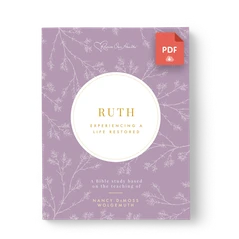
Before then, I want to let you know that there are only a few days left to request your copy of the Ruth Bible study. It’s called Ruth: Experiencing a Life Restored, and it’s designed to help you reflect even more deeply on Ruth’s story. To give and request this resource, visit ReviveOurHearts.com, or call us at 1-800-569-5959.
Don’t forget . . . we’ve got another series about Ruth over on our Women of the Bible podcast and videocast. My friend Erin Davis and some other sisters in ministry sit down together to talk all things Ruth! And they get really practical while they’re at it. Listening to their conversations would be a great way to keep the momentum going and continue studying this book! We’ll link to that series in the transcript of today’s episode at ReviveOurHearts.com.
Let’s get back to our study of Ruth. Here’s Nancy.
Nancy: We come today to the last paragraph of the Book of Ruth, beginning in verse 13 of Ruth chapter 4, and I have titled this paragraph "restoration." Restoration is now complete.
We saw over the last few days how Boaz completed the transaction to take Ruth as his wife. And then we read in verse 13:
So Boaz took Ruth and she became his wife. Then he went to her and the Lord enabled her to conceive and she gave birth to a son.
Now, let's not skip over something here. It's a minor point in this context, but it is a major point for so many people in today's culture.
Notice the sequence of events here. Boaz took Ruth. She became his wife . . . first. Then he went into her. Then he was sexually intimate with her, and the Lord enabled her to conceive and she gave birth to a son.
Now you may think that that's just assumed, but it is not assumed in our culture today. Even within the Christian world it's not assumed that that's the order in which events should take place in marriage and in family. And we see here just a reference to what is a bigger biblical principle.
And that is that the physical sexual union belongs within the context of marriage. That's where God blesses it, that's where He has ordained it to take place. And anything apart from that sets us up for devastation and for consequences that were probably never intended but do, in fact, come to take place.
Marriage is that committed, loving, publicly known, covenant relationship. Within those parameters, within those bounds, the physical relationship, the sexual relationship becomes a precious thing, a gift from God and something that God can bless.
Now we see here that the Lord enabled her to conceive. Remember that for ten years she had been married to Mahlon in Moab, and she had never conceived during that time. We don't know why. But we do know that the Lord enabled her to conceive once she was married to Boaz.
And that says to me, simply, it is a reminder that God is the One who gives life. He is the giver of life. He is the source of life. Life is a gift from His hand. And we see Ruth receiving that gift of God, the willingness to bear children. It may have been that at that stage of life that she may not have been excited about taking on a child, but there is none of that indicated. We see rather just a willingness to receive the children that God would give to her.
And this is so important because a huge part of God's redemptive plan to take the gospel from one generation to the next is dependent upon God's people having children—and not only having children, but teaching their children the ways and the heart of God and leading their children to faith in Christ so that those children will grow up to be spiritually mature disciples of Christ who will have their own children someday. They will not only bear physical life but will bear spiritual life and take the life of Christ to the world.
This son born to Ruth was the gift of God in Ruth's redemption. So Christ was the gift of God for the redemption of the world. And we see here again a picture of what was to come when Christ was to come to earth.
Now in verse 14, "The women said to Naomi," after this son was born to Ruth . . . The witnesses, the townswomen said to Naomi, the grandmother of this little baby, "Praise be to the Lord, who this day has not left you without a kinsman redeemer."
Remember when Boaz redeemed Ruth and her situation, he was redeeming the whole family situation. So he became not Naomi's husband, but he did become Naomi's kinsman redeemer. This woman who had such a hard life, had experienced so much heartache and grief and sorrow and loss, God is restoring her losses by means of a kinsman redeemer.
And so the women say to Naomi:
"May he become famous throughout Israel! He will renew your life and sustain you in your old age. For your daughter-in-law, who loves you and who is better to you than seven sons, has given him birth." (v. 14–15)
Not only was Boaz the redeemer, but in a sense this little child who was born of their union became a redeemer. He was the child who would grow up and would take care of Naomi and Ruth in their old age. He would be their provider, their rescuer, their kinsman, the one who would rescue them.
And so Naomi receives a goel, a redeemer, as does Ruth. And she has the confidence that whatever losses she might experience down the road or in the future, there would always be, as this child grew up, a near kinsman to care for her needs. "He will sustain you in your old age," they said. He will provide you with food. He will meet your needs.
I see this as a key to our spiritual restoration. It's a continuous revival, not just meeting Christ at one point in redemption and then never having any concept of how He redeems us for the rest of our lives. Rather, we see that He is an ever-present redeemer. We sing that chorus: "There is a redeemer, Jesus God's own Son."
He is in the process of continuing to redeem us, to restore what we have lost, to overrule the losses that have been caused by sin. His blood never loses its power. He is not only past tense, our restorer and redeemer; but He is the constant restorer of our lives.
As you and I look forward to aging, You say, "Look forward to aging"?; I do. And the reason I do is because I know I have a Redeemer. And I know that as I get older on this earth, and then as I move to heaven that I will always have a Restorer, even in my old age—One who will sustain, One who has promised to meet my needs. I do not have to worry about how I will be cared for because I know that there is a Redeemer who is looking out for me. He has taken me as His own possession; promised to meet all my needs—spiritual, physical, emotional, relational, every need that I have, I know will be met through Christ my Redeemer.
Verse 16:
Naomi took the child, laid him in her lap and cared for him. The women living there said, "Naomi has a son." And they named him Obed. He was the father of Jesse, the father of David. This, then, is the family line of Perez . . . (vv. 16–17)
And remember who Perez was? He was the son who was born as the result of the incestuous relationship of Tamar and her father-in-law, Judah.
So that is where this line started. And you will see that it is a line that moves from disgrace to grace. And isn't that the way of God? Isn't that the way of Christ our Redeemer? He takes our start in life—enemies from God, separated from God, sinners under the curse of the law—and he says, "I can turn this disgrace to grace."
This, then, is the family line of Perez:
Perez was the father of Hezron,
Hezron the father of Ram,
Ram the father of Amminadab,
Amminadab the father of Nahshon,
Nahshon the father of Salmon,
Salmon the father of Boaz,
Boaz the father of Obed,
Obed the father of Jesse,
and Jesse the father of David. (vv. 18–22)
Now that is where the Book of Ruth ends, but that is not where the story ends. Because you know that as this genealogy continues on, in fact, it is where we started weeks ago by looking at Matthew chapter 1 where we see another genealogy. It takes us this far, then it takes us further to say, from David ultimately came David's greater son, the Lord Jesus.
Christ the Messiah was born as a result of this family line. The ultimate purpose of this family line was to draw attention to David and ultimately to David's descendent, the Lord Jesus. And can I say that the ultimate purpose of your family line and mine should be the same.
Now Christ will not be born literally out of our family line. He already came to earth once. And when He comes back, it will be not as a baby but as a conqueror to take over this world and to rule forever and ever.
But there's a sense in which my family line should have as its goal to lead people to Christ. My physical family line should have that as its goal but also my spiritual line should have that as its goal to win to Christ, to disciple and nurture in His ways—those who will win others, who will disciple them and nurture them so that we can keep passing on from one generation to the next a line that is always bringing people to Christ, always bringing Christ to that next generation.
What's happening in your family line? Is it pointing people to Jesus? Are you living with the confidence that no matter what comes into your life you are secure, you are safe, because you know that you have a Redeemer who through your old age will be your nurturer, your restorer. You will never be without a Redeemer if you are in Christ.
Does that give you confidence? Does it make you want to say to Him, "Thank You, Lord Jesus for taking my emptiness and making it full; for taking my loss and making it gain; for taking the ashes of my life and turning it into something beautiful"?
Would you pray that God would give to you a godly family line—physically and spiritually; that you would be a bearer and nurturer of life. Pray for the new generation who would love God with all their hearts and to know Jesus and take Him to the next generation.
Dannah: That’s Nancy DeMoss Wolgemuth casting a vision for how we might share the gospel with the generations coming behind us. She’ll be right back to pray.
One way Revive Our Hearts wants to help you pass on truth to the next generation of women is through the True Girl podcast. Now, this just happens to be my podcast for girls and their moms. We explore God’s truth one fifteen-minute drive at a time, coming alongside you as you disciple the tween girls in your life.
Have you ever read the Old Testament and realized God had a lot to say, specifically to women? Tomorrow Dr. Katie McCoy will be here to show us how God’s tender love for us as women can be seen in some of those passages that might initially be difficult for us to understand. I hope you’ll be back for Revive Our Hearts, tomorrow.
Now, let’s pray with Nancy.
Nancy: Thank you, Lord, for the greatness and grandness of Your purposes, and for how personally You restore the losses that have been caused and occasioned by our sin.
Thank You that You not only cared for Naomi, but You care for me, and You care for each woman in this room. You are always at work making provisions through Jesus Christ to meet all of our needs. May that line be continued, carried intact from generation to generation until the day that Jesus Christ comes back to claim us for Himself. I pray in Jesus' name. Amen.
This program is a listener-supported production of Revive Our Hearts in Niles, Michigan, calling women to freedom, fullness, and fruitfulness in Christ.
All Scripture is taken from the NIV.
*Offers available only during the broadcast of the podcast season.