Have You Asked the Lord for That? Praying Boldly for God’s Will
Dannah Gresh: When you have a need, do you fret about it? Or do you bring that need to the Lord? Here’s Nancy DeMoss Wolgemuth.
Nancy DeMoss Wolgemuth: Do I fail to receive something that I really need from the Lord, something He's wanting to give, something He's willing to give, something He's able to give, something He has to give, something I need . . . but I don't get it? Why? Because I don't ask.
Dannah: This is the Revive Our Hearts podcast with Nancy DeMoss Wolgemuth, author of A Place of Quiet Rest, for February 19, 2026. I’m Dannah Gresh.
Nancy’s continuing in a series called "Ruth: The Transforming Power of Redeeming Love."
Nancy: In our last session we saw Ruth making her request to Boaz to serve as her kinsman redeemer, her goel, her protector, the one who would protect …
Dannah Gresh: When you have a need, do you fret about it? Or do you bring that need to the Lord? Here’s Nancy DeMoss Wolgemuth.
Nancy DeMoss Wolgemuth: Do I fail to receive something that I really need from the Lord, something He's wanting to give, something He's willing to give, something He's able to give, something He has to give, something I need . . . but I don't get it? Why? Because I don't ask.
Dannah: This is the Revive Our Hearts podcast with Nancy DeMoss Wolgemuth, author of A Place of Quiet Rest, for February 19, 2026. I’m Dannah Gresh.
Nancy’s continuing in a series called "Ruth: The Transforming Power of Redeeming Love."
Nancy: In our last session we saw Ruth making her request to Boaz to serve as her kinsman redeemer, her goel, her protector, the one who would protect their family from their loss. We've been saying over these past several weeks that the Lord had made a gracious provision in the event of the loss of a husband, where the family line could not be continued or where the family would have to lose their lands. God had said that the nearest living male relative who qualified on a variety of counts could step into the situation, could redeem that widow, could redeem the family lands.
Now Ruth has gone to Boaz at Naomi's input and direction and has said in Ruth 3, "I am your servant. Spread the corner of your garment over me, since you are my kinsman redeemer." In other words she is saying, "Will you take me, my family, my situation as your own?" This is an appeal for marriage. It's not in the sense of her going and initiating a marriage proposal as we would think of it today, but it's in the sense of invoking the law of the kinsman redeemer that God had established as a provision for needy Israelites.
We talked in our last session about how Ruth's relationship with Boaz—and Boaz coming in to be the kinsman redeemer of this poor and needy widow, taking her under his covering and his protection, her appeal for his covering—how that is a picture of our redemptive relationship with Jesus Christ.
We must be willing to come to Him as poor and needy sinners and say, "I have no hope, no help apart from You. But in You, I know there is all that I need so I come to You. I ask You to cover me, Lord Jesus, with Your grace, with Your name, with Your salvation. Take all of me—my life, my failures, my sinfulness—take who I am, take me under Yourself and take my situation as Your own."
That's what's pictured in the redemptive story when she says, "Spread the corner of your garment over me. Cover me with your garment, with your mantle. I'm coming under you as my protector."
We've talked about what it means to come under God as our Protector, as our Redeemer. I believe in this story by way of application, there's something else the Lord wants us to see. That is that we have in this story a powerful principle and insight into the marriage relationship—human marriage—between a husband and a wife.
It's hard to separate that from the story of redemption. As we learn in the New Testament, marriage on earth between a husband and a wife is intended to be an earthly picture of the heavenly, unseen, invisible reality of our relationship with Christ as our Husband. You can't always tell in the Scripture which exactly it's talking about. Sometimes the two blend together.
I think of Ephesians 5, where Paul is talking about marriage; then he's talking about the Church. And he's saying that they're really one and the same in a sense. There are some things that apply to both.
I want us to take some moments today before we move on in the text of Ruth to examine what it means in the context of the marriage relationship—to see this figure of the covering and the protection. Ruth says to Boaz, "Spread the corner of your garment over me. Cover me because you are my kinsman redeemer."
In saying that, she is giving a powerful visual image of what marriage was intended to be—a picture of the husband as the savior (lowercase "s"). It's not in the sense of salvation from sin, but a husband who is given the responsibility to wash and cleanse his wife by meeting her needs, by protecting her, and who's given responsibility over his wife and family line.
In order for the husband to fulfill his responsibility, the wife has to be willing to let him fulfill his responsibility. The wife has to be willing to say, "I'm willing. I'm coming under your protection."
Hasn't Satan done a number today on both husbands and wives along this line? We see husbands who won't provide covering, who are not meeting the physical and material and emotional and spiritual needs of their families; and we see wives who are not willing to let their husbands be a provider, a protector, and a covering for them.
It doesn't do any good to cast stones. It doesn't do any good to say that if the men would be better leaders, we would be better responders. The pattern of Scripture is that every one of us, before God, has to take personal responsibility for our own life, for our own calling, for our own responsibilities.
Some of you, as I look around the room, are married currently. Some of you have never been married, and some of you have been previously married. What I'm going to say applies a little differently, depending on your life situation. I think it's important for some of you younger women who have never been married to understand that when you do get married, what you're doing is coming under the covering and protection of your husband—of his authority, of his provision, of his leadership. That is a blessing!
Ruth is not gritting her teeth here and saying, "I don't think I can bear this." She's desperate, and she knows that's God's provision. She's taking advantage of what God has offered. It's an offer of grace. Let me say to some of you younger women who have never heard this kind of truth, that the authority of a husband in the context of marriage is not a curse. It's a blessing. It's a benefit. It's a provision of God's grace to meet your needs as a wife.
We need to focus not so much on the husbands and his responsibility, but on the wives and what is the responsibility of the wife. That is simply to put herself in a position where her husband can cover her.
I read an article not too long ago by a well-known columnist who was talking about this whole matter of manliness and what it means to be masculine and by implication what it means to be feminine. She said that having been a product of the feminist revolution (she is not a believer as far as I know), she said, "You know, I'm part of the reason that men today don't act like men."
I'm paraphrasing. But she said, "I was one of the women who, a generation ago as a young woman—when I would walk into a room and a man would stand up and offer me his seat or want to open the door—I would, in effect, slam the door in his face. I proved my independence by saying, 'I can handle this. I don't need your seat. I don't need you to open the door.'"
We've heard about this kind of response. She's saying, "I'm one of the reasons that men today are so reluctant and scared to be men."
What she was saying, in effect—although I don't know if she knows this biblical principle—is that "I was not willing as a woman to put myself in a position of being protected. I was not willing as a woman to put myself in a position of being covered."
There are some ways that as women, whether married or single, we can allow men to be men as we talked about in an earlier session. But nowhere is this more important than in the relationship of marriage.
When we come to the New Testament, 1 Corinthians 11, the apostle Paul talks about this matter of head coverings for women and how women in the public worship were to have a sign of being under authority, that they were in order, that they were in their place. Theologians have debated, and we won't enter into that in this session, about whether that means women should wear a literal head covering. But one thing we do know, and that is that we need the spiritual covering and protection, that God provides for us by means of authority.
Authority is not a dirty word. Authority is a blessing. Jesus said, "All authority is given unto Me in heaven and in earth." The picture there is, "Because I have authority, I am going to take care of you. I'm going to meet your needs." I realize there is no human husband who is just like Jesus. There are many human husbands—perhaps you were or are married to one—who don't fulfill the role that God has given them to fulfill as husbands.
There are some men who do not provide, who do not lead, do not provide covering and protection. But let me say this, if you put yourself in a position where you say, "I welcome the leadership. I welcome the authority. I'm willing to come under your provision, under your protection, under your leadership," then if your husband doesn't provide that for you, you can be assured that God will provide that for you.
We have widows in this room. We have single women. Who is to provide for those women? God does. He provides a covering, shelter. The Scripture says that God is a Husband to the widow. No matter what your situation in life, if you'll let yourself be covered, you are covered. You can be provided for.
Where it gets difficult is in a marriage where there is still a husband alive, but he's not fulfilling that responsibility. Could I say that, as women, it is so important that you not focus your attention on how your husband needs to repent? He may have great need of repentance, as we all do, but we're much more conscious typically of the failures of others than we are of our own responsibility.
God's calling to us is to say, "What is my responsibility?" Have you created in your marriage a climate, an environment, where your husband feels the freedom and the motivation and the desire—because of your heart—to provide that leadership and that covering for you? If you've never come to him in this position of needing his covering and protection and expressing that to him, you may not know whether he would do it or not.
If you've tended to take the reins on your own, do be your own independent thinker, you may think that your husband would never provide that for you; but you don't know until you put him in a position where you give God a chance to work in his heart and to provide that covering and that protection for you. Regardless of whether he does or doesn't . . . and the best of husbands will do it inadequately, and . . . the best of wives will be inadequate and will not always be what God wants the woman to be . . . But regardless of how well your husband does or does not fulfill that responsibility, you can know that you have refuge under the wings of God, that He is your goel. He is your Kinsman Redeemer.
Even as a single woman, I have found myself many times over the years going to the Lord and saying, "Lord, I'm Your servant. I'm here again. Would You spread the corner of Your garment over me? Would You cover me? Would you cover my situation? I don't want to run this life independently of You. I need You. I need Your authority; I submit to it. I need Your protection; I receive it. I receive Your provision of grace for my life. And all of this I can come and boldly ask because You are my Kinsman Redeemer."
Dannah: Nancy DeMoss Wolgemuth will be right back. We’ve been learning from Ruth that women were designed by God to embrace the covering of male leadership. Next up, we’ll learn from Ruth’s example that we can approach our Redeemer with boldness. I hope this study will influence your prayer life, inspiring you to be fearless as you bring your requests to the Lord.
Speaking of prayer, we would love to pray for you. Did you know you can submit prayer requests on our website? It’s true! Just visit ReviveOurHearts.com/prayer to let us know what bold prayers we can be praying for you. Our prayer team would love to serve you in that way.
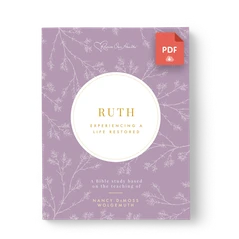
As you consider how Ruth’s story might impact your own, we’d love to send you a helpful tool. Our six-week study, Ruth: Experiencing a Life Restored, invites you to reflect on the messages you’ve been hearing from Nancy over the last couple weeks. It also helps you make the book of Ruth practical in your everyday life. We’d love to give you this resource when you make a donation of any amount to Revive Our Hearts. To donate and request your copy, visit ReviveOurHearts.com, or call us at 1-800-569-5959.
Let’s get back to our study of Ruth.
Nancy: Now, I suspect that as she went to Boaz, she might have easily feared that he would reject her. After all, who was she? She was a foreigner. She was poor. She was a widow. She had nothing to commend her to Boaz. Here he is, a respected citizen of the land. He’s an older man.
I can just imagine all the fear that might have been in her heart as she was making her way there to that threshing floor thinking, Is he going to accept me? Is he going to listen to me? Is he going to receive my appeal? Will he want to be my kinsman redeemer, to rescue me in my situation?
But as we come to Boaz’s response in Ruth chapter 3, verse 10, we find—to the contrary—that Boaz is delighted that Ruth has had the boldness to come and ask him to serve as her kinsman redeemer. He says to her in verse 10:
“The Lord bless you, my daughter. This kindness is greater than that which you showed earlier: You have not run after the younger men, whether rich or poor. And now, my daughter, don’t be afraid. I will do for you all that you ask.” (vv. 10–11)
She has asked him to redeem her, and he is glad that she has asked him to redeem her.
As the story unfolds, we’re going to see in Boaz a picture of the heart of the Lord Jesus—our Goel, our Kinsman Redeemer. We come and ask Him to redeem us, not only to redeem our soul—to redeem us in the terms of salvation—but to redeem us in a daily sense, to rescue and protect us in our areas of need.
When we come to Him as poor, needy sinners, and we come appealing to Him out of His riches, His wealth, His position, His right to redeem us; we come asking Him to cover us. We’re not appealing to somebody who is reluctant to meet our needs. He says, “I’m so glad that you came. I’m so glad you asked. I want to redeem you.” Boaz says to her, “Don’t be afraid. I will do for you all that you ask.”
I love that verse. As I think about this matter of prayer and intercession and how we go to the Lord Jesus and say we have these needs, as we approach His throne, we need to remember that it’s a throne of grace, a throne where He says, “I will do for you all that you have asked. Don’t be afraid to come. Don’t be afraid to ask. In fact, ask boldly!”
He’s told us, “Ask for me. Tell me your requests. Don’t worry about anything,” Philippians says, “Instead pray about everything and the peace of God, the grace of God, the promises of God, the provision of God will come to your rescue” (4:6–7 paraphrase).
I love that stanza from an old hymn that says,
Thou art coming to a king,
so large petitions with thee bring.
For his grace and power are such,
none can ever ask too much.
("Come, My Lord, My Suit Prepare" by John Newton)
He tells us, “Ask in accordance with My Word. Ask in accordance with My will, and I will do for you all that you ask.”
As I read this passage, I wonder—how many times do I fail to receive something that I really need from the Lord; something He’s wanting to give; something He’s willing to give; something He’s able to give; something He has to give; something I need, but I don’t get it. Why? Because I don’t ask; I’m too scared, too timid, too busy. I just don’t ask.
The Scripture says, “Cast your burden on the Lord and He will sustain you” (Psalm 55:22 NKJV). Am I casting my burdens on the Lord? Am I trusting Him to sustain me? He says, “Ask of Me and I will fill you with My Holy Spirit.” I need to be filled with His Spirit. Am I asking Him to fill me with His Spirit? Am I asking Him to guard my heart?
He says if I keep my mind fixed on Him He will keep my mind in perfect peace. I need the peace of God guarding, garrisoning my mind. Am I asking Him to do that? Am I asking Him to meet my needs? Am I asking Him to give me the wisdom that I need?
“Don’t be afraid,” he said. “Bless you. Thank you for coming. Don’t be afraid. I will do for you all that you ask.”
I remember a friend saying once, "I wonder how many things God wanted to give us, but He never did because we never asked? And if God only gave us that for which we ask, how much would we have?"
Now, God is so gracious and merciful. He gives us a multitude of blessings for which we never ask. But think about it. If He only gave us that for which we actually approached Him and asked, how much would we have?
Ruth is going to become a wealthy woman because she was not afraid to ask. She said, "You've got the supply; I've got the need. You are in a position to meet my need, so I am coming to you and I'm asking." And he's delighted that she has.
Let me just back up to one other point there in verse 10. Boaz says to Ruth, “This kindness [you coming and asking] is greater than that what you showed earlier. You have not run after the younger men, whether rich or poor” (3:10).
Boaz realizes that Ruth could have gone and looked for a husband elsewhere. Apparently, he was probably the age of her father-in-law, probably Naomi's age group. She could have gone an looked for a husband if she was just looking for herself, she might have gone and looked for someone in her age group, someone who was younger, and someone who perhaps would have been just what she was looking for in a husband. But she went to Boaz, not because he was her dream man. Remember this is not a story of romance as much as it is a story of redemption.
She goes to Boaz because she has a bigger purpose in mind. She realizes that God’s heart is to redeem her whole family situation and that God wanted to preserve in Israel the family lands and the family name from one generation to the next. In order to have her husband and her father-in-law’s names and lands preserved, she had to find a redeemer, a kinsman redeemer, one who could take their situation on as his own.
So she goes to Boaz and asks him to become her husband, to become her redeemer because she is wanting to fulfill God’s role for her life and for her family. She’s not just looking for personal happiness. She’s not just looking for personal convenience and for her personal desires to be met.
She’s wanting to submit to God’s plan for a legacy, for an ongoing family line, for a lineage that she doesn’t know—but we know—is going to lead to Christ. I think it could well have been a natural desire on Ruth’s part to start a new family, to forget about the old family line where there had been so much pain and so much sorrow.
But she was willing to stick with the family in which God had placed her and to take whatever steps were necessary to believe God for, if you will, a revival of the old situation that seemed so hopeless and so desperate. Rather than starting a new line, she’s willing to believe God to restore the old line.
I wonder how many times, as it relates to our churches or as it relates to marriage, are we quick to throw away the old situation rather than believing God to revive it and restore it and make something new out of it.
What does that have to do with us? I think it is easy and natural of us when things go wrong and our situation in life doesn't work out as we had hoped that it would, to try and get rid of the old situation and start into a new one.
I think what God is saying to us here that is that rather than throw away the old situation and look for a new one, that we need to ask God for a vision of what He could do with the old situation—how He could restore and revive the situation that we thought was so hopeless and helpless. The problem is, we get into some of these situations and we really lose hope that even God can do anything about it.
I received a prayer card in one of our conferences, and she said, "I'm praying for reconciliation for a family that I've been a part of for twenty-eight years. There's been a divorce in this situation, and rather than say that I'll just throw away the old situation and move on to something new and better and different, I'm praying for a reconciliation."
Now, I don't know a lot about that woman's situation, but I can imagine that it is not easy for her to pray for that. Her natural desires would be to just start over again.
I wonder how many times as it relates to our churches, as it relates to marriage are we quick to throw away the old situation, rather than believing God to revive it and restore it and make something new out of it?
I’ve watched people in church situations that get difficult. I’m not saying there’s never a time when it would be appropriate to leave a church where perhaps the Word of God is not being preached or there is being clear violation of biblical principles. There is a time perhaps to leave and go to a different situation.
But today, people are so prone to just “church hop.” If something happens in the church that upsets them, or they get unhappy with something—maybe a decision that’s made in the church—they say, “I’m just leaving that church. I’m just going to another one.”
I’ve been in cities where most of the evangelical churches in that city are splits off of splits off of splits—people not believing God to revive the old situation, but just going and quickly starting something new. Nowhere is that more deadly than in marriage—which is to be a picture of Christ’s redemptive relationship with His Church—where we throw off the old so quickly and say, “I’m going to look for something new. I’m going to look for something fresh.”
Let me just say, and some of you sitting in this room know how true this is, that you don’t solve your problems in marriage by just putting another pair of shoes under the bed. In fact, you may end up with a whole series of problems you hadn’t counted on.
I wonder if someone is in a situation that looks hard, it looks hopeless, it looks impossible for even God to do anything about. Would you believe God to give you a vision for a revival of the old situation?
That's not a promise that God is going to reconcile and restore your marriage. But I would say that far too many people today are far to quick to give up on something that God is wanting to renew, something that God is wanting to revive, and something that God is wanting to heal. I wonder how many times people never see what God could do in restoring a difficult situation because they are so quick to jump out of it and jump into a new situation.
What is the situation you’re facing that just is old and burdensome and wearying to you? Would you ask God for faith to stick with it? For faith to wait on Him? For faith to surrender your own desires, your own happiness, your own convenience, your own personal desires and just say, “Lord, I’ll wait on You. I’m willing to submit and surrender and relinquish my own plans. I’m willing to fulfill Your plan for keeping this family line intact. I want to see You restore and revive that which seems so hopeless.”
Dannah: That’s Nancy DeMoss Wolgemuth talking about our need for God and His grace. Hey Nancy. Thanks for that thought-provoking look at a scene in the Old Testament that, if I'm honest, has always left me with questions! It can be kind of confusing!
Nancy: Yes, if you are reading this passage with twenty-first century eyes for the first time, you would probably raise your eyebrows and say, "What in the world is that all about?" It takes some unpacking to see the beauty of submission and humility.
Dannah, since we are talking today about the beauty of submission and humility, I just want to say one more thing: anytime I mention submission in the context of marriage—a wife submitting to her own husband—I want to be sure to emphasize this: if your husband is misusing that God-given authority or abusing you, you are not called to submit to his sinful treatment of you.
There are constructive, appropriate, and godly ways to get yourself to a safe place. You probably will need the help of another mature believer—maybe a leader in your church, maybe an older woman who walks with God. Someone who can help you rightly deal with any harsh or unhealthy treatment in your marriage.
Let me say it clearly: submission in marriage does not mean saying, "Go ahead and hit me; I'll just submit to it." No! That is not God's plan. As we saw today, that wasn’t the situation at all with Boaz and Ruth.
Dannah, as I hear that, I know that some women are thinking, If I were married to a Boaz, my life would be full of love and loyalty, godliness and joy. But it's just not that way for me.
Let me just remind us that the book of Ruth doesn't point us to the perfect marriage; it points us to a perfect Savior—to Christ who is our heavenly Boaz as we live in this broken, fallen world. We can know that we are loved perfectly, beautifully, and well by Him, no matter what else may be going on in our lives.
Dannah: And don’t forget to explore our relationships page to find wisdom for the relationships in your life. We’ve curated our favorite podcast episodes, blog articles, videos, and more so that you can easily take what’s helpful. Find that collection at ReviveOurHearts.com/relationships.
Next time, we’ll explore what it looks like to wait well. To entrust our circumstances to the Lord and rest in Him. Ruth, once again, will be a great example for us!
Now let’s pray with Nancy.
Nancy: Thank You, Lord Jesus, that You receive us graciously and warmly when we come and ask You to redeem us. Thank You that You are able to take on the most hopeless situation. In Your way and in Your time, You are able to redeem it. Help us to draw upon Your great willingness to be our Kinsman Redeemer, not to throw out the old situation before we have waited on You and trusted You and asked You to come and redeem that which seems so hopeless. I pray in Jesus' name. Amen.
This program is a listener-supported production of Revive Our Hearts in Niles, Michigan, calling women to freedom, fullness, and fruitfulness in Christ.
All Scripture is taken from the New International Version unless noted.
*Offers available only during the broadcast of the podcast season.