
Bible Reading for the Beginner
Dannah Gresh: Soccer practice. Work meetings. Dinner to cook. Laundry to do. Where does Bible reading fit in? Maybe we’re thinking about this all wrong. Here’s Jean Wilund.
Jean Wilund: Instead of scheduling my Bible reading into my day, I schedule my life into my Bible reading.
Dannah: Welcome to the Revive Our Hearts podcast for January 15, 2026. I’m Dannah Gresh. Our host is the author of A Place of Quiet Rest, Nancy DeMoss Wolgemuth.
Now, you’re about to hear Nancy tell a sweet story about marrying her husband Robert. In the days since she recorded this last month, Robert went to be with the Lord. Would you continue to pray the Lord’s comfort over Nancy? Let’s listen now, as she introduces our guest today.
Nancy DeMoss Wolgemuth: When I married Robert, I didn’t just become Mrs. Wolgemuth. I also became . . . …
Dannah Gresh: Soccer practice. Work meetings. Dinner to cook. Laundry to do. Where does Bible reading fit in? Maybe we’re thinking about this all wrong. Here’s Jean Wilund.
Jean Wilund: Instead of scheduling my Bible reading into my day, I schedule my life into my Bible reading.
Dannah: Welcome to the Revive Our Hearts podcast for January 15, 2026. I’m Dannah Gresh. Our host is the author of A Place of Quiet Rest, Nancy DeMoss Wolgemuth.
Now, you’re about to hear Nancy tell a sweet story about marrying her husband Robert. In the days since she recorded this last month, Robert went to be with the Lord. Would you continue to pray the Lord’s comfort over Nancy? Let’s listen now, as she introduces our guest today.
Nancy DeMoss Wolgemuth: When I married Robert, I didn’t just become Mrs. Wolgemuth. I also became . . . a Cubs fan.
For decades of my life, I wasn’t so much into sports. But Robert rooted for the Chicago Cubs, and, by the way, that’s a baseball team. I was able to connect with him and his interests by watching games with him.
At first, I was just doing it to spend time with Robert. But do you know what happened? As I started learning more about baseball and the stories of the individual players, I got more and more into the Cubs. You see, as you learn more about a subject, it’s easier to grow to love that subject.
Well, God’s Word is one subject we should all spend our lives learning about. It’s far, far more important than any sports team—or anything else for that matter. I’m confident that as you read the Bible and get to know it better, you will become a Bible fan.
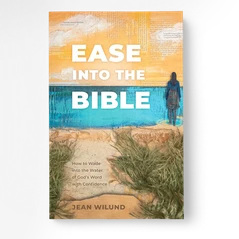
My friend Jean Wilund has written a book that will help you understand and love God's Word. It’s called Ease into the Bible. It’s the perfect introduction for new Christians who may be struggling to understand the Bible as well as mature believers who want to go deeper in their knowledge of God and His Word.
Yesterday we heard part one of a conversation between Dannah Gresh and Jean Wilund about the wonder of God’s Word. And today we’re going to jump back into the second part of that conversation. As we listen, I pray that your love for God’s Word will grow.
Dannah: Jean, welcome back again today. I’m so glad to have you.
Jean: Thank you. I’m thrilled to be back.
Dannah: Today I got to spend time with a friend who is newer in the faith. She grew up in a different faith, and so the Bible is a little bit daunting to her, a little overwhelming.
So, she goes to the self-help section in the bookstore. Recently she went to that self-help section, and she opened a book that’s really a bestseller. She said, “I just got this sick feeling when I was reading the words because (to talk a little bit about what you mentioned yesterday), this book is putting all the pressure on me to be the salvation of myself. It was ‘me, me, me.’”
And, so she said, “I just closed it, and I was just, like, ‘God, I know that You can help me find the right book.” She said, “I don’t know how, but I ended up in the Bible section, and I bought a pink Bible, and that Bible is so fascinating!”
And this is one of the things she said to me, “I didn’t know Adam and Eve had more than two sons.” Like, that new and that fresh to her. Right?
And—I don’t want to offend anybody—but could we have a program called “Bible Reading for Dummies”? Could we do that? (laughter.) Because I feel like I’m one of them sometimes.
I just want to ask you some questions about things you answer in your book because I think they’re really helpful, and they help us understand what we’re reading. I want to start with this: Why is the Bible different from all those other books available in the bookstore that are so-called “helpful” to us?
Jean: The bottom line, this is the only book in all of history that is THE Word of God. It’s the Word of God. It is not the imaginations of men. I had a friend say that the Bible is just written by men who want to be remembered.
It is God’s Word.
Dannah: Well, where in the Bible did it tell us that?
Jean: Second Peter 1:20 tells us,
Above all, you know this: No prophecy of Scripture comes from the prophet’s own interpretation, because no prophecy ever came by the will of man; instead, men spoke from God as they were carried along by the Holy Spirit. (vv. 20–21)
God is the ultimate Author. He used human authors, but God is the Author of His Word.
Dannah: A lot of times we hear the word “inspired.” We hear the word that the Bible was inspired by God. What does that word mean?
Jean: It means “God-breathed.”
Dannah: I think that’s in 2 Timothy 3:16. It says that it is “God-breathed.”
Jean: Yes.
Dannah: “And is useful for teaching, rebuking, correcting and training in righteousness.”
Jean: Yes. The Greek word for “God-breathed,” inspired, is God-breathed or God-spoken. So God breathed down His Word through His authors.
Dannah: That’s beautiful. These are God’s Words.
So, another question that you talk about in the book, and I think this is important: What is the Canon of Scripture? What’s that?
Jean: So, the Canon of Scripture, the whole Bible is the Canon of Scripture, and the word “Canon” means “measuring rod rule and standard.”
So the Canon is the standard for what is God’s authoritative Word. It’s the Scriptures that were recognized as the God’s authoritative Words. Not just commentary written by someone else, but this was actually God’s Word.
So that’s why they use the word “Canon.” All the sixty-six books of the Bible make up what we would call the “Canon of Scripture.”
Dannah: What process did they use? Because men, a council of men, went through that process of measuring these books and these words to decide, “Are they God-breathed? Are these inspired?” What did they use to get to the decision that, “Yes, this belongs in the Canon”?
Jean: Theologian J. R. Packer wrote:
The Church no more gave us the New Testament Canon than Sir Isaac Newton gave us the force of gravity. God gave us gravity by His work of creation. And similarly, He gave us the New Testament Canon by inspiring the individual books that make it up.
So what the Early Church did was, hey looked for the books that had the Creator’s fingerprints on them, that were clear. Not chosen; they did not choose the books, but they recognized the books.
If a book didn’t meet all of the criteria that they set, the books had to meet this criteria, or they would reject it as inspired.
So just three of them were:
- Did one of God’s prophets, apostles, or another wisely accepted spokesman of God write the book?
- Is the book historically accurate and in no way contradicts what God has revealed in already-accepted Scripture?
- Did the overall Church body receive the book as God’s inspired Word and a firm authority over their lives by submitting themselves to the book’s teachings?
And so it wasn’t just, “What’s our favorite books?” It was recognized over history and widely agreed upon.
Dannah: Yeah. I’ve heard some people say, “That’s really cool. If God inspired people then, can’t He inspire people now?” Why aren’t we adding books to the Bible?
Jean: The Canon is closed. That’s the bottom line. What God wrote in the Bible is everything we need to know. There’s nothing left that we need to know.
When the last prophet spoke, when Malachi spoke, then there was 400 years when God was not speaking. And the Israelites say the Jewish people understood that. They were not coming out with new things. God was silent.
And then when Jesus came, He quoted from the Old Testament widely, and it was accepted. The books were already accepted. The same ones we have today are the ones that Jesus was quoting from, the ones that were already accepted in their day.
Now, when John wrote the book of Revelation, by the time that was written, now the Canon is closed. Everything we need to know, we’ve received. Because, to be a writer, they had to be a witness to what Christ did. It couldn’t be hearsay.
Paul was a witness to Christ on the Damascus Road. He met Paul after He ascended, but Paul was a witness through that.
And so while he may not have been a disciple, John Mark wrote the gospel of Mark. He wasn’t a disciple, but he was a witness. We know that the Early Church met at his mother’s home. He was a witness to what was going on.
And so, after that, there are no more witnesses. They’re not alive today. So we don’t need any more. It is closed. We have everything we need until Christ will come back, and He said He will. There’s nothing to say.
Dannah: Yes. He’s told us about future events as well.
Jean: Yes.
Dannah: Let’s talk about translations. You write about that in your book. There are a lot of different types of translations. There are different ways that the Bible is translated. Can you describe some of the different approaches that translators use so we can understand how to make decisions about which ones we want to use?
Jean: Yes. I found this fascinating.
There’s word-for-word. That’s where they take the Word from the original manuscripts, and then they line them up in exactly the order that they show up in the original Greek, Hebrew, or Aramaic.
I have an example of how crazy can come out in English when you translate it literally word for word. I’ve got Matthew 1:18. It’s called an Interlinear Bible, where they put it all in a line. But Matthew 1:18 reads like this in the Interlinear translation:
Now, of Jesus Christ, the birth as follows: Was has been betrothed mother when as married to Joseph before came together, they, she was found with child to be by God’s Spirit, the Holy.
Dannah: (laughter) Yes, that gets hard, that type of translation.
Jean: Right! So, for us to properly interpret that would be, basically, impossible if we were coming to the Bible written word for word, exactly as the original puts it.
So, instead, what the translators’ goal is, they want to remain as close as possible to the original wording so that they can help maintain the author’s original intent, without sacrificing the ease of understanding.
The benefit is we can actually understand what the author originally intended. The challenge is, because they want to be careful not to change it too much, sometimes some of the wording can be awkward to us.
And so their thought-to-thought method is that their goal is that they are going to faithfully convey the author’s original meaning but changing up the structure more when it seems confusing.
Then you’ve got the optimal equivalence method. It is that balance between word-for-word and thought-for-thought. One of the most popular translations here is the Christian Standard Bible.
Dannah: Yes. That’s a version we really love at Revive Our Hearts.
Jean: Right.
Dannah: We have several notetaking Bibles that we have available at ReviveOurHearts.com in the CSB translation. It uses a combination of both of those approaches to balance the absolute accuracy. They are protecting the original meaning, but they’re also making it understandable for us today.
So, if you’re just, like, “Wow! There are a lot of different kinds of translations, and I just felt overwhelmed by that,” go get yourself a Christian Standard Bible. It’s a great place to start.
Jean: Yes, I love it! It’s the one I’m reading every day. I’ve been reading it every day for a couple of years.
Dannah: So, you talk about some Bible-reading commitments—four of them.
Jean: Yes.
Dannah: What are they? They don’t necessarily need to be our commitments too. But they might provoke some thoughts about what our commitments will be? What are yours?
Jean: It’s the four Bible-reading commitments that just cry out in my heart every single day.
One is: to read the Bible daily.
We are slaves of Christ, not slaves of Bible reading and Bible-reading plans. We’re slaves of Christ. But as I said earlier, God gave us His Spirit, and He gave us His Word. That is how we are to know Him.
We can go to church every day, but any learning that reveals to us God, came from His Word. That’s where they’re getting it from. So we need to be faithful to read the Bible every day.
And, for me, knowing God the way I know Him now and am continuing to know Him deeper, comes from His Word. And so, instead of scheduling my Bible reading into my day, I schedule my life into my Bible reading. That’s the priority that it takes.
I love what my husband says, “Tomorrow starts tonight.” What are you going to do tomorrow? It starts the night before. So when I know that I’ve got an early morning (for me, I love to read in the morning more than any other time), I know I need to set my alarm that much earlier.
When my children were little, they got up at seven, so my alarm went off at five. That was for me. I had to do that because I had to be in God’s Word. I needed it for myself. I wanted it. I was desperate for it for myself.
The second commitment that I’ve made is: to look for God on every page.
It’s all about Him. It is not about us. And so in looking for God on every page, we come to know Him in ways that we cannot in any other way. And our faith will grow exponentially as we come to know Him.
He says in 2 Peter 1:2–3, this is one of my favorite passages: “May grace and peace . . .” Who doesn’t want those?!
May grace and peace be multiplied to you through the knowledge of God and of Jesus our Lord. His divine power has given us everything required for life and godliness through the knowledge of him who called us by his own glory and goodness.
The knowledge of Him comes from His Word.
The third commitment is: don’t seem to master the Bible; seek to let the Bible master you.
The more and more we learn about the Bible, the longer we study it, the more it can become a temptation to just be puffed up with knowledge. But when we seek to master it . . . Earlier what you were talking about with the professors, or whatever, that know the Bible well, but they just have head knowledge.
We need to let the Bible master us through the relationship. When we know Him, His Word will master us . . . and that is the most wonderful place to live! That is exciting! It may sound bad to be mastered, but to be mastered by the most wonderful, loving, exciting, perfect, holy, great God . . .
And then the last commitment is: read the whole Bible for the rest of your life.
I can’t believe I’ve gotten so emotional on that. Long before I finished the Old Testament, I knew I’d continue to read the whole Bible for the rest of my life because I’ve never been so in love.
And it’s what you were saying earlier. I wasn’t in love with a piece of literature. I was in love with the God of the Word. Every day that I’m in it, I meet Him there. I see Him there. I hear Him there—not audibly—but I hear Him. I hear His voice. I hear His love. He speaks through His Word, and He changed my heart. He gives me peace, abiding peace and joy, grace and peace, multiplied. I want that for the rest of my life. I will never, ever stop.
Dannah: Well, if you could, Jean, take us into just a really, specific passage as we end today that maybe culminated that love for the Word that you have, which really is a love for Jesus Himself.
Jean: Yes. I want to take you back to that day I told you about yesterday when I was reading in Deuteronomy 6:7–8. That’s when I knew I was different. So this is one of those bench-mark moments, tiny-point moments when nothing was ever the same. This is what I was reading when it happened.
To give you a little context, I had such a low self-image: “I was the worst wife, the worst mother, the worst everything. My children were going to need therapy because of me. I’m the worst Christian. I’m the worst.” I was just so focused on myself.
And then I’m reading this in Deuteronomy 7:7:
The LORD had his heart set on you and chose you (He’s writing to Israel), not because you are more numerous than all people for you were the fewest of all people. But because the LORD loved you and kept the oath he swore to your ancestors. (vv. 7–8)
Israel was on my last nerve. They were not loveable. I’m, like, “Yeah, you’re not! You’re not all these things! You’re not! I’m not either!”
God did not choose you, Jean, because of how great you are. He chose you because of how great He is! I couldn’t believe that He loved me because of who I am, but I could absolutely believe that God loves me because of who He is because He will never, never break His promise. I am His forever because He chose me, because He is love. He loves to redeem. He did that for them, and He chose me and saved me.
His Word tells us that we didn’t choose Him. He chose us. That’s how I know He chose me. But it also says here in verse 9,
Know that the LORD your God is God, the faithful God who keeps his gracious covenant loyalty for a thousand generations for those who love him and keep his commands.
And I just knew I’m different. And not because I’m determined to keep His commands. I’m just keeping His commands more faithfully now because I know Him more; I love Him more. And it’s just spilling out into obedience that I never even tried to do.
And that’s when I knew: it’s all about Him, and it is all of Him. And I’m only at Deuteronomy 7 at this point! I hadn’t read the whole Bible yet, but I had read with a different focus.
Dannah: You were hardly started.
Jean: Yes, I was barely started. But now I have a new focus. My focus was to know God, not to be a better Christian, but to know God.
Dannah: Yeah.
Nancy: We’ve been listening to an interview between Dannah Gresh and Jean Wilund.
I came across Jean’s book, Ease into the Bible, not too long ago, and I’ve been eager for us to share it with Revive Our Hearts listeners.
So when you donate any amount to support this ministry, we’d like to send you a copy of Jean’s book, Ease into the Bible, as our way of saying thank you for standing with us at Revive Our Hearts.
Your gift will help us get more women into God’s Word. For example, this year Revive Our Hearts is encouraging women from all around the world to read the Bible together, each person reading a Bible written in her own language.
You can join us by visiting ReviveOurHearts.com/Bible2026. And then, once we’ve had a chance to read through the Bible this year, Lord willing, next year, we’re going to take the whole year to study together through the entire Bible in a series we’re calling “Wonder of the Word.”
Even now, teams are working to translate this teaching into many languages so women around the globe can understand the Bible for themselves, and, most importantly, get to know the God of the Bible.
Your gift at this time will help Revive Our Hearts continue this project, and when you make a gift of any amount, we’ll be glad to send you Jean’s book Ease into the Bible.
Just visit us at ReviveOurHearts.com to make your donation and to request your copy, or give us a call at 1-800-569-5959.
Thank you for loving God’s Word and for your part in helping others to love it as well.
Dannah: Amen. You know, I am in awe of how God is using Revive Our Hearts across the globe to help so many women do just that—love His Word.
We’re well into our 25th year of ministry now, and our international outreaches have grown so much over the last couple of decades. If you’re interested in learning more about the international ministries of Revive Our Hearts, visit ReviveOurHearts.com/international.
Tomorrow, we’ll learn to love God’s Word even more with Kelly Needham.
Kelly Needham: It is a group of books put together to tell one story, but behind them, there is a proclamation from these pages. This Book is breathed out by God Himself, the Spirit of God operating through humans.
Dannah: Very few women get me as excited as she does to open my Bible and dig in. I think you’re going to feel the same. Please be back for Revive Our Hearts.
This program is a listener-supported production of Revive Our Hearts in Niles, Michigan, calling women to freedom, fullness, and fruitfulness in Christ.
*Offers available only during the broadcast of the podcast season.