
Behold the Daily Mercy of the Word
Nancy DeMoss Wolgemuth:We all know what it feels like to be burdened underneath beneath the weight of our sin. The psalmist experienced that too. Dannah Gresh has some encouragement for us today straight from Psalm 130.
Dannah Gresh:
In your word I put my hope,
more than watchman wait for the morning.
Put your hope in the LORD,
for in the LORD is unfailing love,
and with him is full redemption.
With the Lord is unfailing love and with him is full redemption.
Nancy: Amen! I love this truth-speaking friend of mine. You’re listening to the Revive Our Hearts podcast for Friday, November 7, 2025. I’m Nancy DeMoss Wolgemuth.
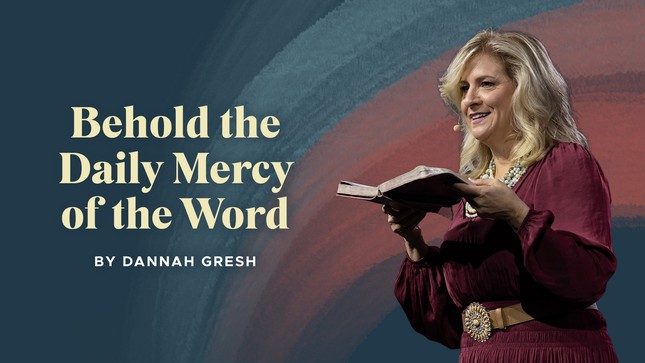
Last month at True Woman '25, Dannah Gresh gave a message about finding the daily mercy of God’s Word. This verse became a reality in Dannah's life when she was feeling trapped by past …
Nancy DeMoss Wolgemuth:We all know what it feels like to be burdened underneath beneath the weight of our sin. The psalmist experienced that too. Dannah Gresh has some encouragement for us today straight from Psalm 130.
Dannah Gresh:
In your word I put my hope,
more than watchman wait for the morning.
Put your hope in the LORD,
for in the LORD is unfailing love,
and with him is full redemption.
With the Lord is unfailing love and with him is full redemption.
Nancy: Amen! I love this truth-speaking friend of mine. You’re listening to the Revive Our Hearts podcast for Friday, November 7, 2025. I’m Nancy DeMoss Wolgemuth.
Last month at True Woman '25, Dannah Gresh gave a message about finding the daily mercy of God’s Word. This verse became a reality in Dannah's life when she was feeling trapped by past shame over sin. Wherever you may be in your spiritual journey today, I'm eager for you to hear how God used His Word to minister grace to Dannah at that point in her life . . . and every day since. I’m excited for you to listen to that message now. Here’s Dannah.
Dannah: I want to ask you a question: Do you have a daily quiet time in God's Word? Do you read it every day? Is it the rhythm of your life?
Some of you are like, “Yeah.” And some of you are like, “Oh, do I have to?” And that is a good question. Do I have to? I want to share with you a time in my life where the Lord convicted me as a young adult woman in my twenties that it was an essential life skill for me. Now, the Lord did this in my life at a time when I was just really weighed down by the weight and the shame of my sin. There were some sins in my life that I would go to the Lord almost every day and say, “Lord, forgive me” . . . and these were sins I had committed years ago. Have you been there? Maybe some of you are there today.
The psalmist, the writer of 130, found a prescription for that. And I discovered it one day when I was listening to a worship album. In the middle of the song, I heard a woman's voice read Psalm 130, much like you just heard it read a moment ago. It began, “If you, O LORD, kept a record of sins, who could stand?” (v. 3).
What? There's someone other than me that feels that weight. Yes, the writer of Psalm 130 felt that weight. And he found a prescription for the pain and the shame. And we're going to look at that today. But he also found two essential qualities of the Christian life: waiting on the Lord and hoping in His Word.
So as you find Psalm 130, I want to tell you something that I just think is a marvel about almost all the psalms, and that's the poetry. Now, if you're like me, you're a girl who likes something a little easier to read. There have been times maybe in your life, maybe still, that you want to skip the poetry. You're like, “Give me a good subject, verb, direct object. I will take that any day, but poetry is so hard to understand.” Any of you ever been there in the Bible?
So, I was writing a Bible study on the book of Habakkuk a few years ago. I was like, this book says God tells the prophet to, “Write it down. Make it plain, easy to understand” (see Hab. 2:2). And it's poetry!
What!?
So I called an Old Testament professor, and I said, “Listen, why is this book, if God said, 'Write it down, make it plain,' why is it poetic? Why do I have to work so hard and roll up my sleeves to get it?”
And he said the most fascinating thing to me. He said, “First of all, Dannah, I want you to notice that so many of the things in Scripture that are essential and very important, not that all of it isn't essential, but the really critical parts, like Genesis 1, 2, and 3, creation, the curse, so very much the foundation of our faith, the prophets, the Psalms, they're written in poetic form. If they're so important, and he uses poetic form, it must be an invitation.”
What is the invitation? And then he said this, and I will never forget it
“Poetry requires us to slow down and become intimate with the Word.”
That good. So that's what we're gonna do today with Psalm 130. We're gonna slow down, and we're gonna become intimate with Psalm 130. We're gonna learn about these two beautiful powers of waiting on the Lord and hoping in His Word.
We're gonna start with the superscript. That's those little words in Psalm 130. You probably have a headline, in big bold, above the Psalm 130, or the number Psalm 130. But right next to it you have the superscript. Those were ordained by God written by the original writers. And this one says: A song of a ascents.
What is that? Well, there are fifteen of them that have this caption at the beginning. It was specifically a song that was meant for the pilgrims of Israel to sing as they walked up the hill to Jerusalem for three feasts throughout the year, feasts like Passover. They would sing it as they made the climb. So I want you to picture this with me a dusty, hot, dirt road. You're a mom or a grandma. You’ve got the weight of all the stuff you’ve got to carry. You’ve got the grumpy donkey behind you. You’ve got the kids darting in and out saying, “Are we there yet?” And you're climbing, climbing, climbing up because the way to Jerusalem is always up. It's a hard climb. It's a lot of work. And as you climb, you hear songs rippling through the crowd, and you join in.
“Out of the depths I cry to you.” (v. 1)
At first glance, this psalm sounds like pure emotionalism. Somebody in the back has an emotionally wealthy day..
No. It's not pure emotionalism because the word “depth” tells us something really significant. When that word shows up in Scripture, so very often it's talking about judgment; it's talking about death.
This isn't just an emotional plea; this is a keen awareness of sin. That's why the psalmist cries for mercy. Verse 2:
Lord, hear my voice.
Let your ears be attentive
to my cry for mercy.
He's pleading with God. “Don't give me what I deserve. I know what I deserve. I am in the depths of my awareness of what I deserve.” And when I first discovered this psalm, that's exactly where I was. I was in the depths being taunted and tormented by memories and pictures in my mind.
I know what it's like to be in the depths. And if you're there today, you're not alone. You're not the first one to be there. I've been there. This writer has been there, and so he's crying out for mercy. What I think is so refreshing is this is such an honest look at sin. I'm not so sure that we have such an honest look at sin. In fact, my look at sin when I discovered this in my twenties wasn't really honest. But as I've been reflecting on Psalm 130 through the past few weeks, I realize it's not very honest today either.
We tend to be very undone by the big sins, and then there are all these everyday sins (don't mind if I step on your toes):
- The nagging at our husbands.
- The losing our temper with our kids.
- The pride and ambition.
- Listen, let's talk about Sabbath for just a second. It's one of the ten commandments. Do you practice it?
I feel like the bad sins over here, they weigh us down with such a burden. And we are like those pilgrims climbing up, up, up, doing all the work of carrying the weight of that sin. And yet over here are all these sins that we're just not really honest about. Listen, I’ve got to tell you something: all sins separate us from God. It has the same impact, whether you think it's bad or whether you think it's not that bad. We've got to stop making excuses about our sins. We've got to be like the psalmist and come honestly.
Here's some of the ways that I excuse my sin:
- Comparison excuses.
- “Well, I'm not doing what she did.” “Did you see . . .?”
- Cultural excuses.
- “Well, it's just kind of what people do these days.” “Everybody's watching it.” “Everybody's listening to it.” “Everybody's saying it.”
- Identity excuses.
- “I can't help the way I am.” “It's just my personality.”
- Rights-based excuses.
- “I have the right to control my time, my body, my choices.”
- Emotional excuses.
- “I can't control my emotions. I just can't.” “If you knew what I'd been through, you would understand why I am the way I am.”
- Blame-shifting excuses.
- “If I were treated better, I wouldn't do . . . fill-in-the-blank.”
Have you ever made any of those excuses? It's time to stop making those excuses and to be honest, like this psalmist. It's the reason that it says in the Bible, “His mercies are new every morning” (Lam. 3:23). Because, guess what?, we need Him every morning. We need Him every single day. And this psalmist is crying out for that mercy. We need them every day. Verse 3:
If you, LORD, kept a record of sins,
LORD, who could stand?
Now, while we need this mercy every day, I want you to know something. God is not an accountant. He's not keeping a ledger of your sin. Why do you?
Nancy often talks about how so many themes in Scripture run on parallel tracks. Have you heard her talk about the parallel tracks of Scripture? One of those parallel tracks is our need for mercy and the beautiful, beautiful gift that God is not a record keeper. When we don't have both of those held in balance, we are not walking as women in Christ. We are either walking as women weighed down by the shame of our sin for getting the mercy of God or pride.
And today the invitation from this psalmist is to understand the tension of those parallel tracks and the beauty of it. Listen, this is what I want to say. The point of understanding our need for mercy is not to hold our sin close, but to allow God to take it far away from us. How far? As far as the east is from the west—those two can never meet.
I don't care what sin you've come in here with . . . If you're coming in here with sins of abortion and sins of sexual sin and sins of pornography addiction, sins of covetousness and murder in your heart, listen, God's mercy is big enough for that.
And if you're coming in with the little, itty-bitty sins, you need mercy.
But make no mistake, He is not a record keeper. Then why do we feel the shame and the pain sometimes?
Here's what I've decided. That period in my life where I was so weighed down by my sin and my shame drove me to Jesus. The pain drove me to Jesus. And listen, if you're feeling shame, if there's something . . . How do you know if you're feeling it? Well, if I walked up to you today and said to you, “Hey, what is it that separates you from God?” And you could not get your mouth to say the words? That's probably shame.
I mean, if you're serving the Lord, you're a leader in the church, and there's a woman in your life who has struggled or is struggling with the same sin that you've never told anybody about, but your testimony could set her free, you're probably struggling with shame.
When we're struggling with shame, we have two choices. We can either allow that pain to make us run to the Mercy Giver and say, “Give me the mercy I don't deserve! Please Jesus, wash this away. Cast my sin as far as the east is from the west.” Or, we can hold onto it and cooperate with Satan's work of silencing us. Which do you choose?
I chose to run to Jesus. I chose to run to Him. I’ve got to tell you something, that included running to my mom, running to my husband, running to my best friend and telling them. Here's the thing, I'd never told anyone.
James 5:16 says, “Confess your sins one to another and then you will be healed” (paraphrased). Confession to God and God alone, it makes us right with God. But He has given us the body for the healing work that has to happen in our hearts.
No more secrets. No more secrets. Today your invitation is to be honest with your sin. Why?
Because with you there is forgiveness
so that we can, with reverence, serve you. (v. 4)
God can and does forgive, and it feels glorious! I want to talk about feelings for just a moment. Never in my life have I felt weight lift from me than when I finally started to live in the power of Psalm 130, that He does forgive sin!
I remember confessing to my husband this weight, and him looking at me and saying “I don't know that I need to say this, but I think you need to hear it. I forgive you.”
And ladies, it sounded like the voice of Jesus. It washed something from my heart. I felt forgiveness. My mom said to me during that time, “I know you've known Jesus since you were a girl, but it seems like you just found Him.”
Sometimes we need a renewal, we need a revival, we need God to revive our hearts, and that's what He did for me through the power of Psalm 130.
Now we're getting to the good stuff. Are you ready for the good stuff? Verse 5:
I wait for the LORD, my whole being waits,
and in his word I put my hope.
We find these two beautiful essential ingredients—waiting for the Lord and hoping in His Word. These are our daily practices, and this is why we run to the Word every day, so that we can wait on Him.
Let's talk about waiting for just a minute. How many of you like waiting? Yeah. Probably about as much as I do. I can think of those weary pilgrims, those grandmas and those moms. How many times did they hear from the kids? “Are we there yet?” Let me ask you something about kids and travel.
You put a couple of elementary kids in the back seat of the minivan, right? You give them nothing to do. How's that gonna go down?
Yeah. Mom is handing them snacks. Mom is handing them toys. Mom is handing them out of desperation, her phone. Mom is saying, “I spy with my little eye . . .” Right?
Because waiting can be hard, waiting can be painful. But the Hebrew word here tells us something really powerful about how the woman in Christ waits. It's the Hebrew word qavah. It's a verb.
It's not passive. It's not a passive verb. It's a very active verb. It meant “to bind together, to tie together.” Think of a rope with two cords bound together. And here's what I have decided as I've meditated on it. When we are waiting, we bind ourselves together to something. And we are called to bind ourselves to the Lord and His Word.
Now, I don't know about you, but that's not my default. One of the things I tend to bind myself to is my phone in my waiting. You ever notice that you can't hardly make eye contact with someone? We can't even wait in a grocery line that our eyes are just like this [looking down at your phone] 'cause we can't wait for three minutes.
This past year my husband was sick for a while, and it was fearful; it was painful; it was hard. There was a lot of waiting, and I was waiting on my phone.
I was at work, I was taking care of life, and then at night when I came home and he still wasn't feeling well, my heart could not handle the fear and the hurt, so I started scrolling. I got in this habit of looking at what people were eating for dinner and other dumb things. What was I doing? I was medicating.
I was medicating 'cause it hurt less when I was distracted, and I was binding myself to my screen and my scroll.
What do you bind yourself to in the hard work of waiting? Not all of our waiting is for the Lord to heal our hearts of sin. There are other kinds of waiting that we do and in all of our waiting, we are binding. We are qavah; it's active.
When our kids are in the backseat of the car and they're not doing anything, they're binding themselves to complaining.
- Do you bind yourself to complaining?
- Do you bind yourselves to friendship?
- Do you bind yourselves to busyness?
- Do you bind yourselves to workaholism? I have done that one, I do that one a lot.
Wait on the Lord. Wait on the Lord.
At a certain point I realized how out of control my scrolling was and I started to just . . . I couldn't read the Word because my brain wouldn't be there. I was too afraid. So I started listening to the Word. I started listening to sermons. I started listening to worship music. You can bind yourself, you can wait on the Lord through worship, through community, through prayer, through reading the Word, through listening to the Word. But ladies, make no mistake, the waiting doesn't get less painful until we start to wait on the Lord.
Have you been there? Do you know what I'm talking about?
And where do we put our hope? We put our hope in the Word.
You know, as those women were on that pilgrimage and they were walking up that climb, I imagine that they finally come to the place where they can see the city gates of Jerusalem in the distance, and that last climb is a hard climb. How many of you know that when we're waiting on the Lord, sometimes it's the last part of the waiting that's the hardest part of the waiting. He is so good to give us something to see so that we can keep walking up the hill.
And here's the thing: they would have seen the city gates and they would look that hill and go “Oof.” And we look at the hills of our lives, the proverbial hills of our lives, and this is the gate we see, because we hope in His Word.
We hope in His Word. We don't hope in our bank account. We don't hope in our career. We don't hope in our marriage—as beautiful as marriage can be. We don't hope in our children—as wonderful a gift as they are. We don't hope in the future. We hope in this right here [the Bible] because this trumps all of it. It makes all of it better, and it makes the hard times bearable.
We hope in this. That means our hearts are hidden in it. And how do we hope in it? Well, you've probably heard . . . every day, right? Jesus said this: “Man does not live by bread alone, but every word that proceeds from the mouth of God” (Matt. 4:4). We know that visual picture. I want to give you a different one today, one that we see here in this psalm.
[My soul] waits for the LORD.
More than watchmen wait for the morning,
more than watchmen wait for the morning. (v. 6)
He wants us to make sure we get this one. So this is military language. This is warfare language. This is a soldier speaking about being a watchman in the night. What is he waiting for? He's waiting for the sun to rise, because that is when the fear ends. That is when the danger ends. He is waiting for the sun to rise.
I want you to keep your finger where you are in Psalm 130, but turn over to Psalm 19 with me. This is not the only psalm to speak of the sun as imagery for us. Let me read this to you.
First of all, I want you to know that I believe that God's written two books—the book of the Bible and the book of creation. Romans 1:20 tells us that we can read God's character and power when we see a sunset or the ocean waves or a horse or a bug. Think about that as we read Psalm 19.
The heavens declare the glory of the LORD;
the skies proclaim the work of his hands.
Day after day they pour forth speech;
night after night they reveal knowledge.They have no speech; they use no words,
no sound is heard from them.
Yet their voice goes out into all the earth,
their words to the end of the world.
In the heavens God has pitched a tent for the sun.
[Circle the word sun.]It's like a bridegroom coming out of his chamber,
like a champion rejoicing to run his course.
It rises at one end of the heavens
and makes it circuit to the other;
nothing is deprived of its warmth.
So David is remembering how creation communicates. He is talking about the glory of the heavens, and the headliner is the sun. Let's keep learning. Let's keep reading. Verse 7:
The law of the LORD is perfect,
[Circle the word law and draw a line from the sun to the law.]
refreshing the soul.The statutes of the LORD are trustworthy,
making wise the simple.The precepts of the LORD are right,
giving joy to the heart.The commands of the LORD are radiant,
giving light to the eyes.The fear of the LORD is pure,
enduring forever.The decrees of the LORD are firm,
and all of them are righteous. (vv. 1–9)
Now let me pull this together by reading to you from an author named Seth Lewis. He wrote a book titled The Language of Rivers and Stars.
David has seen the radiant light of the sun, and now he saw the commands of the Lord are radiant, giving light to the eyes. He has seen the sunrise faithfully every morning. And he knew that he could trust the statutes of the Lord, which came from the same source. He had felt the sun's refreshing warmth and his soul was refreshed by the law of the Lord. The world around him helped him understand something of the meaning of Scripture. And the words of Scripture helped him understand the message of creation.
Back to Psalm 130, the writer is saying this: the Word of the Lord is a daily hope, as dependable as the rising of the sun. Amen.
Oh, have you felt it? Have you known it in your life? I don't know what kind of woman I would be, but I don't think I would like her without the Word being my daily hope, my daily washing.
Verse 7–8: “Oh Israel,” and I say to you, “Oh sisters, oh true women . . .”
. . . hope in the LORD,
for in the LORD there is steadfast love
and with him is plentiful redemption.
And he will redeem Israel
from all their iniquities.
This is the heartbeat that we've been driving to. This is the heartbeat of the gospel. This is where we get a glimpse of Jesus.
Because the women climbing the ascent, climbing the hill to Jerusalem, they would have heard sheep. The children weren't the only ones complaining about the walk. There were sheep everywhere bleating, making noises.
And one of them in their family's group was the pure, spotless lamb. Probably because it had been protected, it was named. There was a familiarity to it. It would be sacrificed when they got into the gates.
Why? Blood shed so that they could remember that it was the blood on the doorpost in Egypt that was their salvation when the angel of death came through. That's what they were remembering and singing about and celebrating.
But ladies, we get to look back, and we can see the spotless Lamb of God who takes away the sin of the world. We don't have to climb hills anymore. We don't have to bring a sacrifice anymore. We just have to cry out for mercy. He does it all. He does it all, and listen this:
It's the steadfast love in the full redemption. Steadfast love, that's covenant language. Do you know what that means? That means God has made a covenant with us, a relationship with us that is unbreakable He says that you will break this relationship, and so there will be a price that has to be paid, and I am the price. I will pay it. I will go for you. I will go for Dannah. I will go for Nancy. I will go for Mary. Covenant love.
It's full redemption . . . not a little bit of forgiveness. Not, “Hmm, let me forgive you just enough so you don't feel the weight of it. But don't do this, and don't serve in that way. You're not good enough for that.” No, it is full redemption, all-the-way redemption. Do you know that redemption is not recycling? Redemption is not repairing. Redemption is being made absolutely 100 percent brand new.
Ladies, I stand before you today, not a woman weighed down by her sin, but very sinful.
I was sinning backstage. I was. I was like, “Lord, last night (I don't remember who said it) one of the speakers' husbands prayed that we would go first.” Oh, I think it might have been Robert. So I thought, You know what, I'm going to go out there and talk about forgiveness of sins. I should confess. So I got on my knees there. I'm saying, “Lord, forgive me of this, forgive me of that, forgive me.” I'm being really honest before the Lord. And then the thought ran into my head, Wouldn't it be wonderful if the photographer took a picture of this moment? Where'd that come from?
I said, “Lord, forgive me for that thought.”
If you, oh LORD, kept a record of sins,
who could stand?
But with you there is forgiveness.
Therefore you are feared.
My soul waits,
and in your word I put my hope,
more than watchman wait for the morning.
Put your hope in the LORD,
for in the LORD is unfailing love,
and with him is full redemption.” (vv. 3–7 paraphrased)
That's the woman I am today. And you know why? You know why I'm that woman? It's 'cause this is what my Bible looks like. It's a mess. But I no longer am. You can be that, but listen, Jesus does do it all. He invites us to open this and put our hope in it.
Nancy: That was my dear friend, Dannah Gresh, speaking to thousands of women at True Woman '25. She encouraged us to wait on the Lord for forgiveness and healing . . . for everything that we need, and to find that t here is abundant hope in His Word.
To help you do that, our team here at Revive Our Hearts has designed a special calendar for 2026. Not only is it beautiful, but it’s also multifunctional! It’s meant to help you keep track of your days and your time in the Word—because in 2026, we’re reading through the whole Bible together. That’s right, we’ll be enjoying that daily mercies Dannah just shared about all year long. This calendar is going to keep us on track! Request yours when you make a donation of any amount to support Revive Our Hearts. Visit ReviveOurHearts.com, or call us at 1-800-569-5959 to do that.
I hope you’ll join us as we read God’s Word together in 2026. If you plan on it, you can head on over to ReviveOurHearts.com/Bible2026 to express your intentions alongside women from all over the world.
On Monday, we’re hearing more from True Woman '25, this time from the lovely Mary Kassian. Please be back for Revive Our Hearts.
All Scripture is taken from the NIV.
This program is a listener-supported production of Revive Our Hearts in Niles, Michigan, calling women to freedom, fullness, and fruitfulness in Christ.
*Offers available only during the broadcast of the podcast season.