All You Need Is Need
Dannah Gresh: Are you numb to the wonder of redemption? Here’s Nancy DeMoss Wolgemuth.
Nancy DeMoss Wolgemuth: There are quite a few great hymns and gospel songs of our faith that talk about what it means to be redeemed. "Redeemed how I love to proclaim it; redeemed by the blood of the Lamb." I wonder sometimes if we sing songs like that without really thinking about what it means to be redeemed.
Dannah: Ruth’s story depicts redemption so beautifully. I hope it will reawaken your wonder today.
This is the Revive Our Hearts podcast with Nancy DeMoss Wolgemuth, coauthor of You Can Trust God to Write Your Story, for February 18, 2026. I’m Dannah Gresh.
Nancy’s continuing in the series, "Ruth: The Transforming Power of Redeeming Love."
Nancy DeMoss Wolgemuth: Today we're in chapter 2. We have left Ruth in Boaz's field gleaning, and …
Dannah Gresh: Are you numb to the wonder of redemption? Here’s Nancy DeMoss Wolgemuth.
Nancy DeMoss Wolgemuth: There are quite a few great hymns and gospel songs of our faith that talk about what it means to be redeemed. "Redeemed how I love to proclaim it; redeemed by the blood of the Lamb." I wonder sometimes if we sing songs like that without really thinking about what it means to be redeemed.
Dannah: Ruth’s story depicts redemption so beautifully. I hope it will reawaken your wonder today.
This is the Revive Our Hearts podcast with Nancy DeMoss Wolgemuth, coauthor of You Can Trust God to Write Your Story, for February 18, 2026. I’m Dannah Gresh.
Nancy’s continuing in the series, "Ruth: The Transforming Power of Redeeming Love."
Nancy DeMoss Wolgemuth: Today we're in chapter 2. We have left Ruth in Boaz's field gleaning, and have seen that Boaz extended kindness and grace to her. He has provided protection and provision. His field has become for her a field of grace.
I don't know but at this point she's maybe thinking that she couldn't even think of getting more from him. He has been so kind to her, so good to her. I imagine she's pretty content and satisfied at this point.
But . . . there's more. God has more for her. God has more for us than most of us ever imagine or than most of us ever enter into, if we could only see the riches of the grace that are ours in Christ. In Boaz, we have a wonderful Old Testament type or picture of Christ. I trust that as we continue through this passage that we're going to fall in love with Jesus in a whole new way and draw upon the riches of the grace He wants to extend to us, particularly in this area of redemption.
Let's pick up in verse 17 of chapter 2. It says:
Ruth gleaned in the field until evening. Then she threshed the barley she had gathered, and it amounted to about an ephah. [That's a weight of about thirty pounds so that was a good day's supply that she was provided there in the field.] She carried it back to town, and her mother-in-law saw how much she had gathered. Ruth also brought out and gave her what she had left over after she had eaten enough.
By the way, when we are disciplined and controlled in even these practical areas of life such as eating, one of the benefits will be that we will have resources to share with others.
Her mother-in-law asked her, "Where did you glean today? Where did you work? Blessed be the man who took notice of you." Then Ruth told her mother-in-law about the one at whose place she had been working. "The name of the man I worked with today is Boaz," she said.
"The Lord bless him," Naomi said to her daughter-in-law. "He has not stopped showing his kindness to the living and the dead. (vv. 17–20)
That word "kindness"—God has not stopped showing His kindness—is that word you've heard me talk about before. It's an Old Testament Hebrew word hesed, and it means "the covenant faithfulness and lovingkindness of God." I love the word! And I hope that you will love it as you see it throughout the Scripture. Here it is translated "his kindness."
She added, "That man is our close relative. He is one of our kinsman-redeemers."
We're going to come back to that phrase in just a moment, but let's continue through to the end of the passage.
Then Ruth the Moabitess said, "He even said to me, 'Stay with my workers until they finish harvesting all my grain.'" Naomi said to Ruth her daughter-in-law, "It will be good for you, my daughter, to go with his girls, because in someone else's field you might be harmed."
So Ruth stayed close to the servant girls of Boaz to glean until the barley and wheat harvests were finished. And she lived with her mother-in-law. (vv. 20–23)
Let's go back to verse 20. "'The Lord bless him,' Naomi said to her daughter-in-law. 'He has not stopped showing his kindness to the living and the dead.'" She said, "God has a plan for us. He is fulfilling it. Though we've lost the ones who were dearest to us"— remember that Naomi had lost her husband. She had lost her two sons, those who were most precious to her. Ruth had lost her husband.
Naomi is saying, "God has still been kind to us. Even in spite of this loss, God is still showing us His covenant love and faithfulness." Then she adds what it is that makes her realize this. She says, "That man—Boaz—the man in whose field you thought you just happened to land today, he is our close relative. He is one of our kinsman redeemers."
Now your translations will translate that word differently, but it all goes back to the same Hebrew word, which is the word goel. We've referenced this a little bit earlier in our study, but I want to expand on that a little bit today now that the concept really comes into focus in this part of the story. He is a close relative. He is one of our goels.
The word goel, just by way of review for those of you who may not have been in the earlier sessions, actually means "protector." It speaks of a kinsman who protects or redeems a needy relative from trouble or from loss. You remember that according to the law of Moses, the next of kin had both a right and a responsibility with regard to an impoverished relative. Remember that the qualification was that you had to have a need.
There were two ways that this would take place. One was in relation to the family lands. The other was in relation to the family name. As it related to the lands, if a man had to sell his property because of poverty, the next of kin, the nearest living relative, had the right to redeem those lands—to buy them back and to restore them to the man who was losing his lands. God wanted the property to stay in the hands of the families.
Then even more importantly, when a man died with no male children to carry on the family name, his brother would marry his widow. I know this can sound a little complicated, but we've tried to review it at times so it would stick in our minds.
The brother of the deceased would marry his widow and through their union the first male child would actually be considered the son of the deceased man and would carry on the family name, the family line.
In order to be a goel, in order to be a kinsman redeemer, there were three qualifications that had to be met. We want to look at those, because then as we come back to the story of Ruth and Boaz we're going to see that not only did he meet these qualifications, but even more importantly when Christ came to earth to redeem us, He met these qualifications to be our goel, our kinsman redeemer.
Let me state the three qualifications and then we'll expand on them a little bit.
- First he had to have the right to redeem.
- Secondly, he had to have the power or the ability to redeem.
- Thirdly, he had to have the willingness to redeem.
In order to be a kinsman redeemer, a goel, a protector, he had to meet these three qualifications.
First, the right to redeem. What gave a man the right to redeem was the fact that he was a relative. No one else had the right to insist that the purchaser sell the property back to the poverty-stricken Jew.
As we come into the New Testament, we find that Christ has the right to redeem us. How did He have that right? He became our near kinsman. The Scripture says, "The word was made flesh and dwelt among us." God took on human flesh. He became a man. That's what we celebrate at Christmas—the incarnation.
Hebrews 2 tells us that, "Since the children have flesh and blood, he [Christ] shared in their humanity."
Philippians 2 tells us, "He humbled himself and took upon the form of a servant. He was made in fashion as a man."
Now the incarnation alone did not make Christ a close enough relative to redeem us. Remember He was a sinless man. He was a perfect man. He was the God-man. In order to redeem us, He had to take one step further to get the right to redeem us. The One who partook of our flesh and blood had to go to the cross and become sin for us. Then He became our near Kinsman, our close relative.
At the manger in Bethlehem, he was made in the likeness of men. But when he went to the cross, He was made in the likeness of sinful men; He became sin for us. It's the cross that made Christ the sinner's nearest kinsman and gave to Him the right to redeem us.
Now a kinsman had to have not only the right, but also the power or the ability to redeem. He had to have the financial means to do so. He had to have the money to buy the property back or to take on this widow as his wife. It was a costly decision. It required the payment of a price.
The Scripture tells us that we were "not redeemed with perishable things as silver and gold, from the empty way of life handed down from our forefathers, but with the precious blood of Christ" (1 Peter 1:18–19). That was the price. Christ, our wealthy near kinsman, had the ability to redeem us. He had the wealth. The price was His lifeblood. He offered that up as the payment for our redemption.
Then thirdly, the kinsman redeemer had to have the willingness to redeem. Boaz, not being a brother of the deceased but a near relative, actually was under no obligation to intervene on Ruth's behalf. He was willing to intervene when he didn't have to.
In fact, we'll see next week when we come to chapter 4, there was actually a nearer kinsman. It was a closer relative who wanted the land but didn't want Ruth.
The wonderful message of the gospel is that Jesus wanted us. He had a willingness to redeem us, to buy us back from the slavery of our sin and ourselves. Titus 2 tells us "He gave Himself for us, that He might redeem us unto Himself: a people for His own possession" (see v. 14).
So we have in Christ our heavenly Boaz, one who is as Naomi said of Boaz, "Our near kinsman." He is our goel. He has the right to redeem us. He became flesh. He was willing to be made sin there at the cross on our behalf. He has the power, the ability to redeem us by the willingness to pay the price that God required for our redemption. Then He demonstrated that He was willing. He did it not because He had to, but because He wanted to. His love, His mercy and His grace said, "I am willing to redeem them."
So we come to the end of chapter 2 and we have, as we did at the end of chapter 1, another reference to the harvest. When we finished chapter 1, it was a sorrowful scene. Here were these two destitute, lonely widows coming back to Bethlehem and not knowing where they would get any provision. But in the course of a chapter, a lot has changed. A lot is still going to change because near at hand there is a kinsman redeemer who is going to be willing to pay the price to redeem these two women out of their poverty and need.
Dannah: Nancy DeMoss Wolgemuth will be right back with the second half of today’s program. She’s been helping us marvel at Jesus as our Redeemer. I hope you’ll study more of the book of Ruth for yourself and get to know Him even better.
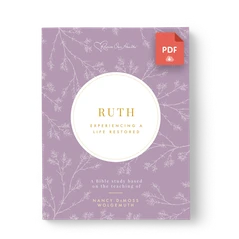
When you make a donation of any amount this month, we’ll send you a resource that will help you do just that. It’s a six-week Bible study called Ruth: Experiencing a Life Restored. This study is designed to help you slow down and apply the truths we’ve been talking about to your life. Use it on your own or gather some friends and marvel at the Lord’s redeeming love together.
Now, maybe there’s someone listening who’s thinking, This whole concept of Christ as a Redeemer is unfamiliar to me. If that’s you, I hope you’ll visit ReviveOurHearts.com/GoodNews. There, you’ll find a simple explanation of the gospel and learn how you can find redemption in Jesus.
Let’s get back to Nancy’s teaching. We’ve made it to Ruth chapter 3.
Nancy: A word that I would perhaps use as a title for this chapter is the word “request.”
We come to the place where Ruth makes a request of Boaz, who is her near kinsman, the one qualified to serve as her redeemer—her goel, if you remember that Hebrew word. She makes the request for him to fulfill that function and to continue the family line.
As we walk through this chapter, you’ll see that in the approaching marriage of Ruth and Boaz, there’s a beautiful, powerful picture of our relationship with the Lord Jesus, who is our Kinsman Redeemer, our Savior, our goel, our protector. Then we’re going to see how we as women fulfill the role and responsibilities God has for us as it relates to other men and to human authorities. So we’re going to approach this passage from a number of those different directions.
Let’s begin in verse 1, chapter 3:
One day Naomi her [Ruth’s] mother-in-law said to her, “My daughter, should I not try to find a home for you, where you will be well provided for?”
The phrase that’s translated “find a home” really should be translated “find rest.” “Should I not try to find rest for you?”
If you’ve been with us through this study, you remember that rest is one of the key words in the book of Ruth. Naomi has been looking for rest all along. She’s a restless woman, because our hearts really are restless, as one great Christian said, until they find their rest in Him.1
When I read that verse, I’m reminded of the gospel of Matthew 11:28, where Jesus said, “Come to me, all you who are weary and burdened, and I will give you rest.”
Ruth had to learn, Naomi had to learn, and we have to learn that, ultimately, rest for our hearts cannot be found in any husband, in any man, in any friend, in any counselor, in any situation, in any job, in any geographic location. Ultimately, rest for our souls is found in our relationship with Jesus Christ, and we’re going to see a beautiful picture of that here in the last portion of the book of Ruth.
As we enter into verse 2, we’re going to see a scene that will sound a little strange to our modern ears, because it’s going to draw upon some ancient Jewish culture that most of us are not familiar with. If the things that took place in this chapter happened today, they might not be appropriate. They would be out of the realm of what would be right. But in this context they’re going to be absolutely appropriate.
Naomi is planning for Ruth to ask Boaz to act for her and for them as a goel, as a kinsman redeemer—to take over their family situation and their family loss as his own. In doing this, Naomi is not just being a scheming, conniving, manipulating woman. She’s fulfilling what was understood to be, in that culture, the responsibility of the parents to make arrangements for the marriage of their children.
So she is acting, I believe, appropriately when she says to Ruth in verses 2–3:
“Is not Boaz, with whose servant girls you have been, a kinsman of ours? Tonight he will be winnowing barley on the threshing floor. Wash and perfume yourself, and put on your best clothes.”
She’s telling Ruth that she is to prepare herself as a bride prepares for marriage, believing that God has brought into their path a man who can act as a redeemer for their lost family situation.
Naomi has the faith to believe that God is going to bring this man to be a husband; again, not in any highly romanticized sense here, I don’t think, but in a sense of fulfilling God’s plan and God’s purposes for this family.
So Ruth takes this step of obedience, this step of faith—surely it was that—and as she has done at every point to this point, she just does what is required of her. She does the next thing. She’s faithful to the direction she’s given without seeing or comprehending what will be the outcome.
We pick up in verse 3:
Naomi said, "Then go down to the threshing floor, but don’t let him know you are there until he is finished eating and drinking. When he lies down, note the place where he is lying. Then go and uncover his feet and lie down. He will tell you what to do."
"I will do whatever you say,'"Ruth answered. So she went down to the threshing floor and did everything her mother-in-law told her to do.
When you are a woman who trusts in God, as we have seen that Ruth did—she had found refuge under the wings of God—then you can trust God to work through human authorities and through counsel that He brings into your life. You don’t have to figure everything out, but you can have a trust and a confidence that God is leading and moving through your circumstances. Verse 7:
When Boaz had finished eating and drinking and was in good spirits, he went over to lie down at the far end of the grain pile. Ruth approached quietly, uncovered his feet and lay down.
When she lies down at his feet, this is a picture of humility. She’s coming not as anyone who has rights, not as anyone who’s in control of this program, but as a woman who says, “I’m a poor, needy widow, and God has raised you up to be our near kinsman.”
She’s coming to let him know he’s in a position to meet her at her point of need, but she comes as one to plead, one to appeal, not one to give instruction or direction.
This is not a case of a woman initiating a courtship, initiating marriage. This is a case of a woman responding to the initiative that God has taken to make provision for her needs as a widow in that particular culture. Verse 8:
In the middle of the night something startled the man, and he turned and discovered a woman lying at his feet. “Who are you?’ he asked “I am your servant Ruth,’ she said.” [Again you see the humble heart. “Spread the corner of your garment over me, since you are [a goel] a kinsman redeemer.”
He was a relative of the deceased father-in-law and husband, and Ruth is saying that she’s requesting marriage—not for herself primarily or initially, not for her own benefit or blessing. I don’t believe Ruth is looking here for a husband for herself as much as she is for an heir for her husband and the restoration of the family lands that had been lost.
There’s nothing improper here. She is simply invoking the law of the goel, which was God’s provision for needy Israelites, and she’s asking that Boaz would fulfill this on her behalf. She’s really just fulfilling her duty, which is to help keep the family line intact.
It’s possible, as Boaz suggests later, that there were other younger men whom she might have been attracted to and gone after, but she says, “No, I’m going to follow the situation that will help redeem my family’s situation. That’s the choice I’m going to make.”
Now, she might have felt that she was really disqualified, as a poor widow, to go and approach this wealthy landowner with her request; but it’s actually her need that qualified her to have a kinsman redeemer.
And it’s our need that qualifies us to go to Jesus and say, “Will You redeem my life? Will You redeem me from destruction? Will You redeem my situation?” Satan tempts us to think that if we have failed and blown it, as we all have, and have blown it, that we’re not worthy to approach Him.
And we’re not worthy to approach the Lord to be our Redeemer—but that’s the point. It’s our unworthiness that makes us a candidate for His grace and for His provision as our Redeemer.
So we go back to verse 9, and we hear her request. She says to Boaz, “‘I am your servant Ruth. Spread the corner of your garment over me, since you are a kinsman redeemer.’”
What Ruth is asking Boaz to do for her is a picture of what God does for us when He redeems us. She’s saying, “I want to come under your covering, under your protection, and to let you take on our whole family mess, our whole situation as your responsibility,” for it was the responsibility of a kinsman redeemer to do that.
When we come as needy sinners to God, when we come through Christ as needy sinners, we’re really saying to God, “I’m coming under Your covering. I’m letting You spread Your wings, Your garment, Your mantle over me and take my whole messed up, sinful, broken, depraved life as Your own.”
We’re coming to Him, approaching Him, asking Him because He has told us we should ask Him to take on our poverty and our losses and our need as His responsibility. But then we’ve got to be willing to let Him be responsible, and not try to continue to manage it on our own.
When Ruth asked Boaz to spread his garment over her, I’m reminded of the passage in Ezekiel 16:8, where we have a parable of God taking Israel as His bride. God says, “I spread the corner of my garment over you and covered your nakedness. I gave you my solemn oath and entered into a covenant with you, declares the Sovereign Lord, and you became mine.”
That’s what salvation is all about, and that’s what living as a saved person is all about. It’s coming under God’s covering, under His protection, under the covering of the wings of God and the blood of Jesus Christ and His name. It’s saying, “I’m no longer my own. I'm handing myself, my life, my whole situation over to You. You’ve expressed Your desire to have a covenant with me, to take me on as Your responsibility, and I’m going to let You do that.”
There’s a wonderful old hymn, written in the 1700s by Charles Wesley, and part of that hymn reads this way:
Other refuge have I none,
hangs my helpless soul on Thee. . . .
All my trust on Thee is stayed,
all my help from Thee I bring;
Cover my defenseless head
with the shadow of Thy wing. . . .
Plenteous grace with Thee is found,
grace to cover all my sin.
So Ruth has been in the field of grace. She comes to Boaz now, who is going to act as her kinsmanredeemer, and she pictures for us what happens when we come to the Lord Jesus and pray to Him, as I have many times over the years, having come to Him initially in salvation but now realizing my need daily for His covering and His protection.
I say, “Lord, cover my defenseless head with the shadow of Your wing. Spread Your garment over me. Take me this day, this moment, as Your own. I come under Your covenant, I come under Your protection, and there I know that I am safe.”
Dannah: Nancy DeMoss Wolgemuth has been inviting you into a genuine relationship with Jesus, your Redeemer. That teaching is part of the series, "Ruth: The Transforming Power of Redeeming Love." You can hear any episodes you’ve missed at ReviveOurHearts.com or on the Revive Our Hearts app.
Tomorrow, Nancy upholds Ruth as an example both for our marriages and our prayer lives. There’s so much we can learn from this godly woman’s story. You won’t want to miss it. Please be back for Revive Our Hearts.
This program is a listener-supported production of Revive Our Hearts in Niles, Michigan, calling women to freedom, fullness, and fruitfulness in Christ.
All Scripture is taken from the New International Version.
1Augustine, “You have made us for yourself, and our hearts are restless till they find their rest in You.”
2Charles Wesley, “Jesus, Lover of My Soul,” 1740.
*Offers available only during the broadcast of the podcast season.