The Family Heart of God
Dannah Gresh: Redemption is more than a one-time event. It’s an invitation into the deepest kind of relationship possible. Here’s Nancy.
Nancy DeMoss Wolgemuth: God is a God with a family heart. He’s a God who comes close to us and says I want to be your nearest relative. I want to be related to you. And then He takes the steps to become related to us.
Dannah: This is the Revive Our Hearts podcast with Nancy DeMoss Wolgemuth, author of Incomparable, for February 23, 2026. I’m Dannah Gresh.
If you’re walking through the 2026 Bible reading plan with us, today we’re reading Deuteronomy chapters 11–13.
Our current series is called "Ruth: The Transforming Power of Redeeming Love." Here’s Nancy.
Nancy: We're looking at one of the most precious and rich themes in all of God's Word. It's the story of redemption. We're looking …
Dannah Gresh: Redemption is more than a one-time event. It’s an invitation into the deepest kind of relationship possible. Here’s Nancy.
Nancy DeMoss Wolgemuth: God is a God with a family heart. He’s a God who comes close to us and says I want to be your nearest relative. I want to be related to you. And then He takes the steps to become related to us.
Dannah: This is the Revive Our Hearts podcast with Nancy DeMoss Wolgemuth, author of Incomparable, for February 23, 2026. I’m Dannah Gresh.
If you’re walking through the 2026 Bible reading plan with us, today we’re reading Deuteronomy chapters 11–13.
Our current series is called "Ruth: The Transforming Power of Redeeming Love." Here’s Nancy.
Nancy: We're looking at one of the most precious and rich themes in all of God's Word. It's the story of redemption. We're looking in the book of Ruth, chapter 4, at the transaction by which Ruth and Naomi and their situation were taken over by Boaz, their kinsman redeemer.
If you've not been following along in the series, we're seeing in Boaz a picture of the Lord Jesus, who is acting as a near kinsman—it's the Hebrew word goel. It's one who acts as a protector, a rescuer, a redeemer. And Naomi and Ruth were two women who desperately needed to be rescued.
Two poverty-stricken widows, who had no hope, no future, no life, no means of making it, if God had not made a provision for them. And God did this by means of a kinsman redeemer.
In the Jewish culture, if a person was going to lose their family lands because of poverty or if there was no male heir to continue the family line, God had made an arrangement that the nearest living male relative could redeem that family, could buy back their family land and then would actually marry the widow of the deceased man and would raise up through that woman a "seed" for the man who was deceased.
So Boaz has stepped into this situation. He's been called to act as a kinsman redeemer. There was another kinsman who had a prior right to Ruth and Naomi's situation because he was a nearer relative. Boaz went to the nearer relative and said, "Do you want to redeem the land?"
The nearer relative said, "Yes, I want the land." But when he found out that Ruth came with the land, that he was going to acquire a wife, he said "Uh-uh, that would endanger my own estate." That was the phrase he used. He said, "I don't want to have this woman as part of my life. I'll take the land but not the woman."
Well in so doing, he forfeited his right to be the kinsman redeemer. He was not willing to pay the price to make the sacrifice to take on this whole situation. But, Boaz was willing!
We said earlier that in order to be a kinsman-redeemer you had to have the right to redeem. That means you had to be a near kinsman. You had to be a relative. You had to have the power to redeem. That means you had to be able to pay the price that was required to buy back the property, to take on the widow as your own. And Boaz was a wealthy landowner; he had the power to redeem.
And then you had to have the willingness to redeem. And Boaz as "a picture of our Redeemer, the Lord Jesus," said, "I am willing to redeem your situation. No matter what it costs me, no matter what it may mean to my own reputation, to my own convenience, to my own comfort—I am willing to take you and your situation under my covering."
And remember when Ruth asked Boaz to become her kinsman redeemer, she said, "Would you spread the corner of your garment over me?"
That's a picture of what is happening now as Boaz says, "I am willing to be your kinsman redeemer. I am taking you and your family and your desperate situation under my covering. I'm taking you under myself as my own situation."
Now there was a transaction required in order for the redemption to become official. And let me just go back to verse 7 of chapter 4 of the Book of Ruth.
Now in earlier times in Israel, for the redemption and transfer of property to become final, one party took off his sandal and gave it to the other. This was the method of legalizing transactions in Israel. So the kinsman redeemer [the one who had the prior right on this property] said to Boaz, "Buy it yourself," and he removed his sandal. (vv. 7–8)
Now all this seems kind of strange to us. When I bought the piece of property on which I was going to build my home, I didn't go to the real estate office and take off my shoe or ask the owner of the property to take off their shoe. This seems kind of strange. We signed some papers and we had a legal transaction.
But in the Jewish culture, in these days, to walk across the piece of property with your shoes on was a symbol of owning the property. You were in charge, you were the controller, you symbolically had the right to possess it.
But by taking off his shoe the other kinsman was saying, as was the custom, "I relinquish my right to this property. I'm giving up my right to purchase this property." So he took off his shoe, he handed it to Boaz; and here we have a transaction whereby the one who could have been the owner says, "I give up my rights." And now Boaz symbolically takes this shoe and says, "I am the owner of this property." The ownership has been transferred from one person to another.
So the other kinsman's rights to redeem has been relinquished, and Boaz is now the one who has the right to own this property and own this situation.
Then Boaz announced to the elders and all the people, "Today you are witnesses that I have bought from Naomi all the property of Elimelech, [Naomi's deceased husband], Kilion and Mahlon [who were her two deceased sons.]
"I have also acquired Ruth the Moabitess, Mahlon's widow, as my wife, in order to maintain the name of the dead with his property so that his name will not disappear from among his family or from the town records. Today you are witnesses!" (4:9–10)
So there's been a transaction here. There's a purchase price paid. The agreement is completed. There are witnesses. And now Ruth and Naomi and the property, the family lands, the family bank accounts which apparently are nothing, maybe they're even in the red, the whole family situation, is transferred to Boaz.
Now he's not becoming wealthier by taking on this situation. He is being generous and gracious and merciful by taking on this situation.
And now, it's not Ruth's problem, it's not Naomi's problem. All this poverty, all the problems with the land, now it's Boaz's problem. He has taken over their whole situation. They are not their own; they have been bought with a price.
Does that remind you of something in the New Testament? "You are not your own," Paul says to the Corinthians, "You have been bought with a price." Your life is no longer yours. Your troubles are no longer yours. Your spiritual failures and needs and problems are no longer yours.
They've been taken over by your Kinsman Redeemer. You've been bought with a price. "Therefore," Paul says, "Glorify God in your body and in your spirit which are His."
Now I don't know about you, but having that concept, that picture of a new ownership over my life does two things for me. Number one, it gives me a huge sense of relief. My life is not my own. Someone else has taken over my situation. I can lean on Him; I can look to Him; I can rest in Him. I don't have to be figuring out the whole direction of my life and how to solve all my problems. I have a new owner. I have a spiritual husband—one who says I've taken your situation as my own.
That's encouraging to me. That's comforting to me. That lets me have peace in my heart. But it also gives me an enormous sense of responsibility. I'm not my own. So I better keep my hands off my own life. I better let Him have control. He purchased me. He owns me. My life is His to do with as He chooses. He has the right to make the final decisions in every area of my life.
And so Boaz affirms in the presence of these witnesses that he is assuming from Naomi the property that had belonged to Elimelech, to Mahlon and to Kilion, that he's also assuming this widow, that he's taking on the whole situation. His purpose is to maintain the name of the dead so that his name will not disappear from among the family records or the town records.
And of course in doing this, Boaz, though he doesn't realize it, is playing a key part, as is Ruth, in bringing about the family line that will lead to the Great Redeemer, our Kinsman Redeemer, our Goel, the Lord Jesus. The child that would be born as a result of their union would be considered the child of Ruth's deceased husband and would continue that family line which, as we know, ultimately leads to Jesus.
As I was reflecting this morning on this whole matter of Boaz and what he did to purchase Ruth and her situation, and actually became a redeemer as well to Naomi, I thought about the other kinsman who was not willing to endanger his own estate in order to take on this situation. I'm reminded of that old gospel song that perhaps you've sung over the years.
I will sing of my Redeemer,
And His wondrous love for me;
On the cruel cross He suffered,
From the curse and set me free.
I will tell the wondrous story,
How my lost estate to save,
In His boundless love and mercy,
He the ransom freely gave.
("I Will Sing of My Redeemer" by Philip Bliss)
Doesn't it make you love Him? Doesn't it make you want to worship Him? Sing to Him? Honor Him? Tell others about Him?
When you think of what He took over, where God found you, where you were apart from Christ, how hopeless and helpless in desperation your situation was apart from Christ, may you realize that He stepped in.
He said "I'll take your whole situation as my own. I want to give yo u a new family line. I want to give you a heritage, a legacy. I want to allow you to be a part of the family line of Christ." What an incredible Redeemer!
Dannah: Nancy DeMoss Wolgemuth will be right back to continue exploring our redemption in Christ.
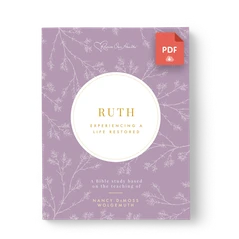
But first, I want to let you know this is the last week to request your copy of Ruth: Experiencing a Life Restored for a donation of any amount. It’s a six-week, deep-dive in the book of Ruth that you can do on your own or with a group of friends. We hope it will help you reflect on Ruth’s story and apply what you’ve learned. To give and request this resource, visit ReviveOurHearts.com, or call us at 1-800-569-5959.
The book of Ruth talks a lot about relationships. We see Ruth’s relationship with her mother-in-law Naomi, and then also her relationship with Boaz, her kinsman redeemer. If this series has led you to reflect on your own relationships and you’d like some helpful resources, we’ve got you covered. Visit ReviveOurHearts.com/relationships to find helpful insights for marriage, friendship, motherhood, and so much more!
And one kind of relationship we have here at Revive Our Hearts is our relationship with our Revive Partners. We love expressing our thanks to all our listeners who make a donation to Revive Our Hearts. And that includes our Revive Partners. They support us every month with a gift of $30 or more. Thank you so much for giving, and I hope if you’re a Revive Partner, you’re taking advantage of the perks and extra resources that come along with being one. Go to ReviveOurHearts.com/partner to learn more about that.
So far today, Nancy’s been in the book of Ruth showing us how amazing it is that we have been redeemed by Jesus. She’s back to continue teaching on this topic.
Nancy: I want us to see today that redemption is not something that just is a past tense privilege that we have as believers. We say, "Oh yes, I was redeemed twenty-five years ago when I trusted Christ as my Savior." There is a past tense sense to redemption, but there's also a very present tense to our redemption—a sense in which we are being redeemed daily as we come under the covering of our Kinsman Redeemer and we allow Him to take our situation as His own.
And then we'll see that there's also a future tense aspect to our redemption. It's not been completed yet. I want us to just look at several Scriptures that describe for us what it is that we've been redeemed from.
By way of background, let me read a paragraph from a book by Larry Richards that has been helpful to me. He's talking about the Old Testament doctrine of redemption. He reminds us that each time the word redemption appears in the Old Testament, it is cast against the backdrop of helplessness.
Each one finds human beings captured, held captive by the power of forces they cannot overcome. Redemption in the Old Testament, involves someone who is in bondage or danger. And only by the intervention of a third party, can bondage be broken and the person be freed.1
That's a real helpful summary to me of this whole matter of redemption. It references first our condition: the fact that we were helpless, that we were in poverty spiritually speaking, that we were in slavery. And the Scripture teaches us that there is no situation so helpless that God cannot redeem it. "There is no pit so deep," as Corrie ten Boom used to say, "that God's love is not deeper still."
But we will never experience the fullness and the wonder of what we have in redemption until we realize how hopeless and desperate our condition was apart from Christ.
So not only is there a helpless condition, but there's also what Larry Richards calls the "intervention of a third party," the intervention of a rescuer, a goel, a redeemer. He comes to set us free. He sees our plight and he initiates redemption. He offers us his grace, his provision, his protection, and his love.
Larry Richards goes on in this piece to remind us that . . .
Redemption is a family matter: an expression of the deepest possible relationship. It is never a stranger who has the right to come to the aid of a person who is owned by another or burdened with an unpayable debt. Only the near kinsman with the resource to rescue is able to act.
And we're reminded that God is a God with a family heart. He's a God who comes close to us and says, "I want to be your nearest relative." And then He takes the steps to become related to us. So there's this intervention that is undeserved, it's costly, it's all of love, all of grace. It's all of His mercy.
And then there's the transaction. We saw this in the last part of the passage where Boaz and the other kinsman who had a prior right exchanged a shoe symbolizing the transfer of the property, transfer of ownership. And we recalled that verse in 1 Corinthians 6 where Paul says, "You are not your own; you were bought at a price." There's been a transaction. Jesus has paid the purchase price and then has transacted to make us His own.
Now when He purchases us, what is it that He redeems us from? I want to read just several verses here from the Scriptures that talk about what it is that we've been redeemed from. I think this will make our redemption even more precious to us.
Galatians chapter 4, verses 4 and 5 tells us:
God sent his Son, born of a woman, born under law, to redeem those under law, that we might receive the adoption as sons.
The law that had held us captive, the law that we could not obey had made us its prisoners ,and Christ came to redeem us from the bondage of the law.
And then He redeemed us from the curse of the law, Galatians chapter 3, verse 13:
Christ redeemed us from the curse of the law having become a curse for us, for it is written: "Cursed is everyone who is hung on a tree."
You and I as lawbreakers were rightly under the curse, the damnation, the condemnation of the law. God would have been just to make us pay that price. But Jesus Christ, our Kinsman Redeemer, came to this earth. He took Himself the curse of the law and redeemed us from the curse of the law.
And then Romans chapter 6 tells us that He redeemed us from the power of sin. Romans 6, verse 18:
Having been set free from sin, you became slaves of righteousness.
Now notice there, we were redeemed from slavery to one thing so that we could be slaves to something else. Every person is a slave. It's just a question of who your master is. And Paul is saying here in Romans 6 that every one of us was a slave to sin. We were owned by sin. We could not be free from sin. It had a claim over us. But he said that Jesus Christ came to redeem us from sin so that we could become slaves to righteousness.
Psalm 49 tells us that Christ came to redeem us from the power of the grave and death. Psalm 49:15:
But God will redeem my soul from the power of the grave for He shall receive me.
You see, death has been conquered, and we've been redeemed, rescued, delivered from the power of death.
And then Psalm 25, verse 22 says that:
God redeems Israel out of all their troubles.
And when you get discouraged, and when it feels like your whole world is troubles pressing in on you, remember that God is in the process of rescuing you and delivering you out of all your troubles. The day will come when you will be totally set free from all your troubles. That should give your heart hope and courage.
Psalm 130, verse 8 tells us that He redeems us from all our iniquities.
He redeems us from all our sins.
That's part of the redemption. And then Titus 2, verse 14 says:
[Christ] gave himself for us so that he might redeem us from every lawless deed and purify for himself his own special people zealous for good works.
He's redeemed us from all iniquity, from every lawless deed so that we could be holy, so that we could live righteous lives, zealous for good works. And then Galatians chapter 1 tells us:
[Christ] gave himself for our sins that he might deliver or redeem us from this present evil age according to the will of our God and Father. (v. 4)
You know there are days when you wake up and you look around at what's going on and you feel like this age is so evil. And we're so much a part of the system and it feels like it's inescapable, like you just can't get away from it.
But there is a very true sense in which God has, in fact, redeemed us from this present evil age. This world is not our home. We do not belong to the kingdom of darkness. We don't belong to the kingdom of this present age. We belong to the kingdom of light, to the kingdom of Christ. We've been rescued from this present evil age.
And one day, not long from now, as you look at it in light of eternity, you and I will be delivered totally from the presence of all of that corruption, all of that evil, those things that we have had to deal with here on this earth.
And then 1 Peter 1 tells us:
We were not redeemed with corruptible things like silver and gold from our aimless conduct, our vain way of life, received by tradition from our fathers. (v. 18)
I think part of what it's saying here is that Christ has redeemed us from Christless religion, from religion without Christ, which is vain. It's empty. It's aimless. And He's delivered us from that kind of religion.
And then Psalm 103, verse 4 (I love this verse), it says:
He redeems your life from destruction. He crowns us with lovingkindness and tender mercies.
When is the last time you stopped to think about the fact that if you're a child of God, your life has been redeemed from destruction? Destruction was your lot; it was your fate. You had no choice but to have a life of destruction until Jesus Christ, your Boaz, your Kinsmanr Redeemer came along. And He has redeemed your life from destruction.
And then we see in Romans chapter 8, the day is coming when the redemption of our bodies will be complete. We'll shed this old, outer body and get away from the presence of sin, from the presence of evil, from the presence of this evil world. And we'll be eternally glorified, redeemed to enjoy life in communion with our Redeemer for all of eternity.
As you look at your past, as you look at your present and as you look at your future, how could you have anything but hope? and joy? and gratitude? and worship? as you realize that we have been redeemed. We are being redeemed. And that we will be fully, eternally redeemed.
Dannah: Nancy will be right back to pray. That teaching is from the series "Ruth: The Transforming Power of Redeeming Love." To hear past episodes or share them with a friend, visit ReviveOurHearts.com or download the Revive Our Hearts app.
And once again, visit ReviveOurHearts.com to give and request your copy of Ruth: Experiencing a Life Restored. Here’s what one woman had to say about that resource.
The Ruth study was super good! I did it along with the Women of the Bible podcast series on Ruth, and I loved being so submerged in the book. I’d never seen the gospel in Ruth before, so that was super neat!
I’ve listened to so many past episodes of Revive Our Hearts to get answers for my questions. Thank you so much for all the time and effort you have poured into this ministry! It’s truly helped me grow in my walk with Christ, and I wanted to let you know what a huge blessing it has been in my life.
What an encouraging message from this listener. Praise the Lord, and Him alone, for the ways he uses Revive Our Hearts to show women the gospel. If you’d like to donate and receive our six-week Ruth study, visit ReviveOurHearts.com, or call us at 1-800-569-5959.
Tomorrow, Nancy wraps up our series in Ruth with one final word of encouragement. God doesn’t leave his people’s stories broken. He redeems them for good. I hope you’ll enjoy the sweet resolution of Ruth’s story with us.
Now Nancy’s back to pray.
Nancy: Lord, we don't have words to thank You for how You were willing to take ownership, possession, of our situation. We didn't deserve it. We were poor and needy, separated from you, hopeless, helpless. In fact, the Scripture says that we were Your enemies.
But You loved us. You had mercy on us. You chose to make that transaction—to take ownership and possession of our lives. Lord, help us to give back to You that which rightly belongs to You now, to live as those who don't own ourselves but are owned by another.
We bless You, we love You, and our heart's desire is to not keep this to ourselves but to tell others of our wonderful Kinsman Redeemer that they, too, might come to find redemption through Christ our Lord. We pray in His name. Amen.
This program is a listener-supported production of Revive Our Hearts in Niles, Michigan, calling women to freedom, fullness, and fruitfulness in Christ.
All Scripture is taken from the New International Version.
*Offers available only during the broadcast of the podcast season.