
What Is Bible Journaling?
Dannah Gresh: If your Bible time feels imperfect—well, that’s because you’re reading with imperfect spiritual eyes. Here’s Nancy DeMoss Wolgemuth.
Nancy DeMoss Wolgemuth: Our eyes cannot see fully all that God’s Word means, but one day we will see clearly, completely, beautifully, because we will see Him face to face.
Dannah: This is the Revive Our Hearts podcast with Nancy DeMoss Wolgemuth, author of Adorned, for December 3, 2025. I’m Dannah Gresh.
Have you ever felt the urge to cover your Bible in notes, highlights, underlines, and written prayers? Well, Nancy DeMoss Wolgemuth has. It’s a practice that has become very dear to her heart, and she wants to invite you to join her in it.
You know, there is so much research out there about writing and memory. Turns out, writing engages your brain in a unique way. It can lead to faster recall, …
Dannah Gresh: If your Bible time feels imperfect—well, that’s because you’re reading with imperfect spiritual eyes. Here’s Nancy DeMoss Wolgemuth.
Nancy DeMoss Wolgemuth: Our eyes cannot see fully all that God’s Word means, but one day we will see clearly, completely, beautifully, because we will see Him face to face.
Dannah: This is the Revive Our Hearts podcast with Nancy DeMoss Wolgemuth, author of Adorned, for December 3, 2025. I’m Dannah Gresh.
Have you ever felt the urge to cover your Bible in notes, highlights, underlines, and written prayers? Well, Nancy DeMoss Wolgemuth has. It’s a practice that has become very dear to her heart, and she wants to invite you to join her in it.
You know, there is so much research out there about writing and memory. Turns out, writing engages your brain in a unique way. It can lead to faster recall, better conceptual understanding, and enhanced long-term memory. So it sounds like adding journaling into your daily Bible time could be spiritually and scientifically beneficial. We want to be able to say with the author of Psalm 119, “I will delight in your statutes; I will not forget your word.”
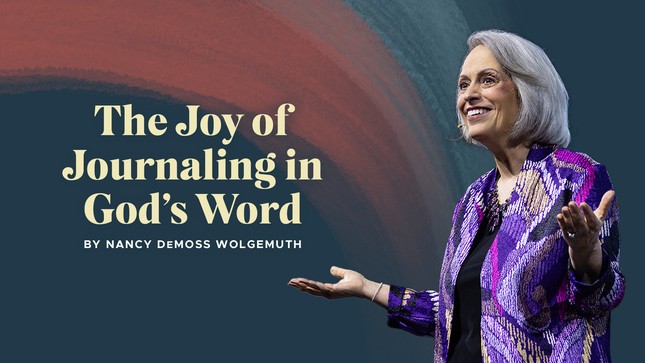
At True Woman '25, Nancy hosted a breakout session on the joy of Bible journaling, and the room was packed with women eager to learn from her. Now you get to do the same today. It's all about the “what” and the “why” of Bible journaling. What is it? And why should we do it? Here’s Nancy DeMoss Wolgemuth.
Nancy: Well, what a joy to see the number of women interested in this subject, the joy of Bible journaling. Some of you, perhaps, have never done this before, and you have a jillion questions. Or maybe you've been Bible journaling for a long time and you would just like to get some tips or hints to help you continue doing that in a more meaningful way. So this is going to be a little bit more of an informal session.
I just want to share some of my own journey and some of what I've discovered and am discovering along the way. I keep learning about God's Word and about the value and the joy of journaling in and with my Bible. But it was an amazing gift that was given to me at the end of 2017 when a precious friend gave me a notetaking Bible of the Christian Standard Bible that was a version, that was fairly new at the time. I had heard about it. I had never read it.
I like reading through different translations of the Bible from time to time. And let me say, by the way, for those of you who feel like you have one Bible with all your notes and all your underlining and you never want to change to another Bible or another translation, that's fine. But something I have found in sixty-plus years of reading the Bible is that for me, it's been a real sweet thing to switch Bibles frequently.
I have a whole row of Bibles on a bookshelf in our bedroom that I have been through, from, I think my earliest ones are probably from like junior high. I do mark them up. I use them heavily, but I use them for two or three years, some a little bit more than that, but I like starting with a fresh Bible from time to time, just because I see the pages in a fresh way. You may not want to do that, but that's been an advantage to me as I'm coming to love God's Word.
So when my friend gave me the notetaking Bible in the CSB translation, I was eager to try out the new translation. I thought I would read through it once, and then probably go back to the translation that I had been using for a number of years. As I began to read, I opened those pages, and I saw those wide margins. I've always written in my Bible. We're going to talk about that in a few moments, because that's something not everyone is comfortable doing, but I have.
In fact, I remember when I was a child, my dad encouraged us to underline in our Bible. So I would underline, underline, underline, underline. And he finally said to me, “Honey, you might just want to try underlining the things that you're not so interested in because there's so much underlining in there.” But it was just a way for me of engaging with the text, even from childhood.
I can remember an evangelist friend of my dad—actually the man under whose ministry my dad came to faith in Christ. He was visiting in our home, and he saw one of my Bibles with my little tiny handwriting. He said he was a Russian Jewish Christian Baptist evangelist. He saw my little writing, and he said in his very thick Russian accent, “Young woman, you want to write larger, because when you are old, you will not be able to see all those notes.” Well, now I am old, and I'm still writing small. But thankfully, the Lord has blessed me with good eyesight. So far, I can still read this. Not many other people can, but I can.
So, I've been accustomed to writing in my Bible and making notes. I would love writing cross references. I would read something and it would remind me of something I had read in another part of the Bible. In fact, I prefer personally (this is not a conviction) Bibles without the cross references in the margin or on the bottom, because I like to come up with them myself. Maybe that's a firstborn thing, but I like to as I'm reading through the Bible, I like to think back to, “Where did I see this?” or “Where did I see a reference to this?” or “Where was that referred to?”
So I'm reading in Leviticus, what does that remind me about something I read in Hebrews or somewhere else? So that's making me think and engage with the Bible. I would write those references down. I would write short little prayers. These are in many Bibles over the years.
So I was accustomed to writing in my Bible. There was never enough room, and I wanted to be able to engage more. I would write my notes, pondering about and meditating on the Scripture in another journal or notebook or something like that. That's what a friend had transcribed for me years earlier. So I was in the habit of Bible journaling, but it was a joy to do it in a different way with a journaling Bible. We'll talk about the difference between those in just a moment.
So I opened to Genesis 1, January 1, 2018. And it's, “What do I write?” Like there's so much you could write on Genesis 1. You could write a book, or books on Genesis 1. It's a really important chapter in the Bible. It's so foundational, so what am I supposed to write? I found myself a little intimidated. I'm mentioning that because we surveyed some women on Facebook a week or two ago and just said, “What has been your experience with Bible journaling? And what questions do you have? What have you enjoyed about it?”
One of the things that came back from so many people was, “It's intimidating to know what to write, what to put down,” and “I don't want to mess up my Bible.” I had many of those same feelings, because it's a brand-new, beautiful Bible. I didn't want to do it wrong. Some of you firstborns, many of you have similar thoughts. So we'll talk about some of those apprehensions.
But I began to just write as I would seek the Lord. “What do you want me to see in this passage today?” To make it a conversation with the Lord, which is really what we aim toward in our devotional life, our quiet time. We're listening to God speak to us through His Word, by His Holy Spirit, and then we're responding.
As I began to write, I would take my time. I wasn't in a hurry. I didn't say how long I'm going to take to do this. In fact, I did the Old Testament in two years, but it took me three years to do the New Testament. I had to add a lot of pages because I was running out of space in the journaling Bible. I think in Romans 12 I wrote like something like 8,000 words or something. That's crazy. But there were no deadlines, there was no hurry. There was no thought of publishing these notes. This was not intended to be read by anybody else.
It was time with the Lord, and I began to think of that time as my happy place. It became such a joy for me. When Robert and I would get together over dinner or whatever, I would be sharing, “Can you believe I just saw this today?” There was an excitement growing about what I was discovering, the joy of discovering the Word of God. So, I came to really appreciate the Christian Standard Bible, which, if you're wondering about that, has a lovely combination of being accurate, true to the original languages and the text, but also being very readable and accessible.
There's a whole range of Bibles. Some are very accurate—just word for word, literal translation. But the way it is worded can be a little more wooden or a little harder for modern readers. Then you have some translations or even paraphrases that are much more thought for thought, not quite as accurate to the original text, but it can be read by a third grader. Then you have some wonderful translations that do their best to . . . These are English translations I'm speaking of, but the same philosophy is true in other languages, where you want that blend of it's true, it's faithful, it's accurate, it's not adding the translator’s interpretation to the text. But they're also using syntax and language that we speak today.
So I found the CSB to be readable and accurate. Now, I'm not a Greek or Hebrew scholar, so I'm just telling you to the best of my understanding, that is what I found. So, I have actually transitioned to the CSB. There are other good translations. I don't want to say it's the only one. There are other very good translations. But I've been really thankful now to be partnering with the publishers of CSB. I just want people reading the Bible, and I want them engaging with it. So that partnership has been a sweet thing, and I'm now primarily teaching from the CSB. I will often reference another translation for a particular verse, but so I commend it to you from that standpoint, if you're looking for a new Bible. I
n the process, I was posting on social media occasionally about my journey of Bible journaling. I love doing everything I can to engage women with the Scripture. So I share that on my journey, not because I was eager for them to read everything I wrote on those pages, because some of it is like, it's not complete sentences. Some of it's just bulleted thoughts.
I've come back and found some things I wrote there that I don't even agree with anymore. So nothing you or I write in our Bible is inspired. None of it's inerrant, none of it's infallible. What's inerrant and infallible and inspired is the text. So that's what we stick to. But this is our engaging with the text. And you say, “Well, maybe it's not all perfect. Maybe it's not all right.”
If you're a mom and you have a four-year-old who writes you a letter and it's got messy handwriting and things crossed out and bad grammar and misspellings; are you going to say, “You should have done better than that?” No, you're thrilled that your child wanted to write you a letter. You know that when they're in fourth grade, or when they're fourteen or they are thirty-four, they're going to write differently as they grow up. But you're very welcoming of what they have to offer at that juncture.
So if you're new to the Bible, if you're new to Bible journaling, maybe you're not really comfortable writing things out. You say, “I'm not a writer.” This is not a professional skill we're talking about here. It's okay to be young at this, to be new at this. I've been studying and reading the Bible for over sixty years, and I'm constantly learning new things. “Why did I never think of that?” Part of me is going, “I don't give up. Keep pressing.” We know now we see dimly as through a glass that’s dark. What our eyes cannot see fully, what all that God's Word means. But one day we will see completely, clearly, beautifully, because we will see Him face to face. We will know Him now in a way we can't fully do now.
So let me just in the moments we have together, I wish we were kind of sitting in our living room and we could be having a conversation about this. I'm trying to pull out some of the things that women posted on that Facebook inquiry I did a couple weeks ago. If I could just be sharing my heart with you, and some ideas that I hope will be helpful to you. I want to just briefly talk about the what is Bible journaling, and then the why, some of the blessings and benefits. And then what I know is a place a lot of us like to start, and that's with the how—just some tips for doing it. And we'll get to some of those. There are many more of those than what I'll have time to share here that are in the opening pages to the new CSB notetaking Bible, the Revive Our Hearts edition. So if you pick that up, you won't need to take notes on everything I say today, because much of this will be in there.
But we have to start with the what and the why before we get to the how. Because if we just do the how without knowing why we're doing it, we're going to maybe get discouraged and give up. So what is Bible journaling? Bible journaling is writing, whether you do it digitally or with an actual pen. It's journaling. It's writing as you read God's Word.
Now, there are other kinds of journaling. There's journaling your thoughts, your emotions, what happened in your day. Those things occasionally will appear in my Bible journaling as I'm going through something that a particular text speaks to me about. When that's in my notetaking Bible, I'll put a little "p" with a circle, which means, if anybody's transcribing this, this is private, like, don't publish this. But mostly, there's other ways to journal your day, your experiences. Have kind of a diary.
This is writing about God's Word as I read God's Word. Bible journaling or Bible notetaking—same thing—is a tool. It's a tool. It's a way of meditating on Scripture and engaging more deeply with it. There are a number of ways of meditating on God's Word. Writing isn't the only one. It may not even be the most important one, but I have found it to be a very helpful one.
The goal is not to fill up the lines on those in those margins. The goal is not to have something that can be photographed as beautiful handwriting or something that could be published. The goal is to get into God's Word and get God's Word into you. I find if I'm writing as I'm reading God's Word, I'm reading it and I'm thinking about it. I'm processing, and I'm mulling it over, and then I'm writing what is on my heart as I read it. If I did this the same passage the next week, I would probably write something different. But I'm processing. I'm meditating on the Word of God.
Bible journaling, notetaking, if this is something that is maybe a little foreign to you . . . I see a lot of people in this conference, and I lot of people in church as they're listening to the messages, they've got a pen and a paper and a notepad, and they're making notes. Why do you do that? Well, you're taking it in. You're trying to capture key points of what's being said. You're trying to capture the main takeaways. You're not trying to get every word that's being said, but you may want to go back and review what it is that you heard.
Even if you have piles of those notebooks that you've taken sermon notes in and you never go back and review them, you're learning more if you're using multiple senses as you listen to a sermon or as you read the Bible. If you just listen—and listening is really important—you're going to take in a certain percentage of what's being said, but you have other things going through your mind too. Am I right? But if you're writing as you're listening, you're using another sense, and you're going to take in more. You're going to be actively engaging with what you're hearing.
So Bible journaling is writing as you read God's Word. We'll talk about what kinds of things you can write. But then, just as a subpoint there, that's Bible journaling. What is a journaling Bible? That's not the same as Bible journaling. What is a journaling Bible or a notetaking Bible? Bible journaling is a tool for meditating on Scripture. A journaling Bible is a tool for Bible journaling. Do you get that? Would it help if I said it again? So Bible journaling is a tool for meditating on Scripture, and a journaling Bible is a tool to help you do Bible journaling.
So there's nothing sacred. There's something that's very sacred about this Book, but about this particular brand or type of Bible with margins and lines, it's just a tool. It's a resource. If it's helpful to you, use it. If it's not, do something else. But make sure you're doing whatever you can to get into the Word and get God's Word into you.
Now, some people have said, “I can't bring myself to write in my Bible.” Just be honest, there's no sin in this. Are there some of you who have felt or do feel that way? It's just hard for you. If you felt that way, maybe you wouldn't be in here. But we have some. I know many have expressed that. Some have said, “I prefer doing it in a notebook.” To which I say, “Great. Do whatever helps you connect with God's Word.” You don't have to use a special Bible with margins and lines in it. You can use a spiral notebook or a separate notebook or a journal or a digital journal. I've done all of these over the years with great blessing. But for me, using the CSB notetaking Bible . . . This is actually the second one. But journaling this way in the Bible has been a fresh experience for me. Anything that freshens your walk with God is a good thing.
It's been a different way of engaging with the text as I'm making notes right next to the text. So for me, that's been huge in my life, in my meditation on God and His Word. It helps me connect my notes more directly to the text. Now, there are notetaking Bibles available today in other translations. Say this is the translation I'm going to use. Chances are they have a notetaking or journaling Bible available.
I'm very thankful for the ones that are available through CSB, the Christian Standard Bible. It has been a joy to partner with our friends at CSB, to produce a special edition CSB notetaking Bible Revive Our Hearts edition. We have three beautiful cover options. The contents are the same in all three—the floral one, the denim or blue one. Two are hard cover, and then the green sage is a kind of leatherette. They're beautiful inside and out. They're wonderful to hold and handle, and inside you'll find those suggestions for Bible journaling.
You'll find some samples from my notetaking Bible pictures of those. You'll also find 150 prayers that I wrote as I was journaling through the Bible interspersed. It'll give you an idea of how you can write your own prayers. The prayers that are in there, I've edited them in such a way that they aren't just mine, but they can be yours too. You can make them your prayer, but then write your own prayers as you're engaging with the text. So those prayers are another helpful tool in Bible journey.
And again, if you've never tried it before, I'm going to encourage you to try. And, try if you've done it before, maybe something you hear today will help freshen that up for you.
So, what are some of the benefits and blessings of Bible journaling? And let me just highlight a few of those. It affects how you read the Word if you're journaling, if you're taking notes as you're reading the Bible—whether it's in the Bible or in a separate notebook. It changes the way you read the Bible, how you take it in.
Let me read to you what a few woman wrote to us in that Facebook post. People said:
- It helps me slow down, meditate, reflect on, and pray through Scripture.
- It helps me to understand and retain.
- It's helped me linger longer in the Word. [I love that!]
- It has really helped me in my faith.
- There's something about taking notes in your Bible that cements truth in your mind.
- When I take time to write down what God taught me, I give it more thought as I write it out in words, and the lessons stay with me longer.
- I had never done Bible journaling before receiving the Revive Our Hearts Notetaking Bible. So, I'm a newbie. I read the hints in the front of the Bible and dug in. It really has changed the way I study God's Word. It makes me slow down and connect with what I'm reading. I found it a rich way to study God's Word.
Amen. Mission accomplished! That's the goal. So, it changes the way that you read, but it also becomes a record of what God has taught you, of your spiritual growth, of His dealings in your life. One woman said:
Journaling is a wonderful way to go back and see where I've grown, what the Lord has taught me, and how He's been working in my life over the years. Since becoming a Christian forty-three years ago, I started a Bible journal, which also contained my prayers. I still have all of them. It is quite something to pull out the journals that I wrote as a young, twenty-one year-old believer and see the journey that unfolded over these years. It is a record of my walk with the Lord, and my grown children and grandchildren will be able to refer to them when I go to be with the Lord.
So, it's a record for your own heart of what he has taught you. It's also a way to record your responses as you read God's Word, including prayers, your submission to the Word of God, your commitment to obey Him. It's a way to write that down which holds you more accountable. “God, by Your grace, I'm saying, ‘Yes, Lord,’ to what You have said in Your Word.”
And then here's another why. It's not the most important one, probably, but it's a sweet one. That is that this Bible or journals where you've done Bible journaling, they become a treasure to share with others, including future generations. One woman said:
My plan is to journal through the Bible for each of my grandchildren and give my journal and notes to them.
Another woman said:
My mom had a Bible with large margins for notes. After she passed away, my dad, who was not yet a believer, read her Bible with the notes. I think it had a great influence on his salvation.
I mean, who would have thought? Would that woman have thought when she was making those notes? She knew that she had an unbelieving husband. Was she writing those to be a gospel tract for him? Probably not. But that's how God used that. Here's one. This woman said:
From the time I was in elementary school, I observed my parents writing in their Bibles. [You may have young children right now, and you don't think about how maybe they're watching you engage with God's Word.] This had a big impact on me. I've been keeping notes in my Bibles since at least junior high. My parents are no longer alive, and I have inherited their Bibles. What a blessing it is to have their notes. My goal is to have multiple Bibles with notes when I die, so each of my children gets one. God's Word is a treasure, and I hope my children will treasure this inheritance from me one day, more precious than any other inheritance you could leave for them—a godly life, a holy life, a faithful life, and a record of your relationship with God in His Word.
Dannah: Don’t you just love that? When I heard Nancy say that, I started to a desire to leave behind a legacy of faith with my children and grandchildren—something to remember, cherish, and learn from. Bible journaling is a wonderful way to do that!
If you’re interested in purchasing a CSB Notetaking Bible, Revive Our Hearts Edition, then I have some wonderful holiday news for you! Our celebrate the season sale is going on right now over at ReviveOurHearts.com/store. It’s the perfect opportunity to save on meaningful Christmas gifts for friends and family. The CSB Notetaking Bible is available at a discount, and so many of our other books and resources, too. You don’t wanna miss it! Again, head on over to ReviveOurHearts.com/store to shop.
One of my holiday traditions is that everyone I buy for in my family gets at least one Bible-directed tool under the tree. You might wantn to adopt that tradition too.
Well, we shared at True Woman that the conference that we are launching a six-year initiative called Wonder of the Word. The best way to say it is: this is a huge deal! In 2027, Nancy will be teaching through the entire Bible—Genesis to Revelation—right here on the Revive Our Hearts program. I know that's a long ways away. But on top of that, we’re also reading through the Bible together in 2026. We’ve got a plan all prepared for you, and we’re gonna walk you through it starting in January!
Earlier this week, you also learned about the upcoming launch of the Wonder App for teen girls. It’s all about including them in this read through the Bible experience in 2026. We want to help them delight in the Word.
All this is just the tip of the iceberg. So much more is coming in the next six years—and we believe the Lord is able to use the Wonder of the Word initiative to transform generations. But we can’t do it without you. If Revive Our Hearts’ vision for these upcoming years of ministry excites you, if you want to advance our mission of helping women of all ages embrace the wonder of God’s Word, then we invite you to join us through a gift of any amount.
Now here’s some exciting news. All December long, when you donate, your contribution will be matched dollar for dollar, doubling your gift—and your impact! This is thanks to a group of generous donors who have chosen to partner with us. We’re seeking to be faithful stewards of this ministry and get ready for another year of ministry, and we need your help to make it happen. If you’d like to donate today, visit ReviveOurHearts.com and click “donate.” Or you can call us at 1-800-569-5959.
Tomorrow, we’re listening to the rest of Nancy’s breakout session, "The Joy of Bible Journaling." She gets super practical and lets you in on all her favorite tips. Please be back for Revive Our Hearts.
This program is a listener-supported production of Revive Our Hearts in Niles, Michigan, calling women to freedom, fullness, and fruitfulness in Christ.
*Offers available only during the broadcast of the podcast season.
Support the Revive Our Hearts Podcast
Darkness. Fear. Uncertainty. Women around the world wake up hopeless every day. You can play a part in bringing them freedom, fullness, and fruitfulness instead. Your gift ensures that we can continue to spread gospel hope! Donate now.
Donate Now

