
Don’t Miss Jesus in Your Bible Reading
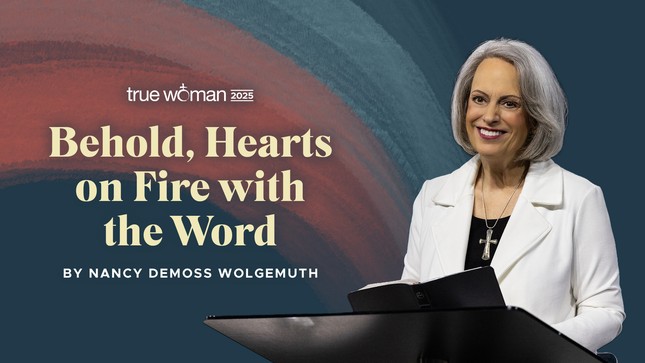
Dannah Gresh: At the end of the recent True Woman conference, Nancy DeMoss Wolgemuth wanted each and every woman to remember one thing.
Nancy DeMoss Wolgemuth: Listen, if you know this Bible from left to right, front to back, inside and out, but you miss Jesus, you will miss life.
Dannah: This is the Revive Our Hearts podcast with Nancy DeMoss Wolgemuth, author of Incomparable, for November 18, 2025. I’m Dannah Gresh.
Last month, thousands of women gathered together in Indianapolis and online to behold the wonder of the Word. It was a weekend of spiritual refreshment, fellowship, and soaking in the transformative truths of Scripture. But you know what? Sometimes it’s hard to leave a beautiful, worshipful weekend like this and step back into ordinary life. That’s why, at the end of our time together, Nancy DeMoss Wolgemuth gave one last message to send us …
Dannah Gresh: At the end of the recent True Woman conference, Nancy DeMoss Wolgemuth wanted each and every woman to remember one thing.
Nancy DeMoss Wolgemuth: Listen, if you know this Bible from left to right, front to back, inside and out, but you miss Jesus, you will miss life.
Dannah: This is the Revive Our Hearts podcast with Nancy DeMoss Wolgemuth, author of Incomparable, for November 18, 2025. I’m Dannah Gresh.
Last month, thousands of women gathered together in Indianapolis and online to behold the wonder of the Word. It was a weekend of spiritual refreshment, fellowship, and soaking in the transformative truths of Scripture. But you know what? Sometimes it’s hard to leave a beautiful, worshipful weekend like this and step back into ordinary life. That’s why, at the end of our time together, Nancy DeMoss Wolgemuth gave one last message to send us off well. We’re listening to part one today. Here’s Nancy DeMoss Wolgemuth.
Nancy: I invite you to turn in your Bible to the Gospel of Luke, chapter 24. It's a longish chapter, and I'm going to attempt to walk through most of it, just a little bit as a tour guide, not in any deep way. But I want to pull out a few things for you to take home as we go from this place.
I want you to notice as we read through this chapter, much of it, the centrality of the Scripture, the Word of God. I had never noticed all the times you see it in Luke 24. We see the written Word. We see the living Word. And when we get to those verses that particularly talk about that, I'm going to have them on the screen and highlighting where we see the references to the Word in this chapter. We'll see that the Word of God is life-giving and life-changing.
Now you're in Luke 24. I'm going to pick up just at the very end of Luke 23 just to give us some context where we are. Chapter 23 details Luke's account of the crucifixion as Jesus is executed. He's hung to die between two criminals. We read about how at noon darkness falls on the earth for three hours, how the curtain in the temple is torn so that access to God can be granted. And Jesus breathes His last and He dies.
Chapter 23, verse 49:
But all who knew him, including the women who had followed him from Galilee, stood at a distance, watching these things.
Now then in the next verse and the several verses following, we see how Joseph of Arimathea takes Jesus' body down from the cross. He places it in a tomb, and we learn that the Sabbath is about to begin. So it's coming to dusk on Friday. We see that the women who had stood there watching at the crucifixion continue to follow the body of Jesus all the way, in verse 55. They observed the tomb and how His body was placed.
Then they returned and prepared spices and perfumes. And they rested on the Sabbath [sundown on Friday to sundown on Saturday] according to the commandment. (v. 56)
That's the first reference I see to the Word of God in this extended passage. These women knew God's Word, even though they did not have copies to hold in their hands as we are blessed to do.
Even in the midst of this enormous loss and grief and pain, they kept His commandments faithfully. God had rested on the seventh day. God had commanded that the Sabbath day be observed and kept holy. So here they are. You think they could say, “But this is a good excuse not to keep God's command.” But they obeyed the Word of the Lord.
Then we come to chapter 24, verse 1.
On the first day of the week [that would be in our week, Sunday] very early in the morning [those same women] came to the tomb, bringing the spices they had prepared.
And you remember how when they got there, they found that the stone had been rolled away. The body of Jesus was gone and there were two men, the Scripture says, who appeared to them in dazzling white clothes. They were angels. We know this as you put the gospel accounts together, and the women were terrified. Of course they were. What in the world is going on? And these men said to them, verse 5:
“Why are you looking for the living among the dead? He is not here, but he has risen!” (vv. 5–6)
Now you think of Easter services, and, “He has risen. He has risen indeed.” And you think, Oh, this is so glorious. He is risen. But that message is not what these women were expecting that morning. They were expecting to find the lifeless body of the one they had followed and loved. But these men said to them:
“Remember how he spoke to you [the Word of the Lord] when he was still in Galilee, saying, ‘It is necessary that the son of man be betrayed into the hands of sinful men, be crucified, and rise on the third day’?” And they remembered his words. (vv. 6–8)
The midst of their confusion, their sorrow, their fear, they needed to be reminded of the words Christ had spoken to them. It was the Word of Christ that turned their terror into clarity and faith and eventually to great joy. It's the Word of Christ that gives us peace in the midst of circumstances for which there is no human explanation, no making sense of it, crazy, confusing, mixed up, messed up. They remembered His words.
You go back to your confusing workplace or home or even church. You may be facing that. We must remember His Word. Verse 9:
Returning from the tomb, they reported all these things to the Eleven and to all the rest. Mary Magdalene, Joanna, Mary the mother of James, and the other women with them were telling the apostles these things. But these words seem like nonsense to them, and they did not believe the women. Peter, however, got up and ran to the tomb. [We know from John 20 that John, the apostle was with him also.] When Peter stooped to look in, he saw only the linen cloths. So he went away, amazed at what had happened. Now that same day . . . (vv. 9–13)
This is Sunday still. This is Resurrection Day. This is going to be a long day for several people in this story. The women had started very early in the morning going to the tomb. Now that same day, we come to a new scene:
Two of them were on their way to a village called Emmaus. (v. 13)
This was about seven miles from Jerusalem. Verse 18 will tell us that one of these was named Cleopas, so we know that one was a man. We're not told who the other one was. It may have been the wife of Cleopas. It may have been a man friend, two disciples walking. We know one was a male. We know there were two of them. The text indicates when you put it all together that these two were among those who had witnessed the crucifixion. They had heard the women's report about what they had seen and heard at the tomb. And they were among those who thought the women were losing it and did not believe the women. So verse 14:
Together [these two disciples, these two followers of Jesus] were discussing everything that had taken place.
They were no “just” bystanders, no “just” tourists. They were part of this whole group of followers of Jesus. They were discussing everything that had taken place.
And while they were discussing and arguing . . . (v. 15)
I just don't know what they were arguing about. And apparently we don't need to know, because Scripture doesn't tell us. But they were discussing and arguing. And while they were having this heated conversation, I love this:
Jesus himself came near and began to walk with them. (v. 15)
How precious is this? How many discussions and even arguments are going on among believers today about things that are taking place in our world, in our country? There's so much confusion. There's a lot of discussion, a lot of arguing. I'm so thankful that Jesus himself draws near to us in our times of confusion. He is with us. He is in us. And He walks with us by His Spirit and enters into our conversations and into our confusion.
He will do this for you in your home. He will do this when you're having an argument with your husband or with your teenager or with your two-year-old . . . and your two-year-old is winning. Jesus Himself will come to you by His Holy Spirit in you and walk with you. And what He will do in those next moments will change the whole scene. Verse 16:
But they were prevented from recognizing him.
The Holy Spirit has to open our eyes to recognize Jesus. They had just been with Him. They had been with Him perhaps for a very long time. But in this moment in Jesus' glorified body, their eyes were not yet open to perceive, to behold who Jesus was. Verse 17:
Then he asked them, “What is this dispute that you're having with each other as you are walking?” And they stopped walking and they looked discouraged.
Your translation may say they “looked sad.” That just describes it. There's kind of a pall over this. These two, they're sad. They're discouraged. They're arguing.
The one named Cleopas answered him, “Are you the only visitor in Jerusalem who doesn't know the things that happened there in these days?” [I love verse 19.] “What things?” he asked them.” (vv. 18–19)
What things? Are you kidding? What things? They're thinking, You don't know? Like, you haven't been watching the news? You haven't been following this!? Of course, Jesus knew what they had been discussing. He knew what things had been going on. He knew they were dejected and discouraged. But I love that before answering their questions or addressing their emotional distress, he wanted them to tell him what they were thinking, what was troubling them. He didn't just launch into the answer as we are often prone to do with people who are in distress.
Because he said to them, “What things? Like, tell me what is bothering you?” And they said to him in this next paragraph, here's their answer.
“The things concerning Jesus of Nazareth who was [past tense] a prophet powerful in action and speech before God and all the people and how our chief priests and leaders handed him over to be sentenced to death, and they crucified him. But we were hoping that he was the one who was about to redeem Israel. Besides all this, it's the third day since these things happened. Moreover, some women from our group astounded us. They arrived early at the tomb, and when they didn't find his body, they came and reported that they had seen a vision of angels who said he was alive. Some of those who were with us went to the tomb and found it just as the women had said, but they didn't see him.” (vv. 19–24)
So here they dump out on Jesus who just said, “What things?” their jumbled, confused, depressed, mixed-up thoughts, while Jesus listened patiently.
Aren't you glad He does? He can handle our jumbled, confused, mixed-up thoughts.
These men knew Jesus, they cared deeply about Him, but their hopes had been dashed. “We were hoping that He was the one who had been promised, the one who was to redeem Israel.” The pieces weren't fitting together. “We were hoping, but now He's dead—although there's a rumor that He's alive. What in the world is going on? This is not what we had hoped for!” They're disappointed. They're discouraged, maybe a little bit mad.
Isn't that the way we feel at times? We were hoping, but things are not as we had hoped in this broken, mixed-up, messed-up world. Yes, we know Jesus. Yes, we love Him, but we live in a broken world, a world of pain, a world where evil seems to triumph—perhaps in your own home, perhaps in your workplace, perhaps in your community. The righteous suffer in some parts of our world today.
I was just reading this yesterday or this morning about thousands of Nigerian Christians who have been killed for their faith in the last couple of years, and you almost never see it in the news. But that is the real world where they are living today.
We were hoping that He would rescue us from our enemies. We were hoping that those who trusted in Him would be safe because isn't that what it says in the Psalms? I was hoping that He would salvage my marriage. I was hoping that my prodigal would return. I was hoping He would bring me a godly mate or that He would give me a child. I was hoping, we were hoping, that He would fix this mess. We were hoping.
So how did Jesus respond to these two? Well, notice how He did not respond. He didn't say, “Look, it's me. I'm not dead anymore! I'm alive. Like, it's really me. Cheer up!” What did He say? Verse 25:
“How foolish you are, and how slow to believe all that the prophets have spoken. Wasn't it necessary for the Messiah to suffer these things and enter into his glory?”
That, by the way, was the same thing that the angels had said to the women when they went to the tomb. Verse 6 of chapter 24:
“Remember how he spoke to you saying, 'It is necessary that the Son of man be betrayed into the hands of sinful men, be crucified, and rise on the third day'?”
Taking these disappointed hopes, dashed disciples, back to the words of Jesus. So now when Jesus spoke to the disappointment and the dashed hope of these two disciples, where did he begin? He took them to the Word—and not to some psalm that you always read to comfort people when they're in distress. He took them to the Old Testament prophets. It’s not necessarily where I would think of starting to give comfort and encouragement to someone who is distraught and hurting. My mind wouldn't just naturally go to the Old Testament prophets in that moment.
But Jesus knew the Scripture was exactly what they needed, and He knew which Scriptures they needed. The Old Testament Scriptures made clear that it was necessary for Messiah to suffer before He was glorified.
Little parenthesis here. If Jesus had to suffer before entering into His glory, how much more so is that true for us? First the cross; then the crown. First we die to self; then we live to God.
But these disciples were having a hard time connecting the dots. They had studied Moses. They had studied the prophets. They could likely quote them to others. These early Jewish followers of Jesus knew their Bibles than most New Testament Christians know their Bibles. But it didn't fit together to them.
So verse 27, “Beginning with Moses . . .” the Pentateuch. We're talking Leviticus and Deuteronomy. I mean, again, is that where you turn to explain how life makes sense to people? Tell them who Jesus is. Is that where you start? Well, that's the Scriptures Jesus and those disciples had.
So beginning with Moses and all the Prophets, he interpreted for them the things concerning himself in all the Scriptures.
Until Jesus came to them, as well as they knew these Scriptures. Until Jesus explained these Scriptures to them and shed light on these Scriptures, they didn't understand that those Old Testament prophecies and writings of Moses were about Jesus. Jesus explained it so they could understand that.
It reminds me that you and I are dependent on the Spirit of Jesus, the living Word of God, to make the written Word understandable to us and to lead us to Christ through His Word. We can't do it. We don't see it. I know people who are very smart, much smarter than I. And people who know their Bible . . . you'll sometimes see some of them on some podcasts and TV shows. Some of them really know their Bibles, but they don't know Jesus because their eyes haven't been open. They haven't let the Holy Spirit point them to Jesus in this Book. It's possible to know and be familiar with the Scripture but miss the point of it all. It's possible for our Bibles to be marked up and highlighted, and you've written in the margins of your notetaking Bible, and you've memorized, and still to miss Jesus.
Jesus had said at one point during His earthly ministry here to the Pharisees, John chapter 5:
You pore over the Scriptures because you think you have eternal life in them, and yet they testify about me. But you are not willing to come to me so that you may have life. (vv. 39–40)
Listen, if you know this Bible from left to right, front to back, inside and out, but you miss Jesus, you will miss life.
Let me just say a word here of caution because we've had a whole weekend where we have exalted His name and His Word above all things. We love the written Word of God. We treasure it. We trust it. We want to obey it. But we don't worship the written Word. We worship the One whose Word it is, and the One who reveals it to us. We worship Christ, the living Word of God. The Pharisees worshiped the scrolls. We worship the God who spoke these words, whose breath inspired these words, who gave them to us to reveal Himself to us. We worship Him—Father, Son, and Holy Spirit. Done with the parentheses there.
When the disciples were confused and discouraged, it was the living Word that pointed them to the written Word. Jesus came alongside of them. He's the living Word. They don't recognize Him yet, but He pointed them to the written Word, and it's the written Word that pointed them to the living Word. That's the way the Word works in our lives. Look at verse 28.
They came near the village where they were going, and he gave the impression that he was going farther. But they urged him, “Stay with us, because it's almost evening and now the day is almost over.” So he went in to stay with them. It was as he reclined at the table with them that he took the bread, blessed and broke it, and gave it to them.” (vv. 28–30)
We've seen Jesus do that at least a couple other times in the gospels: the feeding of the five thousand, at the Last Supper there with his closest disciples. He took it. He blessed it. He broke it, and He gave it to them. Verse 31:
Then their eyes were opened.
They recognized Him. It's Jesus. That's who we've been reading about. That's who we've studied. That's who we've walked with, who we've known, but now we behold Him." This is a supernatural work of the Holy Spirit of God.
Dannah: Amen. We don’t want to miss life! That means we need to read the Word, not to check a box, but to see Jesus.
To help you behold Jesus in the pages of Scripture, we’re inviting you to join us for the 2026 Bible reading challenge. Starting in January, we’ll be reading through the whole Bible together, and we’ll find that every single page is pointing to Christ. To learn more and express your desire to join us, visit ReviveOurHearts.com/bible2026.
Also, to help you keep track of your daily Bible reading in 2026, our design team has created a beautiful and functional calendar for you. It’s designed to not only help you track what day of the week it is, but also what Bible passages you’re reading that day! Request yours today for a gift of any amount. Just visit ReviveOurHearts.com, or call us at 1-800-569-5959.
Tomorrow, Nancy’s wrapping up this powerful closing message. It was a beautiful way to end a beautiful weekend together. Please be back for Revive Our Hearts.
This program is a listener-supported production of Revive Our Hearts in Niles, Michigan. Calling women to freedom, fullness, and fruitfulness in Christ.
All Scripture is taken from the CSB.
*Offers available only during the broadcast of the podcast season.
Support the Revive Our Hearts Podcast
Darkness. Fear. Uncertainty. Women around the world wake up hopeless every day. You can play a part in bringing them freedom, fullness, and fruitfulness instead. Your gift ensures that we can continue to spread gospel hope! Donate now.
Donate Now