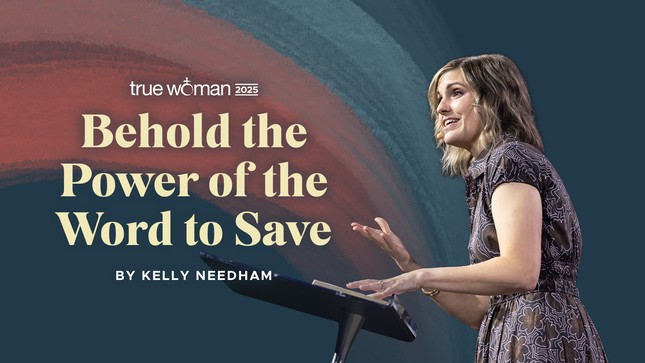

Behold the Power of the Word to Save
Dannah Gresh: Let’s get real honest for a moment. Does the thought of sharing the gospel with that neighbor, coworker, or friend fill you with anxiety—even just a little bit? You’re not alone. Here’s Kelly Needham.
Kelly Needham: Do you feel too young, too old, not well-spoken enough? "I don't know the things to say. I don't have all the right answers." If you are in Christ, you are the right person, and you may be the only person in that person’s life who is saved.
Dannah: This is the Revive Our Hearts podcast with Nancy DeMoss Wolgemuth, author of The Power of Words, for November 17, 2025. I’m Dannah Gresh.
Nancy DeMoss Wolgemuth: Do you ever think that you’re not the right person to share the gospel with a non-believing friend? That maybe you won’t have all the answers? Or that maybe that you’ll offend …
Dannah Gresh: Let’s get real honest for a moment. Does the thought of sharing the gospel with that neighbor, coworker, or friend fill you with anxiety—even just a little bit? You’re not alone. Here’s Kelly Needham.
Kelly Needham: Do you feel too young, too old, not well-spoken enough? "I don't know the things to say. I don't have all the right answers." If you are in Christ, you are the right person, and you may be the only person in that person’s life who is saved.
Dannah: This is the Revive Our Hearts podcast with Nancy DeMoss Wolgemuth, author of The Power of Words, for November 17, 2025. I’m Dannah Gresh.
Nancy DeMoss Wolgemuth: Do you ever think that you’re not the right person to share the gospel with a non-believing friend? That maybe you won’t have all the answers? Or that maybe that you’ll offend someone? Kelly Needham is a wife, mom, and the co-founder of the ministry Teach Equip, and she's a longtime personal friend. Here's what she wants you to know: those fears keeping you from sharing the gospel don’t have the last word. You don’t have to let them win.
Last month at True Woman '25, Kelly gave a message titled “Behold the Power of the Word to Save.” And that’s exactly what she helped us do. Let’s listen to that message together.
Kelly: Well, if you'll turn with me to the book of 1 Corinthians chapter 1, we're going to read from it together first. So get your Bibles out. I would love for you to be looking at the passage with me. First Corinthians chapter 1. We're going to be reading from Paul's words to the Corinthian church. It’s a great word of encouragement for us tonight. We're going to start in verse 17.
For Christ did not send me to baptize, but to preach the gospel—not with eloquent wisdom, so that the cross of Christ will not be emptied of its effect. For the word of the cross is foolishness to those who are perishing, but it is the power of God to us who are being saved. For it is written,
"I will destroy the wisdom of the wise, and I will set aside the intelligence of the intelligent."
Where is the one who is wise? Where is the teacher of the law? Where is the debater of this age? Hasn't God made the world's wisdom foolish? For since, in God's wisdom, the world did not know God through wisdom. God was pleased to save those who believe through the foolishness of what is preached.
For the Jews ask for signs and the Greeks seek wisdom, but we preach Christ crucified, a stumbling block to the Jews and foolishness to the Gentiles. Yet to those who are called, both Jews and Greeks, Christ is the power of God and the wisdom of God, because God's foolishness is wiser than human wisdom, and God's weakness is stronger than human strength.
Brothers and sisters, consider your calling: Not many were wise from a human perspective, not many powerful, not many of noble birth. Instead, God has chosen what is foolish in the world to shame the wise, and God has chosen what is weak in the world to shame the strong. God has chosen what is insignificant and despised in the world—what is viewed as nothing, to bring to nothing what is viewed as something, so that no one may boast in his presence.
It is from him that you are in Christ Jesus, who became wisdom from God for us—our righteousness, sanctification, and redemption—in order that, as it is written: Let the one who boasts boast in the Lord.
When I came to you, brothers and sisters, announcing the mystery of God to you, I did not come with brilliance of speech or wisdom. I decided to know nothing among you except Jesus Christ and him crucified. I came to you in weakness, and fear, and in much trembling. My speech and my preaching were not with persuasive words of wisdom but with a demonstration of the Spirit's power, so that your faith might not be based on human wisdom, but on God's power. (1:17 – 2:5)
Let's pray. God, thank You for Your Word. Thank You for this passage of Scripture and all the hope and courage and excitement that it has for us tonight. Would You open our eyes and ears to Your Word? In Jesus' name, amen.
I met Paulina when I was in my early twenties. I signed up to be a mentor to some local high school girls at my local high school. She was the first girl that I was paired with.
Paulina was a mom of twins at fifteen. She was just trying to finish high school, and so she got entered into the mentorship program, and I was matched with her.
We would meet at the cafeteria during one of her classes. I learned quickly as we met week by week that she had never been to church. She knew very little of Christianity. She didn't have a Bible and so I bought her, her very first Bible. She took it home and she started reading where anybody would start reading a book—right at the beginning. She started reading Genesis and came back to me the next week with a lot of questions.
Over the time we met and talked about the Word, there was a day where I got a chance to tell Paulina the main message of this book. I said, “God loved the world in this way, that He sent His one and only Son so whoever believes in Him would not perish but have eternal life. That Jesus came to fix what was broken in our relationship with God, and He did it all for us. He did all the work. He obeyed for us in His life. He died for all our selfishness and mistakes. He rose again defeating death. And He did it all as a free gift to us, that if we would just trust in His work, we could be made right with God and have eternal life.
I'll never forget her next words to me. “Who wouldn't believe that?” That's what she said to me. She said, “Doesn't everybody believe that? That's the best thing I've ever heard.” The word of the cross is the power of God to save.
I got to watch a girl go from death to life in front of my eyes by the simple word of the cross. And you know it's powerful because you're here, right?
If you look back at your own story, the simple word of the cross is the beginning point of your own transformation. It is the very power of God, the gospel, that good news.
And yet, we're so slow to share it with others. Do you feel that in your life?
Just think for a moment. When was the last time you got to share the good news with someone who's not yet in Christ? Think about it. I did that as I was preparing my message, and honestly guys, I was like, “Wow, when was it?” It's been a while. I mean, I was counting back weeks and weeks and months. It's not because I don't want to.
And I know in this moment when I ask that question, the first thing you probably feel is guilt and shame because we know it's the good news, the hope for the world. But I want you for a second to put aside that shame you might feel, because listen, if you're in Christ, it doesn't matter if you share the gospel every day or you never did for the rest of your life.
If you are in Christ, you are the righteousness of God by no work of your own. You are perfect and pure in Christ. So can we together, sisters, put aside any shame and guilt we feel and just get a little curious.
Why is it that we have the power of God in our possession and we are slow to share it? We're so slow to share it. Why is that? It's like we have the cure for cancer in our pockets and we walk around in a world of people dying of cancer and we're slow to take it out and share it.
Why?
Here's my answer. Because there is a liar among us.
Jesus, talking about Satan, calls him a liar. John chapter 8, verse 44 says,
He was a murderer from the beginning and does not stand in the truth because there is no truth in him. When he tells a lie, he speaks from his own nature because he is a liar and the father of lies.
He's the father of lies.
Peter tells us in 1 Peter chapter 5 that knowing that we should . . .
Be sober-minded. Be alert. Your adversary the devil is prowling around like a roaring lion looking for anyone he can devour. (v. 8)
There is a liar among us, and tonight we're going to take down some lies. How does that sound? We're going to look at five lies we believe about sharing the gospel.That felt really fitting for a Revive Our Hearts conference—the home of the lies we believe book series. To have a message on five lies we believe about sharing the gospel, but that's what we're going to do tonight—five lies we believe about sharing the gospel that the apostle Paul and 1 Corinthians is going to help us take down.
And the first one is this lie, number one: It's not powerful on its own. The gospel is not powerful on its own.
Look with me at the first couple of verses in this passage that we read, verse 17.
For Christ did not send me to baptize, but to preach the gospel—not with eloquent wisdom, so that the cross of Christ will not be emptied of its effect. For the word of the cross is foolishness to those who are perishing, but it is the power of God to us who are being saved. (vv. 17–18)
Paul says the word of the cross is powerful by itself. No eloquent wisdom needed. In fact, to add eloquent wisdom to it would drain it of its effectiveness. It is powerful by itself. And yet, when we think about sharing the gospel with others, one of the first things we reach for is human eloquent wisdom I could use to share the gospel with them. “I really need to get them that debate I just watched,” or “I really need them to hear it from my pastor; he's better at it than me, so I'll just bring them to church,” or “I know I could say it, but I really need to also send them this book or this resource or this thing.”
They're not bad things, but it's letting us know we're believing a lie—it's not powerful by itself; it needs a little help. The gospel does not need our help; it is powerful on its own.
One of my favorite salvation stories is from a woman named Angela Yuan. You may know her; she's been on the Revive Our Hearts program before, years ago. But Angela was on her way one day to say goodbye to her son and then take her own life She was in a moment of great despair. Her son had just told her that he was living a homosexual life. She felt such shame about that, and she couldn't bear to live anymore. Her family was falling apart, and so she decided, “I'm gonna go say goodbye to him and take my life.”
But on her way she stopped by a Christian minister and got a gospel track that actually was about homosexuality in the Bible. That's what it was about. A little portion of it on the back talked about the gospel of Jesus Christ. She got on that train and read that little, tiny tract and believed the message of the gospel on the back. God saved her in that moment on that train ride.
She met her son when she arrived but didn't take her life. Instead, she found a mentor and got discipled. She started praying for her son who later came to faith and now leads a really effective ministry—just from the simple word of the gospel printed on the back of a gospel track that was actually about a topic in the Bible. The gospel is powerful on its own!
Another favorite story of mine is from Charles Spurgeon. Anybody know his story of salvation? In his autobiography talks about this: he was traveling one day and stopped by this little church. The pastor was out of town and a man stood up to preach. His comments about the man's preaching was that he was terrible. He was a terrible preacher. He had nothing to say. He repeated himself over and over again. He had read a passage from Isaiah, and he kept saying the same thing.
And Charles Spurgeon, who will become a great preacher later, sits there grumbling in his heart about this man. At one point this lay preacher gets up and is looking at Charles Spurgeon. He looks at him and says, “Young man, you look miserable. You look miserable. Look to Christ and be saved.”
And Spurgeon trusts God. He's saved through the terrible preaching of the man who was the lay level teacher at the moment. The gospel is powerful by itself with no human help. The best eloquent wisdom in the world cannot aid it. It is powerful on its own.
Do not believe the lie that it's not powerful without human help. This is an opportunity for us if we believe that, to repent of unbelief, to say, “God, I'm sorry for the ways that I have not believed it is powerful by itself. Would You help me believe? Help me believe.”
Lie number two: offending someone is bad.
One of the scariest times I ever shared the gospel was with my Muslim friend Shaheen. Shaheen and I grew up together from junior high and high school. We spent time at one another's homes. I knew her family, her sisters, her nieces and nephews. We spent time together. We weathered storms together, things that were going on culturally. We went through 9/11 together.
We were both very devoted to our faith as well. I was so scared to talk to her about my faith because I was terrified to lose our friendship. But finally as a freshman in college, I got the courage. I asked several friends to pray for me for like a week. We prayed and fasted. I went and stayed with her for a weekend and said, “Hey, can I talk to you about something?”
She knew what I believed. She was smart. She knew. But I had a moment to sit on her bed with her and talk with her and say, “Shaheen, I know you want to know God. But there's only one way to know Him, and it's through Christ. None of us with any of our good works can get to Him apart from the work of Jesus. All we can expect without Jesus is hell and judgment. I know you want to know Him, and I want you to know Him. I would love to invite you to trust Jesus.”
Her immediate response to me was, “Is that what you think of me? That I'm destined for hell without Jesus?” It was so hard to sit there, someone I loved very dearly and say, “That is what I believe. I would love for you to know the God that I know.” I know that was offensive, it was the beginning of a severing of a friendship. Not only that, our shared mutual group of friends sat down with me just a few days after that and said, “How could you say that to her? She is the kindest person that we know. How could you say that to her?”
The gospel is offensive. We know it, right? This book 1 Corinthians chapter 1 look down with me, it gives us a word of hope The gospel is offensive by design. Look at verse 19.
For it is written, “I will destroy the wisdom of the wise, and I will set aside the intelligence of the intelligent.” Where is the one who is wise? Where is the teacher of the law? Where is the debater of this age? Hasn't God made the world's wisdom foolish? For since, in God's wisdom, the world did not know God through wisdom, God was pleased to save those who believe through the foolishness of what is preached. For Jews ask for signs and the Greeks seek wisdom, but we preach Christ crucified, a stumbling block to the Jews and foolishness to the Gentiles. (vv. 19–23)
Did you catch what he just said? This is a targeted weapon to destroy human wisdom verse 19. And verse 20 makes it clear that he is putting to shame the smart people of the world—the wise, the lawyer, the debater of the age. It's making smart people dumb on purpose. It's offensive. God has determined the world would not know Him through wisdom, verse 21.
And verse 22 says not only that it doesn't answer the world's questions—the Jews ask for signs the Greeks seek wisdom—but the gospel will not answer them. The gospel does not answer the questions of the world. Instead it is a stumbling block; it trips people up, and it is unattractive. It is offensive on purpose by design. Why make the good news of God so offensive? Why did You have to do that? Couldn't it be easier?
We are all captive of and captors of worldly wisdom. We are bound and tied to worldly wisdom. It is a captor to us. In the offensive word of the cross, God is loosing the things that bind us to this worldly wisdom and keeping us from being saved. That offensive word of the cross may be the first cord cut in somebody's attachment to self-sufficiency and worldly wisdom. It is offensive by design to accomplish something, to set people free from worldly wisdom.
If you are not a Christian in this room (which I am sure there are those people in this room), I hope this actually makes sense to you. You're going, “Yeah, I'm sitting here going all this is really weird and offensive. I don't understand it, and I don't like it.” If that's how you feel, the Bible says that's actually how you should feel. It is offensive because it's meant to offend your attachment to the wisdom of the world and to your own self-trust.
The invitation for you, if that's you, and you're listening to everything this weekend going, “This is so offensive,” is to explore that. I would just invite you to be curious and explore what offends you. Why does it offend you? The invitation here is to be free from worldly wisdom because there is no hope to be saved before a holy God with your own strength and wisdom and knowledge. But, there is a free gift of grace for you.
If you would come in faith, you would be saved from everything that you have ever done and will do. The grace of Jesus, His blood for you to cleanse you of every evil deed and sinful thought, things you haven't done, should have done; it's paid for! There is a perfect One who did it right. He did it right for you so you wouldn't have to. It's a free gift of grace; it's not of work so that no one can boast.
The offer is there for you, but it usually starts with offense. I'm offended. The gospel is offensive on purpose by design. So friends, those of you nervous to share that offense, don't be. It may be the beginning of someone's freedom. Be encouraged. Take hope. This is why I pray for my friend Shaheen even to this day, because it was offensive to her then, and it may still be now, but it may not always be.
Those little offenses may loosen the cords that attach to worldly wisdom to set us free to trust in God and be saved
Lie number three: it won't go well. Sharing the gospel won't go well.
Now, I don't know if this is because we know it's offensive. Maybe you've shared the gospel and it's been offensive, and so we start to just feel self-protective, right? I've shared. It it didn't go well. So we start to believe this lie that it's just always going to go badly. “It's going to make it awkward at work. I'm going to create tension in my family. My friends aren't going to like me. I'm going to lose that relationship. They're going to think I'm weird. I'm going to fumble over my words. It's just not going to go well. It's just going to go badly.”
Do you feel that? When you think about sharing the gospel with somebody, you just assume it's just not going to go well? It's a lie. Look with me at verse 21 again.
For since, in God's wisdom, the world did not know God through wisdom, God was pleased to save those who believe.
It pleased God. He loves to save. He loves it. He is pleased to save those who believe. Yes, verse 22 and 23 tells us it's a stumbling block to some and foolishness to others—to the Jews and the Gentiles. But look at verse 24.
Yet to those who are called, both Jews and Greeks, Christ is the power of God and the wisdom of God.
Yes, some Jews and Greeks stumble over the foolishness of the gospel, but verse 24 tells us also some Jews and Greeks are called and “Christ becomes the power of God and the wisdom of God.”
Yes, it may not go well sometimes, but it is a lie to tell yourself it absolutely will not go well. That is not true. You do not know what God is doing. We are told by our Savior that the harvest is plentiful. He says, “I'm doing something. I'm calling people to myself. There is a harvest, and there are so few willing to go out.”
Don't hide in self-protection. “It went bad last time. I'm just going to assume it's always gonna go bad.” It may not always go bad. There are people out there who need to hear.
My husband and I really love to share the gospel with our neighbors. We really believe that we are placed in spaces on purpose. And so every home we've lived in, we have intentionally prayed for those around us and asked God for opportunities. And for at least fifteen years, every single gospel conversation with every single neighbor who lived near us did not end well. It was discouraging. It was really tempting to believe this lie: it's not gonna go well. It was really discouraging.
At one point my husband went over to our next-door neighbor's house. We'd built a friendship with him and brought over a copy of The Reason for God by Tim Keller. He thought, Oh, this will be a great way for us to keep the conversation going. He knocked on the door. He had written a note inside.
The neighbor opened the door and Jimmy told him, “Hey, I bought this book for us to go through together. Would you be interested?”
And he said, “Man, no. Can you please stop talking to me about faith? I'm not interested.”
Jimmy said, “Well, will you at least take the book? Because I bought it for you. There’s a note in it.”
And he said, “No, I'm not gonna take the book,” and closed the door.
It can feel so discouraging when that it happens.
But just four years ago we met another neighbor who moved in across the street from us. The first thing that happened, we sat down at the table after we brought them a meal. And we shared kind of, “What do you do for work? What's your life like?” And my husband Jimmy says, “Well, I'm a pastor at our church.” Immediately, our new neighbor Matt says, “Man, don't talk to me about it. I have pastors in my family. I'm not a Christian. I'm an atheist. Not interested. Don't talk to me about it.”
It's like, all right, here we go again, right? But Jimmy responds and says, “Well, as long as I can be who I am, Jesus is the most important thing about me. And so as long as I can just be me, and that's just always going to be part of me, can that work?”
And he said, “Yeah, I think that can work.”
About four years go by. We have relationship and talking and just being good neighbors to each other. And one day Matt comes over to our house to help with the problem going on with the electricity because my husband's a musician, and we don't do that kind of stuff, and Matt is really handy.
So he comes over, and they're working on something in the dining room with the light. And then before he leaves, he looks at my husband and says, “Hey man, before I go, I've just been watching some YouTube videos about the Bible. I have some questions. Would you be willing to answer some of my questions about that?”
I came home in the middle of that conversation and overheard the conversation and went, “Play it cool. Just walk to the bedroom and start praying.” And I walked to my bedroom and I started praying. I was like, “Lord, You can do anything!”
So it’s lie to say it won't always go well. That man not only is now a believer, has trusted in Christ, along with his wife; they lead small groups at our church. They have shared the gospel with many in our neighborhood and are discipling many others. Don't tell yourself the lie that it won't go well. You don't know that. Who have you written off? Who in your life have you already told yourself that lie to?” It's not going to go well with them. Their heart is too hard.”
Open your heart to hope. Ask Him for fresh courage and hope to believe and pray.
Lie number four: I'm not the right person to share it.
I watched a YouTube video recently of Tim Keller. Anybody familiar with Pastor Tim Keller? He's no longer with us. He was talking to some employees at Google about faith in God. It was amazing. I watched him with such grace and kindness and clarity discuss matters of faith.
And I thought, I could never do that. We feel that sometimes. We see people sharing their faith. You may be listening to me up here telling stories and going, “I could never do that. I'm not the right person to share it.” That's not what this text says. Look with me at verse 26.
Brothers and sisters, consider your calling: Not many were wise from a human perspective, not many powerful, not many of noble birth. [Thanks Paul for the pick-me-up.] Instead, God has chosen what is foolish [oh, it's getting better] in the world to shame the wise, and God has chosen what is weak in the world to shame the strong. God has chosen what is insignificant and despised in the world—what is viewed as nothing—[wow, if you wanna feel good about yourself, just read this little section of Scripture] to bring to nothing what is viewed as something, so that no one may boast in his presence. It is from him that you're in Christ Jesus. (vv. 26–30)
Okay, you could look at this and feel discouraged, but you know what I feel? I feel great. I'm like, “Wow, God saves really average, less than average, unimpressive people.” That's what it said. He knows we're nothing. You don't have to be amazing to share the gospel. If you feel average, ordinary, weak, stumbling through your words, God's not surprised. Not only is He not surprised, He saved you on purpose in that condition so that you wouldn't boast in yourself. If you are saved, you are the right person to share the gospel because you have the word of the cross in your heart.
Do you remember the woman at the well in John chapter 4, the Samaritan woman?
She has a moment of faith in Jesus at that well, and what does she immediately do? She runs back to her hometown and tells everybody. She shares the gospel to so many people in the community—the moment that she gets saved.
Have you told yourself the lie that I'm not the right person because I just got saved? Well, congratulations sister. You're in the club. Let's get going. There's no starting line later than faith. Just belief in God and guess what? You have the hope of the world in your heart. You are the right person to share it. Do you feel too young, too old, not well-spoken enough? “I don't know all the right things to say. I don't have the answers.”
If you are in Christ, you are the right person . . . and you may be the only person in that person's life who is saved.
I tell my daughters that all the time . . . I have two teenage daughters who are in a public school. They have trusted in Christ, and they have the hope of the word of the cross in their hearts. So guess what? You are the right person, dear daughter, to talk to that friend. Not me. I'm not there in that school. I may have had more practice sharing my faith, but you have the gospel.
You don't need to be extraordinary to share it. You can be average, less than average, unimpressive, someone who is nothing. And guess what? In Him, from Him, you are in Christ who becomes for you in that moment the wisdom of God.
Have you taken yourself out of the race? Have you already decided this whole sharing the faith thing is not for me? Maybe you never got started. Don't believe the lie of the enemy that you are not the right person to share it. You absolutely are.
Lie number five: I need to know more than the gospel.
Actually, on my way here traveling to this conference I ran into a man in my travels, and he asked, “Where are you going?”
“I'm going to a conference.”
He said, “What's it about?”
I said, “It's about the Bible.”
He said, “Oh I have some questions about that.”
We got into a conversation about faith, and I got to share the gospel with him. He has not trusted in Jesus, but his first question after that was, “Well, I have a question for you. How old is the earth?”
So we get into it. My husband did some research on them. I don't know, okay.
“Well, what do you think about politics? What do you think about sexuality and those issues?”
Have you had that happen? That's why we feel like we need to know more than the gospel. When actually prepping for this message, I felt so encouraged, that I reminded myself of my own notes for this message. I went, “I don't need to know more than the gospel.” What good news this is?
And so as he rabbit-trailed on a thousand issues and I listened and kind of talked, I eventually came back and said, “But sir, what is keeping you from receiving the free gift that's being offered to you?”
He said, “Well, I'm just too weak.”
I said, “That's the only requirement—weakness.” I don't know what he's done since we had our conversation, but you do not need to know more than the gospel.
Let me give you a quick test. One, are you in Christ? Have you trusted in Jesus? Just answer in your heart. Have you trusted Jesus? Okay, two, do you understand that salvation is by the work of Christ alone? His life, death, and resurrection—in His work alone we are made right with God. By just pure faith in Him, we're saved? Do you understand that?
Great! You're good to go. That's all you need. You do not need to know more. Look at what he says starting in chapter 2:
When I came to you, brothers and sisters, announcing the mystery of God to you, I did not come with brilliance of speech or wisdom. I decided to know nothing among you except Jesus Christ and him crucified. (vv. 1–2)
Nothing. He said, “I'm so convinced of the power of God to save, I don't need to know anything else but that. It's sufficient. You don't need to know anything else.
Verse 21 tells us that God loves to save through the simple foolish word of the cross preached in the mouths of average ordinary people. It's wonderful.
Why does He do it that way? Why does He save through this foolish word that's offensive? Why does He save through average people like you and me who fumble over our words? Why does He do it that way? What's all over the passage? Did you catch it?
Verse 29. Why does He do it this way? So that “no one may boast in His presence.”
Verse 31, “Let the one who boasts boast in the Lord.” Chapter 2, verse 5, “so that your faith might not be based on human wisdom, but on God's power.”
God loves to do it this way because He gets all the glory. It's like if He went to go compete in a baking show . . . stay with me. Like the Great British Baking Show or something, and He decided, “I don't need all this fancy equipment. I'm going to go find an Easy-Bake Oven from the 1970s.” You know that little kid's toy that sort of heats up things? “I'm going to go win that competition with that.”
And when He does, what happens? He's magnified. “Oh my, that's the best baker. He didn't even need any of the fancy tools. He used the most obscure random thing and still won.”
It'd be like if He tried to compete in the Indy 500. Again, stay with me. Instead of grabbing a race car, He grabs a bicycle and beats everybody. The average ordinariness of the gospel and of ourselves magnifies God. I think you can actually make an argument that the more average and unimpressive you are, the more glory God gets. What great news.
The only question you have left to answer is, “Will you join Him? Will you let Him use you? Will you be willing to be average and ordinary in this gospel work?” God loves to save those who believe through a foolish, offensive word in the mouths of ordinary people. He loves to do it so that He would be glorified. Remember your own story. He did it for you. Don't let it stop with you.
There is a line of faith. It's all the way back to the cross and the apostles that got passed on from generation to generation. And it's now landed in your lap. Someone shared the good news with you. Who was it? Don't hold the baton. Pass it on.
You have the hope of the world. Yes, it will offend some, and sometimes it won't go well. But God loves to save through the simple word of the cross. It is powerful on its own with nothing you bring to the table or I bring to the table. The only question is, “Will you join Him? Will you be willing to share it with those who are in your life?”
Father, thank You for this word of encouragement to us. Would You help us silence the shame of the enemy and the lies of the enemy that we might take Your Word in all its power to those in our lives who don't know you yet? God, You might be up to good things in their hearts. Would You make us willing and courageous? In Jesus' name, Amen.
Nancy: That’s Kelly Needham inviting you to join God’s mission—to share the simple word of the cross.
Maybe this is something you desire to do, but you’re wrestling with fear of man, or insecurity about your Bible knowledge, or your ability to present the gospel clearly. If so, our team would love to pray for you. You can submit prayer requests at ReviveOurHearts.com/prayer. When you do, you can be sure that one of our team members will receive that request and bring it to the Lord on your behalf.
Now before we go, I want to remind you about the beautiful 2026 wall calendar that’s available to you when you make a donation of any amount to Revive Our Hearts this month. It’s filled with peaceful landscape illustrations, Scripture, and quotes from my book, A Place of Quiet Rest. To give and request your calendar, visit ReviveOurHearts.com, or call us at 1-800-569-5959.
Well, tomorrow we’re listening to the last of the keynote messages from True Woman '25. I had the joy of closing the conference and commissioning women to return to their homes, families, and communities with a renewed passion for God’s Word. It's a commission I want to give to you as well. Please be back for Revive Our Hearts.
This program is a listener-supported production of Revive Our Hearts in Niles, Michigan, calling women to freedom, fullness, and fruitfulness in Christ.
All Scripture is taken from the CSB.
*Offers available only during the broadcast of the podcast season.
Support the Revive Our Hearts Podcast
Darkness. Fear. Uncertainty. Women around the world wake up hopeless every day. You can play a part in bringing them freedom, fullness, and fruitfulness instead. Your gift ensures that we can continue to spread gospel hope! Donate now.
Donate Now
