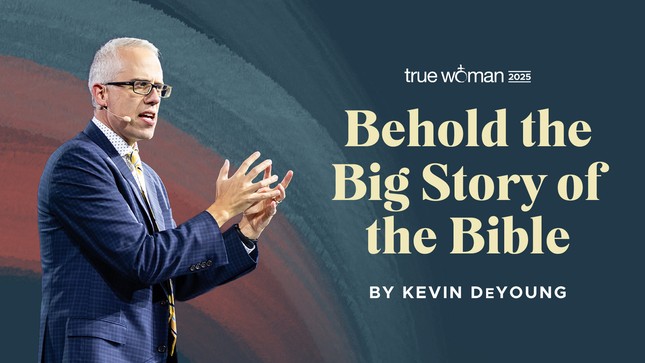

Behold the Big Story of the Bible, Part 2
Dannah Gresh: Pastor Kevin DeYoung wants you to see the cohesive thread running through your Bible from Genesis to Revelation.
Pastor Kevin DeYoung: It’s a story about a man, a woman, and a snake that ruined everything and then they kept on ruining everything until God sent His Son to make all of the ruinous things better and to save us.
Dannah: This is the Revive Our Hearts podcast with Nancy DeMoss Wolgemuth, author of Lies Women Believe and the Truth That Sets Them Free, for November 6, 2025. I’m Dannah Gresh.
Nancy DeMoss Wolgemuth: If someone asked you to explain the “narrative arc” of the Bible, would you be able to do it? Or would you say, "What is a narrative arc?" Pastor Kevin DeYoung is helping us understand how the pieces fit together. He’s helping us behold the wonder of the whole Word of …
Dannah Gresh: Pastor Kevin DeYoung wants you to see the cohesive thread running through your Bible from Genesis to Revelation.
Pastor Kevin DeYoung: It’s a story about a man, a woman, and a snake that ruined everything and then they kept on ruining everything until God sent His Son to make all of the ruinous things better and to save us.
Dannah: This is the Revive Our Hearts podcast with Nancy DeMoss Wolgemuth, author of Lies Women Believe and the Truth That Sets Them Free, for November 6, 2025. I’m Dannah Gresh.
Nancy DeMoss Wolgemuth: If someone asked you to explain the “narrative arc” of the Bible, would you be able to do it? Or would you say, "What is a narrative arc?" Pastor Kevin DeYoung is helping us understand how the pieces fit together. He’s helping us behold the wonder of the whole Word of God.
If you missed part 1 yesterday, you can find that at ReviveOurHearts.com or on the Revive Our Hearts app. It’s a powerful message that stirred and encouraged my heart as I listened during our recent True Woman conference, last month. I’m excited for you to hear the rest of it now. Here’s Pastor Kevin DeYoung.
Pastor DeYoung: Second, the Bible's a story about clothes. It is. Notice the provision in verse 21, “The LORD God made for Adam and for his wife garments of skins and clothed them.” He “made” is the same word earlier in the creation account when it says that He rested from all that He had made.
You could say this is the first time after creation He's made something new for His people. He made them clothes. Why clothes? Because they realize in their shame that they're naked. It tells us that the Creator will also be their Savior. And it tells us that your sin and my sin cannot be covered by grasping at fig leaves. You cannot grasp at the first thing in sight.
Notice this also, what do they grasp for? They're getting leaves. Do you see the language here? And He made for Adam and for His wife garments of skin (see Gen. 3:21). Where do you get skin from animals? What's required? Death.
In order to cover them now, death will be required. Blood will be required in order to have a covering for their sin. You can see through the rest of the Bible the priests receive special clothing because they're holy; they're set apart. Or Joshua the high priest in Zechariah 3 is filthy in his clothes, and he receives a new change of raiment (see vv. 3–40). Or finally, in the wedding supper of the Lamb, the saints are there paraded out in their pure bridal white linen. The Bible is a story of naked people who need clean clothes.
Three: the Bible is a story about God's presence. The temple and the tabernacle will come later in the Bible. The tabernacle is the tent structure that was the temporary one that you can move around on journeys. And then when they finally made a home in the Promised Land in Jerusalem, they would build the temple, which is a permanent tabernacle.
I don't have time to flesh all of this out, but when you look at the details, it's pretty obvious that the tabernacle and the temple are to be a kind of garden of Eden. The colors, all of those chapters that seem very boring with the building of the tabernacle and of the temple and all the cubits and all the poles and all of the colors. They're blue like the sky and like the sea, and there's pomegranates, and there's palm trees. The inside of the tabernacle was an echo of a creation garden. It was to say this garden now, the presence of God, that's what the garden represents. The presence of God now will dwell in your midst.
The Levites, the priests and the Levites, were to guard the east entrance of the tent of meeting. We'll come back to that. The East . . . now I live on the East Coast and so do some of you. So it's not all bad out there in the East, but the East in the Bible is the place outside of Eden. That's why when God's people come into the Promised Land, they come and have to move east to west across the Jordan.
Or Cain, it will say in chapter 4 when he's cursed, he is sent out of the land into Nod, which is east of Eden. Lot, when Abraham and Lot are looking in the land, they have too many possessions, they can't all live in the same place together. We're meant to hear a danger in Lot's choice when he says, “I'll take the land to the east.”
So here the Levites guard the Holy of Holies. They're guarding the presence of God. The New Jerusalem in Revelation 21 will be measured the same height, length, and width. It's a cube with the same three dimensions. The only other cubic dimension in the Bible is the Holy of Holies, because the New Jerusalem that comes down is that Holy of Holies.
The storyline of the Bible can be told in this way. How can a holy God dwell in the midst of an unholy people? And so He has the garden. You notice He doesn't throw the garden out. He banishes them from the garden. It’s as if to say, “You have not destroyed My goodness. You have not destroyed My kingdom. You have not destroyed My paradise. I don't uproot My garden. I uproot you. And because of your rebellion, you're banished.” This is the first of many banishments in the Bible.
Now before this, we read in 2 Peter and Jude that the angels when they rebelled were banished from heaven. Adam and Eve were banished from the garden. Cain was banished from the land. The nations at Babel are banished and scattered. The unclean have to go outside the camp.
Excommunication in the church is a way of setting outside the camp the unrepentant sinner. When the Israelites accumulated after centuries covenant curses, they were finally banished from Canaan. And how does Jesus describe hell? One of the descriptions, the wicked will be banished to the outer darkness where there is weeping and gnashing of teeth. The man was supposed to keep the garden and now the garden is kept from him.
It's the same word in Genesis 2:15, it’s translated “keep.” Here in 3:24. We have “guard.” He was to keep the garden, and now the garden is kept from him. So it's a story about God's presence.
Four: The Bible is a story about coming home. It's about our heavenly citizenship. It's about looking for a better country and a heavenly one. It’s about God who prepared for us a city, this garden city that we will inherit.
Notice this next time when you read through the Bible, every book in the Pentateuch— the first five books of the Bible, five books of Moses—every one of those books ends with a geographic marker. Genesis, Exodus, Leviticus, Numbers, Deuteronomy, each of them conspicuously. Now you won't be able to miss it. Each ends with a geographic marker telling us where God's people are.
Genesis, they've gone down. Joseph dies there in Egypt. Exodus, they're wandering through the wilderness. Leviticus, they're receiving the law there at Mount Sinai, which is there in the Sinai Peninsula. The book of Numbers, it says that they're there looking across the river to Jericho. And then in Deuteronomy, Moses dies and he's looking out over the plains of Moab. Five times the book ends with this geographic marker, to tell us they are not yet home. They're not in the Promised Land. That's what this is all looking forward to.
If you ever feel like, even when you have a great husband, you all do, and you have a great family, or you’ve got a great life, and you’ve got a vacation and a job; and you still have that gnawing sense that there's something more. It's because there's something more. It’s because you're not home. The Bible is a story about coming home.
Five: the Bible is a story about eating. Everything in the garden was given for food except one tree. They ate of that and now we read, verses 17–19, “they will eat by the sweat of their brow.” And in verse 22, “he shall not eat of the tree of life.” Later, the Israelites will have to distinguish between the animals they can eat and the animals they cannot eat. The feast days will be marked off by eating.
It's a book, a big story about eating. And Jesus will say, if you want to be saved, you need to feast on me. Just like, and I'm not the first one to see this. I heard Ligon Duncan say this, and he probably stole it from someone else. Sorry, Ligon, you did.
But when the woman says to the man, “Take and eat,” she grabs the fruit, she says, “Take and eat.” And Satan said to her before, “Look at the food; take and eat, take and eat.” Can you think of somewhere else where Somebody says, “Take and eat”? Jesus gathers His disciples, the Last Supper, and says, “This cup is my blood, this bread is my body. Take and eat” (see Matt. 26:26).
The whole human race was damned by eating. And then we are saved by eating, by feasting in faith, upon the Son of God. That's what Jesus says. We celebrate this in your church with the Lord's Supper, which is eating to counteract the curse of the eating that happened in the garden. And what happens in the new heavens of the new earth? It's a scene of great eating. So next time you're out, maybe later tonight, you say, “Sister, the Bible is a book about eating . . . and clothes.”
Number six, I gotta move quickly. The Bible's a story about trees. In Genesis chapter 1 and 2, fruit trees are a sign of bountiful provision. The tree becomes the place where sin enters the world when they eat that fruit of the tree. The trees are then where they run and hide. Then verse 24, they are barred from eating the tree of life. Deuteronomy 21 tells us the tree is the place of punishment and death. Cursed is anyone who hangs upon a tree. And we know that the tree is the place where mankind receives the gift of life, the one Lord Jesus Christ who hung on a tree. The sin that entered the world by the tree now will find salvation by the one who hangs on a tree. In the new world we will eat from the tree in the middle of the garden city whose leaves will be for the healing of the nations. The Bible is a story about eating.
Seven: the Bible is a story about angels. Now, track with me here. It is possible to make too much of angels, but we can really make too little of angels. What are angels? Well, they're servants. They're bridges. You think of the ladder. “I saw angels ascending and descending” (see Gen. 28:12). That's because they're intermediaries. They connect the heavenly world and the earthly world. They're messengers. That's what the name means in Hebrew and Greek. An angel is a messenger. They're patrol officers. We read that they patrol the earth. They're guardians.
Think about this: angels are guardians of the sacred. Who's placed here at the east of Eden to guard the entrance? An angel. Why? I’ve got Raiders of the Lost Ark on the brain. Think about the ark. The lid for the ark has two winged cherubim. Why do you have cherubim there? Because that ark represents the presence of God. It's the symbolic manifestation of God's presence. And the lid there, the mercy seat, has two cherubim because cherubim in the Bible are guardians.
During the exodus, God says, “I sent an angel before you to guard you on the way.” We see the same thing in Daniel. Now, not personal angels, but we have corporate guardian angels over God's people. So I'm making the point, angels guard things.
Now think about Jesus. Angels attended Him at His temptation. Angels were there to announce His birth. Angels strengthened Him in Gethsemane. And at every key moment—from conception to birth, to wilderness, to Garden, to his resurrection—there are angels. And on Easter Sunday morning, there's a great earthquake. An angel comes down, rolls the stone away, and sits upon it. His appearance was like lightning, clothes dazzling white. This was a dreadful scene. The guards, the human guards, became like dead men. They're irrelevant at this moment.
The angel talks to the women and says, “Do not be afraid. You're looking for Jesus. He's not here. He's risen just as He said. Come see where He lay” (see Matt. 28:5–6). Notice the stone was not rolled away so Jesus could get out. That had already happened. The stone was rolled away so the women could go in. The angel pushes the boulder aside as a proof for the sake of witness, not to help Jesus get on his feet.
You remember that strange scene where it says the grave clothes there were folded?
When the Bible tells you things like that, just stop and think, Why do I have this extraneous bit of information? It doesn't seem like I need to know this, and so there's probably a reason you need to know it. Why does it mention the grave clothes were folded up? I think two reasons. One, to tell us this was not a struggle. This was not a mummy coming back to life and bursting out of his cocoon. This was not hard. Death could not hold Jesus. And they're folded up because He does not need them again.
Now you say, “What's this have to do with angels?” Well, angels guard things, but not this time. These angels are there not to guard, but to bear witness to the One whom death could not keep. Death could not keep Him in the grave. The angels who have all throughout Scripture are guarding the sacred, now they're saying, “Come, come, come, look. You're not gonna believe, but you should believe this. Come, come, look in here.”
So for the first time, angels, instead of saying, “You can't go into the Garden of Eden. You can't go into the Ark of the Covenant. You shall not pass.” The angel is saying, “Come and see. Look who got out!” The Bible is a story about angels. Death is dead; love has won; Christ has conquered.
Two more if I have time. The Bible is a story about marriage. This is true whether you're married or not. The Bible is a story about marriage. And here's one of the reasons why we absolutely cannot budge on what the Bible tells us about marriage, because marriage is not just one or two little places in the Bible. Marriage is one way to tell the whole story of the Bible.
Let me go back to Revelation. Revelation gives a bunch of contrasts. Two cities—Babylon and the New Jerusalem. Two masters—a beast or a Lamb. Two women. Revelation's a book about two women—the whore of Babylon and the pure spotless Bride. Babylon’s the prostitute. He said, “Well, that's offensive. Well, that's the anti-church.” That's the woman that you're not supposed to be. The pure spotless Bride is the woman that collectively we are all supposed to be.
So we know the Bible ends with a wedding, but there's more to it than that. Think about the complimentary nature of creation itself. In the beginning, God created what? The heavens and the earth. That is like a marital pair. And not only that, within that cosmic pairing, we find other quote, unquote, “couples.”
Genesis 1 is all about couples: the sun and the moon, morning and evening, day and night, the sea and the dry land, plants and animals. Do you notice? It's all couples, couples, couples. We have Adam, it's not good for Adam to be alone. He needs a couple. It's not mainly about personal fulfillment and relational companionship, but that the woman and the man together needed to be. They were fitted, each for each other to fulfill that creation mandate. Only a man with a woman could fulfill this creation mandate to be fruitful and to multiply.
This marriage, therefore, is a symbol that in each of these pairings, one belongs with the other—night goes with day, sea and dry land, man and woman. Marriage is a symbol of this divine design, two differentiated entities. You can't have same and same, you can have shame and shame. Hear me, I want to make sure you got that. Two differentiated entities uniquely fit for one another, which is why it makes perfect sense.
Revelation 19, the wedding supper of the Lamb. Revelation 20, the bad guys lose—abyss, Satan, lake of fire. Revelation 21, “And I saw coming down out of heaven the new Jerusalem as a bride adorned for her husband” (see v. 2) It's the wedding. Heaven and earth is the first couple made in the Bible. Genesis 1:1, and it's the couple that comes together. It's the story of the marriage between heaven and earth that God made and sin separated, and then at the end, He brings together.
So the mystical union of Christ and the Church is a picture of that marital union. It doesn't work without the differentiation of male and female. It's a picture of the eternal fittedness of heaven coming to earth. That's what we're waiting for.
And let me give you then number nine. The Bible is a story about a man, a woman, and a snake. Now, you see that in Genesis, and I want you to see it again in Revelation.
So I have some children's books, The Biggest Story. People read them because they have pictures, which I didn't draw, so that's why people like them. But I've gotten two complaints from people. One, I have an ABC board book of The Biggest Story. It tells the story of the Bible. It has a letter as it tells the story. I was going through, and I wanted to go in sequential order. So I was telling the plagues in Egypt, and I got to the G, and I did gnats. And so many moms have said, “Why? I'm trying to teach my kid how to read. You give him a silent G.” Well, be glad God didn't send gorillas or something.
But He sent, more importantly, the other critique I've gotten. The first book before The Biggest Story Bible story book, book of Bible stories or whatever it's called, the first one is just the biggest story. I begin the book by saying, “Once upon a time . . .” And some people have rightfully said, “Well, Kevin, I don't know. Once upon a time is how fairy tales start. And it makes me think when I'm reading it to my kids that they're gonna register this as another fairy tale.”
I said, “That's fair, but let me tell you what I meant.” Sort of like Tolkien and Lewis, I wanted to communicate that this is the true fairy tale of which all the others are but a copy. This is the true myth—not myth in terms of false, but the story of the world is this biggest story. It's a story of a man and a woman and a snake.
So I'll end here. Go back to Revelation. Revelation is hard to understand, but the second half of the book, chapters 12 through 22, it works just like a play. You have to picture, curtains are shut, curtains open, because Revelation 11 ends with that line we sing: “The kingdom of this world has become the kingdom of our Lord and of his Christ.”
It's sort of yay, curtains close.
Now Revelation's gonna tell the same story in a different way. Curtain opens, and there are three people. There's a mother, and there's a child. Now, this mother is not Mary, except insofar as Mary is sort of representative of God's people, but the mother is God's people. It's the imagery from Jacob's dream or Joseph's dream back in Genesis. So the mother here represents God's people. Then the child is the Lord Jesus that came from the people of God. And then there's a dragon.
So there's three characters. There's a man, there's a woman, there's a dragon. And then a new character enters the scene. It's a beast. And then a second beast comes on the scene. He's called the false prophet. And then as the chapters go on, another character comes on, a prostitute, Babylon, the symbol for the anti-church, the symbol for worldliness.
And just as it happens in plays, the characters then go off the stage in the reverse order in which they came. It's very deliberate. Because in Revelation 18, Babylon is overthrown. There goes the prostitute. And then the beast and the false prophet are destroyed. And then in chapter 20, Satan is thrown into the lake of fire. Reverse order. They leave. The dragon, the snake, that ancient serpent, the devil, is gone. We get to chapter 21 in who is left? A man and a woman. Except it's not a mother and a child, now it's a bride and a groom coming together. It’s the final fulfillment of the covenant promise.
This is the thread throughout the Scriptures. Genesis 17, what was that story about? The woman in Genesis 16 and 17? Well, she had some good chapters there. Genesis 17:8, “The whole land of Canaan where you are now as an alien, I will give as an everlasting possession to you and your descendants after you” (paraphrased).
“I will be their God (Exodus 6:7), and I will take you as my own people and I will be your God (paraphrased). Leviticus 26:12, “I will walk among you and be your God and you will be my people.” Jeremiah 7:23, “Obey me and I will be your God and you will be my people.” Jeremiah 30:22, “So you will be my people, and I will be your God.” Ezekiel 36: 28, “You will live in the land I give your forefathers. You will be my people and I will be your God.”
You hear a theme? Why it was so significant then that John 1:14 says, “The word became flesh and his dwelling tabernacled among us.” Revelation 21:3, “Behold the dwelling place of God is with man. He will dwell with them, they will be his people and he will be their God.” Revelation 21:7, “The one who conquers will have this heritage, I will be his God, he will be my son.” Revelation 21:22, “I did not see a temple in the city because the Lord God Almighty and the Lamb are its temple.”
The covenant promise all throughout the Bible is that you don't have to be alienated from God. You don't have to be strangers to God. You can be forgiven of God. You can be close with God. You can be loved by God. He promises that He will be your God and you will be His people.
This is why Matthew 1 was so sweet. “Emmanuel which means God with us.” That's the promise. It's a story about a man and a woman and a snake that ruined everything and then they kept on ruining everything until God sent His Son to make all of the ruinous things better and to save us.
Revelation uses that analogy of the two most intimate relationships—a parent and a child, and a husband and a wife—to point to the most intimate relationship of all—God and His people, and He will wipe away every tear from your eyes. Have you thought about that promise before? How close do you have to be to someone to wipe a tear from their eyes? You can't do it over email. You can't do it by text. You have to be face to face, close right there. It's how close God is to His people.
It's the story we're telling. What went wrong in the garden will be set right in the garden city to come and for all of our eating and all of our feasting and all of our weddings and all of our trees and snakes and all of it. It's painting a glorious picture of what this book is all about. You can be a part of it when you put your faith in Jesus. Let's pray.
Father in heaven, thank You for this Book, for all the many things you teach us here. Yes, and amen, all of your promises in Jesus in whose name we pray, amen.
Nancy: That’s Pastor Kevin DeYoung, speaking at True Woman '25. I hope listening to this message has been an encouragement to you, that the whole of Scripture has become even just a little more beautiful to you.
Speaking of the beauty of Scripture, our newest Revive Our Hearts wall calendar features verses and hand lettering and illustrations designed to let God’s Word capture your heart. I’d love for you to have this calendar in your home throughout 2026, not only because it is beautiful, but because we’re including a daily Bible reading plan inside. That means you can use this calendar to follow along with our 2026 Bible reading challenge. I’m so excited to behold the whole Word together! Request your calendar with your gift of any amount at ReviveOurHearts.com, or if you’d rather donate over the phone, you can call us at 1-800-569-5959.
Well tomorrow, we’re continuing to reflect on our time at True Woman '25. Dannah Gresh shared a powerful message on beholding the daily mercy of God’s Word. I hope you’ll come back to hear that on Revive Our Hearts.
This program is a listener-supported production of Revive Our Hearts in Niles, Michigan, calling women to freedom, fullness, and fruitfulness in Christ.
All Scripture is taken from the ESV.
*Offers available only during the broadcast of the podcast season.
Support the Revive Our Hearts Podcast
Darkness. Fear. Uncertainty. Women around the world wake up hopeless every day. You can play a part in bringing them freedom, fullness, and fruitfulness instead. Your gift ensures that we can continue to spread gospel hope! Donate now.
Donate Now
