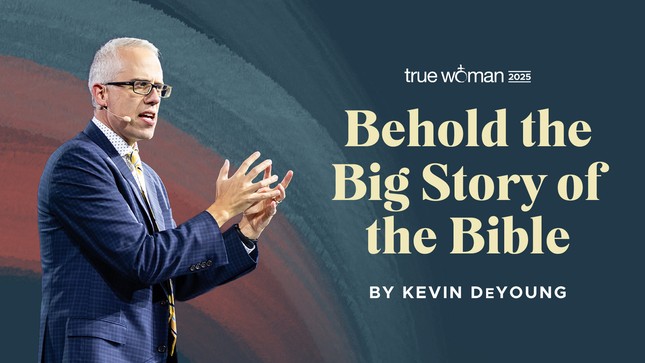

Behold the Big Story of the Bible, Part 1
Dannah Gresh: Pastor Kevin DeYoung endeavored to tell the big story of Scripture in just one message. The climax? Here’s a piece of it:
Pastor Kevin DeYoung: It doesn't say go out and do battle with the devil. It doesn't say you gotta storm the devil's lair. It says stand. Why stand? Because he's been defeated. He's already been conquered.
Dannah: This is the Revive Our Hearts podcast with Nancy DeMoss Wolgemuth, author of Lies Women Believe and the Truth That Sets Them Free, for November 5, 2025. I’m Dannah Gresh.
Nancy DeMoss Wolgemuth: What if I told you the Bible is a story about children . . . and clothes . . . and coming home? It’s true! The Bible is telling one great big story, and it’s woven through with threads that stretch from Genesis to Revelation.
During one of the plenary sessions …
Dannah Gresh: Pastor Kevin DeYoung endeavored to tell the big story of Scripture in just one message. The climax? Here’s a piece of it:
Pastor Kevin DeYoung: It doesn't say go out and do battle with the devil. It doesn't say you gotta storm the devil's lair. It says stand. Why stand? Because he's been defeated. He's already been conquered.
Dannah: This is the Revive Our Hearts podcast with Nancy DeMoss Wolgemuth, author of Lies Women Believe and the Truth That Sets Them Free, for November 5, 2025. I’m Dannah Gresh.
Nancy DeMoss Wolgemuth: What if I told you the Bible is a story about children . . . and clothes . . . and coming home? It’s true! The Bible is telling one great big story, and it’s woven through with threads that stretch from Genesis to Revelation.
During one of the plenary sessions at True Woman '25, Pastor Kevin DeYoung gave us nine themes we can trace throughout Scripture—themes that help us behold one cohesive story and one almighty God.
Pastor Kevin DeYoung is married to Trisha, they have nine children, and he's the author of a whole lot of books, including the beloved children’s book, The Biggest Story. Today and tomorrow, we’ll listen to his keynote message and wonder at the whole Word together. Here’s Pastor Kevin DeYoung.
Kevin: My assignment this evening is a daunting one. I have been asked to talk to you about the whole story of the Bible. You might call it the biggest story. I want to look at one passage, we'll spend some minutes in this one passage to orient you to some of the characters, themes, and ideas in this passage at the beginning of the Bible. And then I want you to see how these carry through and give us different ways to tell the whole story of the Bible. I hope that the effect will be more than simply being reminded of some things, maybe learning some new things, but it will be ultimately to see and to cherish new things about Christ.
I invite you to turn in your Bible to Genesis chapter 3. We have the story of creation, of course, in Genesis 1. And in Genesis 2 we zoom in on the creation of Adam and Eve. Then Genesis 3, we have the Fall. In the first seven verses of Genesis 3, we see why Adam and Eve sinned, this temptation from the serpent. And then the rest of the chapter, what we're going to look at, is about what happens after Adam and Eve sinned:
- Joy replaced with sorrow
- Comfort with cursing
- Pleasure with pain
- Intimacy with expulsion
We have in Genesis 3 an all too familiar picture of the way things are, and the way things were not supposed to be, and the way things will not be forever. So I want you to notice as we pick up reading verse 8, first I want you to notice Adam and Eve's response when they are caught in sin. Let's look at this first paragraph.
And then they heard the sound of the LORD God walking in the garden in the cool of the day and the man and his wife hid themselves from the presence of the LORD God among the trees of the garden.
But the LORD God called to the man and said to him, “Where are you?” And he said, “I heard the sound of you in the garden, and I was afraid, because I was naked, and I hid myself.” He said, “Who told you that you were naked? Have you eaten of the tree of which I commanded you not to eat?”
The man said, “The woman whom you gave to be with me, she gave me fruit of the tree, and I ate.” Then the LORD God said to the woman, “What is this that you have done?” The woman said, “The serpent deceived me and I ate.” (vv. 8–13)
So pause there and notice several things. The first thing they see after their sin, they see their nakedness (v. 7). They have the experience which all of us have encountered in sin. That is an experience of shame.
We read that they hear the Lord in the cool of the day. Now some commentators think this is ominous, but the cool or the breeze or the wind of the day might be the rushing sound of the Lord. Or as it's translated here, it gives us a sense of tranquility that is about to be interrupted. I think that this scene is not yet screaming with judgment, though judgment is coming. It is a picture of a father seeking out His children. Here with the evening breeze, the sound of the Lord, walking is a description of intimacy.
Sometimes when we manage to get a majority of us around the table at night. So, my wife and I have nine children. Why not ten? Well, we were quitters. When we're mostly there, our younger kids love to do highs and lows, roses and thorns, very simple. Tell us about the best and worst part of your day. They usually can tell what dad's worst part of the day was already by some grumbling with all of the shoes that are out. I'm maniacal about wanting them to pick up their shoes. It will say on my tombstone someday, “Please, please, pick up your shoes.”
But I said the other day, “I'll tell you what my rose was today.” It's one many days. I said, “Susanna.” She just turned five, two days ago. I said, “When I could hold your hand and walk you into your junior kindergarten classroom in the morning, that was the best part of my day.”
A father walking among his children. And so, the Lord walking among Adam and Eve in the cool of the day. Except, notice that instead of being comforted, their hand in His by the footsteps of the Lord, now they're afraid, hiding among the trees. And in His conversation with the man and the woman, did you notice the Lord only asks questions? It's like He's a courtroom prosecutor. He asks four questions: Where are you? Who told you you were naked? Have you eaten of the tree I commanded you not to eat? What is this you have done?
Of course, the Lord's not asking these questions because He's ignorant of something. He knows all things, sort of like a father if he sees a teenage child stumble in after curfew and smells alcohol on his breath and says, “Where have you been?” Well, he knows where he has been. He's asking the question to hear if the child will acknowledge where he has been. Adam understands the question to be a rhetorical one. It doesn't actually explain where he is.
The Lord addresses first the man. Even though Eve sinned first, He holds the man accountable. Not to the exclusion of the woman, He will also ask her a question. But more than the woman . . . This is something that we see Paul talk about in Romans chapter 5. Because the man was meant to be the loving head of this marriage relationship, even though Eve, the woman, sins first, He holds the man responsible.
Paul says in Romans chapter 5 that sin entered into the world through what? One man (see v. 12). Why not through Eve? Because Adam was given as the covenant head over the whole human race. You can tell the story of the Bible as two Adams. All of us died in this first Adam. We can be raised to life in Jesus Christ, the second Adam. So though the woman was deceived, the man sinned more willfully. The man was to be the protector, the leader of his wife.
Actually, he addresses the characters in this drama in the reverse order in which they sinned. Who was the first one to sin? Well, it was actually Satan, the serpent. We don't hear about his angelic fall here, but we get hints of that other places of Scripture. Satan sinned first, then Eve, then the man. Notice He addresses them in reverse order. First talks to the man, then to the woman, and then He'll address Satan.
We see two responses from Adam and Eve. These are the two oldest responses to sin, and they are likely the two most common responses to sin. Number one, shame. I've been exposed. I've been found out. I am dirty. I'm embarrassed. I'm unclean. Everyone knows. Look at me; I need to hide.
And blame. The man blames the woman. “You gave her to me.” The woman blames God. Together they blame the serpent. She was God's good gift to him, and now he dares to say that this was some kind of mistake. And so the woman blames the serpent. She has slightly more of a claim to being something of a victim, but still she ought to own her own sin.
Doesn't this happen often when we're confronted either by someone speaking the truth to us or reading God's Word or in a sermon? We describe ourselves as passive actors when we sin, and we describe ourselves as great heroes when we do what is right.
“I lost my temper.” Well, where'd it go?
“I got frustrated,” or “He pushed my buttons.” They’re still your buttons.
They blame. Suddenly they are passive in life. Now it is true that the serpent was also guilty. The woman was, in a way, the victim of his malicious lying. And at the same time, she was also a sinner.
Here are two powerful truths you must never forget. Sinners in your life, the people who really bother you . . . (Don't look around, don't look around.) Those people, the one that bothers you most, is also a sufferer. And the sufferer (which you may say, “Well, that's me. I'm in this category), sufferers can still be sinners. Hurting people usually hurt people.
Now, we have sympathy with them for the ways they've been hurt, but they also must be held responsible for the hurt that they do to others. This blame game is no respecter of persons. It happens on the left. It happens on the right. It happens with Christians. It happens with non-Christians. Shame, blame.
Notice the Lord's response to their sin. Let's continue, verse 14. “The Lord God said to the serpent . . .” So, he's gonna address them now, the serpent, then the woman, then the man.
TheLORD God said to the serpent,
“Because you have done this,
cursed are you above all livestock
and above all beasts of the field.
On your belly you shall go,
and dust you shall eat
all the days of your life.
I will put enmity between you and the woman
and between your offspring and her offspring;
he shall bruise your head,
and you shall bruise his heel.”To the woman he said,
“I will surely multiply your pain and childbearing;
and pain you shall bring forth children.
Your desires shall be contrary to your husband [or towards your husband],
but he shall rule over you.”And to Adam he said,
“Because you have listened to the voice of your wife
and have eaten of the tree
of which I commanded,
‘You shall not eat of it.’
Cursed is the ground because of you;
and pain you shall eat of it all the days of your life;
thorns and thistles it shall bring forth for you,
and you shall eat the plants of the field.
By the sweat of your face
you shall eat bread,
till you return to the ground,
for out of it you were taken;
for you are dust,
and to dust you shall return.” (vv. 14–19)
Speech number one is to the serpent. Notice, no dialogue with the serpent. God does not need you to dialogue with the devil. You quote the Bible to him; you don't need to dialogue with him. That was the woman's mistake.
He said now, “On your belly you will go.” Look at chapter 3, verse 1. “Now the serpent was more crafty . . .” There's a play on words here in the Hebrew. That's the Hebrew word arum. Now he is cursed, that's the Hebrew word arur. You were arum, now you are arur.
There's three aspects of this curse. Notice: crawling on the belly, eating of the dust, crushed by the seed of the woman. All of those images portray the devil low to the ground. And part of what we're supposed to get here is: sin brings you low. The devil promises to bring you high, and sin always brings you low. Every time you see a snake in the grass or crossing the road on some hot summer day, it's a reminder of the curse.
Now, when we moved to North Carolina eight years ago, people helpfully told us, “North Carolina has the largest population of venomous snakes in the country.” Well, my wife hates snakes. I mean, who really loves snakes? And when we went there, she was sort of picturing that scene from Raiders of the Lost Ark. She was sort of picturing North Carolina to be like that, just slithering.
It's not quite that bad, but we have seen a number of snakes usually one or two a year. People tell us, “Don't kill the black ones; they're the good ones. They swallow up the bad ones.” Every time you see one of those, it's not a good day. You see that snake slithering, it's a reminder of how sin brings you low.
I want you to notice we talk about the curse of man here. Technically, only the ground and the serpent are cursed in Genesis 3. Now, Cain will be cursed later, but the man and the woman are not actually cursed. There's no curse pronounced on the man and the woman. They experience the effects of the curse. But it's striking that God never says in these three speeches, cursed are you Adam, cursed are you Eve, which is a whisper of grace. There's blessing; there's blessing left for you.
Cain will receive a divine curse. Here, the image of God remains. He says to the woman, speech number two, you will have pain and childbearing. Right now you're saying, “Pastor, don't . . . don't even talk about it.” I have tried to say to my wife who's had nine kids, “I know, but you will never know the pain I experience to watch you.”
And yeah, it doesn't go very far.
This isn't to say that you can't try to mitigate the effects of the Fall. I hear epidurals are nice. It is simply to indicate the normal course of affairs, apart from the mercy of God, common grace, special grace. And, I think it's not just a reference to the act of labor, but to the whole, “in pain you shall bring forth children.”
Now, this can be a discouraging word, moms, but maybe there's some encouragement here. You're not getting along with your daughter, you're not getting along with your son. You say, “But why? Why am I Christian? I'm doing this right. I prayed for them. I brought them to church.” In pain you shall bring forth children. It’s not just the act of pushing out a baby, but bringing forth children, raising them in the world. We live in a cursed world, and childbearing comes with pain. I heard Tim Keller say one time, “Once you become a parent, you will never be happier than your most unhappy child.” There's some truth to that. You experience all the highs and lows of being a parent.
He tells the man, speech number three, the sentence on the man is the longest. Part of his sin is that he listened to his wife, which normally, is a good thing, but here as she led him into sin was not a good thing. And notice, the punishment fits the crime. He ate, so he will eat. Eating is mentioned five times in these three verses. His sin was eating, and so his punishment will be in what he eats. His primary sphere was the ground, and so now his work will be a chore.
We have seen that each one is condemned to a permanent disadvantage in life, far as the curse is found. And these disadvantages occupy the primary sphere, not the sole thing they can never do, but the primary sphere. So that the woman's primary sphere is raising children, and that will be pain for her. The man's primary sphere here in the Garden will be the ground, and it will bring thorns and thistles. And we see the most devastating consequence for their sin. Verse 20:
The man called his wife Eve, because she was the mother of all living. And the LORD God made for Adam and for his wife garments of skins and clothed them. Then the LORD God said, “Behold, the man has become like one of us, in knowing good and evil. Now, lest he reach out his hand and take also of the tree of life and eat, and live forever”—therefore the LORD God sent him out of the garden of Eden to work the ground from which he was taken. He drove out the man, and at the east of the garden of Eden he placed the cherubim and a flaming sword that turned every way to guard the way to the tree of life. (vv. 20–24)
Here's what I want to do with the second half of this message. Having established what are perhaps familiar verses for some of you, maybe new to others, having established the basic plot line, the curse that falls upon the world. These themes, these ideas, these characters, we want to think together about how this helps us understand the whole story of the Bible. I'm going to dare to give you with my time remaining a nine point sermon.
I want to give you nine ways, and you could probably come up with twice as many, nine ways to tell the story of the Bible.
Number one: the Bible is a story about children. Notice in the midst of these echoes of judgment, these whispers of grace. We've already seen one, that the man and woman are not actually cursed, but also that the woman will have children. And what an act of faith here by Adam. Don't let it pass you by. In verse 20, after all of this devastation because of sin, he dares to call his wife's name Eve. Why? Because she will be the mother of all living.
In God's grace, this isn't the end of us. She is isha, we heard in chapter 2, because she was taken out of ish. Isha, woman; ish, man. Now she's called Eve, the mother of all living.
The Bible is about children, the good of having children is everywhere in the Bible that children are mentioned. It is a gift. It's specifically about a child, the seed of the woman.
The storyline of the Bible is about a child of Abraham, a son of David, one to be born of a virgin, this child who will conquer, who will crush the head of the sermon.
Have you wondered why there are so many stories about a promised child? Harry Potter. The Star Wars legacy. Myth. All of that nonsense. There's this child; there's a promised one to come. We see the real story here.
I love Romans 16:20. It’s one of the benedictions that I will give at the end of our services. “The God of peace will soon crush Satan under your feet.” He has made us more than conquerors through him who loved us because Christ is that Child who comes to crush the head of the serpent. And as we are more than conquerors with Him, we also crush the head of the serpent.
The prime verb (I know we love verbs here) in Ephesians 6 is spiritual warfare. It doesn't say go out and do battle with the devil. It doesn't say you gotta storm the devil's lair. It says stand. Why stand? Because he's been defeated. He's already been conquered. John 16 Jesus promises that.
So we are called to be more than conquerors. You wanna know how to understand the book of Revelation, the most difficult book in the Bible, some people would say, here's a little tip . . . Revelation, singular. Revelations is not a book in the Bible, but Revelation, singular. There are revelations in it, I guess you could say. All of you can know the big idea in the book of Revelation, because some of you have it right now. I know you're wearing some nice shoes, but some of you have it on your feet. Because the point of the book of Revelation is the word nike. It's the Greek word; it means “victory, conquer, overcome.” And the word in its “now” form, nikkei, meaning "victory," or nikau, "to overcome." It's there at end of each of the seven letters: “to him who overcomes, to him who overcomes.”
The majority of all the occurrences in the New Testament are in that book of Revelation. That's what the book is about, how to be an overcomer and not a succumber. And you do it by conquering through this one, this promised Son.
Nancy: Wow, don't your just love God’s Word!? That’s part 1 of a message Pastor Kevin DeYoung gave at our recent True Woman '25 conference. Our theme was, The Word: Behold the Wonder. We’ll hear the rest of Kevin’s message tomorrow.
Now before we go, I want to tell you just a little bit about the beautiful new Revive Our Hearts ministry calendar our team has designed for you. It’s a wall calendar that features quotes from my book, A Place of Quiet Rest. It also has Scripture on each month along with hand lettering and illustrations. It’s your perfect daily companion as you move into 2026—helping you reflect and meditate on Scripture.
The calendar is not only inspiring; it also includes a daily reading plan, making it a practical tool to help you read through the Bible in 2026. Whether you've read through the Bible many times or perhaps not at all, we hope you'll join. Thousands of women around the world plan to do just that.
This month, request your calendar when you make a donation of any amount. To give, you can visit ReviveOurHearts.com, or call us at 1-800-569-5959.
Did you know you can submit prayer requests at ReviveOurHearts.com/prayer? Revive Our Hearts is a teaching ministry, but we’re also a praying ministry, and we would love to pray for you. If you’ve got something weighing heavy on your heart, be sure to visit the website so we can partner with you in bringing that request to the Lord. Again, you can submit your requests at ReviveOurHearts.com/prayer.
Tomorrow, we’ll listen to part 2 of Pastor Kevin DeYoung’s message. I believe you’ll be inspired to love your whole Bible more deeply—because Pastor Kevin’s heart for Scripture is contagious!
Please be back for Revive Our Hearts.
This program is a listener-supported production of Revive Our Hearts in Niles, Michigan. Calling women to freedom, fullness, and fruitfulness in Christ.
All Scripture is taken from the ESV.
*Offers available only during the broadcast of the podcast season.
Support the Revive Our Hearts Podcast
Darkness. Fear. Uncertainty. Women around the world wake up hopeless every day. You can play a part in bringing them freedom, fullness, and fruitfulness instead. Your gift ensures that we can continue to spread gospel hope! Donate now.
Donate Now
