
An Alphabet of Prayers
Dannah Gresh: Why should you read the Bible every day? Here’s Nancy DeMoss Wolgemuth.
Nancy DeMoss Wolgemuth: Your relationship with God will never be any stronger, it will never be any more vibrant, and it will never be any more genuine than your relationship with the Word of God.
Dannah: This is Revive Our Hearts with Nancy DeMoss Wolgemuth, author of A 30-Day Walk with God in the Psalms, for Tuesday, January 17, 2025, I'm Dannah Gresh.
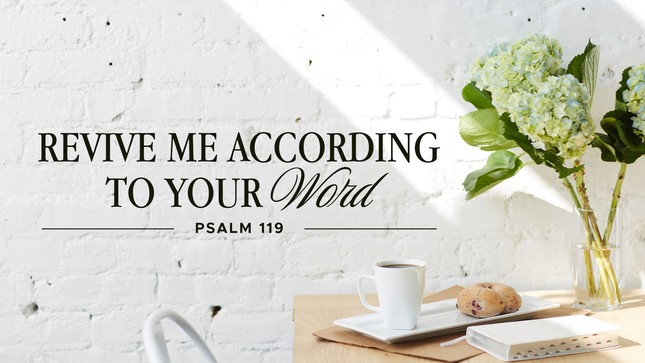
Nancy has an important challenge for you. She’s about to share it in a series called “Revive Me According to Your Word: Reflections on Psalm 119.” She explains that she heard that Bethlehem Baptist Church in Minneapolis, starts each year off with an annual Prayer Week.
Nancy: It is the first week of the year, first week of January. They start the year out as a church in …
Dannah Gresh: Why should you read the Bible every day? Here’s Nancy DeMoss Wolgemuth.
Nancy DeMoss Wolgemuth: Your relationship with God will never be any stronger, it will never be any more vibrant, and it will never be any more genuine than your relationship with the Word of God.
Dannah: This is Revive Our Hearts with Nancy DeMoss Wolgemuth, author of A 30-Day Walk with God in the Psalms, for Tuesday, January 17, 2025, I'm Dannah Gresh.
Nancy has an important challenge for you. She’s about to share it in a series called “Revive Me According to Your Word: Reflections on Psalm 119.” She explains that she heard that Bethlehem Baptist Church in Minneapolis, starts each year off with an annual Prayer Week.
Nancy: It is the first week of the year, first week of January. They start the year out as a church in a time of corporate prayer and seeking the Lord.
Dannah: Bethlehem was the church where John Piper was pastor for many years.
Nancy: Pastor Piper said in a sermon on the first Sunday of the year a number of years ago as he was introducing that week,
Prayer and meditating on the Word of God are like parallel rails that enable the train of our souls to stay on the track that leads to holiness and heaven.
We need to renew our zeal for prayer and Bible meditation at the beginning of the year. Everything gets old and worn and weak without re-awakening and renewal and restoration.
Do you agree with that? You just think about how you come to the end of the year and you’re feeling at times old and worn and weak. Sometimes it’s physically, sometimes it’s spiritual. We need reawakening and renewal and restoration, which is why I love the new year. It is a chance to take a deep breath and refocus and recalibrate and let God reawaken our love for Him and our sensitivity to Him.
So Pastor John Piper went on to say, “During Prayer Week each year we rivet our attention on these great and precious things in order to rekindle our passion for prayer and the Word.” I like that.
Dannah: This isn’t the start of our calendar year, but we’re hoping you’ll make a new start here in June. Nancy is challenging you with a sort of mid-year resolution. It’s this: Read your Bible. Every day.
Nancy: Now I’m not saying how long. You don’t have to read it for an hour every day. Some of you are in a place where you can do that and you’d like to—that is great. I’m not saying how long; I’m not saying that you have to get up at 4:00 o’clock in the morning to do it. I’m not saying when or what you read or that you have to read sequentially through the whole Bible.
We’re going to offer some help, some reading plans, some things if you need a track to run on we can provide that for you. But the challenge is just really simple: Read your Bible every day. But in order to launch us into that challenge, I want us to take a look at Psalm 119, which is as you know, is the longest chapter in the Bible with 176 verses. It is also the chapter in the Bible that has more to say about the Word of God than any other chapter.
I have spent the last several weeks meditating on Psalm 119. To tell you the truth, I wish I’d had about six or eight months more to do that before teaching this series. So maybe I’ll come back next year or another year and do more from Psalm 119 because I feel like I’m just scratching the surface in my own meditation on this wonderful passage.
We’re not going to walk verse by verse through this Psalm (I would love to be able to do that but not this year). Over these next days I’m going to lead us in just some meditations on Psalm 119. Some reflections on key themes out of that psalm that I hope will kindle in your heart a love for God’s Word and a passion to be a woman of the Word this year, and every year for the rest of your life.
With very few exceptions, almost every verse in this psalm refers to the Word of God. One author who has written a chapter on Psalm 119 says that this psalm helps us see "the mind-blowing beauty, the sin-killing power, and the breathtaking expanse of God’s Word.”1 And that is what I hope is going to capture your heart over these next days.
As I think about this longest chapter in the Bible, I think about a friend who is now with the Lord. He tells about how when he was growing up, his mother read five chapters of the Bible to the four children in that family every day. She read them outloud, five chapters. By the way, that is not a bad idea. But my friend tells about how when he said he thought eternity had come when they got to Psalm 119 because it was so long. That was one of the five chapters that day.
I read also about a clergyman in the seventeenth century who was condemned to death. While he was on a scaffold, there was a custom in that day that you could have one dying request. You could ask for a psalm that you wanted to be sung. The psalms were intended to be sung, and many Christians and pastors have actually sung through the psalms.
So his dying request was to have Psalm 119 sung as he was there on the scaffold getting ready to be executed. Well, before the psalm ended, someone arrived. He rode up from the king bearing news of a pardon and his life was spared. It turned out that he was expecting the pardon, but it hadn’t arrived yet. So he intentionally chose Psalm 119 as a stall tactic. So you never know when this psalm will come in handy.
Over the years there have been a lot of people who have memorized, not a lot but a number and some well-known people, who have memorized Psalm 119 and have found it to be such a helpful thing in their lives. I’ve actually started trying to memorize Psalm 119. I am just still early on in that, and I don’t know how far I’ll get. It is something I wish I had done twenty or thirty years ago when I could still remember things. It is not easy, but even when I stumble and try to remember how to recite the part I am memorizing, it is still such a great exercise to be going over it in your mind and in your heart.
Some of you have children, by the way, who could memorize Psalm 119. It would not be a bad exercise to encourage them to do this.
William Wilberforce, do you know that name? He was the great abolitionist. In the midst of a political crisis he wrote in his diary about walking from his home a mile to Parliament reciting the 119th psalm in great comfort. It takes about fifteen minutes to read the psalm. So with just a nice-paced walk, in fifteen minutes you could recite Psalm 119 and William Wilberforce had memorized it and did just that.
Some of you know the name David Livingstone who was a nineteenth century pioneer missionary to Africa. I read that he won a Bible from his Sunday school teacher by reciting Psalm 119 from memory when he was only nine years old. Can you imagine? I tweeted that the other day and one of my friends told her little girl that this man had won a Bible for reciting Psalm 119 when he was nine, and the little girl's response was, “He only got a Bible?” Well, the Bible in those days was more rare and more precious perhaps than it is to us today.
There have been a lot of lengthy works written on this psalm, commentaries. Thomas Manton was a seventeenth century Puritan clergyman. He wrote a three-volume work, 1,677 pages on Psalm 119, 190 long chapters, more than one chapter on every verse out of Psalm 119.
Charles Spurgeon has that classic Treasury of David, which is a commentary on all the psalms. He devotes in that commentary three hundred fifty pages to this one psalm, Psalm 119. More than two hundred fifty thousand words, so a quarter of a million words on Psalm 119. In his preface to the final volume of that commentary, which is the volume that includes Psalm 119, he talks about how this commentary took longer than the other ones (volumes) because of the daunting task of writing a verse-by-verse commentary on Psalm 119. He says:
Its dimensions and its depth alike overcame me. It spread itself out before me like a vast rolling prairie to which I could see no bound, and this alone created a feeling of dismay. . . . I confess I hesitated to launch upon it [which I confess I have felt myself in trying to think how I could do eight sessions, merely eight sessions, on this vast psalm].
Other psalms have been mere lakes, but this is the main ocean. It is a continent of sacred thought, every inch of which is fertile as the garden of the Lord. . . . The more one studies it, the fresher it becomes.
Now, just a word about the literary style of this psalm. It is, of course, in the style of Hebrew poetry, which we could do a whole session on. Maybe will another time, but you see parallel statements that help explain or expand on concepts. The really fascinating thing about the form of this psalm is that it is an acrostic. There are twenty-two letters in the Hebrew alphabet and there are twenty-two stanzas in Psalm 119. Each of those stanzas has eight verses. Each stanza is built on a different letter of the Hebrew alphabet in succession. Each verse in that stanza begins with the same letter of the Hebrew alphabet.
Now on the first reading, this psalm can seem a bit repetitive, and it is repetitive, and to some they might even think it is a bit boring. If your pastor were to say this Sunday in church, “We’re all going to stand and read together Psalm 119 . . .” A lot of people, I think inwardly if not outwardly, might groan and think that is a long time to read something that has so many similarities within it.
But I think of what Spurgeon said in his commentary on this psalm. He said:
I have weighed each word and looked at each syllable with lengthened meditation, and I bear witness that this sacred song is charmingly varied from beginning to end. Its variety is that of a kaleidoscope [I love that word picture] from a few objects a boundless variation is produced.1
Now, in this psalm there are at least eight terms that are used as synonyms for the Word of God. You see them over and over again. Most of them are used twenty or more times, each of these eight synonyms. Each of these synonyms tells us something about the nature or the character of the Word of God. Now it is a little tough to teach through this passage when we all have different translations because there are different ways these words are translated, so just bear with me. I am reading from the English Standard version through most of this series, but I will occasionally refer to other translations just to help shed light on some of these terms.
Let’s begin at verse 1 of Psalm 119. In the first eleven verses you will see these eight synonyms appear. So I want us to read those verses and look for these different synonyms.
Verse 1: “Blessed are those whose way is blameless, who walk in the law of the Lord!”
That is the first synonym. The law of the Lord. It is the Hebrew word torah. It is the instruction of the Lord, the teaching. That word torah can refer to a single law of the Lord. It often refers to what we know as the Pentateuch—the books of Moses—the first five books of the Bible are known as the Torah. Or it can stand for the entirety of Scripture. The law of the Lord. It stands for God’s revelation of Himself, His covenant with man.
Verse 2: “Blessed are those who keep His testimonies,” here is a second synonym, "who seek him with their whole heart, who also do no wrong but walk in his ways!” His testimony. Some of your translations will say "statutes" or "decrees." This is a word that is related to the word for “witness,” and we know that God’s testimonies are reliable because they come from a faithful and true witness.
Verse 4: “You have commanded your precepts to be kept diligently.” Another synonym; this is a word that comes from the realm of an overseer. A precept is that which is mandated by God. They are detailed instructions.
Verse 5: “Oh that my ways may be steadfast in keeping your statutes.” Here is a fourth synonym, the word statutes or in some translations decrees. It is a word that comes from a root that means to engrave or to inscribe. It speaks of the limits and the boundaries that God’s Word provides for our lives. They are engravings. They are precepts and rules which must be strictly obeyed. It speaks of the binding nature of Scripture and the permanence of Scripture. Once it’s engraved, you can’t un-engrave it.
Then verse 6: “I shall not be put to shame having my eyes fixed on all your commandments.” There is another synonym and we see throughout this psalm that obedience to God's commands brings blessing and disobedience brings a curse; it brings conflicts, it brings consequences.
Verse 7: “I will praise you with an upright heart when I learn your righteous rules.” Here is another synonym for the Word of God and different translations translate that word rules. Some translations say judgments, laws, ordinances. There is a legal connotation to this word. It speaks of the justice of God’s Word.
Then verses 8 and 9: “I will keep your statutes; do not utterly forsake me! How can a young man keep his way pure? By guarding it according to your word.” The word of God; God’s revealed word to man, that which comes from His mouth.
Verse 10–11: “With my whole heart I seek you; let me not wander from your commandments! I have stored up your word in my heart, that I might not sin against you.” Now in English that is the same word we read in verse 9, the “word of God” but in the Hebrew it is actually a different word that is translated “word” in English. It is a different word. It is similar but sometimes it uses the word promise. “I have stored up your promises in my heart that I might not sin against you.” This word can refer to anything that God has spoken, anything that God has commanded or anything that God has promised.
So we have these synonyms. Whenever you read these words: statutes, precepts, commandments, rules, ordinances, decrees, the law of the Lord; we’re talking about the Word of God. That is what is being referred to here.
And then as I’ve been meditating on this passage, I found myself kind of categorizing the different verses into four different categories. There are four kinds of statements that you come across throughout this psalm, and most verses fall into one or more of these four categories.
Now, again, I’m going to read lots of Scriptures as we go through this series, and in many cases, I won’t give you the verse number. But if you go to the transcript at ReviveOurHearts.com you can get all the references for these verses.
First of all there are affirmations. There are verses that are affirmations about God, about His Word or about His ways. Listen to some of these affirmations.
- “Forever, O LORD, your word is firmly fixed in the heavens." (v. 89)
- "Your faithfulness endures to all generations." (v. 90)
- "I have seen a limit to all perfection, but your commandment is exceedingly broad."(v.96)
- Righteous are you, O LORD, and right are your rules." (v.137)
- "Your righteousness is righteous forever, and your law is true." (v. 142)
- "You are near, O LORD, and all your commandments are true." (v. 151)
These are affirmations about God and about His Word.
Secondly, there are statements of adoration. These are statements of adoration or celebration. These are verses that praise God for the wonder of His Word. Listen to some of these statements of adoration.
- “Your testimonies are my delight; they are my counselors." (v. 24)
- "How sweet are your words to my taste, sweeter than honey to my mouth!" (v. 103)
- "My heart stands in awe of your words." (v. 161)
- "I rejoice at your word like one who finds great spoil." (v. 162)
- "Seven times a day I praise you for your righteous rules." ( v.164)
Affirmations and adoration.
Then number three, there are verses that are resolutions.
- "I will meditate on your precepts and fix my eyes on your ways." (v. 15)
- "I will delight in your statutes; I will not forget your word." (v. 16)
- "I will keep your law continually, forever and ever." (v. 44)
- "I incline my heart to perform your statutes forever, to the end." (v. 112)
As we read those resolutions we need to remember that Jesus is the only One who has ever perfectly fulfilled those resolutions. It is easy to get a little overwhelmed as you read a psalm like this and think, “I couldn’t say those things, ‘I will obey you continually forever and ever.’” Oh, that it were true in the heart of a child of God as you want that to be true but it is only true of Jesus that he perfectly fulfilled all of those resolutions and that is why this psalm is a reminder of how much we need Christ. It points us to Christ.
And then we have a fourth category of verses. These are the ones that are petitions. They are prayers, they are pleas for God’s aid. The psalmist prays for example in verse 17,
- “Deal bountifully with your servant, that I may live and keep your word.
- "Open my eyes, that I may behold wondrous things out of your law." (v. 18)
- "Put false ways far from me and graciously teach me your law." (v. 29)
Now as we meditate on this psalm as we will do over these next days, I just want to remind you that your relationship with God will never be any stronger, it will never be any more vibrant, and it will never be any more genuine than your relationship with the Word of God.
Throughout this psalm the focus is on His Word, His precepts, His commandments. The goal is not to just have an intellectual exercise of getting to know God’s Word. The objective is to seek God. The One who is revealed in His Book. There is no other way to know God. There is no other way to know Christ than through the written and living Word of God.
Now I have a growing concern and I’ve expressed it in different ways on this program, but I don’t know that it’s ever been any stronger. A concern that we would be women of the Word. I have a concern in relation to the number of believers I’m engaging with who are not reading the Word for themselves on a consistent basis. Many believers and perhaps even most have never read the entire Bible.
God has given us His book. He’s given us His Word, and I just want to imagine standing before the Lord when we die. How are you going to explain to Him why you didn’t take time to read His book?
So I’ve had a burden to challenge our listeners to take a daily Bible reading challenge. The challenge is simple. Make a commitment by God’s grace that you will read God’s word every day. If you go to ReviveOurHearts.com, you can sign up to take this challenge, the Daily Bible Reading Challenge. If you sign up, we’ll send you an email to remind you and encourage you in doing that. So we’re going to help you remember.
We’ll send you an email to encourage you. There are all kinds of featured resources. I want to encourage you to start as we go through this series by reading Psalm 119. It takes you about fifteen minutes to read through it. You may even want to do that everyday through the course of this week and next as we’re in this series.
You may want to read it perhaps on your knees; it is a prayer. Throughout this psalm you will see the word you: "I cry to you O LORD, it is your word." So perhaps get in a posture of kneeling before the Lord. Regardless, read it, let it soak into your heart, into your mind and let God speak to you through it.
Lord, how I pray that in these next days you will open our hearts, our minds, and our eyes, to see your Word in new ways. And in seeing it to love it, and loving it to love you, it’s Author. May we love and obey You and Your Word, for Jesus’ sake I pray it, amen.
Dannah: Nancy DeMoss Wolgemuth has been offering you a challenge. Read the Bible daily. Learn it. Love it. Live it.
To find all the resources she mentioned to help you meet this goal, visit ReviveOurHearts.com, find today’s episode, and go to the transcript, where you’ll see links.
And, our gift-of-any-amount resource for June is a beautifully-designed print of a poem by Nancy called “The Word.” And along with it, we’ll include a helpful book by Colin Smith with this title: Fly through the Bible. It’s written to familiarize you with the overall biblical big picture.
So when you contact us with your donation, be sure to ask about the poem by Nancy and Fly through the Bible, by Colin Smith. They’re our way of saying thank you for your gift. And they’re our way of helping you see that His Word is truly wonderful. To make a donation, head to ReviveOurHearts.com/wonderful, or you can always call us at this number: 1-800-569-5959.
Nancy: Studying and obeying God’s Word is not just the right thing to do, though it certainly is that. But I want you to see as we are continuing in these themes from Psalm 119, I want you to see that being in God’s Word is a means to great joy. It’s not just a task or a chore to be checked off the list—I read my Bible today—but it’s the source, the spring of great immeasurable blessings and benefits.
Dannah: That's tomorrow on Revive Our Hearts.
This program is a listener-supported production of Revive Our Hearts in Niles, Michigan, calling women to freedom, fullness, and fruitfulness in Christ.
All Scripture is taken from the English Standard Version unless otherwise noted.
1 Sam Storma, More Precious Than Gold: 50 Daily Meditations on the Psalms (Wheaton, IL: Crossway, 2009), 213.
*Offers available only during the broadcast of the podcast season.
Support the Revive Our Hearts Podcast
Darkness. Fear. Uncertainty. Women around the world wake up hopeless every day. You can play a part in bringing them freedom, fullness, and fruitfulness instead. Your gift ensures that we can continue to spread gospel hope! Donate now.
Donate Now