

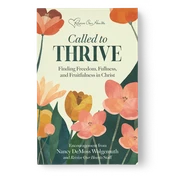
Called to Thrive: Finding Freedom, Fullness, and Fruitfulness in Christ, a new booklet based on the teaching of Nancy DeMoss Wolgemuth, is designed to help you step more fully into a life marked by joy, purpose, and lasting satisfaction in Him. Today we’re sharing the introduction from this new resource, which was written to help you and the women in your life discover the life Christ meant for you to live.
At the end of every Revive Our Hearts program comes our sign-off: “This program is a listener-supported production of Revive Our Hearts in Niles, Michigan, calling women to freedom, fullness, and fruitfulness in Christ.” But freedom, fullness, and fruitfulness is far more than a ministry mission. More than a podcast tagline. It’s a way of life available to all who know Christ as Savior—yet, according to Nancy DeMoss Wolgemuth, “it’s one that few professing believers experience to the extent that God intends.”
Maybe that includes you.
Could This Be for Me?
Perhaps you have doubts when you think about the challenges you’re facing in this season of your life or the baggage you carry from your background or your growing up years. Maybe you recall the patterns of sin that seem to have a hold on you and think, Freedom? Fullness? Fruitfulness? I’m not sure I can relate. Is that really possible for me?
Here’s the good news: on the authority of Scripture, the answer is yes—you can experience freedom, fullness, and fruitfulness in Christ.
From Bondage, Emptiness, and Barrenness . . .
It’s possible that even the concepts of freedom, fullness, and fruitfulness seem abstract. You might wonder, How would I know if these qualities were present in my life? Consider for a moment their opposites:
- Bondage—a slave of sin (John 8:34).
- Emptiness—everything is futile (Eccl. 1:2).
- Barrenness—useless or unfruitful (2 Pet. 1:8–9).
Five minutes spent scrolling any social media platform provides ample evidence that women today—yes, even Christian women—are living in the deathly shallows of bondage, emptiness, and barrenness, while the cool, deep pools of freedom, fullness, and fruitfulness lie just beyond reach, untouched. This need not be so. It must not be so!
To Freedom, Fullness, and Fruitfulness
Psalm 107, a song of the redeemed people of God, gives us an Old Testament glimpse of these gifts from the Lord and illustrates how they can be experienced in our lives. Read the whole thing as you are able, but for now, let’s look at a few highlights gleaned from Nancy’s teaching on this rich passage.1
Give thanks to the LORD, for he is good;
his faithful love endures forever.
Let the redeemed of the LORD proclaim
that he has redeemed them from the power of the foe
and has gathered them from the lands—
from the east and the west,
from the north and the south. (Psalm 107:1–3)
The psalm’s first three verses answer the question, “Why should we give thanks to the Lord?” And the psalmist gives us two reasons: first, we give thanks because of the character of God—who He is—as found in verse 1. Second, we give thanks because of what He has done for us: redeemed us from the power of the foe (v. 2). The Lord has delivered us from the snatches of Satan and sin and rescued us from our lost condition. Praise be to Him!
Like a time-loop film where the characters repeat the same day or scenario over and over, the remainder of Psalm 107 shows us four scenes in which the same progression happens on repeat. In each one, we see God’s people in distress, followed by their desperate cries, God’s deliverance, and finally, thanksgiving.
Distress is a common human experience, and Psalm 107 describes those in distress as wanderers (v. 4), prisoners (v. 10), and fools (v. 17). In verse 23, the psalmist depicts the distressed as sailors who went to sea assuming they would come safely home at night—until the Lord raised up a storm that “stirred up the waves of the sea” (v. 25). Realizing that they were not the master of their own fate, with circumstances beyond their control, the sailors were brought to a place of utter dependence upon God.
In all four scenarios, the people’s distress was followed by the same response: desperate cries for help (vv. 6, 13, 19, 28). When they were deep in trouble, when they had nowhere else to turn, they cried out to the Lord.
There we can find encouragement too: when we call out to the Lord in our weakness, we are met with His divine deliverance. In Psalm 107, each time those in distress cast themselves upon the Lord and His mercy, they were not disappointed. He met them in their precise area of need.
The hungry were satisfied (v. 9). Those in captivity were brought “out of darkness and gloom and [He] broke their chains apart” (v. 14). The fools were healed from their folly through the wonder of His Word (v. 20). The sailors were delivered too: “He stilled the storm to a whisper, and the waves of the sea were hushed. . . . Then he guided them to the harbor they longed for” (vv. 29–30). As Nancy has said, “Not always in the way we would script it and in the timing that we long for, but God always ultimately delivers His children who cry out to Him.”
A Chorus of Praise
Finally, the psalmist leads us in a joyful chorus of thanksgiving, repeated four times: “Let them give thanks to the LORD for his faithful love and his wondrous works” (vv. 8, 15, 21, 31). If we have been redeemed, our lives should be marked by upward praise to the Lord. But that’s not all—our praise is also to flow outward, as in verse 22: “Let them offer thanksgiving sacrifices and announce his works with shouts of joy.”
When our hearts turn to thankfulness, we can live fruitful lives for His glory, no matter our circumstances. Friend, you may be in a hard place right now. You may not understand every trial that takes place in this earthly life. But you can be assured of this: we can always trust the Lord’s hand, and we can always trust His heart.
Finally, Psalm 107:43 says, “Let whoever is wise pay attention to these things and consider the LORD’s acts of faithful love.” Wisdom sees the hand of God both in distress and in deliverance.
So if you’re lost, if you’re wandering, if you’re in some kind of prison, if you’re sick or storm-tossed, cry out to the Lord in your desperation. If you are a child of God, He delights to make you free, full, and fruitful—to root you firmly, that your life may bear fruit for years to come.
And when He has redeemed you and delivered you from your trouble, thank the Lord and tell others. Share the news that He can heal you. He can set you free. He can give you freedom, fullness, and fruitfulness in Christ.
1Adapted from Nancy’s forthcoming “Wonder of the Word” teaching on Psalm 107.
For twenty-five years, Revive Our Hearts has been pointing women to the freedom, fullness, and fruitfulness only Christ can give. We’re not looking back—we’re moving forward with urgency, because too many women are still surviving when they were made to thrive.
Give before May 31. Help us reach $1,400,000. Help her thrive.






Join the Discussion