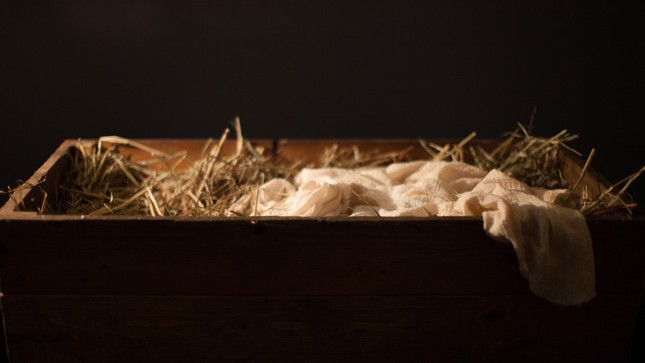

Wonder of the Word Made Flesh
This episode contains portions from the following programs:
"Full Body of Work: The Incarnation of Christ"
"Behold the Big Story of the Bible"
___________________
Dannah Gresh: Hey there! Today we’re going to wonder!
The Merriam-Webster Dictionary defines "wonder" as "rapt attention or astonishment at something awesomely mysterious." It also gives a one-word alternative—miracle. I love this because what we’re talking about today is WONDERful.
Our topic? The birth of Jesus.
Theologians call this the Incarnation—God Himself taking on human flesh, stepping into time and space, and becoming truly man without ceasing to be truly God. We wouldn’t have Christmas without it.
And this isn’t just a sweet seasonal idea or a sentimental nativity scene. The Incarnation is the beating heart of our entire faith:
- If …
This episode contains portions from the following programs:
"Full Body of Work: The Incarnation of Christ"
"Behold the Big Story of the Bible"
___________________
Dannah Gresh: Hey there! Today we’re going to wonder!
The Merriam-Webster Dictionary defines "wonder" as "rapt attention or astonishment at something awesomely mysterious." It also gives a one-word alternative—miracle. I love this because what we’re talking about today is WONDERful.
Our topic? The birth of Jesus.
Theologians call this the Incarnation—God Himself taking on human flesh, stepping into time and space, and becoming truly man without ceasing to be truly God. We wouldn’t have Christmas without it.
And this isn’t just a sweet seasonal idea or a sentimental nativity scene. The Incarnation is the beating heart of our entire faith:
- If Jesus did not take on a real body, He could not have died in our place.
- If He did not die in our place, He could not have risen bodily from the grave.
- And if He did not rise bodily, then our hope collapses.
This doctrine is essential to our faith.
There are countless wonders wrapped up in the Incarnation, but the one gripping my heart this Christmas is this: the eternal Word didn’t just visit us—He joined us. He entered our weakness, our pain, our dust. He took on bones and skin and breath so He could break those bones for us, pour out that blood for us, and breathe new life into us through His resurrection.
Christmas Day is almost here. I know how it goes: meal prepping, present wrapping, stocking stuffing, road tripping—all the things. All the good things. But before you step back into the happy holiday scramble, I want us to stop and soak in the wonder.
John 1:14 says, “The Word became flesh and dwelt among us.”
Let’s ask, "What is so wonderful about this incarnate Savior of ours?"
Here’s Nancy DeMoss Wolgemuth to help us behold Him.
Nancy DeMoss Wolgemuth: When I was a kid, my parents got to know a man named James Irwin, who was one of the U.S. astronauts who actually went to the moon. He’s now with the Lord, but on his return to earth after walking on the moon, Astronaut Jim Irwin said, “The most significant achievement of our age is not that man stood on the moon, but rather that God in Christ stood upon this earth.” This is yet another way that Christ is incomparable.
When it comes to His incarnation, His becoming flesh, we have to agree that there is no one else like Him in all the universe—past, present, or future. The incarnation is what we celebrate at . . . what time of year? Christmas. Many of our Christmas carols reflect this mystery, this miracle, this amazing thing that God would become a man.
We sing “Hark! The Herald Angels Sing.” One of the stanzas in that Christmas carol by Charles Wesley talks about the incarnation:
Veiled in flesh the Godhead see;
Hail the incarnate Deity,
Pleased with us in flesh to dwell,
Jesus our Emmanuel.
God taking on flesh, pleased with us to dwell in the flesh. He came to dwell with us . . . Jesus, our Emmanuel.
So as we contemplate the incarnation, we see the majesty, the power, and the greatness of Christ, who was born of a virgin—that’s miraculous. No human being could be born that way. He is God.
We see His power and His greatness. But we also see His meekness, His humility, and His love as He made Himself of no reputation, Philippians 2 says. He came to this earth to become one of us, to take on flesh. We see His greatness, His exaltation, and we see His humiliation all in the incarnation of Christ.
Now, you have your Bible open there to John chapter 1. Look again at verse 1: “In the beginning was the Word, and the Word was with God, and the Word was God.” This is incomprehensible to us.
- Christ is infinite—we are finite.
- He is holy—we are sinful.
- He has pure, unbroken fellowship with God—we are aliented, enemies from God because of our sin.
But in eternity past, this Word who was with God and the Word who was God, in eternity past God designed a plan through this Word, Jesus Christ, to reconcile us to Himself.
That’s when we come to verse 14: “The Word [Christ Jesus] became flesh and dwelt among us.”
He left the palaces, the ivory palaces, the glory, the splendor, the riches of heaven. He left that amazing presence of God, and He came down to this earth. He pierced the time barrier, pierced the geography barrier. He came to this earth. He became flesh, and He dwelt among us—among us, human beings.
That word "dwelt" is a word that could be translated, “He tabernacled; He pitched His tent” down here among human kind.
- The infinite became finite.
- The immortal became mortal.
- The Creator became as one of His creatures.
He came to live where we live. He pitched His tent among us. He camped down here on earth for thirty-three years.
Matthew Henry, the great old-time commentator said, “The everlasting Father became a child of time. . . . The Ancient of days became an infant of a span long.” It’s amazing!
Philippians 2 tells us that "though He was in the form of God, [Jesus] did not count equality with God a thing to be grasped." He didn’t cling to His rights as God, but He "made himself nothing, taking the form of a servant, being born in the likeness of men" (Phil. 2:6–7).
So He emptied Himself at the incarnation. When God took on human flesh, He emptied Himself. Not by laying aside His divine attributes—He was still God—but by taking on our humanity and voluntarily restricting the use of those divine attributes.
At the incarnation, by becoming a man, He took on our human weaknesses, our frailties, our limitations. Just think about it. (It’s been a joy for me, by the way, in this series to have lots and lots of time to just ponder these amazing realities.)
- The One who never sleeps, became tired—as a man.
- The Creator of the oceans of water—all the bodies of water on the earth—became thirsty.
- The One who fed His people with manna in the wilderness became hungry.
- The One who flung the stars into space slept under the stars.
- The One who inhabited heaven’s ivory palaces was born in a borrowed cattle shed.
- The omniscient God had to learn how to talk and walk as a child, as a baby, as an infant, as a human.
- The eternal Word of God had to learn how to read.
- The Helper of His people became helpless and dependent.
- The beloved Son of God became the rejected Son of Man.
- The One who created angels had angels come to His aid during His temptation in the wilderness, and again in Gethsemane.
So why did He do it? Why did He do that? He did it to bring us to God. We were rebels. We were separated from God by our sin. We were under His wrath. We were subject to the righteous judgment of God on sinners.
So 1 Timothy tells us: “Christ Jesus came into the world [why?] to save sinners” (1 Tim. 1:15).
John 3, verse 17—John 3:16 is maybe the most famous verse in the Bible . . . “God so loved the world, that he gave his only begotten Son, that if anyone would believe in him, he would not perish but would have eternal life.” The very next verse, “God did not send his Son into the world to condemn the world, but in order that the world might be saved through him" (John 3:17).
You see, in order to save us, Jesus had to be born. He had to live. He had to die as a human. He had to take on human flesh. He voluntarily chose the pathway of humiliation, condescension. Stepping down, crossing that infinite gap between heaven and earth, between God and us, all for our sakes, all for love’s sake.
So what? What does that mean for us? Why does it matter? How much does it really matter? Well, it’s only our eternal salvation that is at stake, but think about it:
- What if there had been no incarnation?
- What if Jesus had not come to this earth?
- What if God had not given His Son for us?
- What if Jesus, the Word, had not become flesh?
Well, we could not know God as Jesus has revealed Him to us. John 1 says, “We have seen God’s glory.” We’ve seen the glory of God because we’ve seen Christ. In the face of Christ, we have seen God. We’re able to know God because Jesus has come to this earth and revealed Him to us.
If there had been no incarnation, we could not be reconciled to God. We would be eternally separated from Him and under His righteous judgment. There would be no way to atone for our sins. We would be without hope. We would be eternally lost. We would live a few years on this planet and then die and be eternally separated from God.
It’s something that most people don’t think about, but we need to think about it. We need to think about where we would be if there were no incarnation.
The incarnation means:
- Jesus lived our life, though without sin.
- He perfectly obeyed the Father.
- He died our death in our place.
He paid the penalty we deserved for our sins so that we could be forgiven, so that we could be released from the penalty of death.
Then, by becoming a man and sharing our flesh and blood experiences, Jesus has become a merciful Savior, a merciful High Priest who can not only save us from our sin—as if that weren’t enough—but He continues to be able to meet us at every point of need because He has been one of us. He has lived our life.
Dannah: Nancy DeMoss Wolgemuth on the wonder of Incarnation. Doesn’t that just make you want to stop whatever you’re doing and worship? Yeah, me too.
You know, we focus on Christ’s birth at Christmas, but the Incarnation is only one piece of what Kevin DeYoung calls “the biggest story.” Pastor Kevin is a prolific writer and preacher. He and his wife Trisha have nine children. He’s written many resources, including the beloved children’s storybook Bible called The Biggest Story. At our recent True Woman conference, he helped us zoom out to behold that big story together. And you know what? That message helped us see the wonder of the Word made flesh even more clearly. Let’s revisit part of it now.
Pastor Kevin DeYoung: The Bible is a story about a man, a woman, and a snake. Now, you see that in Genesis, and I want you to see it again in Revelation.
So I have some children's books, The Biggest Story. People read them because they have pictures, which I didn't draw, so that's why people like them. But I've gotten two complaints from people. One, I have an ABC board book of The Biggest Story. It tells the story of the Bible. It has a letter as it tells the story. I was going through, and I wanted to go in sequential order. So I was telling the plagues in Egypt, and I got to the G, and I did gnats. And so many moms have said, “Why? I'm trying to teach my kid how to read. You give him a silent G.” Well, be glad God didn't send gorillas or something.
But He sent, more importantly, the other critique I've gotten. The first book before The Biggest Story Bible story book, book of Bible stories or whatever it's called, the first one is just the biggest story. I begin the book by saying, “Once upon a time . . .” And some people have rightfully said, “Well, Kevin, I don't know. Once upon a time is how fairy tales start. And it makes me think when I'm reading it to my kids that they're gonna register this as another fairy tale.”
I said, “That's fair, but let me tell you what I meant.” Sort of like Tolkien and Lewis, I wanted to communicate that this is the true fairy tale of which all the others are but a copy. This is the true myth—not myth in terms of false, but the story of the world is this biggest story. It's a story of a man and a woman and a snake.
So I'll end here. Go back to Revelation. Revelation is hard to understand, but the second half of the book, chapters 12 through 22, it works just like a play. You have to picture, curtains are shut, curtains open, because Revelation 11 ends with that line we sing: “The kingdom of this world has become the kingdom of our Lord and of his Christ.”
It's sort of yay, curtains close.
Now Revelation's gonna tell the same story in a different way. Curtain opens, and there are three people. There's a mother, and there's a child. Now, this mother is not Mary, except insofar as Mary is sort of representative of God's people, but the mother is God's people. It's the imagery from Jacob's dream or Joseph's dream back in Genesis. So the mother here represents God's people. Then the child is the Lord Jesus that came from the people of God. And then there's a dragon.
So there's three characters. There's a man, there's a woman, there's a dragon. And then a new character enters the scene. It's a beast. And then a second beast comes on the scene. He's called the false prophet. And then as the chapters go on, another character comes on, a prostitute, Babylon, the symbol for the anti-church, the symbol for worldliness.
And just as it happens in plays, the characters then go off the stage in the reverse order in which they came. It's very deliberate. Because in Revelation 18, Babylon is overthrown. There goes the prostitute. And then the beast and the false prophet are destroyed. And then in chapter 20, Satan is thrown into the lake of fire. Reverse order. They leave. The dragon, the snake, that ancient serpent, the devil, is gone. We get to chapter 21 in who is left? A man and a woman. Except it's not a mother and a child, now it's a bride and a groom coming together. It’s the final fulfillment of the covenant promise.
This is the thread throughout the Scriptures. Genesis 17, what was that story about? The woman in Genesis 16 and 17? Well, she had some good chapters there. Genesis 17:8, “The whole land of Canaan where you are now as an alien, I will give as an everlasting possession to you and your descendants after you” (paraphrased).
“I will be their God (Exodus 6:7), and I will take you as my own people and I will be your God (paraphrased). Leviticus 26:12, “I will walk among you and be your God and you will be my people.” Jeremiah 7:23, “Obey me and I will be your God and you will be my people.” Jeremiah 30:22, “So you will be my people, and I will be your God.” Ezekiel 36: 28, “You will live in the land I give your forefathers. You will be my people and I will be your God.”
You hear a theme? Why it was so significant then that John 1:14 says, “The word became flesh and his dwelling tabernacled among us.” Revelation 21:3, “Behold the dwelling place of God is with man. He will dwell with them, they will be his people and he will be their God.” Revelation 21:7, “The one who conquers will have this heritage, I will be his God, he will be my son.” Revelation 21:22, “I did not see a temple in the city because the Lord God Almighty and the Lamb are its temple.”
The covenant promise all throughout the Bible is that you don't have to be alienated from God. You don't have to be strangers to God. You can be forgiven of God. You can be close with God. You can be loved by God. He promises that He will be your God and you will be His people.
This is why Matthew 1 was so sweet. “Emmanuel which means God with us.” That's the promise. It's a story about a man and a woman and a snake that ruined everything and then they kept on ruining everything until God sent His Son to make all of the ruinous things better and to save us.
Revelation uses that analogy of the two most intimate relationships—a parent and a child, and a husband and a wife—to point to the most intimate relationship of all—God and His people, and He will wipe away every tear from your eyes. Have you thought about that promise before? How close do you have to be to someone to wipe a tear from their eyes? You can't do it over email. You can't do it by text. You have to be face to face, close right there. It's how close God is to His people.
Dannah: If that isn’t wonderful, I don’t know what is. Friend, the Incarnation made this possible. Because Jesus came close to us—because he entered into human suffering and cried tears of His own—we can draw near to the Father.
You know, it’s an awesome and mysterious mercy that Jesus would share in our suffering. My friend Erin Davis has thought a lot about this. She’s a wife and mom in ministry, and she’s walked through some seasons of sorrow. One time, she made a very vulnerable public admission:
Erin: Several years ago I stood on a stage a lot like the stage I’m standing on right now, and I was holding this same Bible that I’m holding right now. In a room full of women a lot like you I made a tearful confession. I stood on that stage and said, “I’m so lonely.” Then I looked into that audience and I asked this question, “Do any of you have a family, friends, and a church, and also this nagging ache of loneliness?” And they kind of looked at me stoically, and I took it one step further. I said, “If that’s you, if you’re lonely too, would you stand up.”
Dannah: Two-thirds of the women in that room stood up. Maybe you’re thinking, I would have, too. If that’s you, Erin wants you to know Jesus understands. Not just from a distance, but on a deep, personal, experiential level. To tell you more, here’s Erin in Mark chapter 14.
Erin: From there, Jesus and His friends walked to the Garden of Gethsemane. Jesus’ soul became so heavy that, verse 33 tells us, He was distressed and troubled. Verse 34, Jesus himself said, “My soul is very sorrowful, even to the point of death. Remain here and watch.” In this moment of intense anguish, no faithful friend could be found.
Look at verse 37:
And he came and found them sleeping, and he said to Peter, “Simon, are you asleep? Could you not watch one hour”
Maybe you’ve had this kind of moment. I have. A moment of tragedy or failure or heartbreak or illness comes, and the people who should stand with you scatter. They seem to fall asleep at the wheel.
There have been many people who have loved me exceptionally well as I’ve walked through my mom’s journey with Alzheimer’s, but at first people acted very strangely about it. It’s a funny thing about a diagnosis like that. On some conscious level, people are worried that maybe it’s contagious. A lot of times people are worried they’re going to say the wrong thing so they say nothing at all. Can I tell you as somebody walking through a tragedy, it’s better to say something. It’s almost better to say anything than to give the sufferer silence. The best thing you can say is, “Can I pray with you?” or “I am praying for you.”
When hard comes and you look around and it seems like your people have scattered like sheep, you can know that Jesus knows that kind of loneliness. If you keep reading through this chapter, you’ll see that Judas did follow through on His commitment to betray Jesus. He betrayed Him in an incredibly intimate way. He betrayed Him with a kiss.
Verses 53–65 of this chapter describe Jesus standing trial with no defense attorney, no jury of his peers. It was Him against the system bent on His destruction. And the chapter ends like this,
And as Peter was below in the courtyard, one of the servant girls of the high priest came, and seeing Peter warming himself, she looked at him and said, “You also were with the Nazarene, Jesus.” But he denied it, saying, “I neither know nor understand what you mean.” And he went out into the gateway and the rooster crowed. And the servant girl saw him and began again to say to the bystanders, “This man is one of them.” But again he denied it. And after a little while the bystanders again said to Peter, “Certainly you are one of them, for you are a Galilean.” But he began to invoke a curse on himself and to swear, “I do not know this man of whom you speak.” And immediately the rooster crowed a second time. And Peter remembered how Jesus had said to him, “Before the rooster crows twice, you will deny me three times.” And he broke down and wept.
Jesus wasn’t the only lonely one. His disciples knew moments of loneliness in these dark hours. Peter had the lonely feeling of knowing “I just messed up so royally,” and there was nothing he could do about it.
Every one of us who has ever been betrayed or denied or rejected by the ones we hold most dear, by the ones who maybe took a vow to love and cherish us until death do us part, or who are our parents or our siblings or our pastors or our friends; when we’ve experienced rejection from those people, we know that this sting of loneliness hurts and it doesn’t quickly go away. But Jesus knew it too.
Now we know why Isaiah 53:3 describes Jesus this way:
He was despised and rejected by men,
a man of sorrows and acquainted with grief;
and as one from whom men hide their faces
he was despised, and we esteemed him not.
Certainly Mark 14 describes wave after wave after wave of loneliness in the life of Jesus. But the loneliest moment that Jesus faced during His time on earth is in the next chapter. It came on the cross.
Listen to Mark 15:33–34:
And when the sixth hour had come, there was darkness over the whole land until the ninth hour. [Verse 34 is a lonely verse] And at the ninth hour Jesus cried with a loud voice, “Eloi, Eloi, lema sabachthani?” which means, “My God, my God, why have you forsaken me?”
Remember, Jesus had always enjoyed perfect fellowship with the Father, and in this moment, Jesus felt the loneliness of sin. That’s what sin does. It separates. Sin separates us from God and sin separates us from each other. And Jesus, when He became sin, He who knows no sin became sin for us. Spiritually speaking, He took on the weight of the world. And for a moment—it must’ve felt like an eternity—He was forsaken by the Father and alone in His suffering.
What are we to do with that? Jesus had a lonely side.
One of the things that can do for us is it can comfort us. Because that makes Jesus suited to understand that you have a lonely side, too.
When you are rejected, you can know your Savior was rejected, too.
When it feels like nobody understands you, you can know that nobody understood Him either.
When someone you love and trusted turns on you, you can know that Jesus experienced that, too.
When you face a season of sorrow, when your friends seem to scatter, you can know that Jesus endured that, too.
He knows. He understands.And while I know you will face loneliness, and I will too, because of Jesus one thing that is beautiful and true is that we are never alone in our loneliness.
But Jesus didn’t just face loneliness to give you someone to commiserate with. Just like the anger of Jesus and the wrath of Jesus, the loneliness of Jesus accomplished something significant. Because Jesus endured everything we just read, because Jesus endured friends who sold him out, because Jesus’ best friends, his inner circle, fell asleep when they should’ve stayed awake, because Jesus faced trials where He had to stand alone, and because Jesus endured that moment on the cross when His Father’s face was temporarily hidden from Him; Jesus endured true loneliness so that you don’t ever have to be alone. His death made a way for you and I to be permanently adopted into the family of God.
There are no orphans in the kingdom of God. There are no widows in the kingdom of God. There’s no “lonely” in the kingdom of God, at least not when we’re fully united with Him, because we are a part of a family, a forever family. And because of what Jesus endured, you and I will endure unbroken fellowship with God forever and ever and ever and ever!
Dannah: Erin Davis on Jesus, who joined us in our loneliness to bring us into the family of God. That word “wonder” we defined at the beginning today. Are you feeling it? That rapt attention or astonishment at something awesomely mysterious?
Jesus is worthy of this response because the incarnation is truly miraculous.
So in the middle of all your meal prepping, present wrapping, stocking stuffing, and road tripping, don’t forget to wonder. Because Jesus came for you.
One of the things we’re wondering at here at Revive Our Hearts is the many blessings of God we’ve experienced this year. Did you know He brought us an unexpected blessing of the opportunity to purchase the office building we have been renting for years? It’s true! We are now the humble owners of the Revive Our Hearts Ministry Center.
We’ve seen a lot of growth in our international outreaches too. That’s a huge blessing. More women around the world are hearing of the freedom, fullness, and fruitfulness they can have in Christ.
And you can be a part of it! Would you consider making a donation to support Revive Our Hearts? Almost half of the donations we receive every year come in the month of December. We’d love to hear from you. And the first million-and-a-half in donations will be matched, dollar for dollar. So pray about what God would have you give. Don’t take anything away from what you already give to your church. But if you’ve been blessed by Revive Our Hearts this year, maybe you can bless us back.
To give, just visit ReviveOurHearts.com. Thank you so much!
And then come back next weekend as we prepare to step into a new year with Bibles in hand. We’re giving you three great reasons to read through the Bible with us in 2026.
Thanks for listening today. I’m Dannah Gresh. We’ll see you next time for Revive Our Hearts Weekend.
This program is a listener-supported production of Revive Our Hearts in Niles, Michigan, calling women to freedom, fullness, and fruitfulness in Christ.
*Offers available only during the broadcast of the podcast season.