
This episode contains portions from the following programs:
"Susanna Wesley: A Hero without a Cape"
"Phillis Wheatley Peters: Groundbreaking Poet with a Purpose"
"Avoiding the Irrelevant Question"
--------------------
Dannah Gresh: Welcome to Revive Our Hearts Weekend! I’m your host, Dannah Gresh, and today we’re doing something really special. I invited my dear friend Nancy DeMoss Wolgemuth to let us peek inside the place where so much of her studying, praying, and writing happens—her study.
Nancy DeMoss Wolgemuth: The first thing you are going to notice is there are bookshelves everywhere, and books floor to ceiling—crammed in sometimes two or three deep. Yes, it's a little bit messy, so we'll pretend like you don't see that.
I want you to check this out because my bookshelves give you a little window into who I am, …
This episode contains portions from the following programs:
"Susanna Wesley: A Hero without a Cape"
"Phillis Wheatley Peters: Groundbreaking Poet with a Purpose"
"Avoiding the Irrelevant Question"
--------------------
Dannah Gresh: Welcome to Revive Our Hearts Weekend! I’m your host, Dannah Gresh, and today we’re doing something really special. I invited my dear friend Nancy DeMoss Wolgemuth to let us peek inside the place where so much of her studying, praying, and writing happens—her study.
Nancy DeMoss Wolgemuth: The first thing you are going to notice is there are bookshelves everywhere, and books floor to ceiling—crammed in sometimes two or three deep. Yes, it's a little bit messy, so we'll pretend like you don't see that.
I want you to check this out because my bookshelves give you a little window into who I am, my thinking, and my heart. So yes, I have quite a few Bibles—a sweet collection of Bibles I've been through over the years lined up over there. There's a shelf with my journals from the time I was in junior high school. I have a bookshelf of hymnals. Yes, I'm a hymnal collector.
But then, you've got to see this section. This is multiple bookshelves. It's a whole section scattered about actually at my home and my study at the office that is set aside for biographies. Oh yes, I love biographies. The first one I read as early as I could read was a biography of J. C. Penny. The next one I remember reading was one on William Carey: The Shoemaker Who Gave India the Bible. This book touched my life in such a deep way. It impacted my thinking, my values, my heart, my love for Jesus, and my love for the world.
Here's another about a courageous British missionary to China, Gladys Aylward. She was known as the "little woman." Here's one, actually I have several, all about Hudson Taylor, who was also a British missionary to China. Oh, and this book, it's a big one. It's by Elisabeth Elliot on the life of Amy Carmichael called A Chance to Die. And as you can see, there are many, many more in this collection of biographies. I haven't read them all, but I sure would love to.
Are you getting the picture? I really do love these. It’s been true of me for years and years. And to this day, I’m passionate about encouraging God's people to pass these stories on from one generation to the next.
Now for sure, my favorite biographies contain stories of men and women God used to do extraordinary things for His kingdom. I’ve noticed something about these people. In many ways, they were actually quite ordinary—we might even have called them unremarkable. A lot of them faced huge limitations. Most had significant obstacles to overcome.
But when these people trusted in an extraordinary God, He used them in extraordinary ways. On the pages of Christian biographies, I’ve discovered over and over again that in God’s kingdom, the true “greats” are humble people. They use their lives to declare, “It’s not about me; it’s about Jesus.”
Dannah: I couldn’t agree more, Nancy. I, too, geek out over the biographies of Christian women. My shelves are burgeoning with them.
You too? You’re going to love what I’m about to tell you. Not so much, well, maybe you just need to hear their stories rather than read them.
Over the next three weekends, we’re exploring the stories of nine ordinary women God used. Now, these women, by all earthly standards, were seemingly unremarkable. But God used them extraordinarily!
My prayer is that you’ll be inspired to take a look at your own life and say, “How might God want to use me to do remarkable things for His glory?”
First up, an amazing wife and mother, Susanna Wesley. This woman was a true hero without a cape. She mothered nineteen children. Yes, I said NINETEEN. Now, ten of these precious little ones died young. But doesn’t that make it all the more consider how her life was poured out? I mean, her home and her hands were full! I sat down with my good friend, Erin Davis, to learn more about Susanna’s story.
-----------------
Dannah: Okay, so speaking of heroes, before we get to Susannah Wesley who we’re going to talk about today, we need to introduce two other heroes of the faith. Do you know who I'm talking about?
Erin: I think I do: John and Charles Wesley. They were used mightily by God in an era of history called The Great Awakening that swept over England and the American colonies in the 1730s and 40s.
Dannah: John and Charles were adamant about paying close attention to the rhythms and habits of their lives, doing all they could to grow in personal holiness. They advocated following certain disciplines carefully. They called them “methods.”
Erin: Right, and even though they never set out to form a denomination, they are now considered the main founders of “Methodism” and the Methodist movement.
Dannah: And we still sing some of Charles Wesley’s hymns today, like this familiar Christmas song:
Music: "Hark the Herald Angels Sing"
Hark the herald angels sing
Glory to the newborn king.
Dannah: Or maybe you sang this Charles Wesley hymn on Resurrection Sunday.
Music: "Christ the Lord Is Risen Today"
Christ the Lord is risen today,
Alleluia!
Dannah: It’s an understatement to say, the efforts of John and Charles Wesley impacted millions of lives for Jesus.
Erin: They did! Now, we need to see the undercover hero of this story, and you're going to love it. It's their momma!
Probably one of the things Susanna is best known for as a mother was her unique way of having a quiet time. You can imagine that raising nine, including educating them herself, made for a lot of busyness in her life. Nancy DeMoss Wolgemuth helps us see how Susanna made time with God a priority, in spite of the large family.
Nancy: Now you may be thinking, Well, I’ve got three or four or six or eight children, and there is no way I can really get alone or get private. There’s no place in my house that isn’t occupied. I think of the story I’ve heard many times about Susanna Wesley, the mother of Charles and John Wesley, who had nineteen children—ten of whom died when they were little. But she still had lots of children.
It was said that she would pray two hours a day and that when she couldn’t find a private, quiet place, she would just pull her apron up over her head. She made herself a room where she could go and pray to her Father. If it’s important to us, we’ll find it. We'll find a place. We'll find a time to get alone with our heavenly Father.
Dannah: So, our undercover hero, Susanna, had a different kind of cape: her apron! I have always loved this about her and often tell young mothers about it! It strikes me, she wasn’t hiding under her smock for “me time,” but to pray for herself and her family. Those prayers bore fruit in her children’s lives and multiplied to reach millions.
Erin: They really did. Dannah, I have an apron that you sent me, because you know that one day I want to have my own cooking show. I'll confess that I don't always wear it. But Susanna’s story reminds me of some critical truths for mothering my own growing boys. Truths like:
Prayer is my primary work.
My boys may not see me hiding under that apron, but I would hope they would tell you they see me praying.
Get time with the Lord at all costs, even if you have to “duck and cover” in the kitchen.
Watching me passionately serve Jesus plants the seed of service in my children’s hearts.
Motherhood is hard, but motherhood is worth it.
Dannah: We can all glean something from Susanna’s approach. Tell us about Susanna’s list of guidelines for parents.
Erin: Okay, so I've been fascinated by these for years. So Susanna operated on the premise that if people were going to be self-disciplined adults, they first needed to be parent-disciplined children. So she came up with a list of sixteen rules for disciplining her own children.
Dannah: And you don’t have to try to write these down. You’ll find them in the transcript of today’s program at ReviveOurHearts.com. Here they are, presented without comment.
Susanna:
- Eating between meals is not allowed.
- As children they are to be in bed by 8 p.m.
- They are required to take medicine without complaining.
- Subdue self-will in a child, and this working together with God may save the child's soul.
- Teach a child to pray as soon as he can speak.
- Require all to be still during Family Worship.
- Give them nothing that they cry for, and only that when asked for politely.
- To prevent lying, punish no fault which is first confessed and repented of.
- Never allow a sinful act to go unpunished.
- Never punish a child twice for a single offense.
- Commend and reward good behavior.
- Any attempt to please, even if poorly performed, should be commended.
- Preserve property rights, even in smallest matters.
- Strictly observe all promises.
- Require no daughter to work before she can read well.
- Teach children to fear the rod.
Erin: To modern ears, some of Susanna Wesley’s parenting rules might sound harsh or cruel, maybe even to others in her day. Here was her response.
Susanna: When the will of a child is totally subdued, and it is brought to revere and stand in awe of the parents, then a great many childish follies may be passed by. I insist on the conquering of the will of children betimes, because this is the only strong and rational foundation of a religious education. When this is thoroughly done, then a child is capable of being governed by reason and piety.
Erin: We won’t all parent exactly the way Susanna did. (There’s no way I can get all of my children to sit still in church!) But we can stand on her shoulders by agreeing with her that motherhood is a high and holy calling and seeing our own homes as the place where we can be heroes by pointing our children to Christ.
Dannah: We can, indeed! I always love my conversations with Erin Davis. She’s an editor with Moody Publishers nowadays, but before that, she was content director here at Revive Our Hearts. She wrote a whole chapter on Susanna Wesley in our book, (Un)remarkable: Ten Ordinary Women Who Impacted Their World for Christ. If you want to learn more about this mom who was mighty in the Lord, you’ve gotta grab a copy!
You’ll find the book (Un)remarkable at ReviveOurHearts.com/store. You can also listen to the rest of the Revive Our Hearts episode we were just enjoying at the link in today’s transcript. Just visit ReviveOurHearts.com/weekend to find that.
My friend, Dr. Karen Ellis, also contributed a chapter to the book, (Un)remarkable. Hers is about Phillis Wheatley, an enslaved little girl who sparked revolution with her pen.
Now, Karen Ellis has quite the resume. Karen is a professor at Reformed Theological Seminary. She is also the founder and executive director of the Center for Christian Endurance, an educational center that gathers the practical theologies of historical and contemporary Christians who teach us how they persevere under anti-Christian hostility. She’s passionate about theology, human rights, and global religious freedom.1 I can’t think of anyone better equipped to tell the story of Phillis Wheatley.
Karen Ellis: Let me set the stage for you. It’s the eighteenth century. The only thing I can’t give you as I describe it is the smell. In 1721, a slave trader named Platon Only requested that the Royal African Company capture 500 small slaves, male and female, from six to ten years old, to be delivered annually aboard the slave ship Kent. This was the first time that legislation allowed for the capture and sale of African children in the New World. It would introduce scores of children into these conditions.
They will be stuffed like afterthoughts into the smallest areas of the hold on slave ships. Have you ever seen the cutaway of a slave ship with the bodies lined up? It was a three to six month journey, depending on how the winds went. You’re lying either on your back, if it’s loose-packed, if they didn’t catch that many on the continent. If they caught enough, you would lie on your side, head to toe, head to toe, head to toe.
They’re a land people who had never been on water before, so stomachs are coming up into mouths. They’re urinating and defecating where they lie. Because of the rocking motion of the boat, this is washing this pestilence over people’s bodies.
From this pestilence, a voice rises. A woman named Phillis Wheatley, born in 1754, is seven years old when she makes this trip. It’s called the middle passage. She will later write about her experience as a Christian, as an American, and as an abolitionist. I want to introduce you to Phillis and the community around her as an example of an expression of the other cultural, other political reality of the kingdom of God.
She helped others around her reconcile the inconsistencies of people who were saying that Christianity favored the people who looked like them. The model of Christ, in providence, gave her incredible comfort. Her pen and gifting gave her incredible courage and strength to promote a revolution that was both temporal and eternal.
Let me give you a sampling of Phillis Wheatley’s work. She wrote about her middle passage experience on the ship coming to America to the Earl of Dartmouth. You’ve heard of Dartmouth University, Dartmouth College? This is him, before the school exists. She writes to him. At this point he’s His Majesty’s Secretary of State for all of North America. She writes him these words.
I, young in life, by seeming cruel fate
Was snatched from Africa’s fancied happy seat.
What pangs excruciating must molest,
What sorrows labor in my parents’ breast!
Steeled was that soul, and by no misery moved,
That from a father seized his babe beloved.
Such, such my case, and can I then but pray
That others may never feel tyrannic sway?
Now, Wheatley’s brilliance showed at a very early age. After she was kidnapped from Senegambia and made the trip from West Africa to America at the age of seven, she was purchased at auction by the Wheatley household. She was given the name of the slaving vessel that brought her over. The name of the ship was the Phillis.
She came and was taught the English alphabet by the Wheatleys’ daughter. She was trained to be a domestic. In Senegal and Gambia you could find certain types of slaves. Very much the dehumanization process was to say kind of like how we do with dogs today, “This is a good dog for police work,” if you get this German shepherd. Well, they had the entire region mapped out for different kinds of slaves coming from different regions.
She came from Senegal and Gambia, which was appropriate for various kinds of work. But the Christian Wheatleys soon realized that she needed to be in a life of service with a pen in her hand and not a broom. We don’t know exactly how she got her education, but there’s solid evidence that she was educated well.
Here’s Phillis. Sixteen months after her purchase, at age nine, she’s reading English with fluency and ease from the most difficult portions of the Bible, having only spoken Wolof, her indigenous language, prior to that. She’s delicate in constitution, but her mind is strong. In addition to reading sacred texts in English, she mastered Greek and Latin by the age of ten. (Remember, this is a person who’s not supposed to be smart enough to do this!)
She’s reading Ovid and translating Virgil into English. By fourteen, she’s catechized by the Church and published her first book. This is a brilliant woman in chains.
She converted to Christianity at the age of sixteen. She becomes a member of the Old South Congregational Church in Boston under Reverend George Soule. Then the tradition and teaching were in the tradition of the evangelical and reformed churches. So, though she wasn’t reformed in ecclesiology, she was definitely reformed doctrinally.
In 1773, her first literary work is published in the form of a small book, to mixed acclaim, and sent to the new colonies and England.
If you’ve ever heard of the book The Valley of Vision, you also need to own Phillis Wheatley’s first and only book of poems, Poems on Various Subjects, Religious and Moral. Her owners helped her finance its publication.
Now, remember, Africans are considered inferior in intelligence at this point, so they see a woman who has written extensive poetry, she’s translating, and the men of the day say, “This is impossible!” As proof of her authorship, the volume included a preface where seventeen Bostonian men actually claimed that yes, she had indeed written her poems.
What was that like? They made her translate from English to Latin, translate back from Latin to English; translate English to Greek, back from Greek to English; and then write in poetry on the spot for them. Once she had proven herself; they endorsed her book.
Poems on Various Subjects is a landmark achievement in American history. When she published it, she became the first African American and the first U.S. slave to publish a book of poems, as well as the third American woman to do so.
But not only is she an artist, she’s also an abolitionist. She appeals to the emotions of her readers. She uses her craft to demonstrate the humanity of the African and European people of descent that they shared. She puts that together with an argument of moral superiority of enslaved Africans to hypocritical Christians. She transforms what culture would consider in her a defect—her beautiful dark skin, her otherness. She takes that, and she flips it on its head and she turns it into a virtue.
Wheatley’s work reflects the themes of redemption, the image of God, original sin, total depravity, suffering for righteousness. She would have known through the abolitionist social circles of Boston that Christians in America preached that the Bible justified slavery. But with access to her English Bibles and the original languages, she would have seen that this was inconsistent with the story, “I will be your God, you will be my people, and I will gather you from all the nations.”
Dannah: Okay, I don’t know about you, but this story gets me fired up. A true woman knows she’s made in the image of God. She understands her inherent worth, value, and dignity—even when others don’t acknowledge it. Phillis Wheatley remains a shining example of true womanhood, displaying a resilient dependence on the Lord to correct every injustice and redeem her devastating circumstances for his glory. I love the way she used her pen to uphold God’s values.
If you’d like to read more about Phillis, you’ll find her story in (Un)remarkable, or listen to Karen’s full message. We’ll link to both of those resources in today’s transcript. Visit ReviveOurHearts.com/weekend to find it.
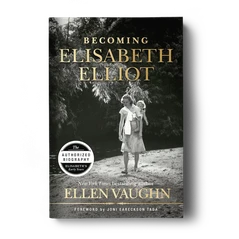
Okay, our next guest, Ellen Vaughn, didn’t contribute a chapter to (Un)remarkable. She wrote a whole biography instead. Actually two. All about one woman’s story. You may be familiar with the name Elisabeth Elliot. Maybe you’ve heard the heroic story of how she returned to the Ecuadorian tribe that speared her husband, Jim, to death. She shared the gospel with them and many came to faith in Jesus.
It’s easy to set Elisabeth on a pedestal, to think, “I could never be like her.” But as Ellen Vaughn studied Elisabeth’s many journals, she met a different woman. An ordinary woman who surrendered her life to an extraordinary God.
Ellen and Nancy spent some time talking about the aftermath of Jim’s death.
Ellen Vaughn: I found that the more time that went by, it seemed that the more Elisabeth was grieving her husband's loss. She dreamed of him incessantly; she ached for her husband; she missed him! She never had any sense of blaming God for Jim’s death. I think she had grown up in a household, in a faith community that was familiar with the notion of martyrdom.
The other thing, though, that I found astonishing is that there was not a shred of blame that I found in Elisabeth, nor in any of the other widows, toward the Waodani who had killed their husbands! There was no sense of bitterness.
It was like reading an alternative form of literature to read these journals where Elisabeth, contrary to everything human, felt a profound love for the Waodani. She felt since Jim had loved them enough to die for them, she loved them, too.
Elisabeth Elliot from a past recording: Jim knew that he was disposable. In 1956, he and four other missionaries sang a hymn together: “We Rest on Thee, Our Shield and Our Defender.” Then they went into what we knew was very dangerous territory, from which no one seemed to come back alive. They were trusting God to give them an opening for the gospel. All five were slaughtered.
Mincaye, the man in the little house near mine, was one of those that did the slaughtering. Mincaye was now singing about God! Obedience is our task; the results of that obedience are God’s . . . and God’s alone.
Ellen: So a persistent theme, right in the aftermath of Jim’s death, was that she wanted to go to the Waodani. She wanted to go into the tribe. Perhaps a woman could go where men had not been able to successfully penetrate . . . perhaps a woman and a child, Valerie.
So she prayed a lot. There’s a prayer that was in her journal that I cite in the book, where she said, “God uses the weak things of this world for His purposes. [from 1 Corinthians 1:27] Certainly Val and I qualify!”
Nancy: She didn’t see herself as some great heroic, strong woman.
Ellen: By no means! She did not see herself as Superwoman. She was just a woman in her twenties encountering things she had not expected, but determining in her spirit to stay true to God and to follow Him as best she could.
Elisabeth from a past recording: The will of God is not something you add to your life. It is a course that you choose. You either line yourself up with the Son of God and say to the Father, “Thy will be done,” or you capitulate to the principle which governs the rest of the world and you say, “My will be done.”
Ellen: Even though it was counter-cultural . . . Who takes a toddler into a group of indigenous killers (as they were known at the time)? But Elisabeth had a strong sense that God was leading and she “set her face like flint.” She packed up all of her pots and pans and things that she would need to live in the jungle.
They received (this certainly was a sign from God!) an invitation from the Waodani to come. That’s a long story; it’s in the book. She and Rachel and Valerie made their way. I have to tell you in reading the journals of this period of time, it had been a goal for Elisabeth for so long!
Now she’s sitting by the campfire and a man comes. And Valerie, who’s just a little girl, says, “Mommy, is that my daddy?”
Nancy: This is one of the indigenous people.
Ellen: Yes, one of the tribal members. Valerie had heard stories of her strong, young daddy. (She was only ten months old when her dad was killed.) She sees this strong, young man by the firelight: “Is that my daddy?” And Elisabeth said, “The truth is, no, that’s not your daddy. In fact, that man was one of the ones who killed your daddy.”
And so, to be reading these journals and seeing these scenes by the fire, as Elisabeth and Val and Rachel Saint all live with the tribal people who accept them, who hunt for them . . . the Holy Spirit was doing incredible things in this clearing in the Amazon jungle circa 1958!
It was a great reminder to me. All of us sort of have in our heads a paradigm of what is or what could be, and we limit God. And what God put Elisabeth Elliot in, as she was living among The People, was extraordinary! There are enough of the journal excerpts in the book that it makes really surreal reading, almost.
She writes, “Today I met some of the men that killed my husband, and I love them with the love that Jim had for them.” She’s trying desperately to find out what happened, why did the killings take place. There’s that sort of quest for what happened.
And so, her time among the Waodani is also characterized by her desire that they would come to know of Jesus, who was speared for them. I found that, in Elisabeth, there’s none of that sort of Western superiority. She didn’t see herself as civilized, and they were uncivilized. She, in fact, admired the way that they lived. She was not an affectionate person, and yet she overflowed with love for them. It’s extraordinary!
Nancy: It was extraordinary, and only God could do that. That’s where she was anchoring her life.
Dannah: That’s Nancy DeMoss Wolgemuth recounting Elisabeth Elliot’s legacy with Elisabeth’s biographer, Ellen Vaughn. If Elisabeth’s story captivates you like it does me, you’ve got to check out Ellen’s two biographies—Becoming Elisabeth Elliot and Being Elisabeth Elliot. These books share insights you won’t find anywhere else. We’ll link to both of them in today’s transcript.
Susanna, Phillis, and Elisabeth have something in common. They’re ordinary women with an extraordinary God. The same is true for you and me.
I hope you’ll take some time this weekend to dream about your own story. What kind of legacy do you want to leave? The busy mom who protected her prayer time? The gifted writer who fought spiritual battles on the page? The tenacious missionary who chose to forgive? God loves to use ordinary women who are surrendered to him. I can’t wait to see how he’ll use you!
To help equip you for a life of true womanhood, we’re offering you Mary Kassian’s new book, What Is a Woman? This resource does something the world is afraid to do. It defines womanhood. Who are we? What was God up to when he made us? Mary Kassian explores it all. The book is yours when you make a donation of any amount to support Revive Our Hearts this month. Visit ReviveOurHearts.com/weekend to donate and request What Is a Woman?
As promised, next weekend we’re bringing you three more stories of ordinary women used by God. These stories have the power to shape ours. I hope you’ll come back to hear them!
Thanks for listening today. I’m Dannah Gresh. We’ll see you next time for Revive Our Hearts Weekend.
This program is a listener-supported production of Revive Our Hearts in Niles, Michigan, calling women to freedom, fullness, and fruitfulness in Christ.
1Check out Karen's book for middle grade readers. The Story of Phillis Wheatley: The African Poet Who Called America to Christ (Lives of Faith and Grace).
*Offers available only during the broadcast of the podcast season.