3 Life-Changing Lessons for Young Women
This episode contains portions from the following programs:
"Engage Your Emotions"
"Stop Striving for the Next Big Thing"
"The Battle for Control"
--------------------
Dannah Gresh: Are you a young woman? I’m talking our college girls, our young professionals, our new moms, our girls in their twenties and thirties. If so, today’s episode is for you!
Titus 2 invites older women to teach the younger women, and today we’ve got three life-changing lessons for you from some of your favorite Bible teachers. They’ve got years of ministry experience and wisdom to share on some topics that are especially relevant for women at your age and stage.
So today, you can consider Nancy DeMoss Wolgemuth, Mary Kassian, and Kelly Needham your spiritual moms. Oh, and I’m your host, Dannah Gresh. You’re listening to Revive Our Hearts Weekend.
…This episode contains portions from the following programs:
"Engage Your Emotions"
"Stop Striving for the Next Big Thing"
"The Battle for Control"
--------------------
Dannah Gresh: Are you a young woman? I’m talking our college girls, our young professionals, our new moms, our girls in their twenties and thirties. If so, today’s episode is for you!
Titus 2 invites older women to teach the younger women, and today we’ve got three life-changing lessons for you from some of your favorite Bible teachers. They’ve got years of ministry experience and wisdom to share on some topics that are especially relevant for women at your age and stage.
So today, you can consider Nancy DeMoss Wolgemuth, Mary Kassian, and Kelly Needham your spiritual moms. Oh, and I’m your host, Dannah Gresh. You’re listening to Revive Our Hearts Weekend.
One of the most beautiful things about being part of the church is that we gain a spiritual family— a family that includes older, wiser women to train us up in Christ.
One of those women in my life was Tippy Duncan. Tippy taught me how to become a full-on adult in my twenties. She taught me about things like forgiveness and redemption and Jesus. She also taught me practical things like, how to handle my emotions as a mom, as a wife, as a woman in business. That wasn't necessarily an easy thing, but it was an important thing.
I want to pause and say, if you'd like to have a sneak peak into the life of an older woman discipling two younger woman, we took some time to videotape a conversation with me, my friend, Erin Davis, and Tippy Duncan, who was a spiritual mother to both of us.
You can watch videos about Tippy Duncan and our relationship with her. Just go to the transcript of today' program at ReviveOurHearts.com/weekend. Click on today’s episode. Now, back to emotions.
Titus 2 encourages older women to show younger women how to be self-controlled. And you know, I’ve found that a big part of self-control lies in how we respond to our emotions.
I had a conversation about that with my dear friends, Nancy DeMoss Wolgemuth and Mary Kassian. You know Nancy as my cohost here on Revive Our Hearts. Mary is also a frequent contributor and a True Woman conference speaker. But what you should know about both of these women is that they are faithful spiritual mothers, investing in the next generation through their biblical teaching and examples. They’ve spent years walking with the Lord and learning to navigate their own emotions in a way that honors him. Let’s listen to part of our conversation.
Nancy DeMoss Wolgemuth: So there’s this kind of push/pull, this ying/yang here about emotions. You say they’re a gift. We know they’re a gift. God has emotions. Jesus expressed emotions. Believers are encouraged to express emotions—and not just happy ones, but sad ones as well. And yet, our emotions can own us, can be the boss of us. We all know what it’s like to feel: it’s that time of the month, or it’s that hard season of life, and we’re under the pile of emotions. That’s not how God intends us to live, either.
Mary Kassian: Well, in the beginning God created us to have our minds and our wills and our emotions work together.
Nancy: Synced up.
Mary: Synced up, all agree, and all move in the same direction.
Nancy: Under His authority and lordship.
Mary: Under His authority and lordship. But what happened after the fall, after sin entered in, was our minds and our emotions and our wills started pulling in different directions.
You know, we can go, “Yes, I know I should do that, but . . .” Right? We don’t have the will to do it, or we don’t feel like doing it, because our minds and our wills and our emotions aren’t on the same page anymore, because of sin. We’ve been fractured.
In fact, one of the Scripture says that “your passions are at war within you” (see James 4:1). They war against you; they fight against you. Your feelings can fight against your will. Your feelings can fight against your intellect, what you know you should do. I see that all the time. I go through it all the time, the, “I know, but . . .” kind of syndrome.
Dannah: It’s just as simple as, “I don’t feel like getting out of bed right now,” or “I don’t feel like helping this friend who’s going through a hard time.”
Mary: Or, “I know I shouldn’t be flirting with my boss, but he makes me feel alive,” or “I know I shouldn’t be indulging in another glass of wine, but . . .” “I know I shouldn’t be following this path, but . . .”
Dannah: Yes.
Mary: When you have that kind of pull going on, you know that your emotions are at war with your mind. Your emotions are at war with your will, because you’re not able to do what you know you ought to do.
Nancy: Which is what Paul said in Romans. “I know what I’m supposed to do; the spirit part of me, the part that loves Christ, wants to do what’s right, but then I have this part of me, my flesh, that says, “No, I want to do what I want to do.”
That’s the emotions, the mind, the will at war with each other and against God. Ultimately, if we indulge our emotions, like, I wouldn’t mind having half that basket of chocolate, you know. I’m not craving it right this minute, although somebody listening to this conversation may be. But there are times when I think, It’s calling my name. I have to have that.
Well, if I give in to any rogue emotion that ends up in my heart, I’m going to become a captive. I think, I’m free to do this; I want to do this, so I’ll do this.” It’s a great day, great freedom, but then you end up feeling sick to your tummy or twenty pounds overweight or just depressed. I’m not saying all those things are always connected, but we can end up being slaves to our emotions.
Dannah: I think that’s one reason why the Scriptures instruct that we should fast. I don’t know that that’s really about the food; I think it’s about our flesh. Our emotions are a piece of our flesh, and I think when we fast and say, “For a period of time I am going to have this type of self-control over what I put in my mouth.” That is our spirit saying, “I’m in charge here. I’m going to make my decisions based on what God’s Word says, not based on what you feel, not what you want, not what you’re having a passion or a desire for right now. Flesh, be quiet.”
Nancy: To me, I think for all of us as women, at times, the battle is stopping to assess, “Are the things I’m feeling right now reliable emotions? Are they based in truth? Or are they emotions that I need to bring into subjection to truth?”
Mary: Now, emotions in and of themselves are not sinful desires per se, but sometimes we want to fulfill those desires in an illegitimate way, in a way outside of what God says we ought to be doing.
So I think it’s really important for us to not suppress or deny our emotions, but to examine them and to see what kind of truth they are saying to us. Then we need to bring them together with our minds and our intellects and our wills, so that all three we’re bringing back together into balance. We need to use our emotions to help us think the right way, to drive us to truth of Scripture, and then to counsel ourselves, so that we’re not just having our emotions drive us around.
Emotions were meant to be like a dashboard. They’re like indicators on your car’s dashboard, to give you good and vital information. How’s your engine running? Are you low on fuel? Is your door open? Do you need to fasten your seatbelt? What do you need to do? But the lights aren’t doing the driving. You need to be behind the wheel and you need to take control.
Nancy: Such a great word picture.
Dannah: That’s a beautiful word picture.
Mary: Now, you don’t ignore them, but you use them to move you in the right direction.
Dannah: So, the way you say it is habit number four: she engages her emotions. I like that, because you’re not ignoring them, you’re not being managed by them; you’re engaging them.
Nancy: You’re saying a weak woman is managed by her emotions.
Mary: Yes. She either denies them or she relies on them, she lets them drive her around.
Nancy: But a spiritually strong woman manages her emotions. Here’s the thing about when you know Jesus; you have not just your own emotions to deal with, your natural emotions, but because His Holy Spirit is in us. He gives us the power of a greater love, a love for Christ and affection for Christ. If we’re fueling that, we’re going to have less trouble being driven by emotions for things of this earth.
God made us for heaven. He made us for eternity. He made us to long for what is ultimate and true and beautiful, so we want to be emotionally alive to Christ, loving Him and focusing our emotions on Him.
Mary: We want our emotions to be full and engaged. I think everyone who met Jesus became alive. There was something—their emotions just took off, they bloomed, they blossomed. I think that as we bring our emotions to Jesus, He helps us with them, because He’s not only Lord of our bodies and our minds, He’s also Lord of our emotions.
Dannah: What a great conversation there with Mary Kassian, Nancy DeMoss Wolgemuth, and yours truly, Dannah Gresh. My dear young friend, you don’t have to let your emotions rule you. I know they can feel so big sometimes, but Jesus is Lord even over the biggest, most turbulent emotions you experience. You can engage them, manage them, and respond to them in God-honoring ways with His help.
You know, a lot of young women also have questions about their purpose, and that makes sense! You’re still figuring things out; you're launching out in life. Maybe you’re a young professional and you’re asking, “What does God really want me to do with my life?” Maybe you’re a young mom and you love your family, but you feel a little aimless in your day to day. Maybe you feel a deep desire for significance, and you aren’t quite sure what to do with it.
If any of that resonates, Kelly Needham is your girl! She’s a wife, mom, Bible teacher, and author. She’s written a book called Purposefooled: Why Chasing Your Dreams, Finding Your Calling, and Reaching for Greatness Will Never Be Enough. My good friend Portia Collins talked with Kelly about this book, and I’m excited for you to hear their conversation. Here’s Portia.
Portia Collins: I would love it if you could start us off by sharing some common misconceptions that you found people having about finding purpose.
Kelly Needham: Well, I think those misconceptions are everywhere. They're in the culture, but they're also in the church, and in ways that we don't realize sometimes. I would say they boil down to this. Anytime we attach our purpose to something we do, it becomes problematic. But by and large, it's how we understand it. When we talk about what was I made to do, you hear do in in how we describe it. I was made to do what was I made for. We usually are thinking about an activity set before us, even in the church. We sometimes think about that, like a specific calling or task.
But as soon as we attach our purpose to a verb, we now need to do that thing to be okay. Like, if my purpose is to write, my purpose is to be an author. Then as soon as I'm prohibited from writing because of just changes in my season, whether it's child care changes, whether it's a sickness that I'm dealing with, or one of my kids is dealing with. I'm now sequestered to this area of meaninglessness living because I can't live out the thing that was made to do.
So, I think that's, by and large, the biggest problem. We're being trained to see purpose is what we do. But I think the Bible teaches us that our purpose is not a verb but a noun. We were made for a person, that our purpose is attached to God Himself, which infuses all of life seasons with meaning.
Portia: Absolutely, absolutely. You're already hitting those touch points. You are what I call, telling my business. Because I have found myself struggling in the very same ways exactly what you described. I have definitely been there.
You know, in your book, you talk about the hunger for the extraordinary. I would love it if you give us the Cliff notes here. What do you mean by the hunger for the extraordinary? And why do you think that we are so drawn to that?
Kelly: I think that's a human longing. We can sometimes peg it on technology, right? We're all obsessed with being YouTube stars now or something like that. But I think if you look at Genesis, you see the Tower of Babel. I mean, from day one, human beings are like, how can we build something amazing that screams we’re important and extraordinary, we've done this big thing.
So, I think it's in us to long for something out of the ordinary, something transcendent. That's why we want to build legacies and start things and be famous. It kind of leads to all of that. I actually don't think the longing in and of itself is wrong, I think it's just misplaced. If we're made in the image of the living God to mean the one who designs galaxies and upholds black holes with the palm of His hand, and yet designs every snowflake differently.
I mean, what? We were made in His image. It is no wonder that we long for something transcendent and otherworldly because we were made for something bigger than this world, we were made for Him.
The problem is we take that big, deep, aching longing, and when we try to channel it toward things we can do . . . Even sometimes in our motherhood, we can see it as ordinary and extraordinary like, I'm gonna mother so well, people can write books about this later, right? Or I'm going to start this nonprofit and do this or whatever it is, whatever mountain we're trying to climb.
I think ultimately, like the book of Ecclesiastes will say, you can get to the top of that mountain, and there's nothing there. Everything under the sun is meaningless. God Himself is the only one who can hold that weight and fill that deep ache in us for transcendent purpose. So, I think the ache is good. But it's just misplaced when we look to be extraordinary ourselves instead of looking to the extraordinary God.
Portia: So that makes me want to dig in a little bit deeper. You know, you're saying we're a bit disillusioned when it comes to purpose. And, we are chasing the extraordinary, which is not inherently bad, but our way of doing that is not correct. And so, I want to know, what's the danger? What happens in a woman's heart when she is trying to or just striving to, “find her purpose”?
Kelly: Well, I think when you go down that path of, I need to find my purpose by my unique purpose, right? You've now opened the door for endless self-discovery. And that is because that pit is never ending, right? Who was I made to be in each new season? Now I'm asking, what am I supposed to be doing in this season and in this season? It's just kind of an endless pit of looking inward at myself, what was I made to do?
And then now whatever I land on, whatever I decide is my unique purpose, now it becomes my lord. I now am going to bend over backwards to do that thing. And I'm going to see any hindrance to being able to do that thing as a problem.
And even if God is orchestrating my days to provide good opportunities for me, if they appear to me as a hindrance to the unique purpose, they now become obstacles to leap over, not something to receive an embrace from God. So, I think that's one problem.
But a second problem is, it keeps us as the main character. I'm still thinking about what I need to accomplish in the world. Instead of letting God be the main character of my own life, He now is the one acting before I had a conscious thought and Psalm 139. He's moving and acting in our lives. Do we see Him as the main character? Does He have the right to be that main character role in our lives? Are we trying to kind of squeeze our way in there?
And most of us, you try to because it feels great to be the main character in a story and to be the hero, but ultimately, that's not who we are. And honestly, that's too much pressure for us. And at the end of the day, we're just burnt out and exhausted when we try to fill that.
Dannah: Kelly Needham reminding you: you aren’t the main character of your story. Isn’t that actually such a freeing thought? We don’t have to be the hero because Jesus is—and we belong to Him.
Speaking of Jesus being the main character of your story—Nancy DeMoss Wolgemuth says one of the most important things you can ever do is get to know Him. When you do, it will be so much easier to trust Him. To surrender control of your life to Him and to say, “Yes, Lord.” Here’s Nancy with more wisdom just for you.
Nancy: I would say, by the way, to you younger women (I’m so glad to see some younger girls with us today). I can remember being at your season of life and in the journey, as I still am, of getting to know God. But there’s so much more I know about Him today than I did back then. It took faith to say, “Lord, what I know of You, I trust. What I know of You, I will submit myself to.” But I’m so thankful I’ve been on a journey of getting to know Him better because the better I know Him, the more I realize He really is worthy of my trust and my wholehearted surrender.
There’s such a battle for control that goes on in our hearts, isn’t there? We will gladly yield control of our lives. Even that wording suggests that it’s not always easy. Sometimes our will conflicts with His will. As you read the Scripture, you see that the wind, the waves, nature, demons obey His Word. How can we resist Him?
Every part, every area of my life is to be under the control of His Spirit. Is there any area of your life where you haven’t yielded control, where you are reserving the right to make the final decision? Any area of your life? We will yield control to Christ as Lord.
That, by the way, is the number one cutting edge commitment. We have twelve of them in our ministry, Revive Our Hearts. We call them Cutting Edge Commitments. The number one cutting edge commitment of this ministry is the Lordship of Christ and the authority of Scripture. Here’s how it reads:
Our lives and ministry must be built on a non-negotiable, lifetime commitment to the lordship of Christ and the authority of Scripture. His Word must determine our philosophy, direct our decision making, and reign supreme over every area of our lives.
That’s just a way of stating what this statement is in the True Woman Manifesto. "We will gladly yield control of our lives to Christ as Lord."
Now, we need to remind ourselves that He is Lord. We’re not making Him Lord. He is Lord. “All authority in heaven and on earth has been given to me,” Jesus said in Matthew chapter 28, verse 18. In his message on the day of Pentecost, Peter said, “Let all Israel be assured of this: God has made this Jesus, whom you crucified, both Lord and Christ” (Acts 2:36 NIV).
Now if Jesus is Lord, and He is, the implication of that is that He deserves our absolute unquestioning obedience. We have to do what He says to do. Jesus asked in Luke chapter 6, “Why do you call me ‘Lord, Lord,’ but you don’t do what I tell you?” (Luke 6:46 paraphrased). You see, it doesn’t do any good to say, "Yes, Lord," as we encourage women to say in this ministry and at our True Woman conferences. We say, "Yes, Lord, yes, Lord." But it doesn’t do any good to say those words if in your heart you’re not yielding control to Him as Lord.
By the way, the great model of this is the obedience of Christ to the will of His Father. He gladly yielded control. He submitted to the will of His Father. Psalm chapter 40 (also repeated in the book of Hebrews), “Then I said, ‘Behold, I have come; in the scroll of the book it is written of me: “I delight to do your will, O my God; your law is within my heart"'" (Psalm 40:7–8). Jesus said, “God, I love You and I delight to do Your will. Your law is within my heart. I have a heart for Your law.”
That’s the example we have in Christ. As He moves in us and fills us, He will put His law within our hearts. He will give to us not just a grudging obedience to God’s law and to God’s ways, but a delight to do the will of God.
I should point out that this heart to yield control to Christ as Lord is an evidence of true salvation. If you’re not saying, "Yes, Lord" with your lips and with your life, you have no basis to have assurance that you are a child of God. So often today we have people in our churches who are living in willful, known, unrepented of sin, yet claiming to be Christians.
Some of you have children who are prodigals and they’re living in willful sin, perhaps they live an immoral lifestyle, living in overt, known rebellion. But you’re saying, “Oh, they made a decision for Christ when they were three years old. I know my child’s a Christian. I’m just praying he’ll come back to God.” Your child may not be a Christian at all. Don’t assume that your child is a Christian or your mate or yourself if there’s no evidence that you have a heart to say, "Yes, Lord," to obey God.
What you may need to be praying for your mate or your child is, “Lord, bring them to recognize that they are not a Christian, that they need to be born again, that they are lost.” Don’t let them be resting on a false assurance, professing something that there is no evidence that they possess.
You see, when we say that a person can make a decision for Christ and then live any way they want to live, we’re implying that salvation is a profession at a point in time that doesn’t necessarily change the way you live, that doesn’t require surrendering your life to Christ as Lord. Sadly, this has been characteristic of so much evangelism that’s been done in the last century. As a result, there are millions and millions of people in this country, people in your church and mine, who think that they are Christians but who really are not. There’s no heart to obey God.
Now some of you are saying, “Oh, I’ve disobeyed God. Are you saying I’m not a Christian?” First of all, I can’t tell you whether you’re a Christian or not. I can also tell you that if you are a Christian, there will be times when you disobey God. What I’m saying is if you don’t have any bent, any inclination in your heart to obey His Word, then you have no basis for assurance that you are a child of God.
Here’s how we know that we know Him, if we have a heart to keep His commandments. Now to say "yes" to Christ as Lord, to say, "Yes, Lord," it requires faith. Because on the front end when you’re facing a decision or an issue in your life, all you can see is the downside, the pain, the cost, the negatives, the fears, the loss, the hard place. If I say, "Yes, Lord"—I’m looking at some single women in this room—maybe He’ll never let me get married, or maybe He won’t let me marry the person I want to marry.
Or if I say, "Yes, Lord, my life is Yours; my body is Yours," maybe He won’t let me have children, or maybe He’ll give me a lot of children. Maybe He’ll send me to . . . and you name whatever it is that’s the worst place you can think of on earth that you don’t want to go. Maybe God will make me do this or won’t let me do this. I won’t have any fun, or I will be miserable.
There are fears. We have to face those fears with faith and faith helps us to see that on the other side of obedience there is always joy. There are treasures. There are pleasures. There are riches. There’s a place of abundance. Now, I didn’t say it’s an easy life because there’s no easy life this side of heaven. But there is joy that comes after we step into the pathway of obedience and say, "Yes, Lord," regardless of what we feel, what we think, what we want, and we let Him be Lord.
Remember that this is not a one-time choice, not a one-time decision to say, "Yes, Lord." Saying, "Yes, Lord," is a way of life. Saying it many times, daily, it’s an ongoing thing in life as God brings new things into our lives and new seasons of life. Say, "Yes, Lord." Surrendering to the ways of God sometimes may involve tragedy and loss and pain and mysteries that we can’t explain.
Saying "yes" to the will of God. That might be motherhood. It might be saying "yes" to singleness. It might be saying "yes" to infertility. It might be saying "yes" to stay in a difficult marriage. It might be saying "yes" to vocational ministry. But it’s knowing that God is good. He is God. His ways are best.
So the heart of a true woman is the heart of Mary of Nazareth who said, “I am the Lord’s handmaiden. I am the Lord’s bondservant. May it be to me as you have said,” Luke chapter 1, verse 38 (paraphrased). "Yes, Lord."
Dannah: So good. That’s my wise friend, Nancy, inviting you to surrender all of your life to the Lord. It’s not easy, but I think every woman you heard from today would attest that it is good.
I've been at places in my life where I wasn't surrendered to the Lord, and I felt the distance in my relationship with Jesus. I felt a level of dissatisfaction—even if I was successful in earthly terms. But no matter what's going on in my life, success or none, there can be terrible failures all around me. But when I am surrendered to Jesus, it's good.
My prayer is that you, precious friend will learn to say, “Yes, Lord” now, so that when trials come, you’ll be steady, confident in the Lord’s gracious providence and love for you. Your emotions won’t get to be the boss of you. You’ll know where your purpose lies. And you’ll be prepared to surrender everything to follow Jesus. I hope today’s lessons from these mothers in Christ have given you a beautiful vision for what that could look like.
We’re able to bring you this kind of teaching because listeners like you give to support our outreaches. Revive Our Hearts wouldn’t exist without so many friends of the ministry who’ve donated, whether it be one time or on a regular basis. If today’s program was an encouragement to you, would you consider making a donation? When you do, you’re partnering with us to reach more women—young and old—with the message of freedom, fullness, and fruitfulness in Christ.
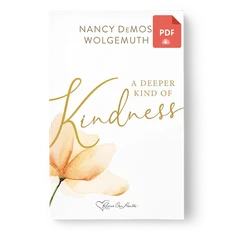
As our thank you for a gift of any amount, we’d love to send you a copy of Nancy’s booklet, A Deeper Kind of Kindness—a resource that invites you to display the gospel in all your relationships. To give and request your copy, visit ReviveOurHearts.com.
Next weekend, we’re talking about the sweet gift of sisterhood, and we’ll unpack what it looks like to be a faithful sister in Christ. I hope you’ll join us for that.
Thanks for listening today. I’m Dannah Gresh. We’ll see you next time, for Revive Our Hearts Weekend.
This program is a listener-supported production of Revive Our Hearts in Niles, Michigan, calling women to freedom, fullness, and fruitfulness in Christ.
*Offers available only during the broadcast of the podcast season.