
Your Heart Is Overflowing
Dannah Gresh: Have you ever said something and wish you could take it back? That moment might reveal something about your heart. Here’s Nancy DeMoss Wolgemuth.
Nancy DeMoss Wolgemuth: If you want your words to change, it’s not enough to focus on changing your speech. What we really need is a heart change.
Dannah: This is the Revive Our Hearts podcast with Nancy DeMoss Wolgemuth, author of Adorned, for July 8, 2025. I’m Dannah Gresh.
Nancy’s continuing in a series called The Power of Words.
Nancy: We’re looking at the book of Proverbs and finding that it has a lot to tell us about the impact of the words that we speak. The verse we’ve been meditating on and I’ve encouraged you to put in different places around your home is Proverbs 18:21. “Death and life are in the power of the tongue.” We’ve …
Dannah Gresh: Have you ever said something and wish you could take it back? That moment might reveal something about your heart. Here’s Nancy DeMoss Wolgemuth.
Nancy DeMoss Wolgemuth: If you want your words to change, it’s not enough to focus on changing your speech. What we really need is a heart change.
Dannah: This is the Revive Our Hearts podcast with Nancy DeMoss Wolgemuth, author of Adorned, for July 8, 2025. I’m Dannah Gresh.
Nancy’s continuing in a series called The Power of Words.
Nancy: We’re looking at the book of Proverbs and finding that it has a lot to tell us about the impact of the words that we speak. The verse we’ve been meditating on and I’ve encouraged you to put in different places around your home is Proverbs 18:21. “Death and life are in the power of the tongue.” We’ve seen that our words have power to wound and destroy or to heal and to build up.
Now, if we were just all the time speaking one of those sorts of words, it would be easy to figure it out. The problem is that out of the same mouth often come the kinds of words that heal and the kind of words that destroy and wound, which is why we need the Spirit of God to fill our hearts with His Word and His ways so that the words we speak will not be the foolish or the wounding or the deadly words.
One of the themes that comes through many times in the book of Proverbs is the connection of our words to our heart. In fact, I counted eleven verses—there may be more than that—where the word "heart" is in the same verse with the word "lips" or "tongue" or "mouth." The connection is made over and over again.
The contrast, for example, in chapter 10, verse 20: “The tongue of the righteous is choice silver, but the heart of the wicked is worth little.” The tongue is connected to the heart.
Proverbs 15:7: “The lips of the wise disperse [or spread] knowledge, but the heart of the foolish”—why doesn’t it say “the mouth of the foolish does not do so”? The contrast is between the lips of the wise and the heart of the foolish. Why? Because there’s a connection between what we say and what’s in our hearts.
In fact, as you go through the book of Proverbs—and I’m encouraging you to do your own study; I’m hoping just to whet your appetite for your own study on the book of Proverbs and its many references to the tongue—you’ll find that there are many places where we read about the mouth or the words of the wicked, or the mouth of the foolish.
Then there are other places where you read about the mouth or the tongue or the lips of the righteous, or the words of the pure or the tongue or the lips of the wise. What’s the connection there? The tongue reveals the condition of my heart. The words that I speak are a mirror into my heart.
The words come out. That’s what’s heard; that’s what’s evident. But they reveal what is not so evident until I speak the words, and that is the condition of my heart. So if I’m a foolish person, I’m going to speak foolish words. If I have a wicked heart, the words that come out of my mouth are going to be wicked words.
Hundreds of years ago Francis DeSalles said this: “Our words are a faithful index of the state of our souls.” So, you want to know what’s in your heart? Jesus said, “Out of the abundance [or overflow] of the heart, the mouth speaks.”
So if I have a critical heart, what kinds of words are going to come out? Critical words. If I have a mean-spirited heart, what kinds of words are going to come out of my mouth? Mean words, unkind words.
If I have a proud heart, I’m going to speak arrogant words. If I have an unloving heart, I’m going to speak unkind words. A self-centered heart is going to speak selfish words. And when I speak angry words, what does that tell you about my heart? It means I’ve got an angry heart.
If I speak profane words, what does that tell you about my heart? It’s profane. Impatient words come out of an impatient heart. Complaining words come out of a discontented heart. A heart that is selfish is going to talk about what? Self.
I can remember my dad telling us as we were growing up that one of the important things in conversation is not to talk about yourself. He said, “People want to talk about themselves. So ask questions that draw them out.”
As you think about the people you know who have a lot of friends, people that others want to be around, one of the things you’ll notice is that they talk about others. They ask questions about others. They’re not always talking about themselves.
I’m thinking of one Christian leader I know; I saw him just recently, and I made the comment after I left him . . . I’ve talked with him a handful of times over the years, and I said about this man who is the head of a ministry, one of the things I so appreciate about this man is that whenever you see him, he’s not telling you how he’s doing or how his ministry is doing. He’s asking how you’re doing. He’s asking about your background and your friends and your life. This is a man whose words reveal that he has an unselfish heart. As a result, he’s an encourager. You want to be around him because there’s blessing and an overflow that comes out of that heart.
Now, we’ve seen that a wicked heart is going to produce wicked words. Conversely, if we have a pure heart, a righteous heart, the overflow is going to be words that are pure and righteous.
So if I have a loving heart, what kinds of words am I going to speak? Loving words. If I have a kind heart, I will speak kind words. If my heart is unselfish, as I saw in that Christian leader, I’m going to speak others-centered words.
If I have a humble heart, I’m not going to be saying arrogant things; I’m going to be saying humble things. I’m not going to be saying things that draw attention to myself or my accomplishments or what I’ve done. If I have a humble heart, I’m going to be lifting others up. I’ll have the attitude of John the Baptist who said of Jesus, “He must increase, and I must decrease.”
Where do those words come from? A humble heart. If I have a pure heart, I will speak pure words. If I speak words that are sensual or corrupt or ungodly words, I’m showing there’s a heart condition, that I’ve got a problem with my heart; my heart is corrupt, and that’s why I’m speaking corrupt words.
Proverbs talks about a gracious woman. If I have a gracious heart, I will speak gracious words. I think of some women I know who are just gracious people. When they open their mouths to speak, they’re encouragers. Some of you in this room are this way. I listen to you and I think, I’d like to be like that.
I’m not—I know you may think of me as being very outgoing and extraverted—but making conversation with people, especially that I don’t know, doesn’t come really easily for me. I would rather just kind of sit behind the scenes or in a corner and let other people carry the conversation. It takes effort for me to go out of myself and out of my way to speak words that are gracious and encouraging.
But I’m noticing that as God does a work in my heart, I’m filled in my heart with His Spirit and with His love and with His grace, then it’s not such an effort to speak words that reflect that heart.
If I have a grateful heart, what kind of words am I going to speak? Thankful words. A thankful heart produces thankful words. Again, you could think of people that you know—they can be in the midst of a really troubling situation, but they’re talking about the goodness of God and the faithfulness of God in the middle of what is a very difficult situation. They are saying thankful words because they have a thankful heart.
Some of you have been so gracious in expressing gratitude for what these sessions have meant to you, and you’ve taken time to stop and say, “Thank you for this teaching. Thank you for your ministry to me.” As I hear you express gratitude, I’m realizing that gratitude is flowing out of a grateful heart.
If you have a wise heart, you’re going to speak wise words. Now, the challenge is that I want to speak wise words, but I don’t always want to pay the price to get a heart of wisdom because it takes work and effort to fill my heart with God’s words so that I have wisdom inside of me that will come out in wise words.
I always have this mental image of what it means to be a wise, old lady, and I want to be that lady. I want to have that kind of wisdom, but I don’t always want to pay the price to get there, to have the kind of heart that is going to give out that kind of wisdom.
If I have an honest heart, I’m going to speak truthful words. If I’m speaking words that are deceptive or not true, it’s telling you something about my heart.
If I have a heart for God, a spiritually-minded heart, it’s not going to be difficult for me, in the course of everyday conversation, to talk about spiritual matters because out of the overflow of the heart the mouth speaks.
I know some people who have been in church forever, it seems—who are active in doing church work and doing various kinds of ministry—but you get them in conversation, and they can talk about everything except the Lord. It’s just difficult.
You don’t hear them talk about what God’s doing in their life or about what God’s been teaching them or what they’re learning about the heart and the ways of God. It’s like that’s a category of their lives that’s for church time, but it doesn’t affect the way they talk all the time.
I’m saying that shows something about the heart. If I can’t talk about the Lord in the course of conversation, it means that my heart is not as focused and set on the Lord as it needs to be; because if I have a heart for the things of God, I will be able to talk about the things of God.
So as we think about our words and our hearts, the words that we speak are really the thermometer of my heart. Those words don’t determine the temperature. The thermometer doesn’t determine the temperature; the thermometer just registers the temperature; and the words that I speak register the temperature, the condition, of my heart.
Now, we’d like to think that that is usually true, but not always. So we tend to trivialize, many times, the words that we say by saying things like this: "I really didn’t mean it. I couldn’t help it. It just came out.
That’s not really true. The fact is, I may have said it thoughtlessly or carelessly, but that too reveals something about my heart. If my words are uncontrolled and unrestrained, that says that I have a heart that’s not disciplined, that’s not restrained, that’s not under the control of the Holy Spirit. The fact is, what I say reveals what I mean.
So we want to just throw out these heated words, these damaging words, and then try and take them back and say, “I didn’t really mean that.” Well, I may be sorry I said it, but I’ve got to acknowledge that this is no trivial matter that I said this. Though it was thoughtless or careless, it revealed a condition of my heart that is serious; my heart had its temperature taken, and what registered was something that is not pleasing to the Lord.
So let me ask you this: What do your words reveal about your heart? And don’t just ask yourself that as we’re sitting in this room talking about . . . well, you’re sitting here listening, so nobody is sinning with their tongue right now. I’m the only one who has the possibility of doing that right this moment.
But as you go back into your home, as you go back into your workplace, as you get back on the telephone, as we carry on conversation as this session is finished (if anyone has the courage to carry on conversation after we finish talking about the tongue), ask, “What do my words reveal about the condition of my heart?”
Then if we want to change our words—and all of us have times when we so regret what we said. Someone was just sharing with me today how she regretted, as a young, angry mother, things she said to her daughter. Now her daughter is grown, and she is still reaping the consequences in that relationship of things that she said as a young mother. She regrets those things; she wishes she could go back and take those words back and redo those conversations.
You can’t. But what you can do is let God search your heart now. If you want your words to change, it’s not enough to focus on changing your speech. What we really need is a heart change.
Some of us need major heart surgery; to say honestly before the Lord and maybe before another person, maybe before your mate who would help hold you accountable, “I realize that the words that I speak show that I’ve got some issues in my heart that are very serious. I’m seeing that those quick, thoughtless, careless, unrestrained, gossiping words reveal a condition of my heart that needs to be repented of.”
Now, I don’t want you to leave here feeling overwhelmed and like, “I’ll never open my mouth again because I just can’t say anything right.” What I do want you to do is to repent, to agree with God, to humble yourself, to acknowledge whatever God shows you about your heart, as I’m being forced to do about my own heart as I’m studying this.
Get before the Lord and say, “Lord, change my heart. Fill me with Your Spirit,” so that when I’m under pressure, when I’m speaking to those children, when I’m speaking to my mate, when I’m speaking to my coworkers, when I get on the phone in a conversation, what will come out will be the overflow of a pure heart, of a heart that is controlled by the Spirit of God.
How many of you would be honest enough to say that over these last few moments, the Spirit of God has pointed His finger at your heart? You have seen there is an issue, maybe more that one issue in your heart that needs to be repented of. Your words are just an expression of what's deep in your heart. You just want to ask the Lord to forgive you, to change your heart. You want to repent of of whatever it is that He has shown you is in your heart. You want God to change your heart in those specific areas, knowing then that the words that come out will be an expression of a pure heart.
If that is true of you in some specific issue that we've addressed, or maybe something the Holy Spirit has pointed out to you, would you be honest enough to slip your hand up in the air? I want to pray for you and pray for us, as most of our hands are in the air. Thank you for being honest. You can slip them down.
Lord, You see our hands, but more important than that, You see our hearts. We do lift up our hearts to You and confess that we want to justify and trivialize this so often, the things that we say.
But we come before You brokenly and humbly to say, “It’s our hearts that are the issue,” and to plead with You to give us repentant hearts, to cleanse our hearts, to purify us, to fill our hearts with You and with Your Word so that what comes out of our mouths will be the fruit of Your Holy Spirit.
Change us, Lord. Change our hearts, and then change the way that we speak so that our words can bring glory to You. We pray in Jesus’ name, amen.
Dannah: I think all of us need that message from Nancy DeMoss Wolgemuth. We all let destructive words out of our mouths. But God is faithful and just to forgive our sins when we ask Him—because Jesus was punished for every destructive word.
We are about to follow up with some practical ways we can live this message in our day to day lives. But first let me tell you about a resource that will help you evaluate your heart and your words.
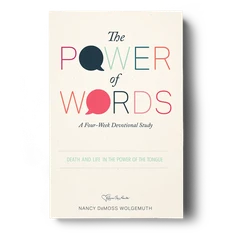
This month, when you make a donation of any amount, you can ask for Nancy’s study The Power of Words. It goes right along with our current series, so you can slow down and reflect on the connection between your heart and your words. To donate, visit ReviveOurHearts.com or call us at 1-800-569-5959. When you do, ask for Nancy’s book so we can send that to you. It’s our way of saying thank you for your generosity.
What phenomenal teaching from my friend Nancy on the power of the tongue. I'm feeling pretty convicted right now. I though what I want to do is get a little practical. What does this look like in our relationships? As I was thinking about what to talk to you about this, my friend Suzy Weibel came to mind.
Well we’ve heard powerful teaching from Nancy today, and I’ve invited a friend to talk more about this topic of our hearts and our words. How do we live this out in our everyday situations?
My friend Suzy Weibel is here. Welcome to Revive Our Hearts.
Suzy: Hello. Thank you for having me.
Dannah: Suzy and I have been ministering together through my ministry, True Girl, to tweens for more than twenty years. We spent a lot of time with teenagers through those years, ministering to them as well. In fact, I'm so excited! Suzy and I are working on a project just for Teen Girls that we're gonna be telling you more about in coming months. It's called Wonder, and it's an app that gets girls into God's Word every single day. And Suzy will be at the True Woman conference this October, talking to teenage girls more about that in our teen workshop.
So Susie, I'm so glad you're here today. Let's talk about the power of the tongue. Why did God put it on your heart that this would be . . . I mean, really, it is a life message for you to talk to women about how we use our tongues.
Suzy: Yeah, there's definitely a story behind how this became something that I speak about frequently, and it has to do with you, Dannah. Long ago, you said, "Hey, I think I'd like you to teach." And you said I could teach on anything I wanted to teach on, which is a great invitation. It just so happened that that invitation correlated with me going home and finding my old seventh and eighth grade diaries in my mom and dad's house—diaries that had been lost for years. We'll call them the Lost Diaries.
When I read the diaries, I just didn't recognize the girl that was inside. I don't remember having the feelings that I had, the thoughts that I had. I definitely don't remember writing the things that I did. But I know that so much of it centered around my heart. I discovered as I reread not only my diaries, but also just spending time in God's Word, that the heart and the tongue are . . . I mean, they're clearly part of the same body. But the Word says "out of the overflow of the heart the mouth speaks." And boy, did I ever see that come to life when I was in seventh and eighth grade with my diary.
Dannah: What a good thing that you matured out of it and didn't recognize that girl.
Suzy: That is a good thing!
Dannah: But not all of us do mature out of it. And those of us that do mature out of it still have moments when what is inside of our hearts comes out of our mouths . . . and it's not pretty.
I have always been convicted when you talk about this topic, you take us to the book of James. Take us there now, Suzy, because there's some real practical advice for us all.
Suzy: Well, the first thing I'm gonna do, before going into James is just really quickly read two clips (I don't know if that's what you call them) from my diary.
Dannah: Excerpts.
Suzy: There we go, two excerpts from my diary. But here's the thing to keep in mind. It's not actually two excerpts, it's one excerpt. My diary was small. It was not a large diary. It was not 8 1/2 x 11. This was a small book, smaller than most paperback books. So I didn't have much room to write every day, just a small space. One day, one excerpt, I managed to write these same things.
"School is out. Boy, it's about time. School is going to be great next year—no more Gina, no more Tara. What a blast. I'm not sorry that I called Gina a "bleep" because she is one. I hate her, and so do many other people."
Dannah: Oh no!
Suzy: Dannah, listen to this. I wrote:
"May she die!! [Oh yes, followed by two exclamation points.] And the same goes for Jessica."
Dannah: Oh no!
Suzy: Continued on the same page . . .
"It was really boring all day long. The best part was chapel. It was fun to sing with the choir again. Real fun! In a way. I'm sorry that I didn't make the student life committee. I love God more than anything. No matter how much I get in trouble, I love God!!! [Three exclamation points and everything underlined.]"
I cannot help but think of James chapter 3, verses 9–12, which says, "with the tongue . . ." This was the pen, but it was my tongue; it was my heart.
With the tongue, we praise our Lord and Father, and with it we curse human beings, who have been made in God's likeness. Out of the same mouth come praise and cursing. My brothers and sisters, this should not be. Can both fresh water and salt water flow from the same spring? My brothers and sisters, can a fig tree bear olives, or a grapevine bear figs? Neither can a salt spring produce fresh water.
I exemplified that in 1979 on the pages of my little diary.
Dannah: And sadly, some days as moms, we exemplify that in our quiet time. We're praising God, and the next thing we know it the kids are getting on our nerves, and we are not using our words wisely. Or, in our quiet time we're praising God, and then we turn around and gossip about a friend that maybe is in the same Bible study that we just did that morning. That ought not to be.
Suzy, how do we start to get control of that kind of behavior in our hearts? And really it is in our hearts, and it's coming out of our tongues.
Suzy: You know, I suppose the first thing to remember is that Jesus said, "Apart from [Him] we can do nothing" (John 15:5). So, this is not going to happen by willpower. This is not going to happen by conviction. You talked about the conviction of good teaching. Good teaching is great. It does bring conviction into our heart, but we can't just stop there, because that conviction will go away. It will melt away in no time.
I would have told you when I was in seventh grade and eighth grade that I had a good heart. And to be honest with you, I believe that I did. I was a kind person. I was always for the underdog.
Dannah: You probably wouldn't have said those things to Gina's face.
Suzy: Never would have said those things to anybody's face. I never would have let my mom read my diary and know that I had written them. But there was One who did know my heart.
You know the Word says, "Our hearts are deceitful above all things." So I think the way that we get control of this is to recognize that we have no power over it. We have no control over it. It's a matter of submitting it to the Father, bringing it before the throne, and asking Him for a new heart.
I think if we think that we're just going to clean up what we have as far as our heart goes, that is not what God is after. He's after a new heart. I think we have to submit that to Him and ask for that.
Dannah: Yeah, it's all about the time we spend with Jesus, really. It always comes back to Him. As I spend more and more time with Him, my tongue is, well, it's bridled. It's reined in, which I think the book of James also talks about that, doesn't it, right?
Suzy: Right, it does.
Dannah: Tell us a little bit about that.
Suzy: Well, there's no doubt that. I guess it's a social principle. You know that you become like the people that you spend the most time with, right? And it just follows that if we spend our time in God's Word, if that's where we choose to devote our time, then we are going to become more like Jesus. We are going to become more like the Father. That's just what that fruit is that we are going to bear. He really is our bridle. He is our peace. He is the one that brings peace.
Dannah: I think too the people we spend time with, they can, for lack of a better word, conjure up those gossipy, slanderous, curseful words that we are prone to speak when our heart's not in the right place. Or we can be around people who really participate in being that bridle on our tongues.
Suzy, on social media, especially, you see a lot of bullying. It's not just seventh grade girls, it's forty-year-old mature women, or supposedly mature women, that are saying unkind things to each other. Is the litmus test for how our tongues are in the hands of Christ, that we're just never saying anything unkind? Or does it go beyond that?
Suzy: I definitely think that it's going to go beyond that. Because, again, if we're the whole concept of never saying anything unkind . . . I hope everybody will think about this. I think that kind of falls under the umbrella of humanism, that kind of falls under this false concept that we can somehow muscle ourselves into a position of behaving in a way that we want to behave, in a way that God wants us to behave. And that's just not a reality. It's just not something that we can pull ourselves up by our bootstraps and become better.
Dannah: One last question I have for you, Suzy. Proverbs says that out of the mouth there's the power of life and there's the power of death (see Prov. 18:21). What you've talked about a little bit is bridling the power of death, words that curse, words that hurt, words that wound. But we also have an imperative to speak words of life. So that means this isn't a neutral thing. We're not just bystanders when somebody is bullying. There is a responsibility we have to confront gossip, to stop slander, to speak up for the person that's being bullied. Talk about that, because I know that's been a soapbox you jump on readily.
Suzy: Yeah, I noticed when I was thinking about my junior high years, I did notice . . . and also with the girls that we've worked with. There really are three types of people. You have the people who are Mean Girls, or the people who are mean. They do aggressively go after others. Then you have the people who you're talking about stand by and say nothing. They see it going on around them, but they figure it's none of my business, and so they do nothing. And then you have the people who are targets.
When I talk with girls, I offer them an opportunity to respond to an altar call that's not an altar call for salvation, but to identify with one of those three groups. I ask them to come before God and one another and stand in one group that says: I'm the bully. I've been the Mean Girl. I ask them to come down and say, "I see it going on all around me at school, and it either breaks my heart, or it doesn't bother me at all. But I know that's a problem because I'm doing nothing about it, and I know that I could do something about it. I could stand in the gap for these girls that are being bullied." And then I have a third group that we just pray over because they are so wounded and broken. That's the girls that are . . . And we are seeing just dire, dire consequences for this on social media right now. Social media bullying does have the power of death. So we just pray over these girls. We assure them that they are seen, and they are loved. We encourage the other girls then to come around them and ask their forgiveness and promise to stand up for them. I've seen kids do it.
Dannah: I think it's an important thing for us as women to identify with one of those groups too. Is our tongue used to be unkind, to be a bully in our home, in our friendships, in our church? Or, are we a target? And do we need to go to someone and talk to them about that and pour it out to a wise friend so they can help us to respond in a godly manner to the people that are hurting us. Or, are we bystanders?
The Lord is calling us today to be life speakers that speak into those situations. It may be something as simple as two friends that are gossiping about each other all the time, and you say, "I'm not gonna be a bystander here. I'm gonna sit the two of you down, and we're gonna hash it out until we are sisters in Christ, and we act like it."
So think about that today. Pray about that today. Are you a mean girl? Are you a bystander? Are you a target? And what does the Lord want and need you to do? What do you need to confess? What action do you need to take so that you can get your heart and your tongue in a place that's truly holy.
Dannah: You know, I'm pretty confident that God might be stirring your soul at the end of today's episode. So let me give you some thoughts about what you might want to do with that. You might be thinking, I really need to make a change. Maybe you desire to use your words differently, but you feel stuck. If that's you, then the staff here at Revive Our Hearts would love to pray for you.
Visit, ReviveOurHearts.com/prayer and let us know what's on your heart today. It might be related to today's episode, or it might be something else. Maybe you're experiencing a trial. Maybe you have a friend who isn't following Jesus and you're just burdened for her. Whatever it is, we'd love to come alongside you in prayer. Again. You can submit prayer requests at ReviveOurHearts.com/prayer.
Tomorrow our guests will be back to help us speak words of kindness, and Nancy will challenge us to ask if there are any ways we're being deceitful with our words? Please be back for Revive Our Hearts.
This program is a listener supported production of Revive Our Hearts in Niles, Michigan, calling women to freedom fullness and fruitfulness in Christ.
All Scripture is taken from the New King James Version.
*Offers available only during the broadcast of the podcast season.