
Dannah Gresh: Here at Revive Our Hearts we love talking about freedom in Christ. But what does it really look like? Here’s the late Robert Wolgemuth.
Robert Wolgemuth: Christian freedom is not freedom from all controls. This is freedom from the slavery that says, “I have to earn God's favor in order to please Him.”
Dannah: This is the Revive Our Hearts podcast with Nancy DeMoss Wolgemuth, author of Choosing Forgiveness, for May 1, 2026. I’m Dannah Gresh.
We’re kicking things off today with a little game. You ready? So, guess the company or organization based on their brand. So I’m gonna read some popular slogans to you, and you’re gonna guess.
Okay, first up we have the slogan “Just do it.” Think you’ve got it? Yep, that’s Nike! I bet you’re imagining the swish in your head as we speak.
Next up: “You’re …
Dannah Gresh: Here at Revive Our Hearts we love talking about freedom in Christ. But what does it really look like? Here’s the late Robert Wolgemuth.
Robert Wolgemuth: Christian freedom is not freedom from all controls. This is freedom from the slavery that says, “I have to earn God's favor in order to please Him.”
Dannah: This is the Revive Our Hearts podcast with Nancy DeMoss Wolgemuth, author of Choosing Forgiveness, for May 1, 2026. I’m Dannah Gresh.
We’re kicking things off today with a little game. You ready? So, guess the company or organization based on their brand. So I’m gonna read some popular slogans to you, and you’re gonna guess.
Okay, first up we have the slogan “Just do it.” Think you’ve got it? Yep, that’s Nike! I bet you’re imagining the swish in your head as we speak.
Next up: “You’re in good hands.” That’s Allstate!
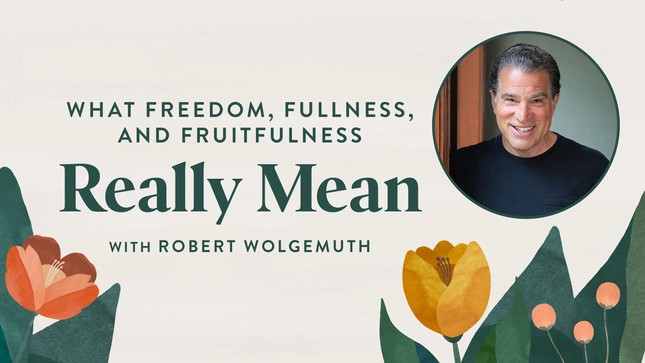
Alright, last one. “Freedom, fullness, and fruitfulness in Christ.” Sweetly familiar, isn’t it? It’s part of our mission statement here at Revive Our Hearts. And not too long ago, Nancy's husband, the late Robert Wolgemuth, spoke to the Revive Our Hearts' staff to help us understand what it really means to help a woman walk in freedom, fullness, and fruitfulness in Christ. Let's listen.
Robert: Calling women to freedom, fullness, and fruitfulness in Christ. In the last few weeks, I went on a treasure hunt, and I said, “Is there a passage of Scripture that's not scattered all about that would help us unpack freedom, fullness, and fruitfulness in Christ?”
And guess what? Galatians chapter 5. In fact, if you've got your Bible, turn to Galatians chapter 5. You're going to be thrilled with what you're going to find this morning in Galatians chapter 5.
We're going to do something that my college professor, my Greek professor, would not have approved of. We're going to treat the next few verses, starting with 13, all the way to 23, and just do stepping stones rather than read every word.
So Galatians 5, verse 13: “For you were called to be free, brothers and sisters; [I love this] only, don't use this freedom as an opportunity for the flesh, but serve one another through love.” Freedom. There it is.
Galatians 5, verse 16: “I say, then, walk by the Spirit and you will not carry out the desires of the flesh. . . . But if you are led by the Spirit; you are not under the law” (vv. 16, 18).
What's the verb that's usually used in relation to the Holy Spirit in our lives? Filling. Filling of the Holy Spirit. In order to fill something, what has to happen to it? It has to be empty. And how do you empty your spirit to make room for the Holy Spirit? How do you do that? You confess, you repent, you make room for the Spirit. That's the way it works. People call that spiritual breathing. Out goes the bad air; in comes the good. It's amazing.
And then we're going to skip down to verse 22. But the fruit of the Spirit . . . this is so familiar, right? But don't let the familiarity give you the opportunity to not pay attention to all these words. “But the fruit of the Spirit is love, joy, peace, patience, kindness, goodness, faithfulness, gentleness, and self-control.” You have your assignments. Incredible, right?
So there it is. There's fruitfulness. So we’ve got freedom, fullness, and fruitfulness. That is good stuff.
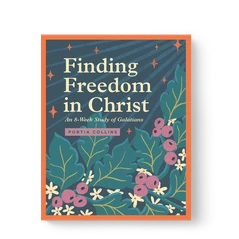
Freedom—let's start there. You may be aware that our very own Portia Collins wrote a book called—it’s a study guide—Finding Freedom in Christ. There it is. This is a wonderful little book. In fact, let me just read. I dog-eared this page.
“One evening in particular, I planted myself on the floor of my small, two-bedroom apartment and began reading the beautiful book of Galatians.” Can't you picture that? I love reading how that takes you there, where the author is actually speaking to you. You know, a book is a long letter to one person. If you read in a book and it says, “Now most of you . . .” they didn't have a good editor, because people don't read in groups. They read one at a time.
So, this is Portia Collins talking to you:
“I planted myself on the floor in my small, two-bedroom apartment, and began reading the beautiful book of Galatians. As I sat there in the quiet, reading page after page, I began to weep. The message of salvation by grace through faith in Jesus Christ that is recorded in Galatians pierced through the noise of my life and spoke directly to my weary heart.”
I love that. So there you go. So freedom.
About twenty years ago my mother's family was massive. If we all get together—I'm not making this up—it's about 350 people. She had seven siblings, and those seven siblings had twenty-five children. Then put an X and the multiplication is astonishing. They're all over the world, these people.
We used to do family reunions in Pennsylvania, which is Lancaster County—that's home. We were in a tour bus because my Uncle Jesse had the microphone. He was describing what we were driving through, and it was family farms. It was amazing.
So we stopped the bus in the middle of this country road, and two other roads were coming together. So, there was like a triangle where those roads met. He said, “I want you to look out there at that little triangular plot of land. What do you see there?”
So we said, “Well, it looks like a marker. It looks like a gravestone.”
And he said, “That's exactly what it is. Let me tell you a story.”
He said that two hundred years ago, my mother's great-grandfather—so that'd be great-great for me—Solomon Sharp was a farmer in Lancaster County, Pennsylvania. He saddled his horse—you’re not gonna believe what I'm about to say—and he drove to Philadelphia, and he bought a slave.
You can imagine my Uncle Jesse saying this into the microphone in the bus. There wasn't a person in the bus who had ever heard this story, and we were stunned. We were stunned!
I mean, this is a very careful Mennonite family that does everything right, at least the things that you can see. And buying a slave . . .
Well, Solomon Sharp rode his horse to Philadelphia, went to the market, and bought a slave. The slave was standing in front of him at a table, as we understand, and he signed the papers that made this young man the property of Solomon Sharp. And then Solomon Sharp took his pen and signed his name and handed the paper back to the slave, and he said, “You are free.”
And the young man took the paper, looked at it, turned, and ran as fast as he could away from the table. And then he stopped—we don't know how far—and turned around and came back to the table. He said to Solomon Sharp, “I don't know where to go.”
And Solomon Sharp said, “Would you come work for us? Would you come live with us?”
And until that young man died, that was his marker. He worked for Solomon Sharp. Solomon Sharp paid him. He was an employee. He was in the family, on the team.
So when I think of the word freedom, I think of that young man. I wrote these things down. What does freedom mean? Freedom from the clutches of sin, free to choose. In fact, I've named this young man Jesse, even though it was my uncle who was telling us this story. I love the name Jesse. We didn't have a son—he may have been Jesse if we had had one. We had two girls, although you could name a girl Jessie, right? We know some precious Jessies.
So what does freedom mean? Freedom from the clutches of sin. Free to choose, like Solomon Sharp’s Jesse. His freedom gave him the opportunity to grow up in a family, free to serve, free to love, free to encourage, free to go, free to stay, free to do, free to not do, freedom to not sin.
It's interesting, you don't think of that: freedom to not sin. I love that—freedom to not sin, freedom to forgive. I think Nancy’s best-selling book—at least the one that most people comment on—is about forgiveness. Like, a lot of us live with a lot of unforgiveness. So in Christ, you are free to forgive.
You're free to make good choices, not from obligation or guilt. You're free to make good choices. Freedom to be disciplined. Now, of course, I could have said freedom to be undisciplined, but I'm going to leave that one on the table. Freedom to be disciplined, freedom to say no.
When my girls were little, we played the “no game.” Freedom to say no. So we’d literally say, “Okay, tomorrow night at dinner, we're going to tell each other stories of when we said no to something.” And then the next night we'd have dinner, and we'd talk about what we said no to—extra dessert, looking at somebody else's paper at school. And we all celebrated! Freedom to say no.
Christian freedom is not freedom from all controls. This is freedom from the slavery that says I have to earn God's favor in order to please Him. It's all there. It's all free. Isn't that great?
So verse 13—our next stepping stones on through our chapter—“For you were called to be free, brothers and sisters. Only don't use this freedom as an opportunity for the flesh, but serve one another.” Free to love.
So our slug line, our motto, our copyright, our trademark—freedom—is a big deal.
And then there's fullness. So back to my daughters. After a meal sometimes they would say, “Oh, I'm so full (groan).”
And I'd say, “Don't do that. Say, ‘I am so full!’ Just think of the people who would love to be full who don't have the opportunity to be full.”
So if they were here, they would smile and say, “Yes, he actually said that.” Sometimes daddies make up stories—that's not one of them.
So again, what does it take to be filled? Emptying, confessing, seeking forgiveness. So, in order for me to be filled, I have to do some emptying. And there it is.
If tonight you say, “I would love to be more full of the Holy Spirit”—easy. Make room. Does that make sense to you?
So verse 16 said, “Walk by the Spirit, and you will certainly not carry out any desires of the flesh.” That's fullness.
So we got freedom, fullness, and fruitfulness.
My first job out of college was selling advertising space, and actually I fell in love with the whole advertising world, the marketing thing that I was just talking about.
This is 1975. I worked for a guy who had come from business and came to ministry. That's where I was working. I had my first sales trip. I was so proud of myself. I actually got paper tickets. Remember those tickets with the red carbon on the backside? If you put it in your white shirt pocket, you’d get red on your pocket. Now it's on your phone.
So, I came back to the office from my first sales trip, and I loved it! I discovered that I love sales. I tell Nancy—she's probably heard me say it 6,000 times—“I used to be in sales,” and she smiles and says, “You still are. I got you, didn't I?”
So, 1975—my first business trip. I came home. First thing I did was walk into my boss's office. His name was Bill Slemp. He was a brilliant man—little eccentric, but brilliant. He said, “How was your trip?”
I said, “It was great.”
He said, “How much did you do in sales?”
I said, “Well . . .”
And he looked at me, and he said, “That was not a great business trip.”
Fruitfulness is about results. I know that's kind of a challenging thing to say. Like, we walk in grace, by grace, filled with grace. Scores don't count, well, they kind of do, because the fruit of the Spirit—that list that we just read that's so familiar to us—we either do that or we don't. And fruitfulness means doing those things or not doing those things. It's what it means.
So love, joy, peace, patience—I mean, are you sensitive enough to the Spirit in your life to catch you when you don't do one of those things? I hope the answer to that is yes. So the question is, how fruitful am I? How fruitful are you? It's right there in our motto, in our copyrighted motto—fruitfulness.
To talk about how many people are coming to True Woman, is that important? Absolutely it is. I mean, if we show up and the room is empty, is there something wrong with that? Yeah, there really is. I mean, if you're a farmer and you throw seed out and it doesn't grow, is that a problem? Yeah, it is. It really is.
My favorite thing about fruitfulness is that it's not vegetables—it's fruit. For fruit to grow, you have to be patient. I mean, zucchini—every farm in the backyard includes zucchini because there's such a payoff. Everybody brings zucchini to the office, and you've tried everything—zucchini bread, zucchini pies, zucchini whatever, hand lotion.
But fruit is different. Fruit is the byproduct of a tree being planted in a spot and staying there for a long time, doing the right thing, being patient, and waiting for the fruit. It's a byproduct of something. I love that.
So there it is—fruitfulness. That's who we are.
Now I'm going to really go out on a limb here. I'm married to the teacher, so I'm going to take some liberties. I'm going to add a fourth “F.” Freedom, fullness, fruitfulness—you ready? Family.
By God's grace, we've just been given the title to our own home [Revive Our Hearts Ministry Center]. This is our home—our first real home. We are not tenants; we're landlords. I'm sitting here looking at Martin Jones [executive direction] and knowing, as only Martin really knows, what it costs to get to where we are, to sign those papers. It's a really big deal, and it's a lot of thankless work.
So there it is—we're adding an “F.” We're adding a word to our slug line: freedom, fullness, fruitfulness, family.
It's an interesting thing . . . real estate is important to God. Ever heard anybody say that? Real estate is important to God. It really is. In fact, if you look at this little, tiny, thin slice of land—real estate in the Middle East—and you realize how tiny Israel is, it makes you wonder, what in the world is going on here? It's because land is important to God. Real estate is important to God. Ownership of real estate is important to God.
So here we are—we're in our own home. The good news about that is that you take care of your own home. So, like, when was the last time you got a rental car washed? Now, Nancy will tell you that I actually have done that—I won't tell you, but it's true. The car was so dirty I couldn't handle it.
But when you own, you take care of it. When you own, somebody comes into your home—what you really want is for them to be thrilled that they walked into your home. What a good decision.
It's like going to Chick-fil-A. That's why all those people buy all those sandwiches, because when you walk into Chick-fil-A, they make you feel like they are glad you came.
My mother . . . I think I have said to Nancy 6,000 times, “I wish you could have met my mother.” And she says, “I wish you could have met my daddy.” And in heaven, maybe we'll get the get-together.
My mother would go through eyeglasses like you can't believe. She would wear them on a sling, which means they hung right there, and then she would crush them because she hugged so many people. I would bring kids home from school. They couldn't have cared less about me; they loved my mother. And my mother made my house our home.
I want people that walk into this building to feel that. We want people, when they walk into our home, to be glad they came—to feel welcome, to see a place that's taken care of by owners. That's what we want. This is family. A good family takes care of their own home and each other.
So there you go—four words in our trademark: freedom, fullness, fruitfulness, and family. When I had a family and we lived in a house, we had a family verse: Ephesians 4:32. “Be kind and compassionate to one another, forgiving one another, just as God also forgave you in Christ.” So, kindness—that doesn't start with an “F,” but we could put that one on our list too. Be kind one to another. What a good idea.
Being kind doesn't sound that terrific or that huge, but do it. My daughter, who's fifty, taught me something years ago, and I still do it. She said, “Dad, your face at rest isn't smiling.” (Kids! Who do they think they are?) And she said, “Dad, smile.”
All part of kindness. That changed my life. I mean, walking through an airport—I used to go to airports, I don't miss it. But whether I'm walking to the grocery store or anywhere, smile. Sometimes it's very disarming if you catch somebody in the eye and you smile at them. It's possible that's the only smile they're going to get all day.
Be kind one to another. Be kind to your family—that's the hardest part, because they know you so well, and they can spot a phony a mile away. Be kind to each other, tenderhearted, forgiving, even as Jesus forgave you.
Well, there you have it—our logo, our slug line. Now, four things: freedom, fullness, fruitfulness, and family in Christ, now that we have our own home.
Lord, we love You. We are so honored to be able to serve You, and to love each other, and to live in the same house, and to find ways—creative ways—of loving each other, affirming each other, caring for each other, loving each other.
We are blessed beyond comprehension, more than we could ask or think, and so we thank You. Thank You for Your blessings. Thank You for Your mercy and Your grace. We worship You. We love You. In Jesus’ name, and all God's people said, “Amen.”
Dannah: Robert Wolgemuth on what freedom, fullness, and fruitfulness really looks like. So sweet to hear his voice. Robert’s passion for the mission of Revive Our Hearts was huge. He loved these three words. They’ve been the heartbeat of our ministry for twenty-five years now, and we’re not wavering on them. Our desire is still to see women thrive in Christ, one podcast episode, one blog article, one book, one conference at a time.
You know, I really love the fourth “F” Robert added, too. Because we are about family here at Revive Our Hearts. This ministry is for every woman desiring a life of freedom, fullness, and fruitfulness in Christ. It’s a life we want to invite more women into. But we can’t do that without your partnership.
The month of May is a critical time for us as we prepare to close the books on one ministry year and ask God to provide for the next. We’re navigating a budget shortfall right now, which means your giving matters even more in this season.
God is opening doors for us to translate Revive Our Hearts material into new languages, to launch new initiatives, and to continue pursuing the next generation of women with the message you’ve come to love from us.
Would you prayerfully ask God how He might want you to come alongside us? I know it’s easy to think, Someone else has got this. Other listeners will give. But that isn’t always the case. Your gift matters more than you know—especially as Revive Our Hearts expands to meet the needs of more women around the world. If you’ve been thinking about donating, there’s no better time. You can do that by visiting ReviveOurHearts.com, or you can call us at 1-800-569-5959.
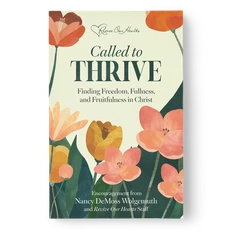
When you make a donation of any amount, we’ll send you a new booklet from Nancy—Called to Thrive. This resource walks you through nine short devotionals, journaling prompts, and reflection questions rooted in Nancy’s teaching on freedom, fullness, and fruitfulness. It’s a reflection of her heart for every woman this ministry reaches. Be sure to request your copy when you donate.
Now if you’re one of our international listeners, we can’t send you the physical booklet, but we can offer you a digital download! You’ll be able to request that when you donate. Again, you can do that at ReviveOurHearts.com or by calling 1-800-569-5959.
Next week, I’m hopping from the host chair into the interview chair! My good friend Suzy Weibel will be here to talk about my recently updated book, And the Bride Wore White. It’s coming out next week!
It's really more than a book relaunch. It's an invitation. I want to invite you to participate in one of the most debated conversations in the church—purity culture. In recent years purity culture has often been dismissed or deconstructed. But I believe the biblical truths it sought to protect about sexuality, covanent, the dignity of the body remain deeply needed. So, I want to call you to help me biblically reconstruct the conversation. That's next week on Revive Our Hearts. Please be back.
This program is a listener-supported production of Revive Our Hearts in Niles, Michigan, calling women to freedom, fullness, and fruitfulness in Christ.
*Offers available only during the broadcast of the podcast season.