
Two Marks of Wisdom: Gratitude and Guardrails
Dannah Gresh: When his grandsons were attacked, Mark DeMoss experienced a whirlwind of emotions—anger, hurt, fear. But because he’s devoted his life to the pursuit of wisdom, a different emotion prevailed.
Mark DeMoss: As I was going to sleep . . . the emotion that really overwhelmed me and overwhelmed all my other emotions was one of gratitude.
Dannah: This is the Revive Our Hearts podcast with Nancy DeMoss Wolgemuth, author of Lies Women Believe: And the Truth That Sets Them Free, for March 16, 2026. I’m Dannah Gresh.
What does gratitude have to do with wisdom? And how can we become grateful people, even on the hardest days? We’ve got a guest today who is going to help us answer these questions and more.
This is an extra special guest because he just so happens to be the brother of our very …
Dannah Gresh: When his grandsons were attacked, Mark DeMoss experienced a whirlwind of emotions—anger, hurt, fear. But because he’s devoted his life to the pursuit of wisdom, a different emotion prevailed.
Mark DeMoss: As I was going to sleep . . . the emotion that really overwhelmed me and overwhelmed all my other emotions was one of gratitude.
Dannah: This is the Revive Our Hearts podcast with Nancy DeMoss Wolgemuth, author of Lies Women Believe: And the Truth That Sets Them Free, for March 16, 2026. I’m Dannah Gresh.
What does gratitude have to do with wisdom? And how can we become grateful people, even on the hardest days? We’ve got a guest today who is going to help us answer these questions and more.
This is an extra special guest because he just so happens to be the brother of our very own Nancy DeMoss Wolgemuth. Mark DeMoss is husband to April, a devoted father, and spent much of his life as the leader of a public relations firm specializing in helping faith-based organizations.
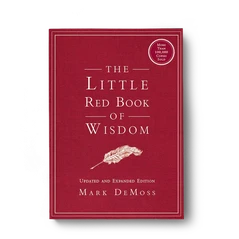
He’s also the author of The Little Red Book of Wisdom—one of my husband’s favorites! It may be small, but it’s rich with insight. Mark and I got to sit down not too long ago to discuss some of the principles covered in that book. It was challenging . . . in the best way. Here’s part of that conversation now.
Dannah: Mark, I am so excited to talk to you today, because you may not know this, but your Little Red Book of Wisdom is one of my husband’s favorite books!
Mark: I did not know that. Thank you!
Dannah: Yes, He doesn’t have a lot of them; it’s one of them. Maybe just explain what that is, because it really is a book that touched a nerve when it first came out, I think particularly among men . . . but it blessed me as a woman. So, what is it, and why do people need that book?
Mark: Well, I’ve always been intrigued with wisdom and the study of wisdom and how we can get wisdom. I was always a little dissatisfied with the notion that wisdom was reserved for older people further down life’s road, that it was reserved for more educated people, more intellectual people, people in big positions of authority. I just felt like that was really wrong, that wisdom is available to all of us, James tells us in the New Testament, if we just ask for it.
So I wanted to take this lofty idea of wisdom and “put it on a lower shelf” where it was available and felt more attainable for everybody. And so, that’s what I did. I think initially I thought I might just be writing to my three children, who were in their—I don’t know—late teens at the time. That was my mindset initially. I honestly felt when I first wrote this if this encouraged and blessed my three children, that would be reward enough for me.
I really had no idea that the book would have a wider reach and would now be in its third edition. My objective was met, because I hear from people from high school kids to ninety-year olds and everywhere in-between who say, “Hey, I read this book. Somebody gave it to me and it really impacted me in this way or that way,” or “I’ve started reading Proverbs every day as a result of reading your little book.” So, it’s very gratifying.
Dannah: Well, you have blessed so many. It reminds me a little bit of Aesop’s Fables, in terms that Aesop’s Fables are these short little nuggets of truth about morality. They’re obviously not from a biblical perspective, they’re told from a Greek historical perspective.
But it reminds me of those because you have written these nuggets of truth about wisdom that are so practical, so easy to digest, and you’re a great story teller! In fact, in one of the new chapters in the book you start with a riveting story. You chose the topic of gratitude. What made you want to add that to this book on wisdom?
Mark: The timing was really, hopefully, providential. As I was working on this revised edition, I had told the publisher I would like to add two chapters. Two of our three grandsons who were six and eight at that time were viciously mauled by two Rottweilers in their neighborhood where they lived. They had just been riding their bikes down in a cul-de-sac.
That phone call rocked our world unlike anything I think I’ve experienced—and I’ve lost a father and a brother at early ages. But this really shook us! April, my wife, and I rushed to the hospital. This was during Covid, so there was limited access in the hospital, but we were able to get up and see the boys before they went into surgery.
It’s still very emotional for me. I wrote about driving home that night. My wife stayed at the hospital and I went home. As I went to bed, my mind was just racing with emotions. I was hurt. I was terrified. I was angry. Why would a neighbor have Rottweilers who would run loose and not be kept inside a gate in a neighborhood where young children are playing?
And so I had some anger, and I had some anxiety about how these boys were going to come through this. But as I was going to sleep, the emotion that really overwhelmed me and overwhelmed all my other emotions was one of gratitude, because my precious grandsons were going to make it!
They were going to make it medically and physically; they were going to live. The Lord has healed them beautifully! Their scars are mostly gone, not entirely, but He’s healed them emotionally almost completely.
And once it happened, you kind of tune in to other cases. We learned about people who had a similar attack and didn’t live, didn’t survive. So these are scary things, and I really was full of gratitude.
You know, gratitude is a healthy way to live, much healthier than the alternatives. So I just started thinking about all the things I’’m grateful for in my life. My father died when I was seventeen; he was fifty-three. He died of a heart attack. Am I grateful for that? Yeah. Because God has proven to be a father to the fatherless.
Our home burned to the ground when I was ten years old in the middle of the night, with everybody asleep, and I’m grateful for that. I went through a cancer battle of my own seven years ago. How could I be anything but grateful for God’s hand on my life and on my family?
So it’s a precious chapter to me, very personal. I just think there’s a correlation between gratitude and wisdom. Wise people understand that we’re not the king of our universe, and no matter how smart we think we are or how much money we think we may have, ultimately there’s Somebody else in charge of all of this. I don’t ever want to be in a place where I’m anything but grateful for God’s work—in our world and in my life.
Dannah: As I’m listening to you tell a story, especially of your sweet grandsons, it’s strikes me . . . You’re sitting there in that room that night contemplating everything that had happened that day. That was really a crossroads—or I guess a fork in the road—where you could have chosen to walk a path of gratitude, or you could have chosen to walk a path of bitterness and anger and fury.
What do you think it is that causes you—that causes any individual—to take the path of gratitude? What had to happen in their life leading up to that moment?
Mark: I think we have to have a really healthy understanding of the order of this universe—there’s a God . . . and it’s not me. So anything that any of us has achieved, again, regardless of our own intellect or our own smarts or our own education or even our own giftedness, a person who understands gratitude understands that I didn’t build a successful public relations career and firm because I’m so smart. Because I’m not that smart!
I also recognize, even if I was that smart, I’m not in control of my health (mostly, I could do some things to be healthier.) This is borne out in a cancer battle. So even if I’m the smartest guy in the world, I need the health that God gives me to go to work or build a business or be a speaker or an author, or whatever we choose to be.
So, I think there’s probably a real close correlation between gratitude and humility. Humble people realize that they’re not self-made. There’s no such thing as a self-made anything: self-made millionaire, self-made businessman, a self-made athlete.
All of us are dependent on God’s blessing and grace and mercy and providence in our lives, and giving us good health and giving us creative genes, to do what we do.
Dannah: When you talk about that, I’m thinking of the Scripture verse that says, “The fear of the Lord is the beginning of wisdom” (Prov. 9:10). What you’re describing is that there’s a respect, an awe, a reverence, that everything you have is a gift from God. That’s the fear of God, and that’s the beginning of wisdom. That’s where it starts. I love that!
So, gratitude, and the other topic that you felt, “I need to add this to this book on wisdom,” was finishing well. Tell me about that.
Mark: Yes. Similar to my initial thinking about wisdom, that people perceive it as being reserved for older people, this idea of finishing well is also something I think people think they can defer that conversation or consideration until they’re closer to the finish life—to the typical finish line I should say.
I think people tend to think, That’s something you think about when you’re in your seventies or if you come down with some kind of illness: “How can I finish well?”
This subject really was driven home to me through my professional work in public relations because I had been closely involved with so many ministries—Christian organizations, churches, universities, parachurch ministries–whose leaders did not finish well. They stumbled and fell morally or ethically or otherwise.
I wanted to see if I could help other people by what I had observed about common characteristics of people that didn’t finish well and people who did finish well. I don’t name names (I certainly could). I keep a list of names in my phone, really as a sobering reminder to myself that it’s a list I don’t want to be on!
I just tried to unpack what it is that causes some people not to finish well and what are some things we can learn from people who have either have finished well, or certainly seem to be on the path to finishing well?
And then as I was working on this chapter, in my regular devotional schedule, I read a verse that really grabbed me. I’d read it hundreds of times before, and I’d never noticed it in the way I noticed it at this point. It’s in John 6:66: “From that time many of his disciples turned . . . and walked with [Jesus] no more” (NKJV).
John Piper says that the sixth chapter of John starts with, I think, three thousand disciples, and it ends with eleven—which is a pretty sobering thing! These people had watched Jesus perform miracles and feed five thousand people.
How is it that people with that proximity to Jesus in the flesh could turn away and walk with Him no more? As I get older and I’ve been privy to so many of these falls from grace, I wanted to unpack and share anything I’ve learned—not in a judgmental way, but in a real sobering fear of not finishing well.
Dannah: Tell me, what are some of the things you’ve seen people who don't finish well do? What do we need to avoid?
Mark: Well, I would put at the top of the list: pride. I think pride and arrogance would be the one denominator that’s present in every single case; I can’t think of an exception. Another would be, these leaders who did not finish well, invariably did not have guard rails in their lives. I mean, things that I’ve almost taken for granted as guard rails that surely every Christian leader would have as guard rails.
Dannah: Things like what?
Mark: Things like avoiding being alone with someone of the opposite sex—always! In an office, in a car, in a restaurant.
Dannah: Yep, I couldn’t agree more!
Mark: And now you have to sort of expand those borders from physical boundaries of a room or a hotel room or an automobile. I think now we’ve seen, you have to really expand those boundaries for protection to digital relationships.
We’ve seen examples of this where a leader got too close on some direct messaging format somewhere, or too frequent communication via text or phone. And so, that’s a guard rail as far as I’m concerned.
This is certainly controversial in any circle, but a significant number of the negative examples would involve the misuse of alcohol. I think that’s a guard rail.
I think people who don’t finish well typically took on a sense of entitlement that because, “I’m the leader, and I built this organization, and all these people work for me,” it's as if the rules don’t apply to the leader. I saw a lot of that. I would often be advising an organization or an elder board or a board of directors . . . I usually got called in when it was too late. But when I would describe some of these things we’re talking about, some of these guard rails, I would get some looks like this was pretty neanderthal thinking.
Yet I wanted to say in those cases, “Look, I’m not the one in trouble here! These might be very narrow-minded, outdated protections, but I’m not in trouble here. Your guy’s in trouble here, and it could have been prevented!”
And so, are these safeguards worth saving your reputation and saving your family and saving your ministry and saving your church? Yeah, I think they’re worth it!
Dannah: We’ve been listening to Mark DeMoss as he shares insights from The Little Red Book of Wisdom. Keep listening to hear how you can get your very own copy of this resource.
Before then, we’ll hear a little more from the author. Mark is retired now, but during his many years serving ministries and nonprofit organizations in the public relations field, he developed firm convictions about protecting relationships and fighting for faithfulness. He and Nancy have talked about this on Revive Our Hearts before. Let’s listen to part of their conversation.
Nancy DeMoss Wolgemuth: Speaking of marriages, I want to touch on something you talk about in your book that is so important! It’s something we talk about a lot on Revive Our Hearts, and that is loving your mate and your marriage and the glory of God enough to safeguard it by the way you handle relationships with members of the opposite sex other than your partner.
You talk in this book about defending your marriage by guarding against inappropriate relationships and contact in the workplace or outside of the home. State the principle for us and how you see that to be wise.
Mark: The principle, essentially, is to avoid being alone with a woman other than April in any room, automobile, etc.
Nancy: So we’re talking about business lunches . . .
Mark: We’re talking about lunch, travel, a taxicab, meetings. And you say, “That sounds pretty narrow or even inconvenient.” It is sometimes inconvenient for working men and women, but it’s a lot less inconvenient than trying to piece back a broken home. It’s a lot less inconvenient than paying alimony and getting joint custody of your children and so many other things that result from cases where things go bad.
I am fully aware that great, great men and women of God have stumbled and fallen, going all the way back to King David in the Bible. I would be foolish to think that I’m somehow immune from those kinds of problems.
But the way I’ve approached this is to say, “Okay, while it’s possible for any of us to mess up in these areas, I want to make it more difficult. Physically and humanly speaking, I’d like to make it more difficult.” One way I do that is to not work alone in an office with a woman.
My profession is, for whatever reason, about 70 percent women in public relations. But I decided I won’t do that. We hire women, but I won’t work alone in my office with one. If two of us are going on an assignment that requires travel, we won’t book a seat together on the airplane, even though that would be productive preparation time.
Nancy: I’m assuming you don’t go to the airport together.
Mark: We won’t go to the airport together. On the other end, we’ll rent two cars. We’ll charge one car to the client, and we’ll pay for the second car, which to some people seems utterly ridiculous. “You mean two people going from the same airport to the same meeting place are renting two cars? That sounds crazy.” But I’ll tell you what it’s done. It’s protected me. It has protected women who work for me.
It has demonstrated to April, my wife, that this is important to me and that she’s more important to me than they are. It just sends a lot of signals, I think, that are good signals. I don’t regret a moment of it. I don’t regret a bit of the inconvenience. It’s really now become sort of second nature.
Nancy: You’ve probably seen some situations where people didn’t take those kinds of precautions and really paid a price for it.
Mark: I’ve seen them, and I hear about another one, it seems, almost every week.
Nancy: People may be saying, “I’m just having a business lunch; that’s not an affair,” and thinking, Why are you going down that road? Of course we can just have our meetings or work together and avoid that. But you’re saying it’s wise to start out on the front end thinking about what the implications could be.
Mark: All of the disastrous stories that any of us could recount had simpler, more innocent roots.
Nancy: They didn’t start out as an affair.
Mark: Right. If you have lunch together, you’re now a little more comfortable together than you were the day before. If I give a woman a ride after work . . . I mean, everybody knows about these circumstances. A woman has her car in the shop and needs somebody at the end of the work day: “I need a ride to pick up my car.” That’s a seemingly very innocent thing to offer.
I just say, “You know what? We’ve got more women than men working in this office. A woman will take you to get your car. I’m not going to take you to get your car at the end of the day.” To me this isn’t legalistic. It’s just, I think, the better part of wisdom. I do it for myself. I’m not preaching to anybody on this. I’m doing this for myself.
Nancy: Actually, I don’t mind you preaching on it, and I do preach on it on this program. The thought has crossed my mind many times—and I think you pointed out in the book as well—that a man and woman who are never alone together in an office or car or a restaurant or whatever are highly unlikely to ever have an adulterous relationship.
Mark: That’s right. The worst thing that could happen, if you follow this guideline, is that you could get an unhealthy emotional attraction for somebody. But you could not fall into a physical relationship with somebody with whom you were not alone behind a closed door. It’s impossible.
Nancy: These are like guardrails that keep you from falling off a cliff. You don’t need to worry about falling off the cliff if you drive within the guardrails.
Mark, I know that so many of our listeners want to be wise women, wise wives and moms. Thanks so much for writing this book and for sharing this week on Revive Our Hearts. I know that a lot of our listeners are going to be blessed by that book.
I'm also hoping they will order it for their husbands, for their dads, because I think that this is a book that not only women will enjoy reading, but the men will as well.
Dannah: Absolutely! My husband would attest to this! This really is a book for everyone, because we all need wisdom from God’s Word.
As promised, here’s how you can get your very own copy of The Little Red Book of Wisdom. We’d love to send it to you when you make a donation of any amount to Revive Our Hearts. To do that, you can visit ReviveOurHearts.com, or call us at 1-800-569-5959. When you give, be sure to request The Little Red Book of Wisdom. We can’t wait to get that in the mail to you.
Here at Revive Our Hearts, we’re reaching women all over the world with messages of wisdom like you heard today. To see which countries the global ministry is engaging with the Word, visit ReviveOurHearts.com/global. It’s truly incredible to see how God has furthered the message of freedom, fullness, and fruitfulness in Christ!
Tomorrow, join us for another day with Mark as he encourages everyone—young and old—to finish well. How do we do this? And what if we’ve already failed? Find out tomorrow on Revive Our Hearts
This program is a listener-supported production of Revive Our Hearts in Niles, Michigan, calling women to freedom, fullness, and fruitfulness in Christ.
*Offers available only during the broadcast of the podcast season.