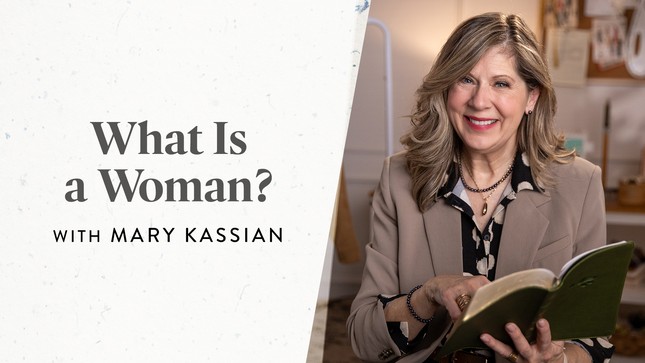

Dannah Gresh: Mary Kassian says if you're a woman, you were made to nurture.
Mary Kassian: So live it out right where you are, with whatever resources you have, for whoever God puts in your path. Because when you do, you're fulfilling your calling as a woman. You're advancing God's kingdom. You're displaying His life-giving, nurturing character to a world desperate to see it.
Dannah: This is the Revive Our Hearts podcast with Nancy DeMoss Wolgemuth, author of Adorned, for July 22, 2026. I'm Dannah Gresh.
We're back with Mary Kassian to unpack the next phrase of our definition. All month we've been answering the question, "What is a woman?"
This content accompanies Mary's newly released book by that title, What Is a Woman? The Question Our World Is Afraid to Answer?
We'll tell you how you can get that resource later. But now, …
Dannah Gresh: Mary Kassian says if you're a woman, you were made to nurture.
Mary Kassian: So live it out right where you are, with whatever resources you have, for whoever God puts in your path. Because when you do, you're fulfilling your calling as a woman. You're advancing God's kingdom. You're displaying His life-giving, nurturing character to a world desperate to see it.
Dannah: This is the Revive Our Hearts podcast with Nancy DeMoss Wolgemuth, author of Adorned, for July 22, 2026. I'm Dannah Gresh.
We're back with Mary Kassian to unpack the next phrase of our definition. All month we've been answering the question, "What is a woman?"
This content accompanies Mary's newly released book by that title, What Is a Woman? The Question Our World Is Afraid to Answer?
We'll tell you how you can get that resource later. But now, without further ado, here's the lovely Mary Kassian.
Mary: Have you ever been in full nesting mode, or heard stories about someone who was? Like the woman about to give birth, folding onesies that have never been worn, or reorganizing the nursery again at 2 a.m., scrubbing baseboards that haven't seen a sponge in five years.
The husband shuffles in from the bedroom, rubbing sleep from his eyes, squinting against the light. He finds his wife moving the crib to the opposite wall . . . again, for the third time this week.
"What are you doing?" he asks.
"Getting ready."
But it's more than that. It's deeper, more primal. She has to prepare. She needs to create a space that's safe, clean, welcoming, ready for the life that's coming.
Scientists call it the nesting instinct, and it's not just psychological; it's actually physiological. The same hormones flooding her body to prepare her for birth are also preparing her heart to nurture.
But here's what's fascinating: humans aren't the only ones who do this. There's a duck in the Arctic, the eider duck, who does something extraordinary. When it's time to build her nest, she reaches down near her own heart and plucks the softest down feathers from her breast. And feather by feather, she lines her nest, literally giving from her own body to transform a pile of twigs into a warm sanctuary where her ducklings can thrive.
Wolves shed their own fur to cushion the den. Rabbits pull fur from their bodies to create a soft, warm nest for their young.
So, what's going on here? Why this universal drive across species? This compulsion to prepare a place? Because bringing forth life isn't enough. Life needs an environment where it can grow, where it's protected, where it can actually thrive.
And God wove that same dual instinct into you, whether you've ever been pregnant or not, whether you have biological children or not. You were designed with this capacity to bring forth life and to create the environments where that life can flourish. That's what we're exploring today.
This isn't just about having babies; it's about something far bigger, something that reaches into every corner of your life as a woman and echoes the very heart of God.
Now, I need to address something head on because I know some of you are already thinking, But Mary, I don't have kids. I can't have kids. I don't want kids. Or, my kids are long gone. So, does this even apply to me? Well, stay with me because what I'm about to say will reframe everything.
Most women will bear biological children, and that's normal. That's good. God designed your body specifically for that—the womb, the breasts, the hormones, all of it. Physical motherhood is a beautiful part of the design.
But here's what I want you to understand: womanhood isn't just about biology; it's about capacity. You have a maternal capacity, and that capacity exists whether you ever get pregnant or not.
Let me put it this way: you know how men are often described as having provider instincts. They want to solve problems, fix things, make sure everyone's taken care of. That's real. It's wired in. But not every man is going to have a wife and kids to provide for. Does that mean that their provider instinct doesn't exist? No. It's the same principle here.
Here's what you need to understand. You have a maternal capacity. It's a God-given pull towards bringing forth life, nurturing growth, investing in others' flourishing. That's woven into your feminine design.
Now, you might never change a diaper. You might not feel maternal right now. Life might have obscured this instinct completely. Doesn't matter. The fundamental reality stands: you were designed to mother.
But what does that mean? Let's go back to the very beginning. When God created humanity, He gave them a mandate. Genesis 1:28, “God blessed them, and God said to them, ‘Be fruitful, multiply, fill the earth.’”
Fill the earth with what? Well, with more humans, yes, obviously, but with far more than that: with worshippers, with a family that knows and loves their heavenly Father.
From the very start, God's goal in creating male and female wasn't just population growth; it was kingdom expansion. God wanted humans to grow His family, and He designed the female body specifically for that, to carry birth and nurture new life.
It's beautiful. It's good. It's exactly as He intended. But then came the tragedy of sin. When the first man and woman rebelled, everything broke, and God outlined the tragic consequences.
Listen to what He said to the woman in Genesis 3:16: "I will intensify your labor pains; you will bear children with painful effort."
This is why the very capacity God designed for joy is now also the place of deepest pain. The life-giving work of woman, both physical and spiritual, would now be marked by suffering. What should have been pure joy would be intertwined with sorrow. The nurturing that should have come naturally would now require perseverance through difficulty and pain.
But even in the midst of this, God gave a promise of hope and redemption. Listen to what He said in Genesis 3:15. He said this to the serpent:
“I will put hostility between you and the woman,
and between your offspring and her offspring.
He will strike your head, and you will strike his heel.”
Did you catch that?
From that moment on, woman, the life giver, would be at war with the serpent, the death bringer. The woman's offspring, her seed, He would someday crush the serpent's head. God would send a Redeemer using the life-giving capacity He had handcrafted into woman's very being.
What a mix of tragedy and hope this is!
Sin brought death into the world, but God, working through a woman, would send the Defeater of death.
And after hearing this promise, Adam did something remarkable. Genesis 3:20 says, “The man named his wife Eve because she was the mother of all the living.”
Eve, hava in Hebrew, “life or living.” Adam named woman based on her calling, her capacity, her purpose.
Despite sin, despite death now being in the world, despite the pain—physical and emotional—that she would experience in bringing forth and nurturing life, Adam believed God's promise. He believed life would continue, that through this woman, the life giver, God's redemptive plan would unfold. Every person who has ever existed came through Eve, and ultimately through her lineage came the One who brings spiritual life to all who believe.
From the very beginning, motherhood was about more than biology. It was always about God's redemptive plan, expanding His family through spiritual fruitfulness.
Parents have biological children, but then what? They raise those children in the fear and instruction of the Lord. Those children grow up loving Jesus, or that's the goal, and they have their own children and do the same. The faith gets passed down generation after generation.
Physical reproduction, serving spiritual reproduction. That's always been God's design.
So, if you're a mom listening to this, raising kids, you're doing profoundly important work. Don't let anyone convince you otherwise, and don't let culture tell you that you're wasting your potential.
When you reading Bible stories at bedtime, when you show them how to love the needy through meals delivered, strangers welcomed, kindness shown. When you model faithfulness through your daily choices, when you teach them to love Jesus more than comfort or success, you're not just parenting. You're making disciples. You're expanding God's kingdom.
Your biological children are your first mission field. You physically mother them, but more importantly, you spiritually mother them . . . and spiritual motherhood is God's primary concern, which means that this calling isn't limited to biological mothers. It never has been, because the goal was never just physical babies; it was always spiritual fruitfulness.
In 1 Thessalonians 2:7, Paul describes himself as being gentle with young believers, like a nursing mother taking care of her own children.
Paul, a man, uses maternal language. Well, why? Because bringing people into God's family and nurturing them toward maturity, that's motherhood, that's spiritual motherhood.
Titus 2 shows us the pattern: older women teaching younger women, spiritual mothers investing in spiritual daughters, faith passed down not only through biology but through intentional discipling relationships. This is your calling too.
And here's what's beautiful: you're always both older and younger than someone. You’re always positioned to receive from those ahead of you, and pour into those coming behind.
Some women mother biologically and spiritually, others just spiritually—same calling, same heart, same eternal work.
Well, what does it mean to nurture? Remember that nesting instinct, that drive to prepare a safe place where life can flourish. That's where nurturing begins, but it doesn't stop once the baby arrives.
Nurturing is the ongoing work of creating favorable conditions for growth. Strip it down to the core and nurturing is paying attention to what's needed to help life grow and thrive.
Sometimes it's intensely practical—a meal dropped off when someone is overwhelmed, watching kids so a friend can breathe, coffee delivered to an exhausted coworker, a box of tissues when someone's world is falling apart.
Sometimes it's environmental. You light a candle, put away the dropped coats and boots, set out a plant, a hand-knitted blanket, some beauty to intentionally calm the chaos and create a home.
Your living room, or your office, or your corner of the church, becomes a place that people can finally let their guard down and unburden and connect. Somewhere where you're fully present, where honesty is welcome instead of the default, "Oh, I'm fine."
Often nurturing is deeply spiritual. You pray with someone who's coming undone. You open Scripture when they don't know where to turn. You point them back to Jesus when anxiety takes over. Walk alongside them through ordinary life, showing what it means to follow Christ.
Peter captures this in 1 Peter 2:2 when he says new believers need pure spiritual milk to grow up spiritually. That's what spiritual mothers do—they feed, care, and help immature believers mature, whatever form it takes. Nurturing says the same. It says, "I see you. You matter, and I'm investing in the work that God is doing in your life."
Think about a gardener tending tomatoes. She can't manufacture fruit. She can't force the plant to produce on her schedule, but she can prepare rich soil, provide water, ensure that the plant has sunlight, protect it from pests.
She cultivates the environment so the plant is given the best opportunity to grow. And that's your work as a spiritual mother. You create environments where life can flourish.
I think of the spiritual mothers who impacted my life. June Kerr was the church secretary. I was ten, maybe twelve, when she invited me to help her make the church bulletin. I still remember the smell of that old mimeograph machine—the blue ink, the hand-cranked handle.
She'd have me collect information and find quotes and verses and track down graphics, trace them onto the Ditto Master. Small tasks, nothing glamorous, but June saw something in me.
One day she had me stop what I was doing and look her in the eyes.
"Mary, I need to tell you something." And then, "Don't let people discourage you from following the path God is calling you to walk. There will always be criticism. Always keep your heart focused, not on those voices, but on His voice."
A church secretary, a mimeograph machine, a ten-year-old with blue ink on her hands.
When I was in my mid-teens, Pearl Purdy often invited me over for shuffleboard and tea. She was a senior citizen, petite, proper English, transplanted to Canada. I towered over her. She wore thick Coke-bottle glasses that made one eye look bigger than the other. She was always in a dress, always in Mary Janes.
When we headed down to the basement to play shuffleboard, she'd offer me a pair of knitted slippers for the cold floor. They fit her perfectly. On me, they were two sizes too small.
She made tea the right way, the British way: warmed the china teapot with hot water, loose leaf tea measured by the spoonful, one spoon per person plus one for the pot, freshly boiled water, and a tea cozy so it could steep.
Dainty flowered china cup, shortbread cookies on the side, and then she beat me at shuffleboard every time with hands that were starting to cripple up.
We'd talk about life, nothing formal, no agenda, just an older woman and a young one sharing an afternoon.
Now Pearl didn't say anything I can point to as a specific lesson. What she gave me was harder to name. It was the spirit of a woman who trusted God quietly, completely, solidly, unshakably, and somehow, sitting in that cold basement in two small slippers, losing at shuffleboard, I absorbed it.
Diane Norse was a single professional woman, one of the adult sponsors of the high school Christian club I led. She'd help me mix colorful powdered tempera paint for the massive banners we'd hang on the school walls to advertise events. And while we painted, she asked me hard questions—the kind that made me think.
She made me read a Josh McDowell book on Christian apologetics, so I would know what I believed and why. Diane was my first real mentor.
And then there was Ann Gil, who had already launched her own children when I was in the thick of raising mine. She'd pop over with a homemade apple pie, but it was more than pie.
Anne always asked me how things were going, really going, and she always prayed right there wherever we were. She saw me. She showed up with prayers and pie.
Four women, completely different expressions of the same instinct.
It can happen a thousand other ways: a text with a verse, a meal with a prayer, a hard question asked at the right moment, a prayer offered right then and there. Small acts, but they call forth life, and nurture it, and God sees every one of them.
Psalm 113:9 promises this:
He gives the childless woman a household,
making her the joyful mother of children.
Biological kids or not, your maternal calling is real. It's God-given, and when you live it out, it bears fruit.
Now let me be honest about something. This kind of mothering, this spiritual mothering, it costs something. Remember that eider duck from the beginning? She doesn't just find soft materials for her nest. She reaches down near her own heart and plucks the softest ones from her own body. The wolf sheds her own fur to line the den. The rabbit pulls hair from her belly to create warmth for her young.
That's the pattern. Nurturing costs something of yourself.
It costs time. You can't nurture from a distance. You have to be present, available, willing to interrupt your plans.
It costs energy, emotional energy especially carrying burdens, celebrating wins, mourning losses, praying through struggles.
It costs margin, your peace, your space, your resources.
Culture says that's foolish. Protect your boundaries. Guard your energy. Prioritize self-care above everything. You can't pour from an empty cup. And listen, there's wisdom in rest. You're not infinite. You're not God. But here's what culture misses: the fullest life is found pouring out. Joy comes through sacrifice.
Jesus said it in Matthew 16:25:
Whoever wants to save his life will lose it, but whoever loses his life because of me will find it.
When you nurture others, when you invest in their flourishing, create environments where they can grow spiritually, you are living out your calling as a woman.
You will discover, as many women have, that though it costs, pouring yourself out for your children—biological and spiritual—is one of the most fulfilling and consequential things you can do.
So here's where we land. You were created to bring forth life and nurture it, not just biologically, though for many that's part of it, but spiritually, eternally.
- To see potential in people and draw it out.
- To create spaces—physical, emotional, spiritual—where life thrives.
- To invest in growth.
- To expand God's family through ordinary faithfulness.
That capacity is in you—eighteen or eighty, house full of kids or living alone, married or single. It's woven into your feminine design, so embrace it!
Don't let culture convince you that caring deeply is weakness. Don't let the world dismiss your nurturing instincts as unimportant. Don't buy the lie that relationships matter less than resumes.
God wired you with a capacity for motherhood on purpose. It reflects His own heart, the God who gives us new birth and patiently nurtures us towards maturity.
You were made for this, so live it out right where you are, with whatever resources you have, for whoever God puts in your path. Because when you do, you're fulfilling your calling as a woman. You're advancing God's kingdom. You're displaying His life-giving, nurturing character to a world desperate to see it.
That's not small work. That's eternal work, and there's nothing more significant that you could do.
Dannah: Mary Kassian has been illustrating just how powerful a nurturing woman can be. She transforms ordinary spaces into safe shelters. She looks at a younger woman and sees a daughter, and she depicts the heart of a tender God, one who gives new life to all who trust in Him.
I don't know about you, but Mary's teaching today makes me want to tell God thank you for making me a woman because it's really a beautiful gift.
If you're feeling the same, we're inviting you to study this topic further with Mary's book. It's yours when you make a donation of any amount to support Revive Our Hearts in July. So visit ReviveOurHearts.com today to give and request your copy of What Is a Woman, or call us at 1-800-569-5959. If you live in the U.S. or Canada, we'll send you a physical copy. If not, don't worry, we've got a digital version all ready for you.
So visit ReviveOurHearts.com today to give and request your copy of What Is a Woman. Now, don't forget, we've also got our summer Bible study sale going on right now. It's time to stock up with resources for the fall.
I'm talking classic Revive Our Hearts studies like Adorned, Lies Women Believe, Women of the Bible, and so much more—all at discounted prices! So whether you're planning to study with a group or on your own, we've got you covered. You're going to also find our CSB Notetaking Bibles are a part of this sale. So it is a great time to pick out one of those.
I hope you'll shop the sale, save big, and then let the truth of God's Word shape you this fall and beyond. For more information, check out ReviveOurHearts.com/summer2026.
Tomorrow we're back with Nancy to hear more about the True Woman Manifesto.
She's going to share all about living life as a true woman because that's what we want to do with the truths we've been learning all month, right? Live it out. So please be back for Revive Our Hearts.
This program is a listener-supported production of Revive Our Hearts in Niles, Michigan, calling women to freedom, fullness, and fruitfulness in Christ.
All Scripture is taken from the CSB.
*Offers available only during the broadcast of the podcast season.
Available Now for Your Donation

Additional Resources
Questions Answered in This Episode
Bringing forth and nurturing life reflects God’s design for women to cultivate growth and help others flourish. While many women express this through motherhood, every woman has the God-given capacity to invest in the spiritual and relational growth of others.
No. God has given every woman a capacity to nurture, whether she is single, married, has children, or never becomes a mother. Women reflect God’s life-giving character by encouraging, discipling, serving, and helping others grow in Christ.
Women nurture life by investing in others, creating environments where people can flourish spiritually, and faithfully pointing others to Christ. Through ordinary acts of love, encouragement, and discipleship, women participate in God’s work of bringing spiritual life and growth.