
Taking Faithfulness One Day at a Time
Dannah Gresh: A life of faithfulness may be less intimidating than we’re prone to think. Here’s Mark DeMoss.
Mark DeMoss: I can't swear that I'll be faithful to my wife the rest of my life, but I know I can be faithful to her today. I don't know that I'll spend time in God's Word every day forever, but I did it this morning. I don't know that I can always love my children well and be patient and long-suffering, but I'm pretty sure I can do it today.
Dannah: This is the Revive Our Hearts podcast with Nancy DeMoss Wolgemuth, author of Lies Women Believe: And the Truth That Sets Them Free, for March 17, 2026. I’m Dannah Gresh.
What happens when a leader falls on his way to the finish line? Sometimes that leader is in the media. But sometimes, he’s a little closer …
Dannah Gresh: A life of faithfulness may be less intimidating than we’re prone to think. Here’s Mark DeMoss.
Mark DeMoss: I can't swear that I'll be faithful to my wife the rest of my life, but I know I can be faithful to her today. I don't know that I'll spend time in God's Word every day forever, but I did it this morning. I don't know that I can always love my children well and be patient and long-suffering, but I'm pretty sure I can do it today.
Dannah: This is the Revive Our Hearts podcast with Nancy DeMoss Wolgemuth, author of Lies Women Believe: And the Truth That Sets Them Free, for March 17, 2026. I’m Dannah Gresh.
What happens when a leader falls on his way to the finish line? Sometimes that leader is in the media. But sometimes, he’s a little closer to home. A husband, a father, a local pastor. This can be a painful subject, but not one without hope.
Today, we’re listening to the second part of a conversation I had with Mark DeMoss, brother of my beloved cohost Nancy DeMoss Wolgemuth. When we left off yesterday, we were talking about some of the reasons leaders in ministry don’t finish well. Here’s Mark.
Mark: The thing about being a leader, a leader can almost do what he or she wants. They can have protection, or they can have no protection. They can have yes people only around them, or they can have some people that will challenge them and hold them accountable.
That’s one of the challenges I think of being a leader. You have the ability to hire who you want and fire who you don’t want. And I want to point out, too, because this isn’t a moral failure or sexual sin. It’s not the only way to not finish well.
I use an example, again, without a name, of a remarkable man who’s now in heaven. He built two very large organizations, ministry organizations. In the world he was so devoted to his ministry that his family sacrificed tremendously.
This person said publicly many times, and his daughter writes about it in a book, that early on in his ministry he made a deal, essentially, with God. He told God that he would take care of God’s little lambs around the world if God would take care of his children at home.
I don’t happen to think that’s a deal God makes with us. It’s one of the most tragic stories of the way it ends with separation from his wife. One of his daughters called him while he was overseas and asked if he would come home. She needed him. He said he couldn’t. He actually extended his trip to another country. His wife did head home, and by the time his wife did get home, his daughter had attempted to take her life, and subsequently did.
It’s a real tragedy. It did not involve a moral failure or a sexual sin or embezzlement of money, but an overcommitment to “God’s work.” And I wanted to be clear. This wasn’t all about messing up morally, but we can have our priorities out of whack and be busy serving the Lord and neglecting our children or our spouse. I want to be cognizant of that, too.
Dannah: Yes. I love that, and I love your heart for that.
As you’re saying this, it’s interesting to me. This is a subject in the headlines of the media, both the Christian media and the secular media, I feel like once a week. I'm like, “Oh no! Not again!” I’m just so grieved and tired of seeing the headlines, of reading the stories.
I was reading about one this morning. You’ve had a unique look at that because of your work in helping these churches mitigate . . . I don’t want to necessarily use the word “damage,” because what’s at stake here is the testimony of Jesus Christ and the gospel every single time this happens. That’s why we need the guard rails. That’s why we need to work at training ourselves to think with humility rather than pride and operate in humility rather than pride, and so forth.
But I guess my question, too, is: With so many stories hitting the headlines, there are so many that are not. And certainly there’s a wife listening right now, her husband is not finishing well. Her father didn’t finish well. Maybe she’s not finishing well. They’re in that place where everything is falling apart. That’s a gospel issue, to. What would you say to them if they’re in the middle of that pain?
Mark: Yes. So, I would say, we can’t change the past, but we can start today on a quest to finish well. I came up with a definition for finishing well—I should have mentioned this earlier. But as I was processing this whole idea, I decided to define finishing well this way: Living well until you’re finished living.
The reason I say this, none of us knows where our finish line is. We assume it’s down the road in our seventies or eighties, but my father died at fifty-three. That was his finish line. Seven years later my brother was killed in a car accident at age twenty-two. So to think about finishing well and staying the course for another ten or twenty or thirty or forty or fifty or sixty years, depending on our age, is pretty intimidating. It seems unattainable. But if you think about finishing well as living well until you’re finished living, then the key to that is today.
And so my encouragement to anybody would be this: I can't swear that I'll be faithful to my wife the rest of my life, but I know I can be faithful to her today. I don't know that I'll spend time in God's Word every day forever, but I did it this morning. I don't know that I can always love my children well and be patient and long-suffering, but I'm pretty sure I can do it today.
And so, if you take this long view, daunting idea of finishing well and break it down to today, all of us I think could say, “Yeah, I could live well today.”
So that would be my encouragement to anybody who’s struggling or doesn’t know how to do this or is living with somebody who’s making bad decisions. Think in terms of today. And I’ll just say, it’s so worth it!
Proverbs is so rich with instruction and correction and warning lights and caution. I think that’s one reason I like this habit of reading a chapter of Proverbs every day, because I’m going to get every tidbit of Proverbs, the whole book of Proverbs, Every month I’m going to read it once. I’m going to read it twelve times a year.
I remember one day, April was getting ready, and I sat down to read my Bible while she was getting ready for the day. She was running a little behind, and she saw me open my Bible, and she said, “Hey, I’m running late. Just read me whatever you’re reading.”
I turned to that day’s Proverb, and I saw the subheading, and I said, “It’s about the crafty harlot. Do you still want to hear it?” And she said, “No, but I want you to hear it. Go ahead and read it.”
I mean, that’s funny, but it’s also real. Like, I’m going to read those warnings every month on that same day, and then another chapter and another chapter.
To me, you can’t get enough of this. If you’re thinking about doing it daily, Proverbs 8, which I read this morning, talks about the man who watches daily at the gates for wisdom. And one way I think we can watch daily is to read a chapter every day. That’s watching daily. I’m going to be reminded of a number of things that are guard rails, and they’re there for my protection.
Yes, I want to finish well. I’m not arrogant enough to say that I won't stumble, but when I think about it in terms of living well until I'm finished living, I'm optimistic. I feel like I can do that today.
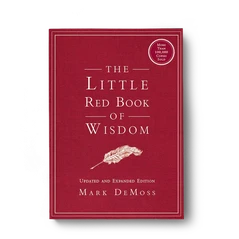
Dannah: Such a great conversation with Mark DeMoss, author of The Little Red Book of Wisdom. God’s Word is a guardrail for us, and I’m so grateful for it. None of us could live well without it.
We’ll hear some more from Mark, along with his big sister Nancy DeMoss Wolgemuth in just a moment.
Before then, I just really want to offer a word of hope and encouragement for the person who feels overwhelmed by the thought of living well, who does have to push the reset button of God's grace in their life. Or maybe someone they love has fallen and needs an overflow of grace. Whatever the case, you’re in that season right now. You’re in the throes of it.
Friend, if this resonates, I want you to know the gospel is still for you. It’s still for your husband. It’s still for that leader or pastor in your life.
Romans 8 says “There is no condemnation for those who are in Christ Jesus.” That isn’t just true for other people. It’s true for you and for your people. I hope you’ll cling to that hope today and then tether yourself to Jesus. He can help you walk well from this day forward.
Now, let’s get back to Mark. He and Nancy took some time to reflect on their father’s example of wisdom, and it was so sweet. Let’s listen.
Nancy DeMoss Wolgemuth: As we think about our growing up, I think one of the things we would say is that our dad really had an emphasis on the fact that life is short, and you need to live it carefully.
When we were young—you were still a teenager and I was twenty-one—we had a first-hand experience that proved to us. It demonstrated to us for sure that life really is short.
Mark: Well, and that’s where I start this book, with a chapter called “A Matter of Death and Life.” I was seventeen, just about a week before my senior year of high school, and had been away that whole summer (which is a subject of another chapter). So I had not been with our dad except for a day or two at this point for that entire summer.
He was playing tennis with three other men at our home and fell to the court at age fifty-three, and was rushed to the hospital. Shortly after that we were looking at a doctor saying to us, “I’m sorry. We did all we could.” There I was at seventeen learning that my father, my hero, was gone.
Nancy: Let me say, by the way, that was Labor Day weekend. It was the weekend of my twenty-first birthday. I had been home that weekend. I don’t know if you remember that the night before, Friday night, we had gone out to dinner, and one of you guys had a friend with you. The whole family had been together. I was home just for the weekend. As we got home from dinner that night—that Friday night—Daddy said to the friend, “You’re really fortunate to be with us when we’re all together. We’ll probably never all be like this together again.”
Then that next morning, Saturday morning, Daddy and Mother took me to the airport and put me on a plane to go back to Virginia where I was living at the time. When I landed in Virginia, I got the call from Mother saying that Dad had gone to be with the Lord. So for both of us and for the other children as well, some of whom were still there at home, this was just the last thing in the world that you expect to hear. That Saturday morning everybody was together, and that evening he’s gone.
Mark: Well, I had forgotten some of those details, but it impacts your life like only like those who have experienced it can really begin to understand. It made a strong impression on me at an early age of the brevity of life. I was old enough that I had seen death, but it was in other families and usually people older than fifty-three. Somehow in our humanness we presume seventy or eighty years of life. There’s no real basis for that presumption, but it hit hard.
Then there was another experience. Seven years later, our brother David, at age twenty-two, was killed in a car accident. That was a whole other kind of dynamic because I think there was something in me, losing my father, that I sort of assumed that would be all of the loss in the immediate family. That was sort of the quota perhaps, and it would be a long, long time before an immediate family member would die. Then here we were just seven years later losing not a fifty-three-year-old but a twenty-two-year-old. It puts a whole lot of things in proper perspective.
Nancy: How so?
Mark: It’s sort of a constant reminder that each day matters. Each week matters. Each moment with our children matters.
April and I have watched a precious family in our school bury a second grade boy. We’ve watched a high school senior in our Christian school die in a car accident. It seems every month or so there’s another example, but everybody sees those examples. I think it’s in your immediate family that perhaps impresses this more upon you than it does watching it just in the world around you perhaps.
Nancy: One of the things that comes out of your book that just brought such memories back to me was the fact that our dad lived in a way that he was prepared, though he had no idea that September 1, 1979, would be his last day on earth. He lived in a way that he was ready. He was intentional about life. He was conscious that we have no guarantees about tomorrow.
Mark: Yes, he was probably—not probably; he was the most purposeful person I think I’ve ever known. To describe it to somebody, if you didn’t know him, would almost seem fanatical or over the top or sort of scheduled to an absurd degree or something. It was not like that.
I learned from him to use time, use all time. Use time in your car. Use time on airplanes. Use time sitting in a line waiting for something. Use time sitting at a ballgame. To use time for something of value. It was purposeful.
He could relax. He could play. He could have fun, but it was purposeful. And it was not the kind of thing that you’d see in today’s sort of classical workaholic that’s just burning the candle at both ends. In fact, he didn’t burn the candle at both ends. He was notorious for going to bed about 10:00.
This was not a man that was up all night cutting one more deal and writing one more proposal. That’s a different kind of mentality. This was a very rational, reasonable, purposeful kind of living.
Nancy: But it did have some practical ramifications in our home. For example, the fact that we didn’t have television. My recollection is his number one reason for that was just the colossal waste of time that it was for so many people.
Mark: I guess if we were to calculate the hours that we redeemed for something else that an average family devoted to television, I guess it would be in the thousands of hours probably.
So I think that encouraged some of us to be better readers and to be involved musically or with something else besides sitting on a sofa watching television. So there were practical applications, absolutely.
Nancy: Tell about the piece of paper that Mother found after Daddy had gone to be with the Lord that I know has had an impact on all of us.
Mark: When we returned from the hospital that Saturday afternoon, my mother found on or in his nightstand beside his side of the bed a little notepad where he had just written out a verse from Psalm chapter 90, verse 12, which, depending on the version, reads something like this: “Lord, teach us to number our days that we may present to You [that we may gain] a heart of wisdom” (NASB).
That was on his nightstand. I don’t know that we know when he wrote it. If he had written it that morning or the day before or the month before, I don’t know, but it was there.
Nancy: I was thinking this morning about that verse. “Teach us to number our days.” Help us to realize how few they really are. Thinking of word pictures in the Scripture that talk about the brevity of life, James says your life is a vapor. Psalms says it’s a hand-breadth or a few hand-breadths, just no distance at all. It says it’s a breath. It’s like the grass. It’s here today; tomorrow it’s gone. All those word pictures Scripture uses to talk about the brevity of life.
We tend to live as if we would just be going on in this state indefinitely without taking thought for what’s next. What will I have in eternity of value to show for the few, short years or days or months, whatever, that I had here on earth?
As I think back on our dad’s life, I think that here’s a life that was cut short, as men would measure things, in what humanly speaking we would have considered the prime of his life. A godly man, fruitful, ministry-minded, and at age fifty-three he’s gone. Age forty, my mom was age forty with seven children ages eight to twenty-one. No more days with our dad, her husband, here on this earth. But he lived in such a way that he could go into heaven without regrets.
I think you have really thought to pattern your life, and I have mine as well, to live today in a way that is focused, that is purposeful, that is intentional, and we really don’t have regrets when we come to face the Lord. How has that concept of being able to live and die without regrets impacted your life now as a grown man?
Mark: I’ve been struck by the times that I’ve heard an older person speak at a conference or in church or read an autobiography from a well-known person nearing the end of their life, as they would recount regrets that they’ve had.
I don’t think you ever hear a new one. We know what the regrets are. We could all list them. And they’re things like:
“I regret that I didn’t spend more time with my family. If I had it to do over again, I would have spent less time at the office and more time with my family.”
“I regret that I didn’t spend more time studying God’s Word.”
“I wish I had known His Book better.”
“I wish I had taken better physical care of my body so that I didn’t have this disease or this heart attack so young.”
Those are the things we hear people talk about in the twilight of their life. I remember thinking to myself many times, “I want to get to that point and not have that regret.” And since I already know what the regret will be, because people have already gone this way before me, why don’t I just determine not to have them? That seems like a wise thing to do.
It’s not to say I won’t have a regret because whatever time I spend with my family won’t be enough. Whatever time I spend in God’s Word won’t be enough. But I can sure get it pretty well-balanced and make it a whole lot better than it would be if I weren’t thinking about avoiding that regret.
So I just had made some deliberate steps along the way in my thirties and forties to address some of those things.
Nancy: Such as?
Mark: I started a business. Unfortunately, the timing of that business was coinciding with our beginning a family, and April and I had three young children. I love what I do. I love my company and our work and the people we work with, and have had some very exciting, rewarding travel all over the world, and all kingdom work. This is ministry work.
But I remember deciding when I was about thirty-eight to cut my travel in half. I sort of set a goal to do that by the time I was forty. And so, I began to say “no” to more things and be much more discerning about assignments I would take and trips I would take. I relied more on staff to travel.
Nancy: And your goal there was to be able to invest in your children.
Mark: Invest in my children, who are now in high school, and one soon to go to college. I will never look back and say, “I wish I had traveled more so I could have built our business up to a bigger business.” I’m sure I will never say that.
Dannah: Nancy DeMoss Wolgemuth and her brother, Mark DeMoss, on the faithful legacy of their father. What an inspiring portrait of a life well lived.
You can hear more from Nancy and Mark in the series “Wisdom for Daily Life.” We’ll link to that in the transcript of today’s program. You can find it at ReviveOurHearts.com.
And don’t forget, for a gift of any amount, you can receive Mark’s book, The Little Red Book of Wisdom. To donate and request your copy, visit ReviveOurHearts.com, or call us at 1-800-569-5959.
Tomorrow, we’re hearing from Dr. Jim Tour, and I have to tell you, this conversation was fascinating. I mean, this man is an American chemist and nanotechnologist who grew up a secular Jew and then came to know Jesus.
He loves to talk about the biblical origins of life, the transformative power of Scripture, and so much more. You’re going to want to be back tomorrow for Revive Our Hearts.
This program is a listener-supported production of Revive Our Hearts in Niles, Michigan, calling women to freedom, fullness, and fruitfulness in Christ.
*Offers available only during the broadcast of the podcast season.