
Showcasing the Beauty of the Gospel Together
Dannah Gresh: Nancy DeMoss Wolgemuth says when you love well, you showcase the beauty of the gospel.
Nancy DeMoss Wolgemuth: Show me! Show me! Show me! Let me see it! Show me your redeemed life—not perfect, but perfectly humble, growing in grace. Show me your redeemed life, and I might be inclined to believe in your Redeemer.
Dannah: This is the Revive Our Hearts podcast with Nancy DeMoss Wolgemuth, author of Adorned, for March 3, 2026. I’m Dannah Gresh.
We’re about to hear part two of a message Nancy gave at a marriage conference sponsored by our partner ministry FamilyLife. Yesterday she began unpacking the opening verses of Titus chapter 2, and she’s been encouraging us to embrace intergenerational relationships‚spiritual mothers, daughters, and sisters.
Let me read that passage for you quickly to refresh your memory.
Older women are to be reverent in …
Dannah Gresh: Nancy DeMoss Wolgemuth says when you love well, you showcase the beauty of the gospel.
Nancy DeMoss Wolgemuth: Show me! Show me! Show me! Let me see it! Show me your redeemed life—not perfect, but perfectly humble, growing in grace. Show me your redeemed life, and I might be inclined to believe in your Redeemer.
Dannah: This is the Revive Our Hearts podcast with Nancy DeMoss Wolgemuth, author of Adorned, for March 3, 2026. I’m Dannah Gresh.
We’re about to hear part two of a message Nancy gave at a marriage conference sponsored by our partner ministry FamilyLife. Yesterday she began unpacking the opening verses of Titus chapter 2, and she’s been encouraging us to embrace intergenerational relationships‚spiritual mothers, daughters, and sisters.
Let me read that passage for you quickly to refresh your memory.
Older women are to be reverent in behavior, not slanderers, not slaves to excessive drinking. They are to teach what is good, so that they may encourage the young women to love their husbands and to love their children, to be self-controlled, pure, workers at home, kind, and in submission to their husbands, so that God’s Word will not be slandered. (vv. 3–5)
Good stuff there!
Okay, here’s Nancy with part two of her message, “The Beauty of Living Out the Gospel as a Woman.”
Nancy: Paul is saying this is a calling for every Christian woman. That includes you! And so, this model of older women, we’re all supposed to be aspiring to this and the calling to ministry. It doesn’t say what job you have, what you do in your church, what you do in the work place, what you do in your home. Those things are important. But he’s saying, part and parcel of all of that is you’re supposed to be a teacher. You’re supposed to be training the younger women.
And what’s the curriculum? He explains that here. He gives us seven things. They’re to teach the younger women:
- To love their husbands.
- To love their children.
- To be self-controlled.
- To be pure.
- To be working at home.
- To be kind.
- And to be submissive to their own husbands.
Now, this is what flows out of sound doctrine. This is what flows out of sound teaching . . . and this is a countercultural model. It was countercultural in the first century; it’s countercultural in the twenty-first century. It’s probably not the plan we would have come up with, but it’s God’s plan . . . and it works. God’s wisdom and His ways are timeless, and we are called to learn and to live out this model.
And so, this is an indispensable role we have. Whatever else you do with your week, whatever your hobbies are, your recreation, your season in life—some of you are homeschooling kids, some of you have grandkids, some of you have great-grandkids. You’re in different seasons of life. This is a model for single women as well. I know we don’t have a lot of those in here, but this is a calling for all of us as women in whatever season of life we may find ourselves.
And so, as older women, we are to be intentionally investing in the lives of other women around us. We’re to have the kind of character and example that will give us the platform and the credibility to teach God’s ways to other women.
Now, again, we may be teaching out of our failures. You may say, “Man, I really blew it on the marriage front.” Maybe you’re in a good marriage now, but you had a really horrible first marriage. God wants you to teach out of that.
Maybe you’ve blown it morally. Maybe you’ve blown it in terms of self-control issues. Maybe you’ve blown it in terms of how you parented. God wants you to teach out of that journey and to be willing to share that for the blessing and the encouragement and the discipling of the next generation.
We are called to take what God has poured into us, what He has taught us, and plant it like a seed in the hearts of the next generation.
And, again, this is not a formal structured program. It may be. You may have a discipleship program or mentoring program in your church, and that’s great. But I’m telling you, so much of this takes place in just the course of ordinary life. I think the most fruitful ministry in our church is what I call an “aisle ministry.” That’s a-i-s-l-e. It’s before and after the service. It’s just being available to see who God has put in my path.
We’re in a small church in Southwestern Michigan. I’ll see our sweet pastor’s wife. She and her husband have adopted six special-needs children, four of them in a sibling group. Their motto is “love one more.”
She was never able to have her own biological children, so when they adopted these six kids—they all look about the same age. They’re young. They’re elementary-school aged kids. And then, she and her husband adopted a frozen embryo, a snowflake baby, and she gave birth to this baby. So now they’ve got one-year-old William, number seven child in their family. She always has her hands full. Her arms are full. The kids are on every side of her. It’s a challenging season of life.
And part of my aisle ministry some weeks is to find Melissa and just touch her, hug her, hold her, love on her, encourage her, let her know that I’m cheering for her. I’m not called to do right now what she is, but I want to lift up her arms. I want to help strengthen her in the battle.
Sometimes it’s the college girls that I will find myself in the aisle with. They’re trying to figure out, some of them young, career women just out of college, what God’s calling is in their lives, and how to think about singleness and marriage, and how to think about relationships. Sometimes we’ll end up in a little huddle in the aisle with these young women in their twenties.
Hardly a day goes by—except when I’m on a ship like this and can’t get WiFi very well, but when I’m on land, hardly a day goes by—that I’m not texting, emailing, Instagramming with younger women, young moms, single women, moms with their hands full. I’m just encouraging them. “How’s it going? How can I pray for you? What are you dealing with today?” Women struggling with this or that.
It’s just a way of life. It works its way into the warp and woof of my everyday life, and it can in yours as well.
So, what are we called to teach these younger women? To love their husbands, to love their children, to be self-controlled, pure, working at home, kind, and submissive to their own husbands.
And might I say that if you and I have been making a list of what we need to pass on to the next generation, we might have come up with a different list. Don’t you think? What’s the core curriculum?
We need to teach them how to study their Bible.
We need to teach them how to pray.
We need to teach them how to witness.
These are important things, but when God’s talking about women discipling women, He wanted to make sure that these things don’t get left out, that we don’t think they’re unimportant or insignificant.
You see the priority that God places on our personal lives and relationships, on our attitudes, on our habits, on our homes. There are so many women today who are running about doing all kinds of ministry, loving and serving the Lord and other people, but inside the four walls of their homes, it’s shambles.
Listen, if your husband doesn’t experience you living out the beauty of the gospel, then why should anybody outside your home believe what you have to say? Why should your kids believe what you have to say if all your ministry is outside your home?
So, you may have an incredible gift of hospitality, and you can make and bake and sew and cook and serve and take meal train meals to shut-ins and new moms, but you don’t have a heart for serving your own family.
And you speak so kindly and graciously to the women at church or the women in your work place, but you get home, and it’s snappy and it’s critical, and it’s negative.
Why do we treat a family member, the ones closest to us, in a way we would never talk to a guest, we’d never talk to our boss, we’d never talk to someone we were trying to impress? Because we forget that the gospel has to work at home.
Now, the gospel means that we’re not perfect. The gospel is for sinners. The gospel is for failure. It doesn’t mean we never blow it at home. We have to be real. And what we are is so much outside the home not real. It’s more a performance. And then we get home and we say, “Whew, I don’t have to perform anymore!”
You don’t have to perform, but you’ve got to walk in grace, walk in humility, walk in the mercy of Christ so that when we blow it—we don’t feign perfection—we’re honest about our failures. We know how to get to the cross to get God’s forgiveness and to seek each other’s forgiveness.
My husband and I often say that we want in our marriage to race to the cross, to see who can get there first. My husband is amazing at this. He’s so tender. He was married for all those years. He’s raised daughters and now has five young-adult grandchildren. I got to be grafted into that family, and I’m so grateful. But I’ve watched my husband again and again model what it is to race to the cross. But I want to see if I can get there first and to see if we can humble ourselves.
So this passage shows us the priority God places on our homes and on love. Love: teach them to love their husbands, to love their children.
Now, you would think that would come naturally. You wouldn’t think that would need to be taught. But we need to learn to love, don’t we? It doesn’t come naturally. What comes naturally is to be selfish, to be proud, what matters to me. “You love me!” That’s what comes naturally.
And you say, “Well, I just don’t know if I can love that child. That child is for whom no textbook was ever written.” That’s a child in your home. Maybe it’s a prodigal who’s broken your heart.
Maybe it’s a husband. You guys are here on this wonderful, Love Like You Mean It Cruise, but you know that the love in your marriage isn’t anywhere near where it ought to be. You say, “I just don’t know how to love this man. I’ve been so hurt. I feel so neglected, so abandoned. How can I love him?”
Well, the Scripture says you can learn to love. And how are you supposed to do that? You need an older woman in your life. Maybe a woman who’s been there in a difficult marriage. And let me say, you don’t have to have a horrible marriage to be able to learn to love.
I have older women in my life who, in those early years of marriage, in our sisterhood, they’re teaching me how to love Robert. As I’ve watched their lives, and I learned how to deal with . . . Robert’s not hard to love, but it’s hard for me sometimes to love because I’m selfish, self-centered. And so, I have other women in my life who are modeling and encouraging me: “Here’s how you love.”
How to love step-daughters, sons-in-law, step-grandchildren of blended families. There are unique challenges to that kind of family. Many of you know what that’s about. We need to learn how to love.
And so the older women in the church are supposed to get involved in these younger women’s lives and teach them how to live self-controlled lives and what that looks like in every area of their lives.
And younger women, you need to be intentional about being a learner, about growing into this kind of woman, about biblical responsibilities and priorities. That means you have to be teachable. You have to be receptive, not isolated. You don’t just need women your own age in your life. You need multi-generational relationships.
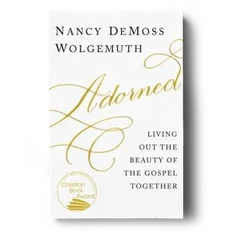
One of the things I love about this Adorned book is that women are studying it in groups—small groups, larger groups—where there are older, medium, and younger women. They’re talking about this together. At the end of each chapter, there are questions for older women and questions for younger women. You may want to answer both sets of questions if you’re kind of in that mid-range.
We grow in the context of community. You may not have an ideal set up or an ideal community. Listen, there’s not going to be an ideal community this side of heaven, but you use what God gives you. Pray for this if you don’t have it. Ask God to show you how you can be one to initiate it. Aspire and resolve to become an older woman who models Christlikeness to the women coming behind you and who you will pass on the baton of faith.
I want to just touch for a moment on why this is so important. Does it really matter for each one of us to be intentional about living this lifestyle of discipleship and mentoring, spiritual mothering? Why does it really matter? Why is it so important?
In Titus 2, the apostle Paul gives instructions to men, women, older, younger, various seasons and stations of life. He says, “Here’s what the gospel looks like on you.” And then there are three purpose clauses. I want to just point them out to you. This is why this really matters.
In verse 5 he says, “So that the word of God may not be reviled” (ESV).
That word “reviled,” some of your translations may say “blasphemed,” the Greek word is actually related to the English word “blaspheme.” So that people will not look at our lives and speak ill of Christ or His gospel.
You see, when we don’t live out these qualities in these kinds of relationships, people around us are given ammunition to take aim at Christ. The Word of God, the truth of God will be blasphemed because of our lives.
And then in verse 8, he says, “So that an opponent . . .” We have lots of opponents of the gospel! “So that an opponent may be put to shame, having nothing evil to say about us” (ESV).
They’ll see Christians, and they’ll want to take target, and they’ll want to tear into the message and the gospel of Christ. We don’t win them by arguments. We don’t win them by talking, by dialogue—not that sometimes we will have conversations. But ultimately, what will cause them to shut their mouths from critiquing and attacking the gospel is when they see the beauty of Christ lived out in us.
And then the third purpose clause in verse 10 is at the end of this whole section. He says, “So that in everything they may adorn the doctrine [there’s that word again] the doctrine of God our Savior” (ESV).
You see, sound doctrine is not only true, but it’s also good. It’s right. It’s beautiful. It’s true. It’s right. That’s the best defense for the Christian faith. This is the best apologetics, when people see a marriage, a life, a family, an individual.
Your husband may not even be a believer in Christ. So obviously, your marriage is not going to be all that a marriage could be as a witness to the world. But your life can be, even in the midst of hardship and difficulty, an example of how to bear up under tests and trials and challenges.
So much is at stake here.
When my husband and I were planning our wedding, we said our goal was that our wedding would showcase the loveliness of Jesus. We wanted people to see that. That impacted the dress I chose, the flowers we chose, the church venue that we chose. Everything about that wedding, we wanted to put the beauty of Jesus on display.
I didn’t want them to all go away and say, “Oh, what a gorgeous bride!” Listen, at fifty-seven, when you’re trying on wedding dresses, you feel a little silly, let me just say. I wanted to be adorned for my husband, but we wanted together to be adorning of the doctrine of God our Savior.
And that’s what we want to be true in our marriage. That’s what we want to be true in our lives, that people will look at us and say, “Wow! Jesus is amazing!” Not, we are amazing, but He is amazing.
Our lives have a ripple effect. Our lives can make Christianity believable in this rough, pagan culture. We can adorn the gospel of Jesus Christ.
I think of the nineteenth century German philosopher, Heinrich Heine, who said, “Show me your redeemed life, and I might be inclined to believe in your Redeemer.” Show me! Show me! Let me see it! Show me your redeemed life—not perfect, but perfectly humble, growing in grace. “Show me your redeemed life, and I might be inclined to believe in your Redeemer.”
The gospel is under attack today. As women, we need each other, those intergenerational relationships, to showcase the beauty of the gospel so that they, too, might come to know and believe in Jesus.
I’d like to pray for you before we close this time. I’m just going to ask you, if you consider yourself a younger woman—you pick what that is. Maybe you’re still in the child-bearing or child-rearing years, or you want to just pray for a younger woman, would you just stand? And if you’re near one of those younger women, would you just reach out your hand and touch her.
If you want to be prayed for as a younger woman, if you feel the need for a spiritual mother in your life, or you just want us to pray for you, and if you’re near one of those women, would you just reach out or reach toward them.
And, Lord Jesus, I lift up these younger women to You today. Thank You for them. I pray Your blessing on them. I pray that You would encourage them and their marriages. And if they have children, or if You give them children in the future, bless them as moms. Some would love to be moms, and You haven’t blessed them that way yet.
I pray that whatever challenges of their lives in this season that You would encourage them in grace, You would strengthen them. Would You bring spiritual mothers into their lives? Would You give them this great, beautiful vision of maturing into a godly old lady. That’s what we want to be, Lord. We want to be godly, old ladies someday.
And so for these younger women, would You give them faith? Would You give them courage? They’re living in a difficult world where everything is pushing. This is swimming upstream to be a woman of God in this culture. So encourage and strengthen them in this season, I pray, for Jesus’ sake.
Now, if you’re an older woman, and you want to be prayed for as an older woman, would you just stand? I want the younger women around you to reach toward those older women.
And Lord, we’re older women here. We need prayer. We need each other. We lift up these older women, Lord. Gray hair is supposed to represent wisdom. We pray we would be wise women, that we’d be women of God, women of faith, women of courage. women of humility, women who are self-controlled and reverent in behavior and not slanderers, not slaves to much of anything other than Jesus.
Lord, give these women a vision for pouring out their lives, for investing their lives in the next generation. Don’t let us be lazy. Don’t let us get sloppy. Don’t let us just slip and slide through life. Don’t let us just drift. Let us be intentional and purposeful. Make us lovers. Make us gentle. Fill us with Your Spirit. And may our lives be something that younger women could look at and emulate.
Help us be intentional and get over our fears and our insecurities and to look around and see who You’re wanting us to invest in. If it’s an “aisle ministry” or it’s a weekly discipling ministry, or whatever it is, show us for this season. Help us not to sit on the sidelines but to stay engaged and pass the baton of faith intact on to the next generation.
And for all of us, Lord, together, as we live out the beauty of the gospel together, may our lives adorn the gospel of Jesus Christ for the sake and the fame of Your great name, we pray it. Amen. Amen. Thank you.
Dannah: Amen. That’s Nancy DeMoss Wolgemuth praying for our intergenerational relationships, that they would showcase the beauty of the gospel.
What a sweet vision Nancy’s cast for us over the last two days. Now it’s time to live it out.
I wonder, is there one spiritual mother, daughter, and sister you could reach out to this week? Maybe send an encouraging text. Invite them to coffee. Or just ask how you can pray for them. As you continue to foster these relationships, we’d love to help equip you.
We’ve put together a collection of our favorite resources on friendship, marriage, parenting, and so much more. It’s to help your relationships thrive in Christ. To find those podcast episodes, articles and videos, visit ReviveOurHearts.com/relationships.
Also, don’t forget, for a gift of any amount, we’d love to send you Nancy’s booklet, A Deeper Kind of Kindness. This resource is derived from Nancy’s larger book, Adorned, the very book she’s been drawing from throughout today’s message. To give and request A Deeper Kind of Kindness, visit ReviveOurHearts.com, or call us at 1-800-569-5959.
Well, I’m excited about tomorrow. We’ll be hearing from Erin Davis, and she’s going to help us make what we’ve just been talking about super practical. She’s sharing about the unique irreplaceable ministry of your home. I hope you’ll be back for more on Revive Our Hearts.
This program is a listener-supported production of Revive Our Hearts in Niles, Michigan, calling women to freedom, fullness and fruitfulness in Christ.
All Scripture is taken from the CSB unless otherwise noted.
*Offers available only during the broadcast of the podcast season.