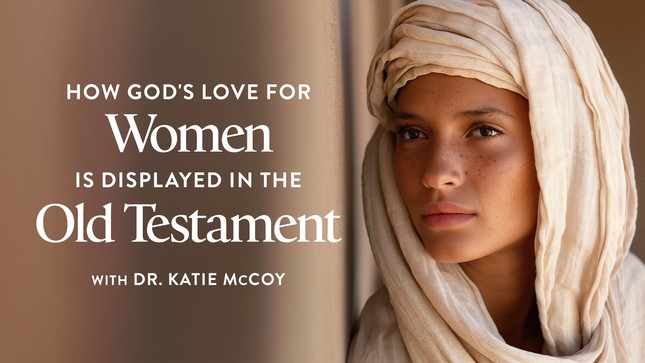

Looking at the Law through Cultural Lenses
Dannah Gresh: Dr. Katie McCoy sees God’s love in God’s law.
Dr. Katie McCoy: Ultimately, the law of God reveals the Lawgiver. So when we’re studying these laws about women—unusual as it may seem—this is expressing the ultimate purpose of the law, which is summarized in love for God and love for one another.
Dannah: This is the Revive Our Hearts podcast with Nancy DeMoss Wolgemuth. This year we celebrate our twenty-fifth anniversary. Today is February 25, 2026. I’m Dannah Gresh.
Maybe you’re one of our thousands of listeners who are walking through the 2026 Bible reading plan this year. If you’re sync’d up to that schedule, these days you’re deep into the book of Deuteronomy, with laws about witnesses and marriage and all sorts of things. As you read, are you confused by any of those laws? If so, I think today’s program is going …
Dannah Gresh: Dr. Katie McCoy sees God’s love in God’s law.
Dr. Katie McCoy: Ultimately, the law of God reveals the Lawgiver. So when we’re studying these laws about women—unusual as it may seem—this is expressing the ultimate purpose of the law, which is summarized in love for God and love for one another.
Dannah: This is the Revive Our Hearts podcast with Nancy DeMoss Wolgemuth. This year we celebrate our twenty-fifth anniversary. Today is February 25, 2026. I’m Dannah Gresh.
Maybe you’re one of our thousands of listeners who are walking through the 2026 Bible reading plan this year. If you’re sync’d up to that schedule, these days you’re deep into the book of Deuteronomy, with laws about witnesses and marriage and all sorts of things. As you read, are you confused by any of those laws? If so, I think today’s program is going to help.
Oh course, one of the areas of the law that gets confusing is that some people claim that the Bible is demeaning to women. In fact, some people leave Christianity over it. But is that claim true?
Our host, Nancy DeMoss Wolgemuth, would say no.
Nancy DeMoss Wolgemuth: Scripture gives great honor, worth, value to women. Contrary to what many would say today, you'll never find the Scripture belittling or demeaning women, or men for that matter, because they're created alike in the image of God. So there's no place for despising one gender or the other. There's no place under God's authority, under the sovereignty and the Word of God, for abusing women or men.
Dannah: And our guest today, Dr. Katie McCoy, would agree with Nancy. But today she’s going to help us unpack more of why certain passages seem confusing to modern ears.
Katie serves as Director of Women's Ministry at Texas Baptists. She holds a PhD in Systematic Theology from Southwestern Seminary, where she served on faculty for five years. Katie's research includes the patterns of justice for women in Old Testament laws, as well as the intersection of theology, gender, and women's studies.
She speaks and writes on women's and gender issues, and she is the author of To Be a Woman: The Confusion Over Female Identity and How Christians Can Respond. Katie tells us she loves to bake (or maybe just make a mess in the kitchen), and she says the Container Store is her "happy place."
Katie, welcome back to Revive Our Hearts.
Katie: Thank you so much for having me, Dannah.
Dannah: I want to talk to you about something that's really interesting and really confusing and problematic for many of us. It's also something that I have heard a lot of young twenty-somethings who are deconstructing point to as evidence that they should be walking away from the faith . . . and that is the Old Testament laws for women.
Katie: Yes, it is a treasure trove, Dannah, a treasure trove.
Dannah: You are going to have to unlock the treasure trove, because for many of us, we get into the conversations about these topics, especially with these younger, deconstructing women, and we don't know what to say. So take us to one of those Old Testament laws of women that's very troubling and help us to unlock that treasure chest.
Katie: Yes, so part of why it is so troubling is we jump into them without setting the stage of understanding the world that we're entering.
Dannah: In fact, you gave a helpful illustration along those lines at a True Woman conference. Let's listen to that.
Katie (from conference): The story goes that there was this business group that was hosting this Chinese delegation for a major business deal. This was huge—I mean—they'd been trying to land this for months.
And so, they bring these executives from China, meet them for dinner at the best restaurant in town. The Chinese executives come to the restaurant, and the Americans look at them and just say, “Oh, just sit anywhere. Come on in, just sit wherever you want.”
They have the dinner, and it seems like everything’s going fine. They're very happy with the way the dinner went. And then the next morning, they got the call: the business deal is off. They are irrevocably offended.
Well, these American executives are going, “What in the world did we do? We did everything we could! We rolled out the red carpet for them; we brought them to the best restaurant we could; we made them feel so welcome. What in the world happened?”
And then they realized that when they said, “Sit anywhere,” that was a sign of disrespect. Because, Chinese culture values hierarchy. With hierarchy, you would have had the head of that company sitting in a place of honor. You would have thought through where you are putting everybody at this table to communicate respect.
Dannah: Again, that's our guest today, Dr Katie McCoy, speaking at a recent True Woman conference. And by the way, we'll be playing more excerpts from that message today. I won't necessarily mention it every time.
Katie, those business professionals missed each other because they didn't really understand the bigger picture.
Katie: They're coming at it from a very different cultural framework. Well, in our information age of internet where you can learn anything and have all knowledge at your fingertips, we still experience things like that at the same time. How much more might we have cultural mistranslations when we're looking at the Bible's culture from thousands of years ago, in a completely different, not only era, but place in the world?
Katie (from conference): See, when you and I come to the Bible, we put our cultural lenses on. Oh, we don't realize it. We all have them. We all have a perspective that we come to when we're reading the Old Testament.
Now, because of this, a lot of times we can look at the Old Testament and think that it is horrible for women, that it is oppressive to women, that it was misogynistic to women. Maybe you don't say it out loud, because that's not what good church girls do. But the truth is, we can read some of these passages, especially in the Old Testament law, and feel like this seems out of sync with the God that I know, especially in the New Testament. What is going on?
What comes to mind when we think about Old Testament law often reflects the cultural perspective that we are bringing to Scripture. So what do we have to do? We have to take off our cultural lenses and understand the cultural lenses of the Bible. That's what we're going to start with today.
Now, we still need the Old Testament law. It's so easy to think, Oh, that's Old Testament. We don't need to know that. Jesus saved us from all of that. Well, He saved us from the penalty of our law breaking. We no longer relate to God on the basis of how we are doing in keeping His law.
But as Romans tells us, we are saved now so that we can fulfill the law of God. And the law of God is summed up in what? “Love the Lord your God with all your heart, soul, mind, and strength. . . . The second is like it: Love your neighbor as yourself” (Matt. 22:27–38).
So when we're studying these laws about women, unusual as it may seem, this is expressing the ultimate purpose of the law, which is summarized in love for God and love for one another. Ultimately, the law of God reveals the Law giver.
Here's what you need to know. Any time you are talking about a law, any law—biblical law, American law—every law is grounded in a moral claim. Behind every law that has ever been passed, you trace it back to why that law was passed, and you'll find a moral claim: something that people should do or something that people shouldn't do. Well, those shoulds and shouldn'ts reflect moral claims, moral frameworks—what is right, what is wrong. So when we encounter Old Testament law, we are encountering God's moral framework, and that includes the laws that are specifically about women.
---------
Katie: We live in the West. And by that I don't mean like cowboys. I mean like Aristotle and Western philosophy. The West is characterized by valuing the individual.
Now that is a result, by the way, of the influence of Christianity. That said, every individual matters, no matter how much money they have, what gender they are, what their ethnicity is. But part of Western culture is valuing that individual. If you are an American, you are a hyper individual. But then if you are an American living right now, you're like an individualist on steroids.
Dannah: Yeah, almost to an idolatrous point of view, right?
Katie: Completely.
Dannah: We've taken it too far.
Katie: Think three word mantras: you do you; follow your heart; live your truth.
Dannah: Yes.
Katie: Our culture today generally accepts that truth is how you feel about yourself. And “your truth,” quote, unquote, is the truth and the truth for everybody else, that everybody else should agree with, affirm and conform to. So you can already see that coming to the Bible that has a completely different culture, we're going to hit some clashes.
The Bible is not an individualist culture. It was not written to an individualist culture. Its immediate audience was a collectivist culture. Now, in a collectivist culture, your highest good was to do what was for the benefit of your family or your community. If you had personal desires or ambitions, and you sacrifice those for your family or your community, that's something that made you honorable. It was very valued.
In our individualist culture, if you go against the traditions of your family and community to do what is in your heart to do, and you have confidence and individuality, that's what we celebrate and valorize.
So perfect example, imagine with me that my parents came to this country with nothing. They came to the United States with nothing from another country. And they took everything that they had and opened up a business. They opened up this business with the hope that I would eventually take over that business for them, and I would take care of them in their old age. And then along with that, I would be able to take care of my family with this business.
There's only one problem. I want to be a Broadway actress, and I don't want to do what my parents expect me to do. I want to go be a famous star on Broadway. Now, Which one are you rooting for? Or maybe just say, which one is the movie version?
Dannah: Yeah, which one is the American Dream version?
Katie: Right, exactly, even if we might say, “Well, the right and prudent thing would be taking over her family business.” But inside, I really want you to live your dream of being a Broadway actress. How we sort of fill in what is the right ending of that story is a reflection of our own culture.
We as individualists look at things in the Bible that are written with communities and families in mind, and we can easily think that this is somehow harmful to women, treating women like property, ignoring the fact that they are individual people. And in reality, it's that the Bible is a completely different cultural system.
That, Dannah, is just part one of setting the stage.
Dannah: Okay, so I am mesmerized.
So an individualistic culture like ours needs to remember the Bible was written in a more communal, collective cultural context. Being aware of that helps us understand and interpret God's Word better.
Now, you told the women in your session at True Woman that there are other cultural lenses we need to recognize as well.
Katie (from conference): Here's another difference. We live in what's called a guilt or innocence culture. The Bible was written in an honor / shame culture. Now this is a subtle thing, but it's very different.
So when you and I, if we break a law . . . Let's say we run a red light. We're pulled over and we're guilty. We ran the red light. What we have to do is we make restitution, we pay a fine, and then we are restored. We have made that restitution. We're put back in right standing because we have paid a debt. The opposite of guilt is innocence. You are innocent of that wrongdoing or that particular transgression.
The biblical culture, there are still the concepts of guilt and innocence, and certainly we see how the Lord Jesus pays our debt and restores us to not innocence with His righteousness.
But in collectivist culture, it's not guilt or innocence, it's honor or shame. The difference is your relationship to the community. So if you do what is good, you do what is right, you have honor in the community. But to transgress the expectations, to go against the commands of the Lord, to defy one's parents, is something that brings shame.
Shame brings exclusion. So when someone is restored to honor, they are not primarily seen as innocent, but rather they are brought back from exclusion, from the community, which is a place of shame, and brought back into the community. So when Hebrews says that Jesus died outside the gate, He was excluded. This is part of Him. He was taking on our shame. It's exclusion that was considered kind of the greatest punishment—to be outside of your community.
Because of that, individual sins have a major communal concern. Because of that, sexual integrity, especially from one person, reflects an entire family. One person's obedience or disobedience does not just affect that one person, that's kind of that guilt or innocence framework. Rather, your individual obedience or disobedience affects the whole.
So when you read in Deuteronomy about how they are to respond when they find idolatry in their neighbor or their family member, it's their responsibility. It’s not, “Oh, this is just my distant relative over here.” Oh, no, it's a communal concern. That helps us understand a lot of these laws that we're going to read and understand. Why in the world is everybody part of the punishment? Well, because in an honor / shame culture, morality has communal effects.
Next, oh, this is the big one, patriarchy. Oh, I just heard a little bit of a rumble. Yeah, patriarchy.
You've probably heard that word, patriarchy. It's usually preceded by the terms “smash the patriarchy,” “down with the patriarchy.” In our post-feminist world, the idea of patriarchy is considered the root of all inequality and all women's oppression.
Patriarchy properly means “father rule,” pater is father. And then patrocentrism, you see that right next to it, that's the idea of a community or a family revolving around the father.
Now I'll just be honest, patriarchy, patrocentrism, father rule, father-centered, neither of those sound particularly appealing in themselves, do they? Why? Because we are individualists. We are wired to see the world through very self-centered lenses. Autonomy, self-direction, these are the things that our culture values.
Well, in a patriarchy, especially in Ancient Near Eastern culture like the Bible's, patriarchy was simply like your local government. Patriarchy was a part of life, and the patriarch, or the eldest male of a family or a clan, ruled over the entire household. He was at the center of the entire household.
Now, some of the things we mean by that is: this patriarch was responsible for everyone under his care. I'm not just talking about his wife and children either. I'm talking about extended family, servants, people who worked on his land, people who were traveling through. They didn't have hotels. They stayed with people locally, like someone's family home or a clan. People who were foreigners, who had been living among the Israelites, all of these people would take up residence in a household, and that household was vast and far reaching.
The patriarch was the one who was responsible for everyone in his care. If he did not take care of them well, it was a dishonor to him. It was shameful to him. Again, you and I hear that through individualist ears, but in the biblical culture, a patriarch also represented his household.
That's why there are certain laws that require the men to come and fulfill a religious obligation. It's not because, “Oh, we don't want women.” It's because that man represents and is the head of that particular household.
Now, we typically and oftentimes unknowingly associate authority with being the best part of what happens. We look at being in charge, or we are the one who is responsible, and that must mean that you are superior. I mean, nobody wants to be second, right? But in the biblical culture, the greater your authority, the greater your responsibility.
Theologian Daniel Block says it's a fundamental fallacy if we don't distinguish between authority and ownership. Men had authority. This is a patriarchal culture of authority, but that's not the same thing as ownership. Women were dependent on men, but they were not slaves to men. They were not the possession of men.
The ideal of leadership and authority all throughout the Bible is that of a servant, of a husband and father using his authority in such a way that it is for the benefit of everyone in his care.
So we can't say, “Oh, well, you know, biblical law written in a patriarchal culture, it was just automatically oppressive to women.” We don't know that.
Case in point. We live in a democratic republic. We can vote. We can hold office. We can own land. We can own a business. We can say whatever we want. Are women no longer mistreated? No. Why? Because the problem is not primarily the structure of our culture or our government. The problem is primarily the condition of the human heart. Laws, cultures, don't change behaviors. They punish bad behaviors, but laws do not make people righteous. We know that from our Bibles, don't we?
Here's one more thing to make sure you know. Within this culture, marriage is essential for a woman's life. If you're not married, you don't have a home. You don't have a stable source of food. You don't have children who will take care of you in your old age. So unless you are under your father's household, you are on your own. Your options are: you are the daughter of your father, or you are the wife of your husband. Again, this is a cultural difference.
So when a woman is widowed, when a woman has something happen in her life that completely affects her marriage prospects, that is devastating. It's not just grief, it's not just the pain of widowhood or the pain of singleness. No. This is socio-economic disaster. And when we understand that, it helps us see many of the laws about marriage for women within that frame of mind, that this is something that is actually helping women who need to be in the security of a marriage.
So God's law reveals His character, and it reveals His character at a particular point in history, in a particular culture.
Dannah: Dr. Katie McCoy has been setting the stage for us to dive into specific laws in the Old Testament—laws written for women. That’s something we’ll start doing on tomorrow’s program. There’s more information about her book To Be a Woman at a link you’ll find in the transcript of this program. That’s at ReviveOurHearts.com, or on the Revive Our Hearts app.
Now, speaking of different cultural approaches to things, it’s fair to say that our individualistic society often doesn’t do well dealing with relational challenges. We need the wisdom of God’s Word to help us navigate the pressures and stresses and strains that come along with marriage and family relationships, as well as friendships and basic acquaintances.
That’s why we’ve put together some helpful resources related to relationships. Go to ReviveOurHearts.com/relationships to check it out.
You know, there are some fascinating cultural traditions that come out in the Old Testament book of Ruth. I mean, some of them can sound downright odd to us in this day and age.
Our February donation-of-any-amount resource is our Bible study called Ruth: Experiencing a Life Restored. It’s part of our series of studies on Women of the Bible. It’ll explore some of those cultural differences Katie has been talking about today. Ask for your copy when you make a donation of any size at ReviveOurHearts.com, or by calling us at 1-800-569-5959.
Today Katie McCoy set the stage by explaining the different cultural lenses we all have. Tomorrow she actually explains some of the more difficult laws for women. Did you know that according to the Old Testament, when a woman gave birth to a baby boy she needed to be treated differently than when she gave birth to a girl? It’s true. Katie will help us understand that tomorrow on Revive Our Hearts. Hope you’ll join us!
This program is a listener-supported production of Revive Our Hearts in Niles, Michigan, calling women to freedom, fullness, and fruitfulness in Christ.
*Offers available only during the broadcast of the podcast season.