

Dannah Gresh: If you’re navigating painful circumstances and wondering, Where is God in all of this? Nancy DeMoss Wolgemuth wants to turn your eyes toward comfort.
Nancy DeMoss Wolgemuth: Do you have burdens today that feel too weighty to bear? “Turn your eyes upon Jesus.”
Dannah: This is the Revive Our Hearts podcast with Nancy DeMoss Wolgemuth, author of Heaven Rules, for October 30, 2026. I’m Dannah Gresh.
Have you ever been tempted to think that God doesn’t know or care about what you’re going through? Nancy’s here to help you resist that thought. Today, she’s giving you a preview from her biggest project yet—the Wonder of the Word. Over the next two years, she’ll be walking through the entire Bible with us, from Genesis to Revelation. And she’ll help us to marvel at the God who floods every page with glorious purpose.
This day …
Dannah Gresh: If you’re navigating painful circumstances and wondering, Where is God in all of this? Nancy DeMoss Wolgemuth wants to turn your eyes toward comfort.
Nancy DeMoss Wolgemuth: Do you have burdens today that feel too weighty to bear? “Turn your eyes upon Jesus.”
Dannah: This is the Revive Our Hearts podcast with Nancy DeMoss Wolgemuth, author of Heaven Rules, for October 30, 2026. I’m Dannah Gresh.
Have you ever been tempted to think that God doesn’t know or care about what you’re going through? Nancy’s here to help you resist that thought. Today, she’s giving you a preview from her biggest project yet—the Wonder of the Word. Over the next two years, she’ll be walking through the entire Bible with us, from Genesis to Revelation. And she’ll help us to marvel at the God who floods every page with glorious purpose.
This day of the Wonder of the Word project that we're about to hear is particularly meaningful to Nancy. As she’s been recording over the past couple years, she’s come up against roadblocks, trials that have tested her endurance and her trust in Jesus. She’ll begin today by sharing about the most significant one yet.
Finding God’s Comfort in the Midst of Grief
Nancy: I want to tell you from the outset that today may be the hardest program I've ever recorded, certainly the hardest for Wonder of the Word, which we're recording over the course of several years.
Shortly after we recorded the last program, my precious husband became sick. He had pneumonia as it turned out. I took him to the hospital, and within the next several days, he declined rapidly. Within several days, he was on life support, and then less than two weeks later, as I sat next to his bed and held his hand, he breathed his last breath and then went home to be with the Lord.
This has been an enormous loss. There have been waves of grief along with waves of grace and gratitude. We paused recording Wonder of the Word for several months, and today is the first time that I'm back in the studio to continue this journey as we study through the precious Word of God together.
Today is the first session in this whole series, in fact, over the last ten years, that Robert has not been with me as I recorded. He always sat in the room next door, where the producer said he had a special chair, a white rocking chair, and he would sit there. He would pray throughout each session. At the end of each program, he would cheer, he would encourage. He would tell me that night how the Lord had been so good to open His Word to His people.
And today, that chair is empty.
I miss Robert terribly, and I know by the time this Wonder of the Word series goes out and people listen to it around the world, we'll be far past this day. But I wanted to let you enter into the moment that I'm experiencing today and to say that, as hard as it is to be here without my dear husband, my DH as I often called him, here's what I know.
I know the Lord is here today. He's with me, and He's with you as you're listening—whenever that is, wherever that is, and whatever set of circumstances you may be facing that cause you to feel emptiness or loss or loneliness or grief.
And then, in God's amazing providence, the chapter we're coming to today, the next chapter in the Wonder of the Word, could not be more perfect for this season of my life, and I believe that's going to be true for many who are listening to this program as well.
So Lord, we come into Your presence. This is Your Word. It's about You, not about us. So, how I pray that You would give me strength today. Open up to me and to each person who will ever listen to this program someday, the wonder of the comfort that You give through Jesus Christ our Lord. Help us to lift our eyes up and to see You in ways that perhaps we haven't before. I pray in Jesus' name, amen.
From Judgment to Comfort: The Message of Isaiah 40
Now, before we dive in here, let me just give you a little bit of context. If you may not have been with us for the last program, we're in the book of Isaiah. We've shown that Isaiah falls into two major sections. The first thirty-nine chapters some have likened to a picture of the Old Testament, which has thirty-nine books. But the first thirty-nine chapters of Isaiah have a message of judgment, a message of warning, as God exposes the sin of His people, the rebellion, the idolatry, the injustice, and how prone they were to trust alliances with other nations rather than trusting in God.
After this chapter after chapter that we've been in for the last several sessions are of judgment, of warning, of dire consequences, now we come today to Isaiah chapter 40, and there's a dramatic shift, because the last section of this book takes a whole different turn from the first. It moves from confrontation and condemnation, which we've seen a lot of, and now it moves to consolation, comfort, compassion.
Look for those words as you read through the rest of Isaiah. I want you to just look at the very first verse with me, Isaiah 40:1, thinking what I've been through over these last few months. And here's the first verse in the first chapter where we're looking in this next session, Isaiah 40:1:
“Comfort, comfort My people,” says your God.
How precious is that after all these messages of judgment that God's people had been hearing. What a sweet gift those words must have been to those people: “Comfort My people.” And what a sweet gift those words have been to me as I've been soaking in them in recent weeks. What a wonderful place this has been to park my heart when the waves of sadness and grief have felt overwhelming at times: “Comfort My people,” says the Lord.
So the first thirty-nine chapters, the message is: you will be judged, rightly judged, because of your sin. And then chapter 40 through chapter 66, the end of the book, the message is: yes, you have sinned, but you will not be abandoned. You will be judged, but you will not be abandoned.
I've been reading a wonderful commentary on the book of Isaiah by Derek Thomas. He says this at this point in Isaiah:
After the clouds of judgment that have overshadowed the entirety of the first thirty-nine chapters comes the sunshine of God's grace that will occupy the final twenty-six chapters.1
First the clouds of judgment, and now the sunshine of God's grace.
Well, at the end of chapter 39, where we ended the last session, here's what we read. Verse 6:
Behold, the days are coming when everything in your palace will be carried off to Babylon.
Judgment is certain. The future looks bleak.
Now, at the time that Isaiah was writing, the current threat was not Babylon. The current threat was another nation, the nation of Assyria, which had already taken the northern kingdom of Israel into captivity. And now under the inspiration of the Holy Spirit, the prophet Isaiah looks ahead one hundred years, because at the time he was writing, people didn't know or really care who Babylon was. Assyria was the fearful power, the fearsome threat.
But now Isaiah looks ahead to the day when another nation, Babylon, would take the southern nation of Judah into captivity for seventy years to chasten and discipline God's people in that day for their sin.
Isaiah 40 is the hinge between these two sections—the judgment and then the comfort and consolation. Isaiah speaks prophetically into the future, as if the seventy-year exile yet to come had already happened. And in that place of loss and discipline yet to come, God speaks comfort to His people.
The focus changes from exposing sin to restoring hope, from impending judgment to promised redemption. The God who judges is also the God who restores and redeems.
Now, I hope you have your Bible with you. I hope you can follow along with the first eleven verses of Isaiah 40, because we're going to spend this whole session in just this one chapter. The first eleven verses are a sort of prologue for the rest of the book of Isaiah. They set the stage.
God's prophets speak to people who are discouraged, they're fearful, and they've lost heart. They desperately need hope and encouragement. And so verse 1 again:
“Comfort, comfort My people,” says your God.
“Speak tenderly to Jerusalem and announce to her
that her time of hard service is over, her iniquity has been pardoned.” (vv. 1–2)
God Provides Comfort Before the Affliction Comes
Now, that word “comfort” comes from two Latin words that mean “to strengthen, to give strength or relief in affliction.” So here we have comfort for God's weary people. He's looking beyond the Babylon captivity and God's chastening of His people to the end of the story, the rest of the story.
Remember that this comfort is promised to them before they've even been through their affliction. God is saying, “Your sin has been dealt with. It's been forgiven. Your exile yet to come will not be the end of the story.”
Just a reminder that God knows what afflictions lie ahead for His people, and He's already made provision for their deliverance and their comfort.
This means God has comfort prepared for you and for me, not only for your current affliction, but for whatever affliction you may face next week or next month or next year or when you're old or when you're dying. God has made provision in advance. That's His providence, making provision for affliction yet to come, and the reminder from this opening set of verses that there will be an end to your hardship and to your trials.
The God who chastens us to purify us is also the God who redeems and comforts us. Payment has been made for our sin so it can be pardoned through the sacrifice and the blood of the Messiah, the Lord Jesus Christ. Isaiah 40:3:
A voice of one crying out: Prepare the way of the LORD in the wilderness;
make a straight highway for our God in the desert. . . .
And the glory of the LORD will appear, and all humanity together will see it. (vv. 3, 5)
Preparing the Way for the Lord’s Presence
So the prophets tell us that the Lord is coming to be with His people in the wilderness, in the desert, the hard place, the dry place, the barren place, the place of hardship. The Lord is coming to be with His people in that very place, and they need to prepare the way for His coming. Obstacles must be removed. The description here is one of repentance. In order to have fellowship with God, they must prepare the way so that God can come and walk among His people.
Now, we know from the New Testament that this passage was fulfilled in the ministry of John the Baptist, who was sent to prepare the way for the Messiah, His first coming to earth. He came in humility. And in Christ, in the face of Christ, we would see the glory of God, God made flesh. So, we who are separated from God could be brought near to Him.
And then we know that He didn't just come that first time. He will come again in might and power, and this is what we live for! This is what we long for: to behold the glory and the face and the beauty of God in Christ Jesus.
Well, in verses 6–8 here in Isaiah 40, Isaiah is told by God to proclaim to the people that human strength is frail and it's temporal, but God's Word is enduring and eternal. His promises are absolutely reliable. We need to remember that, because the people were in a hard place. They had judgment yet to come. They would be in exile. But God is saying that there are promises I'm making. He wanted to assure us that every word He speaks can be counted on. He will fulfill His promises.
Proclaiming the Good News: Behold Your God
And then we come to verses 9–11. I'm going to skip over some verses in this chapter, but the people of God who have received comfort from God are now called to become proclaimers of the good news that they have received. So, verse 9:
Zion, herald of good news,
[It's a word that means “evangelist, the one who proclaims the gospel.”
go up on a high mountain.
Jerusalem, herald of good news,
raise your voice loudly.
People of God have good news for those who are in despair, who are discouraged, who are defeated. We have received the good news of God's comfort, His pardon for our sin. He's releasing us from our debts. He's setting us free from captivity. And now, we as the people are called to proclaim that good news to others, to proclaim it boldly to our world.
Go tell it on the mountain. Tell the gospel of Jesus. And what are they to proclaim?
Say to the cities of Judah,
“Here is your God!” (v. 9)
I'm reading the Christian Standard Bible, and that's how it puts this phrase. Your translation may say, “Behold your God.” I love that too: “Here is your God. Behold your God.” That's our message.
Our message is not about us. It's not about our programs. It's not about our institutions or our organizations or our way of thinking about the Christian life. What is our message to our world? “Here is your God. Behold your God.”
See, the Lord GOD comes with strength,
and his power establishes his rule. . . .
He protects his flock like a shepherd;
he gathers the lambs in his arms
and carries them in the fold of his garment.
He gently leads those that are nursing.” (vv. 10–11)
Here is your God. It's the best possible news for weary, sad, sin-sick hearts. Here is your God. He comes, verse 10, as a strong, powerful king, and then, verse 11, he comes also as the Good Shepherd who gently and tenderly protects and cares for His own.
When We Feel Forgotten by God
Now keep that in mind, and I want to ask you to look ahead in this chapter to verse 27. I'm going to skip over for just a moment to verse 27, and I want you to see here how God's people are feeling and what they are thinking during this season as they're facing the exile and the punishment, the chastening of God for their sin, and they're in despair. Verse 27:
Jacob, why do you say,
and Israel, why do you assert,
“My way is hidden from the LORD,
and my claim is ignored by my God”?
This is what these people are feeling. They're feeling God doesn't know what we're going through. He doesn't know the pain, the anguish, the discomfort, the problems that we're facing in our world. He doesn't know, and if He does, He doesn't care. “My way is hidden from the Lord.” He doesn't know, or He doesn't care. “My claim is ignored by my God.” He isn't doing anything.
Even those of us who know the truth of God's Word, isn't it true that we can sometimes feel like God has forgotten, like He's ignoring us, like He doesn't really care?
Now keep that in mind, because that's the frame of mind that God, through His prophecy, is speaking to those people who are feeling that way. You may be feeling that way. I feel that way at moments. And the message of Isaiah 40 is for us. It was for these people. It's for you. It's for me.
Look Up and See the Greatness of God
Now go back to verse 12 of chapter 40, and in verses 12–26, we see the greatness of God revealed. This is a passage that we need to hear and to read over and over again. Read it aloud. Listen to audio of it. Read it silently. Read it to others. Read it to yourself. We need this passage.
It's a little bit like those chapters in the book of Job, chapters 38–41, where God reveals Himself to His suffering servant Job through a series of questions that reveal the greatness of our God.
And what you realize as you soak in this passage is that our response to life, how we deal with life, how we deal with hardship, how we deal with guilt, how we deal with shame, how we deal with grief, all of this is a matter of perspective. What are we looking at? What are we seeing?
A key sentence in this chapter—again, let me take you ahead just a little bit—but just look at this phrase in verse 26, four words: “Look up and see.” Look up and see. Here is your God.
When all around us is craziness, it's hurtful, it's painful, it's burdensome, it's confusing, it's perplexing—here is your God. Look up and see.
Gaining a Right-Sized Vision of God
I've been having some trouble with my vision recently. I have one eye that works great for reading and another eye that works great for distance. It's called monovision, and it's been a real gift. It's been the reason I haven't needed glasses for much of my life. But my reading eye, my right eye, it's been blurry, and I'm just struggling to read and to look at my laptop.
I spend a lot of time reading and working on my laptop. I'm waiting to get an appointment with the eye doctor to see what's going on here. But it's just been a reminder to me, as I've been kind of straining to read my notes and my Bible, that our spiritual sight gets blurry at times. We can't see right. Our problems look massive and overwhelming, and then God, well, we can't see Him so well. He looks small.
We may wonder, Does He know? Does He care? Has He abandoned us? Has He forsaken us?
Oh, my friend, you and I need—and God gives us here in Isaiah 40—a right-sized vision of God. Here is your God. Look up and see.
Isaiah 40 corrects our spiritual vision. It lifts our eyes upward from our circumstances, our pain, our weakness, our confusion. Look up and see who God is.
Let me just give you a taste of that from this chapter. In verse 12, look up and see how vast and immense God is. Verse 12:
Who has measured the waters in the hollow of his hand,
or marked off the heavens with the span of his hand?
Who has gathered the dust of the earth in a measure
or weighed the mountains on a balance and the hills on the scales?
God is infinitely bigger and greater than His creation. What is huge to us is small to Him. It's a matter of perspective.
Let me give you an example.
He holds the waters of the earth in the hollow of His hand. I don't know how much water you can hold in your hand, but I'm told—and again, I don't know how anybody ever figured this out or how they know this—but they say that there are 340 quintillion—that's nineteen zeros—340 quintillion gallons of water on the face of the earth.
God can hold all the water on the earth in the palm of His hand. Do you think He can take care of whatever you're dealing with, whatever I'm dealing with today?
The universe, I'm told, is 93 billion light years across. That's 550 sextillion miles. I have no idea what those numbers mean or how big or far that is. But what I know is that it's massive, and yet God measures all of that span with the width of His hand, the span of His hand.
The God Who Rules the Universe Also Holds You
God is massive. He is immense. He is bigger than all of His creation. God puts all of the dust of the earth into a measuring cup, all the deserts, all the sand, all the dirt, and He puts all the mountains and the hills on a scale, and it doesn't topple over.
God is immense. Look up and see how great He is.
Verse 13, look up and see how infinite God is in wisdom. He never needs a counselor. Verse 13:
Who has directed the Spirit of the LORD,
or who gave him counsel?” Who did he consult? . . .
Who taught him knowledge
and showed him the way of understanding?” (vv. 13–14)
See how great in wisdom God is. And then verses 15–17, look up and see that what looks massive and overwhelming to us is microscopic to God. Verse 15:
Look, the nations are like a drop in a bucket.
If I am carrying a bucket of water to clean a floor or do something—clean windows or whatever in my house—and a drop falls in, is anybody going to notice? Or a drop falls out, is anybody going to notice? That's what the nations are like. The nations of the world are like a drop in a bucket.
They're considered as a speck of dust on the scales . . .
Remember this when you watch the news, when you see what's going on in our world, the nations, the wars, the struggle. It's all like a speck of dust on the scales. It doesn't change the weight at all.
. . . he lifts up the islands like fine dust. . . .
All the nations are as nothing before him;
they are considered by him
as empty nothingness. (vv. 15, 17)
What looks massive and overwhelming to us is tiny. It's minuscule. It's microscopic to Him.
And then Isaiah 40:21–26: look up and see that God is the Creator of all. He is the Creator of all, capital “C,” and He is the Controller of all His creation—Controller with a capital C. Look at verse 21 and following.
Do you not know?
Have you not heard?
Has it not been declared to you
from the beginning?
Have you not considered
the foundations of the earth?
God is enthroned above the circle of the earth;
its inhabitants are like grasshoppers.
He stretches out the heavens like thin cloth
and spreads them out like a tent to live in. (vv. 21–22)
Makes it sound like creation was so easy for God. I mean, we can't paint it, we can't draw it, we can't even take in a sunset—we can't see it all at once, the splendor of the view. But God stretches out the heavens like just a piece of cloth. He spreads them out like a tent to live in. It’s not that big, because He is so very big. Verse 23:
He reduces princes to nothing
and he makes judges of the earth [those who think they're in charge, he makes them] like a wasteland.
They are barely planted, barely sown [elections are hardly over],
their stem hardly takes root in the ground
when he blows on them and they wither,
and a whirlwind carries them away like stubble. (vv. 23–24)
Kings, rulers—they pass away. Good ones, bad ones—they don't last forever. God is the great King and ruler. Verse 25, look up and see:
“To whom will you compare me, or who is my equal?” asks the Holy One.
Look up and see! Who created these?
He brings out the stars by number [he numbers them; he calls all of them by name [every last one]. (vv. 25–26)
We think we're so great when scientists, with their great equipment, can see a star they've not seen before. They give it a name. But God knows them all. He counts them all. He names them all. Because of His great power and strength, not one of them is missing.
Look up and see. Behold your God. Here is your God.
See that He oversees every detail of the universe. He sustains, He upholds His creation. He holds it all together. Without Him, it would all fall apart.
He's got the whole world in His hands.
He's got the nations.
He's got the kings.
He's got the rulers.
He's got the great and the mighty.
He's got the mountains and the hills.
He's got the rivers and the seas.
You've sung this song. He's got all those big things, but He's also got the tiny little baby in His hands. He's got you and me, sister, in His hands. He's got the whole world in His hands.
G. Campbell Morgan was a great Bible teacher of the last century, and I love what he said and thought about it many, many times over the years. He said this:
The supreme need in every hour of difficulty and distress is for a fresh vision of God. Seeing Him, all else takes on proper proportion and perspective.
Did you get that? The supreme need, my supreme need, yours, in every hour of difficulty and distress, is to look up and see: “Here is your God.” And when we see Him, all else takes on proper perspective and proportion.
You have burdens today that feel too weighty, too heavy, too hard to bear?
Turn your eyes upon Jesus,
Look full in His wonderful face.
And the things of earth will grow strangely dim
In the light of His glory and His grace.
("Turn Your Eyes Upon Jesus" by Helen Lemmel)
Fix your gaze on Him. He does see. He does know. He does care. The big things—the planets, the stars, the rulers, the kings, the little things—your family, your prodigal, your finances, your health, your friendships . . . He is carrying you. He is holding you. He is leading you. Look up and see your God.
Renewed Strength for Those Who Wait on the Lord
So we come to the last paragraph, one we could do many programs on but just these few words. Often in my teaching notes I will put some initials, MIP and TIH. That means make it personal and take it home. That's where I will often draw some conclusions, make some applications, and to make it personal and take it home today.
Today, I just want to read this last paragraph to you, beginning in verse 28. Here's the take it home and make it personal.
Do you not know? Have you not heard?
The LORD is the everlasting God, the Creator of the whole earth.
He never becomes faint or weary; there is no limit to his understanding.
He gives strength to the faint and strengthens the powerless.
Youthsmay become faint and weary, and young men stumble and fall,
but those who trust in the LORD [those who wait for the Lord, your translation may say] will renew their strength;
they will soar on wings like eagles;
they will run and not become weary, they will walk and not faint.” (vv. 28–31)
Probably the single line from any gospel song that I've sung and thought about more times than any other over many years, is that little line from “Jesus Loves Me.” That's a gospel song, and it says, “We are weak, but He is strong.”
That's what this passage says. I am weak. You are weak. We are weak, but He is strong—one who created and controls and cares for every part and particle of this universe.
He cares for His people.
He has not forgotten you.
He never gets tired.
He never gets exhausted.
He never gets depleted.
We do. But as we trust Him, as we lean on Him, as we wait for Him; He infuses us with His supernatural grace, strength, and power.
So the writer to Hebrews says:
Let us run with endurance, the race that lies before us, keeping our eyes on Jesus. [Look up and see] . . . Consider him . . . so that you won't grow weary and give up. (12:1–3)
Oh, my friend, here is your God. Look up and see. Look up and see your God. Amen.
Dannah: Amen. What an encouraging message from Nancy—one that’s been proven in the crucible of her own suffering. It’s a gift to learn from this faithful sister.
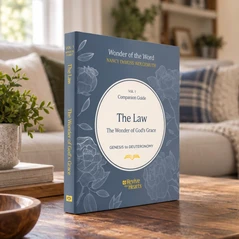
It’s time to really get excited for the Wonder of the Word kick-off in January. We’re starting with a deep dive into our first series of six, "The Law: The Wonder of God’s Grace." To go along with that series, we’ve got a gorgeous and oh so useful companion guide for you. You are gonna LOVE this resource. Inside, you’ll find:
- An introduction to the Law and its place in the whole of Scripture.
- A book overview for Genesis, Exodus, Leviticus, Numbers, and Deuteronomy, covering authorship, themes, and gospel connections.
- Daily content for all forty-four episodes of Season 1, with a prayer prompt, reading options, and the day’s “Big Idea.”
- And last but not least, space to record your own notes, responses, and life lessons as you go.
You can go ahead and order your copy now in the Revive Our Hearts store, and I hope you will! There’s a link in the transcript of this program at ReviveOurHearts.com.
One more special reminder before we go! Tomorrow is the last day to register for True Woman '27 at super early pricing. You’re gonna want to take advantage of that, so don’t wait! Visit TrueWoman27.com to find all the conference details you might need, and then grab your tickets.
Next week, join us as we fill our minds with the truth together. In a world that tries to convince us that truth is whatever we make it, we need the message of real truth more than ever.
Please be back for Revive Our Hearts.
This program is a listener-supported production of Revive Our Hearts in Niles, Michigan, calling women to freedom, fullness, and fruitfulness in Christ.
All Scripture is taken from the CSB.
1Thomas, Derek. Isaiah: God Delivers. Welwyn Commentary Series. Darlington: Evangelical Press, 1993.
*Offers available only during the broadcast of the podcast season.
Available Now for Your Donation

Resources Related to this Episode
Questions Answered in This Episode
After thirty-nine chapters of judgment, Isaiah 40 opens with God’s tender words, “Comfort, comfort my people” (Isa. 40:1), reminding us that discipline is never the end of the story. Because our sin has been pardoned through Christ, God has already prepared comfort for every affliction we will face.