
Dannah Gresh: Revive Our Hearts is brought to you, in part, by members of the Revive Partner Team, friends like Lisa.
Lisa: Revive our Hearts was a lifeline for me when I was going through a particularly difficult time. I am thankful that they are focused on the Word of God, helping me to stay grounded in the truth. Their excellent resources have helped me to grow in the faith, and it is a joy to partner with them, so other women can also be pointed to Christ.
Dannah: Thank you, Lisa, for partnering with us. We’re sooo grateful for you!
Not too long ago, Missy Schrader had a late-night realization. Those tend to be the best, don’t they? Here’s what she discovered.
Missy Schrader: I woke in the night pretty recently with this thought, Your nearness is my good,. It was in …
Dannah Gresh: Revive Our Hearts is brought to you, in part, by members of the Revive Partner Team, friends like Lisa.
Lisa: Revive our Hearts was a lifeline for me when I was going through a particularly difficult time. I am thankful that they are focused on the Word of God, helping me to stay grounded in the truth. Their excellent resources have helped me to grow in the faith, and it is a joy to partner with them, so other women can also be pointed to Christ.
Dannah: Thank you, Lisa, for partnering with us. We’re sooo grateful for you!
Not too long ago, Missy Schrader had a late-night realization. Those tend to be the best, don’t they? Here’s what she discovered.
Missy Schrader: I woke in the night pretty recently with this thought, Your nearness is my good,. It was in my head. So I was like, “What even is that—‘your nearness is my good’?” I get up in the middle of the night, go to my computer, and Google it. It is Psalm 73. This is what it says:
Whom have I in heaven but you?
And earth has nothing I desire besides you. . . .
As for me, it is good to be near God. (vv. 25, 28)
And guess how that last line is translated in some versions? “Your nearness is my good.”
Dannah: This is the Revive Our Hearts podcast with Nancy DeMoss Wolgemuth, author of A Place of Quiet Rest, for June 3, 2026. I’m Dannah Gresh.
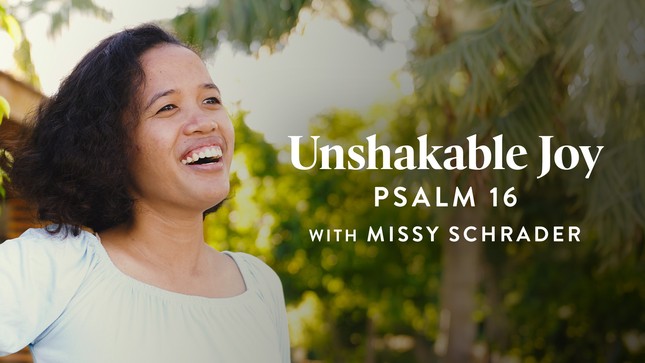
Today and tomorrow, we’re answering a big question: “How do I experience joy when I’m suffering?” We all have to grapple with this, and we have a special guest to help us do that—Missy Schrader. She’s one of two beloved daughters of Robert Wolgemuth, who went to be with the Lord in January.
Missy shared this message from Psalm 16 with the women of her church not long before her father passed away. I’m excited for you to hear her wisdom, and to hear a little of her dad in her as well.
Missy: I want to start by telling you a story. When I was about five years old, I was playing in the cul-de-sac with the neighbor kids, and my dad was in our backyard trimming rose bushes. He tells this story, so I checked with him to make sure that my details are correct.
So, he’s working on his rosebushes and he sees little five-year-old Missy run through the backyard, open the back door and shout, “Mommy!?”
And I would hear her say, “Yes, Missy. I’m here.”
And then I would shut the door and happily skip back to play.
And then a few minutes later, he would see me run through the backyard, open the door, “Mommy!?” “Yes, Missy. I’m here.” And then I would shut the door and skip happily back. I kept doing this.
So he started to get curious, and he followed me. As he followed me into the cul-de-sac, he saw that I was playing with the “big kids,” and we were playing hopscotch. I didn’t know how to play!
So when it would be my turn, they would laugh at me instead of teaching me how to play. (I know! Isn’t that so sad?!) And so I would feel insecure, and I would run to my back door, open the door and shout, “Mommy!?” When I heard that she was near, then I would be able to go back happily to play.
What did my little five-year-old heart need? What was I looking for? Security! Safety! I knew Mom. I knew she was “safe.” I knew she loved me, so the assurance of her presence settled me, brought me safety and security and then joy, and I could go back and play.
Maybe David felt a little bit like this when he wrote Psalm 16. He was in trouble. . .We don’t know what his trouble was. We don’t know exactly what he was facing at this time. But his unsettled soul began begging the Lord to keep him safe and to protect him.
He was experiencing “big kids” insecurity and fear. Just like my little five-year-old self knew, in order to be settled, I needed to know my mom was near. David tells his soul the truth about who God is, in order not to be shaken by his trouble.
As we dig into Psalm 16 today, here is a question we’re going to look at: How do I experience joy when I’m in distress? So let’s read it together; you have it printed in front of you, and this is the NIV version of Psalm 16.
And let me just say, I love Jesus so much! Do you know what He did? I hadn’t done this whole Bible study before we chose our psalm. So I prayed, “What psalm do you want me to teach on, Lord?” I felt like doing Psalm 16. That was His answer.
And then this week in our contentment study, what do we study? Psalm 16. And at first I was like, “Ahh! She stole my psalm!” But then I was like, “No, this is perfect!” Maybe you have a little understanding before we dig into together. Okay, are you ready?
Keep me safe, my God,
for in you I take refuge.
I say to the Lord, “You are my Lord;
apart from you I have no good thing.”
I say of the holy people who are in the land,
“They are the noble ones in whom is all my delight.”
Those who run after other gods will suffer more and more.
I will not pour out libations of blood to such gods
or take up their names on my lips.
Lord, you alone are my portion and my cup;
you make my lot secure.
The boundary lines have fallen for me in pleasant places;
surely I have a delightful inheritance.
I will praise the Lord, who counsels me;
even at night my heart instructs me.
I keep my eyes always on the Lord.
With him at my right hand, I will not be shaken.Therefore my heart is glad and my tongue rejoices;
my body also will rest secure,
because you will not abandon me to the realm of the dead,
nor will you let your faithfulone see decay.
You make known to me the path of life;
you will fill me with joy in your presence,
with eternal pleasures at your right hand.” (vv. 1–11)
Let’s pray. Oh, Lord, will You calm and open our hearts to hear from You today? Please, Holy Spirit, show us the treasure in Your Word as we study together. “May the words of my mouth and the meditations of my heart be pleasing to You today” (Psalm 19:14). In Your precious Name, amen.
What we are going to answer is this: How can I experience joy when I am in distress? And here’s our answer (it seems long, but we’re going to unpack it): Like David, I can move from feeling troubled to being joyful when I know God and experience Him as my refuge, my treasure, and my Lord—both in His nearness now and in the hope of His presence forever!
Okay, so let’s start reading. We’re going to go verse-by-verse. David starts with a prayer, “Keep me safe, O God!” This plea for safety can also be translated as, “preserve my life, guard me, save me, protect me!”
Again, we don’t know what David is facing in order to feel unsafe and vulnerable, but we know he is feeling this way. But he knows where to go with these feelings, doesn’t he? He cries out honestly in prayer.
We begin our psalm and we see David experiencing all that we’ve studied in our Psalms study. Let’s think about it. He’s feeling fear. He’s waiting; he’s lamenting and he’s desperately seeking contentment. Isn’t that so cool?
Let's keep reading. “For in you I take refuge . . .” (v. 1).Other translations say, “In you I trust.” Often in the psalms—I love this—David speaks to his soul. It’s like he says, “I’m feeling afraid and unsafe! Oh my soul, you know the truth! You are safe when you hide in God! You can trust Him!”
I had a counselor say to me one time, “Don’t listen to yourself. Talk to yourself!” And that’s what we see in lamenting. We have permission to do the same thing. This is just what David is doing.
This psalm reminds me of Psalm 62; look at what David says to his soul here:
Yes, my soul [you see, we can practice this] find rest in God;
my hope comes from him.
Truly he is my rock and my salvation;
he is my fortress, I will not be shaken. . . .he is my mighty rock, my refuge.
Trust in him at all times . . .
pour out your hearts to him,
for God is our refuge.” (vv. 5–8)
In Psalm 62, what does David tell his soul about God? That He’s a rock, “My mighty Rock!” I love that—a fortress, a refuge, a shelter from storms and danger, a place of hiding.
David knows this about God and he tells his soul to find rest in Him, and, ultimately, to trust Him at all times, even in this troubling time David is facing when he writes Psalm 16. So let’s go back to it.
In David’s troubled state he asks for protection, and he reminds himself of who God is. David can move from feeling troubled to being joyful because he knows and experiences God as his—what?—refuge! That’s first.
Now before we go on, I want to highlight that I have in our answer, “knows and experiences.” There is a difference between knowing and experiencing. I may “know”someone onInstagram, I may “know” someone on Facebook, but do I really knowthem intimately? There is a difference.
It is possible for us to know something in our head about God—“Yes, I know God’s my refuge”—but it’s a completely different thing to have that knowledge moved to our heart where we experience Him as our refuge. Does that make sense? So, not just “know,” but know.
One definition of “refuge” is “shelter or relief from danger and anxiety.” Think about when you have experienced God as your refuge in trouble, as your shelter or relief from danger and anxiety.
If God does not take away a difficult or scary circumstance, how does His being your refuge change your feelings in that trouble? Let’s look at verse 2: “I say to the Lord, ‘You are my Lord; apart from you I have no good thing.’”Oh ladies, this part is so good, I can hardly handle it!
David moves from feeling troubled to feeling joyful because he knows and experiences God as his refuge–he’s hiding there–and (read it with me), his treasure! David said, “You are my highest good!” If David compares any good that he has to God, all fall short. Nothing compares to Him!
It’s like David says to God . . . Think if you know a little person; they would say it like this: “You are my goodest good!” You are my treasure. What are some things that we can think are our “goodest good?” David is declaring, “You, Lord, are my goodest good!”
As I’ve been preparing and praying about our time together, I woke up in the night pretty recently with this thought, Your nearness is my good. It was in my head. So I was like, “What even is that—‘your nearness is my good’?” I got up in the middle of the night, go to my computer, and Google it. “Hmm. . .” It is Psalm 73.
This is what it says. Whom have I in Heaven, but you and Earth has nothing I desire besides you. As for me, it is good to be near God. And guess how that last line is translated in some versions? “Your nearness is my good.”
David’s greatest treasure, his best good, is being near God! Being in His presence is His greatest desire. David says here, “Earth has nothing I desire besides You!”
I like to learn, sometimes, by “flipping,” or looking at the opposite. So if we flip that sentence, what would we say? “God is everything my heart truly desires and delights in.” Isn’t that exactly what we studied this week in Psalm 23? We learned that He gives us everything we need.
To be near God truly is our greatest good. When David experiences God as His refuge, he is near Him, isn’t he? He’s protected by Him? We can experience this nearness, too, and we can declare with David, “Your nearness is my good, being in Your presence is my greatest treasure!”
I want you to think about someone whom you love to be with, and it doesn’t even matter what you’re doing! My first thought, when I was thinking about this, was my daughter. We can be folding laundry, we can be doing the dishes, we can be playing with the kids on the floor, we could be walking on the beach, we could be getting pedicures (those last two things don’t happen very often), we could be in the grocery store. It doesn’t really matter. Can everybody think of someone like that?
Well, what is the true delight? It is the person that you’re with, right? It doesn’t even really matter what you’re doing. It’s the same idea here. No matter what is happening, even if it’s troubling, if we’re near Him we can feel safe and secure. Even as we’re going to see later in this psalm, it’s joyful! This reminded me of walking in the Spirit, delighting, “doing life,” being near, being guided, experiencing that intimacy. That is our greatest good!
Let’s continue reading, verse 3. David looks at two groups of people and talks to God about them:
I say of the holy people who are in the land,
“They are the noble ones in whom is all my delight.”
So first David sees those who love God and he says he delights in them. It would be like if we said now we have a love for the Body of Christ. He delights in fellowship with people who love God.
Next, David looks at those who are not God's people, verse 4:
Those who run after other gods will suffer more and more.
I will not pour out libations of blood to such gods
or take up their names on my lips.
Look at the phrase, “run after.” I listened to Tim Keller’s sermon on this psalm. He talked about that phrase “run after” is the word “pant.” David sees those who are godless panting, wanting for, seeking for life in things other than God. He knows the truth about their future.
Do you see what it says? “[They] will suffer more and more.”Other translations say, “Their sorrows will increase.” It may seem like their lives are easier now, but it will be unhappy for eternity. I’m curious if David contrasts these two groups because his decision to follow God—to delight in Him, to know Him, enjoy His nearness—is not making his life easier now!
Maybe it appears that those who are godless are experiencing prosperity and safety while David is in distress. So he talks about these wicked people again in Psalm 37. Here’s what he says:
I have seen the wicked and ruthless man
flourishing like a green tree in its native soil. (vv. 35 NLT)
It’s kind of like, “That’s not fair!”
But he soon passed away and was no more. (v. 36 NLT)
In Psalm 73, verse 12, David laments that it seems like the “wicked are carefree and rich” . . . “[until] I entered the sanctuary of the Lord and understood their final destiny” (vv. 12, 17).
Is this true for us today? Sometimes it seems like the ungodly are flourishing, but David knows their ultimate future! This eternal perspective keeps David holding onto the truth that only God is truly good.
So, he keeps hiding in God as his refuge and delighting in Him as his treasure. He says, “I won’t worship those idols or even say their names!” David Guzik says:
David knew that his life lived for God was not an easy one. He experienced many hardships because he remained faithful to God. Nevertheless, he also knew that life lived for another God was [what?] even more difficult.
Let’s keep reading. After he contrasts the godly versus the godless, again he speaks truth to his soul about who God is. Verses 5-6 of Psalm 16:
Lord, you alone are my portion and my cup;
you make my lot secure.
The boundary lines have fallen for me in pleasant places;
surely I have a delightful inheritance.
“You alone are my portion and my cup.” Does that seem to echo, “I have no good thing apart from You” (I might even draw an arrow on my paper!) You are my treasure; Your nearness is my good!
There’s a new layer of what David knows about God here, though. David can move from feeling troubled to feeling joyful because he knows and experiences God as his refuge, his treasure and his Lord. Look back at verse 2, what does he declare? “You are my Lord.”
Numbers 18:20:
The Lord said to Aaron, ‘You will have no inheritance in their land, nor will you have any [portion] among them; I am your [portion] and your inheritance among the [people of Israel].
David reminds himself as he prays, “You alone are all I need—my treasure. You alone are my portion and my cup.” And there’s more here. David declares to the Lord, “What I have is what You have said is best for me.” Some versions say, “You have assigned my portion and my cup” (CJB).
“You are my treasure and my Lord.” He says, “You provide what You think I need.” David is declaring to the Lord, “I am content with what You have portioned me.” Because, ultimately God is all he needs. He is his portion and his cup. He is all that will satisfy.
He assigns our marriage, our bodies, our health, our children, our homes. It’s what He says is best. Elisabeth Elliot said,
Nothing brings greater security and quietness to the soul that in everything God works for the "good of those who love Him, who have been called according to His purpose."
The portion assigned to me each day is precisely measured by God. My cup may have a bitter taste. Shall I suppose then that my Father either has nothing to do with choosing my portion, or that He is not dealing with me in mercy and grace?”
Such thoughts are from our "ancient foe who seeks to work us woe!" It is the Lover of our soul who hands me the cup of suffering, giving me the priceless privilege of learning a fellowship with Him which can be learned in no other way.
How many of you have experienced that? What the Lord has allowed into your life has drawn you into deeper intimacy than you ever could have experienced any other way. I see your heads nodding. What a privilege! Elisabeth Elliot knew and experienced God as her Lord.
Kay Arthur says, “Every disappointment, even if it’s tragic and evil, is His appointment.” I may not like His appointment or agree with it, but God is in charge. Nothing happens apart from His permission. He is the ultimate authority, the ultimate cause and He has the ultimate responsibility for all that goes on!
That’s why He commands, “In every thing give thanks: for this is [God’s will for you] in Christ Jesus” (1 Thess. 5:18). If we experience God as our Lord, how do we see our circumstances? How does knowing that the Lord assigns our portion and cup, and makes our lot secure, change our perspective?
Dannah: What a great question to pause and ponder today! That’s Missy Schrader, teaching from Psalm 16.
I am already loving summer in the Psalms. In case you haven’t heard, we’re spending the month of June just soaking in this sweet book together here on Revive Our Hearts. This is an invitation to rest in the Lord’s presence. I hope you feel that this month.
It’s also an invitation to dive back into Bible reading if you’ve begun to neglect that a little bit. It’s easy to do that as the warmer months approach and schedules become a little more fluid!
If you’ve been reading with us and you’ve fallen behind, don’t worry! We’re beginning Psalms next week, and this is a really sweet time to reset. I hope you will if that’s something you need. Visit ReviveOurHearts.com/Bible2026 to join the community if you haven’t already.
Now, if you need some further motivation, I want to remind you of what Nancy DeMoss Wolgemuth said. Actually, I’ll just let you listen to her:
Nancy DeMoss Wolgemuth: Read your Bible! You can read it through in a year. It's a hike, it's an effort, it's not easy. But do you know that if you would read for just about twelve minutes a day, you can read through the whole Bible in one year?
What do you do for twelve minutes a day that maybe you could do without and read through your Bible in a year? If you don't love reading, or maybe that's not easy for you, get an audio version of the Bible. There are plenty of apps for that.
Listen to it being read. I love listening to my audio Bible on my phone as I'm getting ready in the morning, doing my makeup, my hair. I will often listen to whatever I'm getting ready to teach. I will listen to it and read through it. Get through it however you need to.
Now, you may feel like, "I just don't understand it." Well, the effect of Bible reading, meditation [and] study is cumulative over time. You have to do it to get more out of it. I just want to tell you (and I'm saying this to myself too), if we would spend half the time that we spend scrolling on our phones each day, or doing other mindless activities, to read and ponder the Bible, over time we would come to know the Word. We would come to understand it better. We would be changed. You see, the more you read it, the more you will understand it.
And you think, Well, I don't really love it. I'd rather scroll. I'd rather watch Instagram reels or do something that's more entertaining to me. Let me tell you this: the more you eat the Word of God, the more you take it into your system, the greater appetite, hunger, and longing you will have for the Word.
So that's my first point: read your Bible. Read it. Read it. Read your Bible! Then a second, I don't want to call these suggestions; I really want to call them strong recommendations. Read it daily. Read it daily!
I saw a study where eighty thousand people were polled between the ages of eight and eighty. So you probably fit in that demographic. The survey was about what happens when people read the Bible.
And here's what they found out: when people engaged with the Bible in some way—even if it's opening the Bible during their pastor's preaching and he says, "Open to Psalm 119.” But they engaged with the Bible one time a week, there was almost zero difference that was measurable in their life.
If they read it twice a week or engaged with it twice a week, it was the same thing. There was almost indiscernible difference in their lives. If they read it or engaged with it three times a week, they noticed in these surveys a small change—not too much—but a small change.
But what shocked researchers was what happened when they found out that people had read the Bible four times or more each week. The results were staggering!—the difference between one, two, or three times, and four times or more! Listen to these poll results (and this was eighty thousand people who were polled):
- Loneliness went down 30 percent.
- Anger went down 32 percent.
- Bitterness in relationships, down 40 percent.
- Alcoholism, down 57 percent.
- Sex outside of marriage, down 68 percent.
- Feeling spiritually stagnant, down 60 percent.
- Viewing pornography, down 61 percent.
- But (listen to this!) four times or more a week reading, engaging with the Word, sharing their faith went up 200 percent.
- Discipling others went up 230 percent.
Frequent reading of the Bible changes your life. It does!
Dannah: Amen to that! You can listen to that full message. It’s linked in the transcript at ReviveOurHearts.com. To help you soak in Scripture, we’re offering you Nancy’s book, Dwell: 30 Days with God in the Psalms for a donation of any amount.
It’s the perfect companion to our program lineup this month, and we hope it will help quiet your heart, especially if your summer schedule is looking a little chaotic. To give and request a copy, visit ReviveOurHearts.com, or call us at 1-800-569-5959.
Tomorrow, we’ll hear the second half of Missy’s message. She’ll begin by unpacking this beautiful statement from King David: “The boundary lines have fallen for me in pleasant places. Surely, I have a delightful inheritance” (Psalm 16:6). By God’s grace, you and I can say the same thing. We’ll learn more about what that means tomorrow.Please be back for Revive Our Hearts!
This program is a listener-supported production of Revive Our Hearts in Niles, Michigan, calling women to freedom, fullness, and fruitfulness in Christ.
All Scripture is taken from the NIV unless otherwise noted.
*Offers available only during the broadcast of the podcast season.