
Grace for Careless Words
Dannah Gresh: Have you ever sinned with your mouth and wish you could take it back? Nancy DeMoss Wolgemuth says you can be free from that shame.
Nancy DeMoss Wolgemuth: There’s grace for sinners. There’s mercy for failures. There’s the blood of Christ for our evil, wicked, sinning hearts and tongues.
Dannah: This is the Revive Our Hearts podcast with Nancy DeMoss Wolgemuth, author of Brokenness: The Heart God Revives, for July 16, 2025. I’m Dannah Gresh.
Today, Nancy’s continuing in a series called “The Power of Words.” Before we hear from her, I want to quickly let you know that today kicks off our summer Bible study sale! This is your opportunity to gear up for fall Bible study season and grab some excellent resources at discount prices. Head on over to ReviveOurHearts.com/summer to shop!
Now, here’s Nancy.
Nancy: We've been talking the …
Dannah Gresh: Have you ever sinned with your mouth and wish you could take it back? Nancy DeMoss Wolgemuth says you can be free from that shame.
Nancy DeMoss Wolgemuth: There’s grace for sinners. There’s mercy for failures. There’s the blood of Christ for our evil, wicked, sinning hearts and tongues.
Dannah: This is the Revive Our Hearts podcast with Nancy DeMoss Wolgemuth, author of Brokenness: The Heart God Revives, for July 16, 2025. I’m Dannah Gresh.
Today, Nancy’s continuing in a series called “The Power of Words.” Before we hear from her, I want to quickly let you know that today kicks off our summer Bible study sale! This is your opportunity to gear up for fall Bible study season and grab some excellent resources at discount prices. Head on over to ReviveOurHearts.com/summer to shop!
Now, here’s Nancy.
Nancy: We've been talking the last several days about the tongue. But I don't know if you have felt as uncomfortable as I have at points about what we've seen in the book of Proverbs.
Some of what I've seen I kind of wish wasn't in there because it is so hard to look in that mirror, the Word of God, and see, "This is the way God views the words that I speak."
We've talked about words that are harsh or rough, words that are untrue, words that are too many, words that are tearing others down rather than building them up. And I experienced a lot of conviction.
Now I know some of you have shared with me that that's been the effect in your own heart as we've looked into the Word of God.
Now that conviction can do one of two things. It can either make you depressed and you leave here wishing you had never come. Or it can point you to Christ and take you to the cross and become a means of getting release from the guilt and a change of life.
I have a little devotional book that I read sometimes. You may be familiar with it. It's called Daily Light. And each day it has readings for the mornings and readings for the evenings that are just verses right out of the Scripture. No comment, just verses right out of the Scripture.
And I just have to share with you what this morning's reading said in the Daily Light. As I read through these verses early this morning, I thought, Though this does not talk specifically about the tongue this really gives us a guideline, these verses give us a guideline about how to respond to conviction of God's Spirit about any area of our lives.
So I want to apply it to what we've been experiencing as God's conviction in relation to our words and our tongues.
The heading at the top is a verse from Lamentations 3:40 that says "Let us search out and examine our ways, and turn back to the Lord." The searching, the introspection is not meant to lead us to discouragement or defeat. It is meant to lead us to repentance. That is why conviction from the Holy Spirit is a good thing. The goodness of God brings us to repentance.
And it is good that God would give us His Word. It is good that God would give us these challenges and these convictions. If you have never experienced conviction when you read the Word of God, then you need to ask yourself this question, "Am I child of God?
Because if you are a believer you will experience conviction when you hold up the Word of God to your life even as we've been experiencing in these sessions. And the next verse in this reading comes from Psalm 26 where the psalmist says "Examine me, O Lord, and prove me; [Try me.] Try my mind and my heart."
The psalmist is opening his mind up to God, as we have been trying to do during these days, and saying, "God, I want You to search my heart. I want You to examine me. Give me a test."
We've been in the Proverbs and Proverbs has been administering a test about our tongues. And some of us feel, in fact how many of you would say, "I feel like I have really failed this test as we've been in the Proverbs"?
Almost every hand is up and the ones who didn't have their hands up didn't understand the question. We've been taking a test and when you hold your life up to the Word of God, we are all failures apart from the transforming, sanctifying work of the God's Spirit in our hearts. But the starting place for change is to let God search us.
And then this reading goes on to say, this time with a verse from Psalm 51:6 "Behold, You desire truth in the inward parts, and in the hidden part You will make me to know wisdom."
We've been talking during this series about wisdom—wisdom versus foolishness. Proverbs talks many times about the mouth of the wise, the tongue of the wise, the lips of the wise, the words of the wise. It also talks about the mouth and tongue of the foolish. We want to have wise hearts. We want to have wise tongues. And we've spoken about the matter of truthfulness, speaking truthful words rather than deceptive ones.
And so if we want to progress in Christlikeness as it relates to our tongues, we need a good dose of honesty, not just speaking words that are true but also being honest about what God shows us is in our lives.
It's so easy when the conviction comes to justify or to rationalize, "Well, my tongue isn't as bad as "so and so's." "At least I don't talk the way my kids talk." And to blame others and to put the responsibility on others. "I wouldn't talk this way if my husband didn't talk the way he talks to me."
That is not taking personal responsibility. And the challenge of God's Word is to be truthful in our inward parts and to know wisdom in our hidden parts, to be honest with God about what God shows us is in our innermost parts.
And then the passage goes on to say, this one out of Psalm 119:59, "I thought about my ways." That is a good thing to do. When God speaks to us to stop and think about our ways, to ponder what God is saying.
So many times we hear a message at church or we read something in our quiet time or we come to one of these sessions and we hear something on Christian radio and we say, "Yes that's right." But we just go on to the next thing. And we don't stop to let the convictions settle in.
The psalmist says, "I thought about my ways." And then what did he do? He repented. He says, "I "turned my feet to your testimonies." That changed my course. That changed my direction. "I made haste, and did not delay to keep Your commandments." There is obedience.
So God has been convicting us. We've been letting Him search our hearts. We want to have a repentant heart, which is to turn around, not to go on justifying the way we have been using our tongues. But now we want to take responsibility for the way we've been using our tongues. And now we need to obey and to trust God to give us the power of His Holy Spirit to obey in areas where we could never obey on our own.
Now this passage in the Daily Light inserts a verse that at first seems a little out of place but it is not at all. It is from 1 Corinthians 11:28. "Let a man examine himself, and so let him eat of that bread and drink of that cup."
Once you examine yourself and you let God examine you and you see the corruption, the wickedness, the foolishness that is in your heart, how are you going to get free from that? It's just who I am.
That is where the guilt can just settle in and weigh down upon you and be oppressive until you go to the cross.
"Let him eat of that bread and drink of that cup." What is it saying? Take communion. Go to Christ. Flee to Christ for refuge, for grace, for forgiveness. That's what the cross is about. It's the Body of Christ broken for us. It's the blood of Christ shed for us on the cross. It is our only hope when God shows us the needs in our lives.
So the reading goes on to say "If we confess our sins, He is faithful and just to forgive us our sins, and to cleanse us from all unrighteousness" (1 John 1:9). Confess it. Agree with God what He has shown you about it. It might help you to find someone else—maybe your husband or another believer—that you can go to after this session and say, "Here's what God has shown me about the needs in my life as it relates to my speech, my tongue."
Confessing it first to God and then even horizontally being honest with each other about what God has shown us, it is a step of humility. And if we confess our sins to Him and we agree with God about what He has shown us, He will forgive. Because of what Christ has done for us, He will cleanse us from all unrighteousness.
I found myself praying this morning, "Lord, wash me with the water of Your Word. Wash my heart; wash my tongue; wash me from the inside out that my life may be pure. How can that happen? Only through the cross and the redeeming sacrifice of Christ.
This reading in the Daily Light picks up on that thought by turning us to the Book of 1 John and then Hebrews. "We have an advocate with the Father, Jesus Christ the righteous. And He Himself is the propitiation for our sins" (1 John 2:1–2).
Now that is a big word, technical, theological word that most of us don't use in everyday conversation. But it means simply that through Christ's sacrifice on the cross, He satisfied the just wrath of God against my sin. He bore the penalty. He paid the price. He satisfied God's wrath so now I no longer have to bear the wrath of God for my wicked, foolish heart and words. And now He is in heaven being my advocate. He is pleading for me. He is interceding for me. He is taking up my case with God.
It's not because I have any righteousness. It's not because I can say pure things, that I can say all the right things. I mean well, but chances are, before I get out of here, I'm going to have opportunity to sin with my tongue. So what do I do. I've failed. I've blown it.
Some of you are sitting here making resolutions and purposing that you will never yell at your husband again, you will never yell at your kids again, you will never speak a cross word again. I am just telling you, "You will." And when you do, you need someone who is going to plead your case before the Father, who is going to say, "Father accept My righteousness." That is the righteousness of the Lord Jesus and His righteousness can then cover us, cleanse us and wash us.
So the writer to Hebrews says "Therefore having boldness to enter the Holiest by the blood of Jesus" (Hebrews 10:19). Can you imagine, by the way, after what we've seen about our hearts and our tongues that we could come boldly into the presence of a holy God? Is that awesome?
After the conviction and the sense of guilt and failure and foolishness that weighs in upon us, now we are told that we should have boldness to enter the holiest place, the presence of God. How? By the blood of Jesus. "By a new and living way which He consecrated for us, through the veil, that is, His flesh, and having a High Priest over the house of God. Let us draw near with a true heart in full assurance of faith, having our hearts sprinkled from an evil conscience [sprinkled with the blood of Christ] and our bodies washed with pure water [the water of the Word, the water of the Spirit" (Heb. 10:20–21)
So I want to encourage you. There is grace for sinners. There is mercy for failures. There is the blood of Christ for our evil, wicked, sinning hearts and tongues. Lay hold of it and give thanks for it.
Dannah: Nancy DeMoss Wolgemuth will be back to lead us in prayer. She’s been giving us so much hope. If you sin with your words, you can be forgiven. Jesus never sinned with His mouth, but He took the punishment you and I deserve.
What does it look like to repent from habits of sinning with our tongues? I was thinking about who might help us with this. I thought of my friend, Kimberly Wagner. She's the author of a book titled Fierce Women: The Power of a Soft Warrior. We'll put a link to the book in the transcript of today's program.
Kimberly, welcome back to Revive Our Hearts. You are a frequent guest and a well-love name here.
Kimberly: Good to be with you, Dannah and all of the ROH crew. I just love you guys.
Dannah: Well, we love you, and we love your husband, LeRoy. And that brings us back to your book, Fierce Women. You were pretty transparent in there about your fierceness needing to be bridled because you had attitudes and words that were impacting your marriage? Tell us about that.
Kimberly: Yeah, I sure did, Dannah, and I am so thankful for God's grace to wake me up to that, because, like so many women, I kept blaming him for our marriage issues. I had a wake up call that came from the Lord, thankfully, to open my eyes to a lot of things, but especially my mouth, how I was using my words.
And sometimes Dannah, it wasn't so much the words I was saying, but the tone that I conveyed that in. I've coined a phrase for what I did to my husband and can do to other people. I realized I was what I call a "shame dispenser," not a "grace dispenser,"—not a soap dispenser, but a shame dispenser.
I did not even recognize I was doing that because I was guilty of what's called a passive-aggressive attitude sometimes, or tone that verbalizes things unintentionally. But it comes across that you're incompetent, or you're inferior to me. It could be as simple a thing as saying something to LeRoy like, "Why did you turn the thermostat down so low?" Or something like, "Did you really think that shirt was the best one to choose to be in public in?" You know, just things that we as . . . What am I the only wife that . . .?
Dannah: And maybe he did need to change his shirt. Right? Like last night, my husband was walking out to a board meeting, and he had a big old splash on his shirt. But there's a right way to say it, and there's a wrong way to say it. Right? You can say, "Hey, babe, I want you to look your best tonight, so you might wanna change that shirt." Or I could say, "Do you really think you should be wearing that? So at some point, no, you're not the only one.
Kimberly, that's the answer to your question. You're not the only one, but at some point, you did see that you were this shame dispenser. You did see that you were crushing his spirit. Tell us about that turning point.
Kimberly: I recognized it, really, because he changed. He started becoming really depressed and quiet. I no longer saw him laughing or smiling. There was this wall that was erected between the two of us, and because of that, for about at least a decade were living almost like roommates in our isolation of one another. We were both wounded and hurting because of that dysfunctional relationship.
I am so thankful for God's Word. There was a combination of things, like God is so good to do. He had various things He was bringing into my life to confront me on the issue of my tongue—Nancy's teaching being one. But also, I'm thankful for the practice of being in the Word daily. Because even though I wasn't using my mouth like I should, I was living with a pretty hard heart toward my husband, I still was in the Word and God used a little phrase in Titus chapter 2, verse 5.
We call it the biblical portrait of womanhood. We're told in Titus 2:3–5, starting with verse 3, it tells us that we need to love our husbands and children. Isn't that interesting? We're instructed to love them. Why would we need to be instructed to do that? Well, we do. As you read through that passage, the very last phrase says we need to love our husbands, our children "so that the word of God will not be blasphemed" (is what the King James Version says). Other versions say "reviled."
When I was reading that phrase, it was like the Holy Spirit, opened my eyes to the fact that the way I talk to my husband, the way I treat him, that is tied to me displaying the truth about God, me glorifying God, me showing others. If I claim to know Christ, I claim that the Word of God is true and powerful and able to transform me into a new creation, and yet I talk to my husband in a way that is demeaning, that is hurtful, even cruel at times. Then, others are not going to see Christ in me. That is like I'm saying, "You know what? The Word of God really isn't effective. It isn't what I claim for it to be."
Dannah: Wow. Kimberly, how's your marriage today? How's your tongue honoring and loving your husband today?
Kimberly: Oh, don't make me cry now. I cannot adequately convey to you how grateful I am for God's stepping in so many decades ago and changing my heart—first of all toward my husband, and then breaking that pattern, that communication pattern that we had developed. I talk about this in Fierce Women quite a bit. I share more.
But where we are today, since 2015, ten years ago, LeRoy began developing an illness. He lives with two debilitating diseases, and I'll just tell you, Dannah, I am so grateful that the Lord had already rescued us from that destructive communication pattern that we had developed. We often have said, "Wow, we can't imagine what it would be like if God hadn't already developed life-giving speech between the two of us long before he became ill, because, of course, today, I am not a shame dispenser to him.
How can you say something cruel to a person who's physically afflicted and suffering daily? But and I'll confess this every morning, every morning, when I start my prayer time, I'm always asking God to do the Ephesians 4:29 work in my heart and my mouth, that there will be no unwholesome or cruel word come out of my mouth that only such a word as is good appropriate for the need of the moment and that I will give grace and blessing and benefit to those who are listening. And also James 1:19–20, that I would be quick to listen, that I would be a good listener for my husband or anyone else I'm speaking with, and that I would be slow to speak, to pause and think, which is something I never did as a fierce young woman,
Dannah: You're the right kind of fierce now.
Kimberly: Ah, thank you, friend. Dannah, you are as well. I love watching how God's using you and using the True Girl movement. I love it.
Dannah: Thank you, my friend. Hey, what advice do you have for the woman who's listening and she's saying, "I am damaging my husband. I am a shame dispenser." Where does she start to begin to use her words to build him up instead?
Kimberly: She starts with going to God about her heart issues, because that's where it begins . . . in the heart. You know, I heard you and Suzy speaking about this last week. She mentioned the book of James as well, and she mentioned how this is a heart issue and that you can't pull yourself up by your own bootstraps to change how you're speaking.
One thing I've learned that's so vital to me in my walk with the Lord is not only do I need to be in His Word daily meeting with Him, asking Him to search my heart, because I don't know my own heart. I ask Him to open my eyes to anything going on, any blind spots, sinful attitudes that I need to confess. And then in order to repent and turn from those things, I need to do something that Romans 8 talks about.
There's this valuable tool in Romans 8:13 where Paul tells us how to put to death those fleshly things that we struggle with. You know, Paul himself in the chapter before talked about, "I don't do everything that I want to do or should do." And then He gives us a key in Romans 8:13, where he says, "It is by the Spirit of God that we put to death these works of the flesh." It's by the Spirit of God that I'm able to bridle my tongue, like James talks about.
So that looks like this for me, Dannah, in a practical way. Yes, beginning the morning in prayer, asking God to do the Ephesians 4:29 work on my tongue and in my heart. But then when I'm talking to people, something the Lord has taught me to do is have a silent prayer while I'm talking. I'm asking the Holy Spirit, "Give me ears to hear and fill my mouth with words You have for me to give. Whether they're life-giving words, hopefully gospel-centered words, I need You, Holy Spirit, to do that work in me and through me."
Dannah: Love it. You say that so beautifully and so eloquently, Kimberly. I'll tell you how I pray that prayer. When with my tongue I'm feeling that fleshly desire, I just say, "Jesus help!" That's my prayer. Two words, "Jesus help!"
Kimberly: Oh, that's great. That's great, and that's quicker.
Dannah: Thank you so much for being with us today, Kimberly, and thank you for being an example that we can be formed and fashioned by the power of the presence of Christ and His gospel truth so that we are wives that have kind tongues, that lift up our husbands and not crush their spirits.
Kimberly: You are welcome. Good to be with you. Love you all.
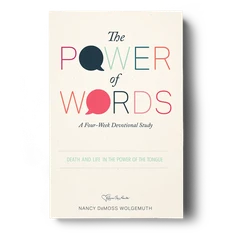
Dannah: Maybe you can relate to Kimberly. Maybe your words are not giving glory to God, and you’re ready to learn to speak differently. If so, Nancy’s booklet, The Power of Words, may be the perfect addition to your bookshelf. It goes right along with this series and includes reflection questions to help you take what you’re learning and apply it to your life. Right now when you make a donation of any amount, we’d like to send you a copy to say thank you. Just visit ReviveOurHearts.com, or call 1-800-569-5959 to give and request The Power of Words.
Can a wife’s encouragement transform her relationship with her husband? Yes! Kimberly Wagner’s a testimony to that fact, and tomorrow we’ll hear from a wife name Margaret who found her words were often negative. She’ll share how making a conscious choice to change how she spoke to her husband changed things.
That’s tomorrow on Revive Our Hearts. Now, here’s Nancy to pray.
Nancy: What an incredible thought, Father, that I could come into Your presence this day knowing the things that I've said, and worse than that, the things I've thought, and I could come before You and speak to You. You invite me to come, and You tell me to come boldly, not because of my righteousness, but because of the righteousness of Christ.
Thank You for washing me by faith. I thank You for that. Thank You for cleansing my heart afresh this day. Thank You for Your mercy and Your grace and Your forgiveness. Thank You for the blood of Jesus Christ that covers and removes all my sin. I worship You. I praise You with my lips in Jesus' name, amen.
This program is a listener-supported production of Revive Our Hearts in Niles, Michigan, calling women to freedom, fullness, and fruitfulness in Christ.
1 Daily Light on the Daily Path is a Christian daily devotional scripture reading published by Bagster & Sons about 1875. It has been reprinted continually since then. Nancy uses the one adapted by Ann Graham Lotz.
All Scripture is taken from the New King James Version unless otherwise noted.
*Offers available only during the broadcast of the podcast season.