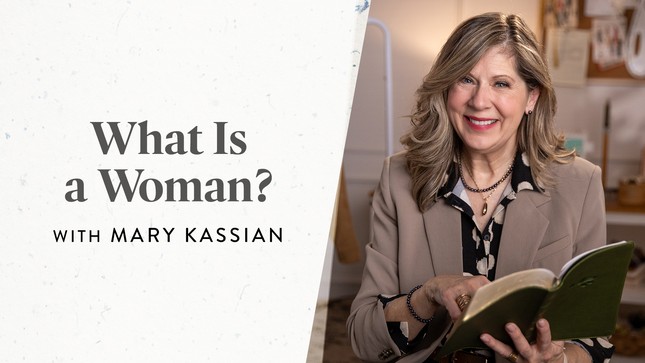

Dannah Gresh: Hollywood paints feminine women as frail, weak, and deficient, but is this true? Here's Mary Kassian.
Mary Kassian: The God who measures the seas in the hollow of His hand, the God who calls stars by name, He looks at women with a gentle, soft, feminine spirit and says, "This is what I treasure."
Dannah: This is the Revive Our Hearts podcast with Nancy DeMoss Wolgemuth, co-author of True Woman 101, for July 16, 2026. I'm Dannah Gresh.
It's time for episode four of our series, “What Is a Woman?” Here's Mary Kassian.
Mary: I was once in a fight, and it wasn't just a mild skirmish. It was an all-out, fist-swinging, shin-kicking, arm-twisting, knockdown WWE-type brawl. And the fight was with my brother Gordon, who is three-and-a-half years older than me.
Our parents were out for the evening, and we were …
Dannah Gresh: Hollywood paints feminine women as frail, weak, and deficient, but is this true? Here's Mary Kassian.
Mary Kassian: The God who measures the seas in the hollow of His hand, the God who calls stars by name, He looks at women with a gentle, soft, feminine spirit and says, "This is what I treasure."
Dannah: This is the Revive Our Hearts podcast with Nancy DeMoss Wolgemuth, co-author of True Woman 101, for July 16, 2026. I'm Dannah Gresh.
It's time for episode four of our series, “What Is a Woman?” Here's Mary Kassian.
Mary: I was once in a fight, and it wasn't just a mild skirmish. It was an all-out, fist-swinging, shin-kicking, arm-twisting, knockdown WWE-type brawl. And the fight was with my brother Gordon, who is three-and-a-half years older than me.
Our parents were out for the evening, and we were assigned to do dishes. There was no electric dishwasher in our house, so he washed and I dried. We started squabbling about something, as middle school siblings will do. I can't remember what we were bickering about, but I do remember the wisecrack that roused my fury and pushed me over the edge.
"What do you know?" he sneered. "You're just a weak, sissy girl."
Well, that was it.
I threw down the dish towel, raised up my fists, and challenged him to a duel. No one was going to call me a weak girl. It was the ultimate insult.
I hated dresses, hated pink. I wasn't a girly girl. Anything remotely feminine made me want to hurl, and I certainly wasn't weak. I could climb a tree. I could hit a baseball. Anything the boys could do, I could do better.
And the smug, amused look on my brother's face infuriated me. I was going to school him. No one was going to get away with calling me weak. No woman likes to be called weak, especially not by a man.
So I wonder what women in the early church thought when Peter instructed husbands in 1 Peter 3:7, "Live with your wives in an understanding way, as with a weaker partner."
What? Weaker partner? Can you imagine? In our current cultural moment, that phrase would get Peter canceled and doxed in five seconds flat.
Is being weaker an insult, or is this describing something real and beautiful about how God made us? That's what I want to explore today.
In this series we've been unpacking a definition of womanhood. “A woman is God's living masterpiece, handcrafted in His image, intentionally created female, fashioned with softness and relational beauty.” And that's the phrase we're focusing on today.
Some of you just felt your defenses go up. “Softness? I'm not soft. I'm strong. I'm capable. I'm no pushover.”
I get it. I really do, because I spent years resisting anything that smacked of traditional femininity. But here's what I've learned: softness isn't a sign of frailty or deficiency. It's not a liability. Let me show you why.
When the Lord presented the first man with his wife, the man burst into a delighted poetic exclamation over his beautiful new counterpart. That's in Genesis, the second chapter.
“Then the LORD God made the rib He had taken from the man into a woman and brought her to the man. And the man said, ‘This one, at last, is bone of my bone and flesh of my flesh; this one will be called “woman,” for she was taken from Man’" (vv. 22–23).
Now Adam gave Eve a Hebrew name that was both a clever play on words and a profound revelation." This one will be called woman—isha—for she was taken from man—ish."
Man, woman—ish, isha. The sound is nearly identical. The Hebrew word for woman simply adds a feminine ending to its word for man, but the two words have complementary meanings.
Many scholars believe that ish comes from a root meaning strong, while isha comes from a root meaning soft. So, Adam was celebrating something he noticed immediately: man strong, woman soft.
His body designed to initiate, to move toward, to pursue. Her body designed to welcome, to draw in, to respond. Perfect counterparts, different expressions of the same image of God.
Now, here's what's remarkable. God didn't make your body soft and then tell you to be hard. He designed woman, head to toe, inside and out, for softness, and it's not just skin deep.
Your body carries more adipose tissue than a man's, distributed in curves that speak femininity. Your skin has more subcutaneous fat, creating that smooth, gentle texture. Even your muscle tissue is structured differently, more pliable, more flexible, whereas a man's is dense and rigid.
Your face tells a story too: more gentle contours, softer angles, a more delicate architecture that's unmistakably feminine.
And in the most intimate moments of marriage, this design becomes crystal clear: masculine strength giving, feminine softness receiving, united as one flesh.
But here's what matters most. Your physical softness isn't random, it's a signpost. The visible points to the invisible. God wrote softness into your body because He wove it into your soul.
Now, our culture has declared war on softness. Turn on any action movie and you'll see it. Female characters who've stripped away every hint of softness to become men in women's bodies. They punch, they kick, they kill without flinching. The only thing that distinguishes them from male characters: tighter costumes, false lashes, and better hair.
Hollywood's message couldn't be clearer: real strength looks masculine, and if you want power, erase your femininity.
But is softness truly devoid of power?
Just consider water for a moment. You can't get much softer than water. It yields, it flows, it bends around obstacles, and yet, given enough time, water cuts through granite. It shapes coastlines. It carves the Grand Canyon.
Stone is hard and impressive, but water, water sustains every living thing. It cleanses wounds. It satisfies thirst. It makes deserts bloom. The power is in the softness.
Or think about the steel magnolia, that distinctly southern image of a woman who somehow manages to be both delicate and indestructible at the same time. Sweet, but with a spine of iron. Gracious, but fierce when it matters. Gentle in matter, but absolutely unwilling to be pushed around.
You don't have to choose between softness and strength. You can be both. That's the femininity God designed. Not fragile weakness, not doormat passivity, but soft strength, which is the most formidable kind.
This kind of strength knows when to bend and when to hold firm. It's gentle with hurting people, but fierce in the face of evil.
Just look at Abigail facing down an enraged David and his four hundred armed men. She didn't cower, but she didn't come out swinging, either. She came with humility, with wisdom, with provisions, and respect. Her softness disarmed what weapons couldn't touch. She prevented a massacre through gentleness. That's power.
Or the Proverbs 31 woman. Strength and dignity are her clothing, but kindness is on her tongue. She works with capable, vigorous hands, but she opens her mouth with wisdom and gentle instruction. Soft and strong. Both. Always both.
So, what do I mean when I say soft?
I mean the tendency for women to be more yielding, while men are more firm.
More gentle, while they are more forceful.
More tender, while they are more tough.
More peaceful, while they are more purposeful.
More cooperative, while they are more commanding.
A feminine disposition has a different texture to it than a masculine one. It's not less than, it's just different.
And here's what you need to understand: being different doesn't make you inferior, it makes you necessary, complementary, beautifully, purposefully distinct.
Now, some of you are still wrestling with this, because soft feels like capitulation, like weakness, like everything feminism taught us to reject. And maybe soft just isn't a word you'd use to describe yourself. You're bold, you're direct, you get things done.
Now, personality differences are real, and God made you that way. But softness isn't a personality type. It's woven into your femininity. So hear this: God doesn't just tolerate your softness, He treasures it.
Here's why: it reflects His own character. Scripture describes God as compassionate and gracious, slow to anger, abounding in steadfast love, patient, tender, longsuffering. Those soft qualities are at the very heart of God.
And Jesus said about Himself, "I am gentle and lowly in heart" (see Matt. 11:29). Gentle. Not harsh, not domineering, not aggressive. Gentle. He even used maternal language: longing to gather Jerusalem as a hen gathers her chicks (see Matt 23:37).
And listen to what Jesus said about His approach to those who are broken. He won't break a bruised reed or snuff out a smoldering wick (see Matt 12:20). He's tender with the wounded, careful with the fragile, soft with the suffering. The fruit of the spirit: love, joy, peace, patience, kindness, goodness, gentleness, self-control (see Gal. 5:22–23). Nearly all of them soft qualities.
So, when the world mocks softness as weakness, when culture dismisses gentleness as outdated, when feminism tells you to harden up, remember this: God looks at a woman with a gentle, quiet spirit and says, "This is precious to me, very precious."
Your softness isn't a bug in the system, it's a feature. God's tenderness flows through both His sons and His daughters, but He created women to display it in a uniquely feminine way.
Now, let's talk about that phrase that makes modern women's blood pressure spike: the weaker partner. In 1 Peter 3:7, it says, "Husbands . . . live with your wives in an understanding way, as with the weaker partner," or weaker vessel, "showing them honor as coheirs of the grace of life."
Now, notice what Peter does here. He doesn't say weaker to diminish women, he says weaker to elevate how men should treat them.
So think about it this way. If I handed you two items, a plastic melamine plate and a piece of fine china, which one would you handle with more care? The china, right? Like your grandma's heirloom china. Not because it's less valuable, but because it's more valuable. It's more precious. It's more worthy of careful, gentle handling.
A woman is not a man. She's not one of the guys, and that's Peter's point. He's not insulting you. He's commanding men to treat you like the treasure you are. And watch what comes right after: “as co-heirs of the grace of life.”
Equal, not inferior, not less than. Co-inheritors of God's grace. Same standing, same value, same inheritance, different design, equal worth.
And here's what's stunning. The same passage that tells men to honor women as the weaker partner also tells women what God values most in them. Listen to 1 Peter 3, verses 3 and 4:
"Don't let your beauty consist of outward things like elaborate hairstyles and wearing gold jewelry or fine clothes, but rather what is inside the heart—the imperishable quality of a gentle and quiet spirit, which is of great worth in God's sight."
Great worth.
The God who measures the seas in the hollow of His hand, the God who calls stars by name, He looks at woman with a gentle, soft, feminine spirit and says, "This, this is what I treasure."
The world dismisses it. Culture mocks it, but God, He celebrates it. Your femininity isn't something to apologize for, it's something God prizes. And when I say femininity, I'm talking about your inner being, not your wardrobe.
Softness doesn't mean you're a doormat.
It doesn't mean you never stand up for what's right.
It doesn't mean that you're passive in the face of evil or injustice.
Softness means having the wisdom to know when and when not to bend. It's feminine strength exercised with gentleness and grace and backbone.
But softness is only half the story. The other half is relational beauty, and this is where something distinct about women comes into focus.
Just think about the last conversation with a close friend that you had. You didn't just exchange information, you connected. You shared feelings. You talked about what was happening in your hearts. That instinct that pull toward relational depth, that's not cultural conditioning, that's divine design.
Before God created woman, He said something revealing. He said, "It is not good for man to be alone. I will make a helper fit for him."
Now, notice that word: “for.”
Woman was created for man. Before you bristle, just hear me out. This isn't about ownership or utility. The preposition points to “relationship, toward, with reference to, in connection with.”
Paul makes the same point in 1 Corinthians 11. He says, "Man was not made from woman, but woman from man. Neither was man created for a woman, but woman for man" (v. 9 ESV).
She was created for him, built with someone else in view, oriented toward relationship from the very first moment of her existence.
Now, that doesn't mean a woman needs a man to be complete. It means something deeper. It means that woman is wired for connection in a way that man isn't. Relationship isn't something she adds to her life, it's woven into the fabric of who she is. She was made for others, made to turn toward, made to connect.
Now, personality matters here. Some of you are introverts, and some are naturally more reserved, more self-contained. You may not be the woman who loves a crowd or craves constant conversation. But even the most introverted women tend to have a few significant relationships. The capacity for deep connection is there. It just expresses itself differently.
Men tend to find their identity in what they do. Women more often find it in who they love and who loves them. Forming bonds, nurturing friendships, creating community, these aren't peripheral to femininity, they're central to it.
And here's what's fascinating: God wired this into you biochemically. You produce oxytocin, the bonding hormone, at significantly higher levels than men. When you hug someone, connect deeply in conversation, or comfort a hurting friend, nurse a baby, that oxytocin floods your system, creating bonds at a molecular level. And this isn't accidental. God engineered you for relationship. He wove it, He coated it into your very DNA.
Your brain even reflects this. Women's brains have more neural connections between the right and left hemispheres than men's brains do. You're literally wired to pick up on relational dynamics, read emotional cues, notice what's happening beneath the surface.
This is why you can walk into a room and sense the tension nobody's talking about.
This is why you remember not just what was said, but how it was said and what it meant.
This is why you can carry on five different text conversations, track the emotional state of each person, remember what they told you three weeks ago, and keep track of all the family events posted on the refrigerator.
It's not magic, it's design.
And just like your softness reflects God's tender character, this relational capacity reflects something profound about who He is. God Himself is relational—Father, Son, and Holy Spirit existing in eternal communion, perfect relationship, perfect love.
He created you for fellowship with Him, and He designed you to long for deep connection, because that longing ultimately points you toward Him, toward the one your heart was made for.
But here's where this gets personal, because that deep relational capacity, as beautiful as it is, can become dangerous if it's not rooted in the right place.
If you've ever felt suffocated by a relationship or found yourself desperately clinging to someone who can't carry that weight, that's what happens when a God-sized longing gets aimed at a human-sized heart. If you've ever lost yourself in trying to make someone love you the way you want to be loved, same thing.
That relationship-shaped void in your heart, it's real. But here's what you need to understand: no human relationship, not your husband, not your children, not your best friend, can fill that void. Not because they're failing, but because they were never meant to.
Augustine said it this way: "You have made us for yourself, O Lord, and our hearts are restless until they rest in you."
That relational hunger you feel, it's meant to drive you to Jesus. He's the only relationship that can bear the full weight of your longing. He's the only One who will never let you down, never leave, never stop loving you.
And here's the freedom: when you find your deepest satisfaction in Him, you can finally love others rightly. You can connect without clinging. You can give without demanding. You can perceive needs without losing yourself in meeting them.
And this is where your relational design finds its true power, not in making relationships your god, but in letting God transform how you relate.
So where does this leave you?
Maybe you've spent years trying to prove you're just as tough as the guys. Maybe you've been told that femininity is weak and women who aren't fiercely independent are simply needy.
Here's what I want you to hear: God fashioned you with softness and relational beauty, not as limitations, as gifts. Not as weaknesses, as strengths.
You don't have to choose between tenderness and strength. Remember the steel magnolia. You're designed to be both. Soft strength is real strength.
Just ask any woman who's ever walked someone through the darkest night of their life or stood firm for what's right without becoming hard in the process.
You don't have to apologize for prioritizing relationships. That's not a flaw, it's how you reflect the relational God who made you for Himself.
And you don't have to make independence your highest goal. Our culture worships self-sufficiency—the woman who needs no one and answers to no one, but God designed you for others, for community, for connection.
God made you a woman on purpose. The tenderness, the relational capacity, the gentle strength, it's all good, all exactly as He intended.
You don't prove your worth by erasing your femininity. The world dismisses gentleness as weakness, but God, He calls it precious, very precious.
So, what would it look like to embrace how God made you fully and unapologetically?
Your softness isn't a liability. Your relational capacity isn't a flaw. They're a gift. So, embrace them. Your womanhood isn't something to tolerate or transcend, it's something to celebrate, because when you embrace God's design, you discover something remarkable. The things the world dismisses as weakness are the very things that God treasures most.
I started today by telling you about that fight with my brother, and here's how it ended. And, spoiler alert, it did not go so well.
At first, he just dodged, amused by his little sister's fury. I swung harder, and I caught him square on the nose, and that's when he started fighting, and that's when I started losing fast. Soon I was a sobbing, enraged mess on the floor.
So our older brother who was downstairs heard the commotion, and he stormed in, and he grabbed Gordon by the neck, and he shouted, "How dare you hit your sister?"
And through tears, I choked out what had started it all. "He called me a weak, sissy girl."
Well, Bert looked at me, exasperated and not a bit amused, and he said, "Well, you better figure out that you are a girl."
And he was right. I am a woman, and just like God fashioned my body as a woman, He fashioned my heart for connection and for tenderness. That's not weakness, that's design. His design. And His design is always, always good.
A woman is God's living masterpiece, handcrafted in His image, intentionally created female, fashioned with softness and relational beauty.
That's not an insult, it's not a limitation. It's a calling, it's a glory, and it's very precious to God.
Dannah: That’s Mary Kassian, reminding us that our softness and relational tendencies are gifts from God to embrace.
Mary talks about these topics even more in her book, What Is a Woman? The Question Our World Is Afraid to Answer.
So, if today's conversation resonated with you, you're going to want to add that to your bookshelf. It's available exclusively at ReviveOurHearts.com. We're offering Mary's book for a gift of any amount this month, so go make a donation at ReviveOurHearts.com, or call us at 1-800-569-5959, and be sure to request your copy of What Is a Woman? If you live outside the U.S. or Canada, you'll get a digital copy.
And know this: when you donate, you not only receive this incredible resource, you also help content like you heard today reach farther until women around the world can answer the question, "What is a woman?" with confidence.
Now, we talked a lot today about the ways God made us for relationships. Women are uniquely equipped for connection. What if you could use this gift to serve women's ministry leaders and pastors' wives in your area with the Revive Our Hearts Ambassador Program? You can when you apply to become an Ambassador, you'll be equipped to cheer on women's ministry leaders in your community, supporting them through prayer and encouragement. If this sounds exciting to you, visit ReviveOurHearts.com/ambassadors to learn more.
Tomorrow, Nancy DeMoss Wolgemuth is sharing more about the True Woman Manifesto. What does it mean to develop virtue by being rather than doing? You'll have to join us to find out. Please be back for Revive Our Hearts.
This program is a listener-supported production of Revive Our Hearts in Niles, Michigan, calling women to freedom, fullness, and fruitfulness in Christ.
All Scripture is taken from the CSB unless otherwise noted.
*Offers available only during the broadcast of the podcast season.
Available Now for Your Donation

Additional Resources
Questions Answered in This Episode
Biblical femininity reflects God’s intentional design for women and is marked by qualities such as gentleness, relational strength, and inner beauty that honor Him.
No. Scripture presents gentleness, humility, and relational beauty as godly strengths that reflect God’s wisdom and character rather than signs of weakness.
God values a woman whose life reflects His design through a gentle spirit, godly character, and love for others. Inner beauty and Christlike character have lasting value that goes far beyond outward appearance.