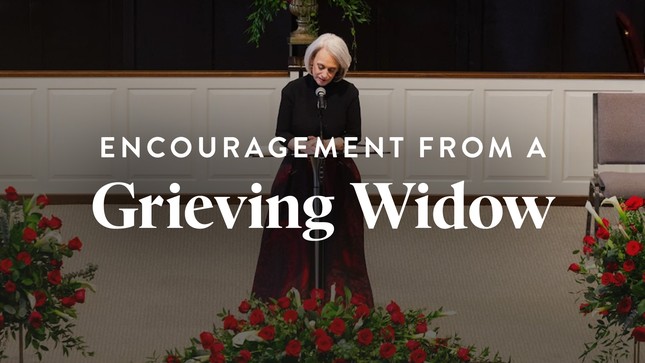

Dannah Gresh: For Nancy DeMoss Wolgemuth, grieving her husband’s passing has been hard, but her confidence in the Lord is unwavering.
Nancy DeMoss Wolgemuth: I don't have a shred of doubt that God is good and that God is faithful, that He's kind, that He can be trusted to write my story. At times I doubt my ability to hold fast to Him, but I don't doubt His ability to hold fast to me.
Dannah: This is the Revive Our Hearts podcast with Nancy DeMoss Wolgemuth, co-author of book she wrote with her late husband, Robert Wolgemuth, You Can Trust God to Write Your Story, for August 26, 2026. I’m Dannah Gresh.
Friend, are you grieving the death of a loved one? Do you know someone who is? Today’s program is for you. You’re in for a . . . not a treat, so much as …
Dannah Gresh: For Nancy DeMoss Wolgemuth, grieving her husband’s passing has been hard, but her confidence in the Lord is unwavering.
Nancy DeMoss Wolgemuth: I don't have a shred of doubt that God is good and that God is faithful, that He's kind, that He can be trusted to write my story. At times I doubt my ability to hold fast to Him, but I don't doubt His ability to hold fast to me.
Dannah: This is the Revive Our Hearts podcast with Nancy DeMoss Wolgemuth, co-author of book she wrote with her late husband, Robert Wolgemuth, You Can Trust God to Write Your Story, for August 26, 2026. I’m Dannah Gresh.
Friend, are you grieving the death of a loved one? Do you know someone who is? Today’s program is for you. You’re in for a . . . not a treat, so much as a holy privilege.
You know, Ecclesiastes chapter 7 says:
It is better to go to a house of mourning
than to go to a house of feasting,
since that is the end of all mankind,
and the living should take it to heart.
Grief is better than laughter,
for when a face is sad, a heart may be glad. (vv. 2–3)
Today we’re spending some time in a house of mourning.
As you may know, Nancy’s husband Robert Wolgemuth went home to be with the Lord in January of 2026. It happened pretty suddenly, and Nancy, who had been married to Robert for only ten years, found herself in the midst of grief and lament like she’d never known before.
We’re about to listen to something she shared with the Revive Our Hearts' staff only four months after Robert’s death.
Let me set this up for you. Every year, Revive Our Hearts reserves some time for staff to seek the Lord together in a more concentrated way. We call it our Staff Summit. Sometimes we travel from all over the world to get together. This year, in May of 2026, we did it virtually. We met in a massive zoom call to hear messages from God’s Word, to reflect on God’s goodness, and to encourage one another. Pastors Chris Brooks and Trent Griffith, along with Steve Canfield, all helped us get our eyes on Jesus. You’ll hear Nancy refer to a few things they shared.
During our time, Nancy also spoke. So let’s listen now what she shared with the Revive Our Hearts' staff, just four months into her widowhood. You may need a tissue. I hope you’re encouraged.
Nancy: Today I was asked to share just an update on how I'm doing and what's happening in my life.
This team, this family, has been so amazing to be praying for me and with me. I've so sensed the presence of Christ and His grace as we have walked together, are walking together. There's a lot of gratitude. So many things that were shared this morning speak to my life in a different way today than they might have just a few months ago.
This week was the fourth month marker since the Lord took Robert home. There is also a lot of gratitude this week. Thursday is our month anniversary—fourteenth of every month. May 14 is also the day that I came to know Jesus in 1963. So, if my math's correct, I think that will be sixty-three years of walking with Jesus.
There are these highs and these lows; these sweet things and these hard things. I so related to that passage Steve pointed us to from Psalm 96 about the earthquakes, and him pointing back to that earthquake when the Lord took the founder of Life Action Ministries home.
That was a huge earthquake in my life. I was, I think, just 30 at the time. I look back, and I see how God met with me and met with us over those next months and years. But for sure, then and now, those earthquakes do upset the status quo . . . and status quo in my life has been turned upside down and inside out.
One of the questions after Trent's message was, "Where do you feel unsure, confused, or mentally fatigued?"
And I'm going, "Yes, yes, yes."
“Have you experienced loss?”
Yes, and in a different and greater way than ever in my life before. But I also think about how many times I have said and we have said to the people we're ministering to and to each other, anything that makes me need God is a blessing. And, it's true. It's true whether we feel it. It's true whether we don't feel it.
And so, as I look over these months, and how I reflect on them varies from day to day and from one part of the day to another part of the day. You've maybe seen me write in social media about these waves—waves of grief, waves of grace, and waves of gratitude. Sometimes it feels like it's more one than the other. Sometimes that wave of grief feels like it's taking me under, but then often those waves are intermingled with each other, and one comes on top of the other, and one gives way to the other.
I think my biggest concern would be if I were only seeing waves of grief, but I'm seeing all three every day in different ways. I've experienced waves of all of those in different ways in the past, but I've never experienced grief in this way.
It's a good thing to lament. It's a good thing to acknowledge loss.
I've ministered to many, many, many widows. I've stood at grave sites with people burying a child or a mate or a parent. I've walked through people confessing things to each other. I've walked a lot of people through a lot of hard things in person, and then of course, through our ministry, we're doing that every day.
But there's something really, I want to say, good about experiencing that grief myself in a deeper way than I have before. I think about all the widows I've talked to. One of them was here at our recording just a couple of weeks ago. Shortly after the Lord took Robert home, this friend from out of town (I don't know her that well) sent me a text that I had sent her years ago when her husband died. She said, "This is the best thing I know to say to you. It's what you said to me."
So, I've said those things. I've shared those things—heartfelt truth, encouragement, grieving alongside of others. But to experience it yourself in a deeper way, it's broadening my heart. It's helping me care.
I won't see widows in the same way moving forward that I have in the past, which has not been bad how I've seen them. I mean, the things you've experienced that I haven't experienced, I can’t know. So it's God who writes our story. He knows what experiences He wants to use and take us through. But to sit alone at times, or with others on a Zoom call, and weep, it's something about our humanity, our humanness, our frailty, our weakness.
This world is broken. It's not what it was intended to be. It's not what one day, by God's grace, it will be. This is all part of what grief does and brings into our lives. So grief strangely becomes a subject for gratitude. I don't know how to explain that, but you've experienced it. It becomes a means of grace because it's God seeing and hearing and knowing things I can't even figure out myself, but pouring out grace.
He says He poured out grace on the humble. Well, to be humble is to say I can't do this. I need you, Lord.
I just want to assure you that as unsteady and still grieving, I never know quite when sometimes I can be clearer headed and clearer tongue, and then other times it's like it's gone. But I want you to know that there is grace and there is gratitude with the grief.
I reflect a lot on what are the things that are carrying me and sustaining me and that gives me hope. It's the things we talk about every day in this ministry. It's the things we tell others. It's the way we respond to people's emails. It's what we know. But it's what gets tested in the fire and in the earthquake. It's the Word of God. It's truth. It's what God has revealed to us.
I was thinking this week that hymn. “How firm a foundation, ye saints of the Lord, is found for His saints in His excellent Word.” His Word is everything I've always told people it is. Everything I've known it to be and discovered it to be is true. It is rich. It is pure. It is good. It is faithful because it's got God behind it. It's God's Word, and it is a firm foundation for those who are His.
So I'm learning one day at a time, one moment at a time, to counsel my heart according to truth from God's Word. I’m learning to speak to myself—even my doing this here—saying these things to you. That is a way of speaking to myself. It's saying things that I know to be true, even when I don't feel them to be true, but acknowledging that they are true—not because I feel them, but because God is God.
It's learning to speak those things to others. I loved what, I think, Pastor Chris Brooks said about the safety of covenant community. I have experienced that in this place, with this team, with other friends and family members, with our pastor and his wife.
I remember Joe and Becky coming and sitting here on this couch where I'm sitting today, and for three hours on Joe's day off several weeks ago, to weep together, to talk together, to provide a safe place where I don't have to be somebody who's put together, or who knows the answers, or who's got it figured out. I don't have to be the public speaker. But to be able to say, “Here's what's going on in my heart.” To walk through those things in the company in the safety of covenant community.
I will tell you, years ago I shared with a friend a season in which I was clinging to grace and hanging on for dear life to Christ in a difficult season of my life. I found out probably a year later that conversation had, from that person’s perspective, tanked their own faith. I didn't know it for a very long time because the assumption was, “If Nancy can't walk through this, if this is a struggle for her, what chance do I have of being able to walk through hard things myself?”
That was a sobering thing for me. I just want to say to you, I want you to know that in all of this, in my heart there's not a moment of doubt after now sixty-three years of knowing and walking with Christ. I don't have a shred of doubt that God is good and that God is faithful and that He is kind. He can be trusted to write my story.
Yes, there's grief. Yes, there's heartache. Yes, there's at times confusion and not knowing how to put one foot in front of the other. I doubt myself at times, but I don't doubt Him. At times I doubt my ability to hold fast to Him, but I don't doubt His ability to hold fast to me.
To, especially a younger believer or younger person, I just say to you, “I know grief is messy and life is messy, but God is not messy. God is good.” I just want to keep affirming that for your sake and for mine as well.
And then something else that is sustaining me, and it will help you as well in different ways at different times, is future grace. We spell it H-O-P-E, hope. Not like I hope it won't rain today. But hope that's this solid, steadfast assurance of something coming that is unlike what we're experiencing now, even the best of what we're experiencing now.
I mean, I hope that most of us in this call today are not in the throes of deep grief at the moment, though that's fine too. You may be, you may not be, but no matter where we are, the best is yet to come.
So, for us not to place our hope in what we see today or what we're experiencing today, but in what we know is a solid, secure future ahead of us. Like one of the characters in Tolkien’s Lord of the Rings thinks about the day when “everything sad will come untrue.”
As I'm getting ready to teach through the rest of Isaiah . . . I’ve spent months in this book now. I’ve taught most of it. In a high view, there's been a lot of judgments and warnings and sin and idolatry and mess and the prediction of the coming Babylonian takeover and exile. It's messy! But as you come to those final chapters, which is the part I'll be teaching next week, there's so much promise, so much hope, so much glory!
That word "glory" or “glorious” are used, I don't know, fifteen to twenty times more in those last seven chapters. There's glory promised. As I've been studying those passages, I came across a phrase that’s new to me. Maybe you've heard it before. Tolkien is the one who coined this term.
I don't know if anybody else uses it in their writing, but he wrote a book on fairy tales and the plots of fairy tales, where this theme has been used. You'll find it in movies and literature of different kinds. It's the term “eucatastrophe”—e-u catastrophe.
You'll see that word eu in the Greek is “good.” Like eulogy—to speak well of. So he takes the word “catastrophe,” which is something dismal, something hard, something broken, something messed up, something that catches you off guard. In that sense, Robert's death was a catastrophe. Those weeks in the hospital, what I'm experiencing now, it feels catastrophic. It's that earthquake.
Tolkien talked about the eucatastrophe, the good catastrophe. How can a catastrophe be good? It's that promise, that hope that the time is coming when everything broken will be radically, dramatically changed. He talks about how this eucatastrophe in our lives, or in plots in literature or movies, it's not the person going through the catastrophe that turns it to good. It's an infusion of grace from the outside that comes and changes the whole situation.
So it's this dramatic, radical change that turns. It’s where everything sad becomes untrue, where everything old becomes new, where the broken is fixed. It's a redeeming God who is making all things new. We don't see it yet, but we know by faith that it is coming. So we walk in that faith, and that's how grace and gratitude overwhelm our grief.
We're in the now, but not yet. We have glimpses of it, glimpses of glory. But we are still here in our tears and dying bodies and sad things and hard work and tough relationships and tears and brokenness. So what do we do now?
Well, we walk and we live with our hearts firmly planted in His Word, in safe community with one another, where we can say what's going on in our hearts to the Lord and to others as best we know how. But we also live with this unquenchable hope of the great eucatastrophe to come, knowing it's not far off.
I'm almost 68. For me, it's closer than ever. For you, it's closer than ever, even if you're 28. We don't know the days we have, but we know that a breath away, a moment or two from now, the Man on the white horse appears from heaven, or our bodies are resurrected, or we're taken up in the rapture, or whatever your eschatology tells you . . . We know the moment is coming when faith turns to sight, prayer turns to praise, and there is this great, massive eternity ahead of us with no more sorrow, no more sickness, no more dying, no more tears.
I read yesterday somebody saying (I think it was one of those great dead guys who used to preach great things) that, “Five seconds from the time we're in heaven, or less, we'll be saying to each other, ‘Cancer, terrorism, what was that? Hmm, I kind of vaguely remember, but never mind. Let's move forward.’” These things will be past. Then ahead of us we have this whole, great, glorious, amazing eternity—the eucatastrophe.
Because, “How firm a foundation, ye saints of the Lord; is laid for your hope in His excellent Word” and in Christ who has spoken that Word to us.
So, kind of in a mishmash, that's how I'm doing. That's what I'm doing with a lot of grief, a lot of grace, and so much gratitude for you and for Christ. I say that to say thank you to you and to Him. And, it's good; it's hard. But as Mark Vroegop reminds us, “Hard is hard, but hard is not bad.”
So thank you for letting me share my heart. Thank you for joining me and praying and seeking the Lord and waiting on Him.
The Lord clearly was done with Robert. He's not done with me. So I'm saying, “Lord, You’ve got more for me to do, whatever that is. I want to be faithful to it and finish the race, and run it faithfully all the way to my finish line however many weeks, days, months, or years that may be.” I love you guys. Thank you so much.
Dannah: That’s the sweet host of Revive Our Hearts, Nancy DeMoss Wolgemuth, sharing with the Revive Our Hearts' staff in May of this year, just a few months after Robert transitioned from this life to heaven. I warned you that you might need a tissue!
If you know anyone who would be encouraged by what Nancy said—maybe a widow or anyone who is deep in grief, feel free to send them a link to this episode. You’ll find it at ReviveOurHearts.com, or on the Revive Our Hearts app.
We also want to make available to you, a link to Robert's memorial service. It was truly full of the legacy of faith he left in his children and his grandchildren and in so many of us who called him friend. In fact, I was particularly blessed by one of his grandchildren who spoke at his funeral. He commented on how his grandfather discipled him, prayed for him, and left a legacy of faith. We'll put a link in today's program at ReviveOurHearts.com.
In fact, that reminds me, we’re making available to you a special resource from Revive Our Hearts this month. It’s especially for grandparents. Nancy’s friend Kimberly Wagner wrote 30 Days of Praying for Your Grandchildren. If you as a grandparent sometimes feel like your prayers get into ruts, this resource will help get you out of them.
Here’s how you can get a copy. Contact us with your donation, and when you give, request 30 Days of Praying for Your Grandchildren by Kimberly Wagner. In the U.S. or Canada, we can mail you a paper copy. If you live farther away, we’ll give you access to a digital copy. To make a donation, just go to ReviveOurHearts.com, or call us at 1-800-569-5959. Thanks so much for your donation; we truly do appreciate it.
How can an older woman spend her time in ways that build God’s kingdom? That’s something Susan Hunt will talk about tomorrow on Revive Our Hearts. Please be back!
This program is a listener-supported production of Revive Our Hearts in Niles, Michigan, calling women to freedom, fullness, and fruitfulness in Christ.
All Scripture is taken from the CSB.
*Offers available only during the broadcast of the podcast season.
Available Now for Your Donation
Additional Resources
Questions Answered in This Episode
Trusting God in grief does not mean the pain disappears. It means holding on to the truth that God is good, faithful, and kind even when His purposes are difficult to understand. When your strength feels weak, you can trust that He is able to hold you fast.
Grief can reveal how deeply we need the Lord. In seasons of loss, God invites us to bring our sorrow and lament to Him while depending on His presence, His promises, and His sustaining grace.
Christian hope is rooted in Christ and the promise of eternal life with Him. Sorrow over death is real, but believers can grieve with confidence that God remains faithful and that death does not have the final word.