
Dannah Gresh: Do you believe—really believe—God has forgiven you? Heidi Jenkins wants you to know . . .
Heidi Jenkins: “As far as the east is from the west, so far [has] he removed our transgressions from us.” And if you picture how far the east is from the west, arms just can’t open wide enough to even give us a picture of that!
Dannah: This is the Revive Our Hearts podcast with Nancy DeMoss Wolgemuth, author of Incomparable, for October 8, 2026. I’m Dannah Gresh.
God’s forgiveness. It’s a miraculous mercy. But sometimes, we have a hard time believing it’s for us. We’re like, “I’m sure God can forgive her, but me? I’ve sinned too deeply. I’ve strayed too far. It just feels too good to be true.” But it’s not, my friend—it’s not because of Jesus. That’s what we’re gonna see …
Dannah Gresh: Do you believe—really believe—God has forgiven you? Heidi Jenkins wants you to know . . .
Heidi Jenkins: “As far as the east is from the west, so far [has] he removed our transgressions from us.” And if you picture how far the east is from the west, arms just can’t open wide enough to even give us a picture of that!
Dannah: This is the Revive Our Hearts podcast with Nancy DeMoss Wolgemuth, author of Incomparable, for October 8, 2026. I’m Dannah Gresh.
God’s forgiveness. It’s a miraculous mercy. But sometimes, we have a hard time believing it’s for us. We’re like, “I’m sure God can forgive her, but me? I’ve sinned too deeply. I’ve strayed too far. It just feels too good to be true.” But it’s not, my friend—it’s not because of Jesus. That’s what we’re gonna see today.
First, Nancy DeMoss Wolgemuth is going to tell us about a precious name of Jesus—Lamb of God. Then we’ll hear the real life story of a woman named Heidi. At one point, she thought she was too far gone for God’s forgiveness, but it found her anyway and changed her life forever.
To kick us off, here’s Nancy DeMoss Wolgemuth.
Jesus, the Lamb of God
Nancy DeMoss Wolgemuth: Sacrifices, blood and lambs and all this stuff, it’s not part of our everyday life. It was part of the everyday life of the Israelites. And so when we get to chapter 53 that speaks into their culture their milieu as we have this prophecy of the Messiah suffering. And He is likened to a lamb.
Isaiah 53:6:
All we like sheep have gone astray; we have turned everyone to his own way; and the Lord has laid on him the iniquity of us all.
They were used to their iniquity being laid on the heads of lambs. But God's Word promises that there is One coming. There is a Suffering Servant coming—the ideal servant of the Lord, the Messiah. He is coming, and our iniquity will be laid on Him, the Lamb.
He was oppressed, and he was afflicted, yet he opened not his mouth; like a lamb that is led to the slaughter, and like a sheep that before its shearers is silent, so he opened not his mouth. (v. 7)
Now, every Jew knew this prophecy. They could quote it. They were familiar with it. And so you fast forward seven hundred years from the time when this prophecy was written and John 2 tells us that “the Passover of the Jews was at hand” (v. 13). More lambs being slain. More blood being shed.
And in that context, John 1 tells us that,
[John the Baptist] saw Jesus coming toward him, and said, “Behold, the Lamb of God, who takes away the sin of the world!" . . . The next day again John was standing with two of his disciples and he looked at Jesus as he walked by and [he] said, “Behold, the Lamb of God!” (vv. 29, 35, 36)
That was a stunning declaration to the Jews in that day. And it should be a stunning declaration to us because in that one sentence, “Behold the Lamb of God,” in that sentence is the whole heart of the gospel message in one sentence. “Behold the Lamb of God who takes away the sin of the world.”
The lamb symbolizes innocence and submission and vulnerability, quiet suffering and sacrifice. And here the Creator, the King of the universe, comes to this earth as a meek, humble, gentle, sacrificial Lamb. Innocent, blameless, He suffers quietly for sins not His own. He doesn’t resist.
The historian, Josephus, tells us that in the time of Christ that at the time of Passover there would be a quarter of a million Passover lambs that were slaughtered. And the blood of those lambs would flow out through viaducts down into the river, the brook Kidron.
As those lambs were being slaughtered on that Passover, a carpenter from Nazareth named Jesus was put to death on a hill outside Jerusalem as the blood of God’s Passover Lamb ran down from His hands and head and feet onto the ground below. And in that moment, Jesus, the Lamb of God, slain and slaughtered, fulfilled all those Old Testament types and pictures and sacrifices.
And so Paul tells the Corinthians “Christ, our Passover lamb, has been sacrificed” (1 Cor. 5:7). He was sacrificed once and for all, not repetitively like those lambs that were slain again and again and again. But now once for all and our works, our efforts, cannot add anything to what Jesus, the Lamb of God did for us there on the cross that day. That’s why Peter says,
You were ransomed . . . not with perishable things such as silver or gold, but with the precious blood of Christ, like that of a lamb without blemish or spot. (1 Peter 1:18–19)
But I want to remind us that that picture of Christ being the Lamb of God is not just something that is for our past tense salvation. The Lamb of God figures prominently in God’s future and eternal plans for His people. In fact, in the book of Revelation you have more than twenty-five references to Jesus as “the Lamb.” I wish we could take a whole session on just those. But let me just give you a taste of it over these next few moments.
The Lamb Who Conquers
We read in Revelation 5:
And one of the elders said to me [John, the apostle], “. . . behold, the Lion of the tribe of Judah, the Root of David, has conquered, so that he can open the scroll and its seven seals.” And between the throne and the four living creatures and among the elders I saw [not a lion but what?] a Lamb standing, as though it had been slain, with seven horns and with seven eyes, which are the seven spirits of God sent out into all the earth. (vv. 5–6)
The conquering Lion turns out to be a slain Lamb—the greatest paradox of history that Jesus conquered by His death. And what seemed to be a massive victory for Jesus' enemies at the cross turned into their ultimate defeat and the eternal victory of the Lamb. And so we see throughout the book of Revelation that the Lamb will defeat all of God’s foes, and He will bring judgment on unrepentant sinners.
Revelation 6:
Now I watched when the Lamb opened one of the seven seals, and I heard one of the four living creatures say with a voice like thunder, "Come!" (v. 1)
And thus begins a whole series of passages about judgment being poured out on the earth. It’s the Lamb who opens these seals, who reveals them and executes the judgment of God, the wrath of God on unrepentant sinners.
And then Revelation 6:15:
Then the kings of the earth and the great ones and the generals and the rich and the powerful, and everyone, slave and free, hid themselves in the caves and among the rocks of the mountains, calling to the mountains and rocks, "Fall on us and hide us from the face of him who is seated on the throne, and from the wrath of the Lamb." (vv. 15–16)
Could you imagine that a lamb could strike such terror into the hearts of all those big, famous, rich, powerful people? A lamb! It sends them running for cover and cowering and begging for the mountains and rocks to fall on them so that they can escape the wrath of the Lamb. The Lion is a lamb-like Lion, and He is a lion-like Lamb—Jesus, the Lamb of God.
Revelation 14:10 tells us that,
[Anyone who worships the beast] will drink the wine of God's wrath, poured full strength into the cup of his anger, and he will be tormented with fire and sulfur in the presence of the holy angels and in the presence of the Lamb.
Rev. 17:14: “They will make war on the Lamb . . ." All these kings of the earth will gather together. The beast, the dragon, all the forces of hell, and the people on earth who have followed Satan. They will make war on the Lamb.
Now, who would you expect to win a battle like that?
"They will make war on the Lamb and the Lamb will conquer them” Hallelujah! “The Lamb will conquer them for he is Lord of lords and King of kings" (17:14). A conquering Lamb. Slain from the foundation of the world for the sin of the world, to take away the sin of the world. And then the Lamb is the one who conquers, who executes the wrath of God, the judgment of God on unrepentant sinners.
The Lamb Who Saves
But we see something else, another thread running through Revelation: the death of the Lamb results in salvation—salvation and victory for the people of God. Unrepentent sinners, they’re consumed by the wrath of the Lamb, by the judgment of God. They are conquered by the Lamb. But those who have believed in the Lamb, who have trusted in His death, in His slain blood will be saved, and they will be victorious.
Revelation 7:9:
After this I looked, and behold, a great multitude that no one could number, from every nation, from all tribes and peoples and languages, standing before the throne and before the Lamb, clothed in white robes . . .
They’re not running from the Lamb. They’re not cowering from the Lamb. They approach the eternal throne bold through the blood of the shed Lamb.
. . . clothed in white robes, with palm branches in their hands, and crying out with a loud voice, "Salvation belongs to our God who sits on the throne, and to the Lamb!" (vv. 9–10)
The Lamb that strikes terror in the hearts of unbelievers strikes rejoicing and praise and worship in the hearts of those who have believed in Him.
Dannah: What a merciful word from Nancy DeMoss Wolgemuth. We don’t have to fear judgment because Jesus, the Lamb of God, bore it on our behalf. I love that imagery in Revelation of being clothed in white robes. It’s symbolic of being washed completely clean. No sin stains left to haunt us, nothing God holds against us. Jesus paid it all.
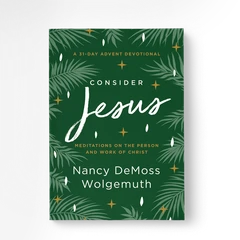
What a Savior He is! Nancy’s newly released Advent devotional, Consider Jesus, is all about Him. For 31 days, you’ll marvel at the person and work of Christ—remembering the true source of hope and joy this Christmas. You can find this devotional at ReviveOurHearts.com.
And don’t forget, this is also our thank you gift for those who make a donation of any amount in October. So give and request your copy today at ReviveOurHearts.com, or call us at 1-800-569-5959.
Well, if you’ve struggled to believe God has forgiven you, you’re not alone. Heidi Jenkins also wrestled with this many years ago, when abortion became part of her story. Prior to coming to Christ, she chose the path of abortion twice, and it led to a period of deep depression and despair. But Jesus. He met her in that dark place. We’ll pick up her story there.
Heidi’s Journey from Shame to Christ
Heidi: My sister had become a Christian and invited me to hear Chuck Colson speak about how he had accepted Christ while serving time in prison for his role in the Watergate break-in when he was the White House counsel for President Nixon.
Dannah: And that appealed to you?
Heidi: I thought it was interesting. I remembered the whole Watergate drama, and I just remember thinking, Well, I remember Chuck Colson. Wow, how did he get to be a Christian? He went to prison.
Dannah: Right, it was shocking! Now, what’s interesting is the invitation. There’s a little bit of a connection to where you were invited to go. Tell us where you were going to hear Chuck Colson speak.
Heidi: Well, I had been invited to a Bible study at the DeMoss house.
Dannah: The DeMoss house . . . Nancy DeMoss, not as in our Nancy, but as in her mom.
Heidi: Her mom! And my sister, Vicki Rose, at the time was working there. She has been a guest on Revive Our Hearts and shared her testimony about her marriage.
Vicki Rose: My burden really is for marriages, Christian marriages especially, that are struggling. If everyone were honest, probably everyone would say marriage is a struggle. It’s very hard work, not just a struggle, but hard work, daily.
God has brought us through so many murky waters, and we still face challenges. We’re looking toward almost thirty years of marriage, and we still face challenges yet. We can turn to the Word of God and stand on that foundation and watch God bless us for our feeble attempts at obedience. That’s the excitement and the joy.
Dannah [to Heidi]: Are you the big sister or the little sister?
Heidi: I’m the big sister.
Dannah: Wow, what a powerhouse you two are!
Heidi: Well, thank you. Vicki invited me to the Bible study at the DeMoss house right after my kids were born. So, I had been going there for Bible studies . . . not totally sure that I agreed with the part about how I was a sinner and needed redemption.
Dannah: So I’ve got to ask a question about that, though. You’re saying you were feeling depressed, anxious, guilty, ashamed about these abortions. And at the same time, you were seeking and interested in things of the Bible but going, “I’m not so sure that I need redemption.” That seems like holding two very diametrically opposed thoughts in your head! You must have been aware of that. Or were you not aware that those were in opposition to one another?
Heidi: Well, I was aware. I was totally destroyed by what I had done. I was desperate to figure out how to move forward!
Dannah: Yeah. And how did you?
Heidi: My husband and I went to the dinner. Chuck Colson spoke about how he’d made choices he regretted . . . but he radiated a peacefulness and a joy that I really envied!
Chuck Colson [testimony]: I thank God for going to prison because, although I had found and accepted Him—or He had found me—that was only the beginning for me. I was a pretty strong-willed guy of Swedish ancestry with a lot of drive. I thought I had gotten myself to the top. It took a long time to bust my will. I had to be in prison, absolutely helpless, before I really had the lesson proved to me, that I had to simply say, “Well, Lord Jesus, I trust You to be Lord of my life!” It was through a lot of personal agony and hardship. But when that happened, I really found a freedom that I’d never had before!
Heidi: When he offered a prayer to receive Christ as my Lord and Savior, I prayed silently along even though I wasn’t totally sure what that would change. I had gone to church, been confirmed, and even prayed occasionally.
But he explained that that didn’t make me a Christian any more than sitting in a garage made me a car. That imagery really made a lot of sense to me. I’d grown up sitting in a church, but clearly, it hadn’t made me a Christian. I didn’t know what being a Christian was.
Chuck: The illness which affects humanity is alienation, and the answer to it is the reconciling power of Christ! I love the verse of Scripture that says, “God was in Christ, reconciling the world [to] himself” (2 Cor. 5:19 KJV) because God is in Christ reconciling the world to Himself today.
When you accept Christ, when you come to Him, when you find that tremendous excitement of knowing who you are and where you’ve come from, and where you’re going, the Creator of the universe loves you through Jesus Christ. Know that it goes deeper. As you begin to walk with Christ, and as you begin to try to have a daily relationship, it deepens. He gets to be the Lord of your life as well!
Dannah: And did that night make a difference?
Heidi: Yes!
Dannah: What happened that evening? To put it in the words Paul uses in Colossians chapter 1, that God delivered Heidi from the “domain of darkness and transferred [her] to the kingdom of [his beloved] Son. In him we have redemption, the forgiveness of sins” (vv. 13–14 CSB).
And what’s more, it was the beginning point of a transformation process in Heidi. Now, a process doesn't happen in a single moment. But God began to work on her heart. He used a variety of tools to gradually change her thinking.
Learning to Receive God’s Forgiveness
Heidi: First of all, finding an understanding, non-judgmental space to share and validate what I was feeling and experiencing. Also, knowing that there were other women like me who were struggling, yet they allowed themselves to be vulnerable and to share their stories.
I sought help from a Christian counselor who modeled Jesus’ grace, forgiveness, and love. He helped me to realize that I was so busy blaming everybody else for my decision that I had never taken responsibility and ownership for my own actions.
Dannah: That must have been hard to hear.
Heidi: Well, I needed to hear it!
Dannah: Heidi needed to come to terms with the fact that God had truly forgiven her for those abortions. Shame and condemnation controlled her. Her counselors pointed her to the Scriptures, and that produced in her a drive to study the Bible.
Heidi: I needed to learn more about this Jesus who forgave me despite my—what I thought was unpardonable—sin. It led me to want to spend time with Him and develop a quiet time so that I could learn more.
Dannah: You used the words “unpardonable sin.” What is the truth about that? Is abortion an unpardonable sin?
When Jesus’ Sacrifice Is Enough
Heidi: No! There are two verses that really were so meaningful to me that I carried them around on an index card in my purse. I Scotch-taped them on a mirror in the bathroom. I had one attached to the dog’s leash. I had them everywhere my eyes could sort of wander, in the beginning.
The first verse is from Psalm 103, verse 12: “As far as the east is from the west, so far [has] he removed our transgressions from us” (KJV). And if you picture how far the east is from the west, arms just can’t open wide enough to even give us a picture of that!
Dannah: Yes, they are unending! They cannot meet! It’s impossible.
Heidi: They cannot meet, exactly!
And then, there was a wonderful Bible study teacher at the DeMoss house who really took an interest in my healing from my abortions. She introduced me to a verse from 1 John 1:9: “If we confess our sins, he is faithful and just to forgive us our sins, and [purify] us from all unrighteousness” (KJV).
And “all unrighteousness” includes abortion! And she said to me, “This is the Christian’s ‘bar of soap.’” And then she said, “If we confess, He is faithful and just to forgive . . . from ALL unrighteousness!”
And that sent me on a journey of searching for truth throughout the Bible. There are countless verses about forgiveness. There’s a passage from Micah 7:18–19, that says:
Who is a God like you, who pardons sins and forgives the transgressions of the remnant of his inheritance? You do not stay angry forever but delight to show mercy . . .You will again have compassion on us; you will tread our sins underfoot and hurl all our iniquities into the depths of the sea. (NIV)
And then, there’s one from Isaiah 38:17:
Surely it was for my benefit that I suffered such anguish. In your love you kept me from the pit of destruction, you have put all my sins behind your back. (NIV)
So, this was evidence to me of God’s forgiveness. I felt that if God had forgiven me, then I needed to forgive myself. And yet, I was told that there’s nowhere in the Bible that talks about self-forgiveness.
And the counselor who was helping me initially walk through this said, “By not forgiving yourself you’re saying that what Jesus suffered on the cross wasn’t enough to cover your sin, and therefore He needs to suffer more! That’s your pride in saying you can’t forgive yourself.”
And yet, so many women—Christians and non-Christians alike—state that they grapple with the inability to forgive themselves.
Resting in the Finished Work of Jesus
Dannah: Maybe you’re in bondage to a sense of having to “do penance” for your sin, like Heidi Jenkins was. You know, the Bible calls that “a different gospel.”
- It’s trying to earn God’s favor.
- It’s legalistic, performance-based thinking.
- It’s a sort of self-imposed slavery.
But we learned today that we are forgiven. All the way. The true gospel invites us to rest in the finished work of Jesus, the Lamb of God.
If you’re struggling with this, would you let us pray for you? You can submit a prayer request with as much or as little detail as you’d like at d. One of our team members will receive that request and bring it to the Lord, who so desires your peace and joy in Him.
If you’ve been redeemed, then you have a special job to do. It’s a simple one—tell your story. Tomorrow, we’ll hear some more from Nancy and Heidi, and learn what it looks like to let our spiritual stories flow out of us, infusing our neighbors with hope. Please be back for Revive Our Hearts!
This program is a listener-supported production of Revive Our Hearts in Niles, Michigan, calling women to freedom, fullness, and fruitfulness in Christ.
All Scripture is taken from the ESV unless otherwise noted.
*Offers available only during the broadcast of the podcast season.