
Anchor Yourself in Sound Doctrine
Dannah Gresh: Nancy DeMoss Wolgemuth says you’re in the place you are right now because of God’s purpose.
Nancy DeMoss Wolgemuth: That husband, that child, that assignment, that impossible task, that situation at work, that physical challenge is part of God’s purpose for me right now.
Dannah: This is the Revive Our Hearts podcast with Nancy DeMoss Wolgemuth, co-author of You Can Trust God to Write Your Story, for September 23, 2025. I’m Dannah Gresh.
Just a heads up as we get started. Today's program contains a brief mention of suicidal thoughts. We know this is a sensitive topic for many, and we’re committed to dealing with it biblically. We just want you to be aware ahead of time so you can plan accordingly.
Nancy: We're talking this week about how to survive the storms of life. Life does have storms, and Psalm 57 …
Dannah Gresh: Nancy DeMoss Wolgemuth says you’re in the place you are right now because of God’s purpose.
Nancy DeMoss Wolgemuth: That husband, that child, that assignment, that impossible task, that situation at work, that physical challenge is part of God’s purpose for me right now.
Dannah: This is the Revive Our Hearts podcast with Nancy DeMoss Wolgemuth, co-author of You Can Trust God to Write Your Story, for September 23, 2025. I’m Dannah Gresh.
Just a heads up as we get started. Today's program contains a brief mention of suicidal thoughts. We know this is a sensitive topic for many, and we’re committed to dealing with it biblically. We just want you to be aware ahead of time so you can plan accordingly.
Nancy: We're talking this week about how to survive the storms of life. Life does have storms, and Psalm 57 gives us insight into how David survived some of the storms he experienced. We said, first of all, that he was honest about the fact that he was in a storm; he didn't pretend like it didn't exist. And then, secondly, he took refuge in God. He said:
Have mercy on me, O God, have mercy on me,
for in you my soul takes refuge.
I will take refuge in the shadow of your wings
until the disaster has passed. (v. 1)
Now David goes on in verses 2 and 3 to tell us something else he's going to do in the midst of the storm. He says:
I cry out to God Most High,
to God, who fulfills his purpose for me.
He sends from heaven and saves me,
rebuking those who hotly pursue me—
God sends his love and his faithfulness.
David says in the midst of the storm, "I'm going to cry out to God. I'm going to lift up my voice. I'm going to cry out for help and tell Him that I need Him."
I don't know about you, but when I'm in the midst of a storm, I have to say, sadly, my first impulse is often not to cry out to God but to cry out to someone else.
I mean, isn't that what friends are for—and pastors and counselors? And I thank the Lord for godly friends that we can share our burdens with and who can help us get God's perspective in a time of storm. But I'll tell you, when we've been to all the counselors and all the friends and all the helpers, if we want to really get our need met, we're going to have to cry out to the Wonderful Counselor whose name is Jesus.
I love teaching the Word of God, I love ministry, I love serving God's people. There are a lot of blessings associated with being in ministry, but there are also a lot of demands. And I have to say that some of the demands of the deadlines have become something of a storm for me at times.
And I found myself recently very overwhelmed by all there was to do. It just seemed like there weren't enough hours for the preparation. The deadlines were crowding in. I felt like I was this little tiny boat bobbing around in this great big ocean that was very stormy.
I found myself late one Friday night picking up the phone and calling one of my fellow staff members in the ministry where I serve and crying out—literally, I was sobbing. And I said, "I just can't do this! I just can't do this! This is too hard!" And I just poured out my heart, and my dear friend wanted so badly to do something.
But, you know, there was a limit to what they could do. I mean, they could pray, they could care. But they couldn't go through the storm with me. I found, as I so often do, in the midst of the storm, after I've cried out to everyone else that I think may want to hear, that ultimately, if I really want to survive a storm, I've got to cry out to the Lord.
David says he cried out to God because of His Person. "I cry out to God Most High," he says. That's the Hebrew name for God, Elohim Elyon, God Most High—the sovereign ruler of the world. God, Elohim Elyon, who is the creator and the possessor of heaven and earth. What's David saying? There is no higher source to whom you can go. There is no one higher than God. You've gone to the ultimate One, the One who's over all the storms when you cry out to Him. You're crying out to the One who is infinitely high. He's the Most High God.
Isn't it incredible that the Most High God would also condescend to care about our burdens and our storms and our needs? The Most High God cares!
David says, "I'm crying out to the One who is the sovereign ruler of the earth." As Daniel said, "His kingdom is an everlasting kingdom and his dominion endures from generation to generation" (Dan. 4:34). We cry out to the Most High God. That's His person.
But David says not only is His Person something I want to cry out to, but also because of His purpose I cry out to Him. He has a purpose for my life in the midst of the storm, and that purpose will be fulfilled. That's what David says: "I cry out to God Most High, to God, who fulfills his purpose for me" (Psalm 57:2).
Psalm 138 tells us that God will perfect that which concerns me, that the things that are troubling to me, the things that are devastating my life right now have a purpose that God is fulfilling, and He will finish fulfilling His purpose.
I love that passage in Job 23. Some of you have heard me quote it before and you'll hear me quote it again. I go back to it often. Job said in the midst of his own storm: "I looked to the right, I looked to the left. I looked in front of me. I looked behind me. But I can't find God. But God knows the way that I take. When he has tried me (there's purpose in this), I shall come forth as gold" (vv. 9–11 paraphrased).
There will be an end to this. God's purpose for me in this storm will have been fulfilled, and I will look back and say, "God, You did all things well."
When we can look back from heaven's vantage point and see what God was doing here on earth, we will have no complaints about any of the circumstances that came into our lives. We will say, "God, You had a purpose, and You were doing it right, and You did fulfill Your purpose for me."
It helps me to remember that where I am right now is part of that purpose for my life. That husband, that child, that assignment, that impossible task, that situation at work, that physical challenge is part of God's purpose for me right now. I was thinking over the last few days about that long passage in Psalm 107 about storms. It tells us two things about storms and God's role in storms. Psalm 107:25 says that God "commands and raises the stormy wind which lifts up the waves of the sea" (NKJV).
Who makes the storm? God does. He commands and causes the waves and the stormy wind to come. And then that passage goes on to say that the people in the midst of that storm "are at their wits' end" (Psalm 107:27). "Then they cry out to the Lord in their trouble" (v. 28). Part of God's purpose in the storms is to bring me to the place that I'm so desperate that I have no one else to cry out to other than God.
Some of you are living in a situation with a family member, a situation at work or in your church or with a relationship where there's no one else you can cry out to but God. You're at your wit's end. Part of God's purpose in that storm is to bring us to the end of our own resources, the end of our own ideas about how to handle this so that we cry out to the Lord in our troubles.
And then verses 28 and 29—still in Psalm 107—"He brings them out of their distresses. He calms the storm, so that its waves are still." You see, God creates the storm. But He also calms the storm. And as we've said before, He knows exactly the duration, the intensity, and the fierceness needed to fulfill His perfect purposes in my life. And when He knows that His purpose has been fulfilled, He will speak the word and the storm will be gone.
As we started the Revive Our Hearts ministry there was such excitement, and there was also a very stormy time, just in terms of the challenges of a new kind of ministry. I often said during those days, and I still say sometimes during these days, "If I didn't know that Jesus was in this boat with us, I'd be terrified." I couldn't do this. I couldn't ventue out into the challenges involved in this kind of ministry. But the thing that gives my heart confidence and rest in the midst of the storm is knowing that He's in this boat, someone that I can cry out to.
So David looks at God's Person, he looks at God's purposes and recognizes that they will be fulfilled. And then David looks at God's provision. He says in Psalm 57:3:
[God] sends from heaven and saves me, . . .
[He] sends his love and his faithfulness.
Some of your translations say, "God shall send forth His mercy and His truth." These are two words that are often paired together in the Old Testament: the mercy and the truth of God, the love and the faithfulness of God.
The word translated "love" or "mercy" is translated differently because it's a hard word to translate. There's not one English word that really communicates the whole meaning of this Hebrew word hesed. It's a word that means "the covenant, faithful, loving kindness of God." His love that never fails in the midst of any circumstance.
And David says, "In the midst of my storm, God sends resources from heaven." He sends a provision. What does He send? His covenant love. And God sends His truth and His faithfulness. Faithfulness is the word for "steadfastness." Yes, the waves are high. Yes, the storm is great. But God is faithful and steadfast in the midst of the turbulence.
Now, interestingly in verse 3, David says God sends down his love and his faithfulness from heaven. When you come to verse 10 in this passage, he says that God's love and God's faithfulness reach up from earth to heaven. So it's going both directions. And where are we in the midst of that stormy sea? Caught right between the love and the faithfulness, the mercy and the truth of God. All that I need in the midst of the storm, He sends to meet my need.
As I was in that storm not too long ago and cried out first to a friend, I found that it was helpful to have someone pray and care. But after I hung up the phone, I was still there alone in my storm. And then I did what I needed to do all along. And that is to get on my knees and cry out to the Lord as David did.
I cried out to God Most High, to God who fulfills His purpose for me. I said—not as calmly as I am right now—"Oh Lord, I can't make it through this storm without You. I'm crying out to You. My little boat is very frail and weak right now. Would You have mercy? You are God Most High. I trust that You are fulfilling Your purposes, and that I am where You want me to be right now. I'm here by Your appointing."
What did God do? He did what He always does when we cry out. He sent His love and His faithfulness, His mercy and His truth. And He said, "This is My provision, this is what you need. And it's all that you need. And it really, really is.
Dannah: Well, God helped Nancy DeMoss Wolgemuth through that storm and He has continued to protect her in the years since that was recorded. Just like He will sustain us.
Nancy recorded that teaching in front of a studio audience. And she asked some of the women there to share about some of the storms they’ve been going through. Let’s listen.
Diana: I suffered with depression from age nine until age forty-two. My first suicidal thought was at age nine. It was a long journey. I was high-functioning because you have moments of joy and happiness, and you function in the world. But still inside is this self-loathing that is almost indescribable. It's the darkest place in the world to be. You can say that you know Christ loves you, but you really don't believe it . . . and yet you love the Lord. And it's the most confusing place in the world to be.
I was at a place where I had even told my husband I would gladly divorce him and allow him to have the children because I felt like he would be a much better parent than I would, because they didn't deserve this.
And he said, "No, I'm committed to this marriage." He knew that I was just in this deep, deep, dark, dark place. I just wanted to retreat. And it was through the course Search for Significance, it was like busting out of being inside of a black bowling ball. It's never returned. It's been gone forever, and I praise the Lord for that.
I have never understood words like justification, sanctification—those were words that had never made sense to me. I had this upside-down picture of God where He had the club ready to hit me on top of the head. Even though He had forgiven me for my sins, the fact that I could still sin as a Christian—things like pride or envy or coveting, just those day-to-day things. That He could still continue to forgive me, I couldn't get that concept down at all.
There were some major doctrinal concepts that that course brought home to me.
Nancy: It wasn't actually the Search for Significance course itself that is what made the difference in Diana's life. It's the truth, the truth of God's Word that she saw through that course. Jesus said, "You will know the truth, and the truth will set you free!" The other verse that comes to mind that I think Diana is illustrating is from the Psalms where it says, "He sent his word and healed them" (107:20).
You say, "What difference does doctrine make in my life?" People aren't that interested in hearing about doctrine today. I'll tell you this: Doctrine makes all the difference in your life because what you believe about God, your theology . . . You may not think you're interested in theology. You have a theology. You have a good theology or a bad theology, a biblical theology or a non-biblical theology. Theology is just what you believe about God. And what you believe about God affects every area of your life.
If you have a flawed view of God, you'll see everything else in life through a flawed lens. Everything else will be distorted. So it all goes back to your view of God, doesn't it? What kind of god do you have? Is it a god that you've made in your own image or in the image of someone else that you've known? A god you've constructed? The Bible has a word for that kind of god. It's an idol.
Virtually every problem and issue in my life comes back to idolatry in one way or another, that I've been worshipping a god with a lower-case "g." That god may be myself. It may be a view of God that is not a biblical view of God. But when I don't worship the true and living God as He's revealed Himself in Scripture, as He's revealed Himself through Christ, then I'm going to falsely accuse God. I'm going to make choices with my life that are wrong responses to pressure and to circumstances.
You see, there are circumstances in our lives over which we have no control. You didn't decide what home to be born into. You didn't know when you married that husband that he was going to be a depressed man. You had no control over perhaps some health issues. There are things we can't control. And God doesn't hold us accountable for those.
But when we have the right theology, the right view of God, when we see a God who is El Elyon, God Most High, the Creator and Possessor of heaven and earth, a God who is a God of hesed—covenant love, and mercy and faithfulness—a God who incarnated Himself in the person of Christ, took on flesh and took our sin upon Himself, a God who gave His life for our sin—these issues of justification and sanctification. Don't tell me you're not interested in those topics, because if you're not, I can tell you why you've got some of the problems you do. Romans 1–11; it's theology, it's doctrine.
So how can we be free from sin, based on what we know about God and His ways and His salvation? Based on the doctrine, based on the theology, how can we walk in newness of life? How can we live in the power of the Spirit? Why does that matter? How does it affect my life today?
Ephesians 1–3; it's the knowledge of God and the knowledge of His ways and the knowledge of the gospel. Chapters 4–6; here's how that affects your marriage; here's how that affects your worship; here's how that affects the way you do church; here's how that affects the way you parent; here's how that affects the way you do your job. It's all based in theology.
So as we have these issues and these struggles in life, and they have different names and different descriptions, they look different at different seasons of life; but we have to keep going back to What is my view of God? Is my doctrine biblical? Is my life rooted in the truth? "You will know the truth and the truth will set you free" (John 8:32).
He sent His Word. Who's the Word? Jesus . . . and He healed them! All the healing that Jesus did here on earth, the physical healing, was wonderful, it was impressive, it drew crowds. But it was an earthly picture of a heavenly reality that's intended to be true for every one of us—and that is that we can live in Christ as whole people.
We may have been damaged in our past. We may be living in damaging or dangerous or hurtful circumstances right now. But in Christ, we are whole. We don't have to be dependant upon human counselors and medications and things to get us up and things to put us down in terms of narcotics and drugs. The sufficiency of Christ is an incredible truth of God's Word. He sent His Word, Christ, and healed them.
Someone who's been coming to these sessions, she's not in here right now, but she shared with me some of how God has been walking her through a many-year process of dealing with this issue of depression. And for years she lived in dependence upon the world's prescriptions, the world's alternatives, the world's programs.
But she came to discover that, in her case, the depression has been, though very real, the fruit of wrong theology, of a wrong view of God or an inadequate view of God. As her theology, her doctrine, her view of God, her understanding of the gospel has grown, she's found that she didn't have to be dependant upon the world's crutches, that she's been set free.
Lord, I do lift up these women. I don't know what storms, waves, tumults are facing individual women who are sitting in this room today. I don't know what issue they may be facing with a mate, with a child, with a parent, with a loss, with financial need, with an issue at work—but you know, Lord. Thank You that You shape those winds. You're the One who determines the extent and the intensity and the timing; not one of those winds or waves can come into our lives without Your permission.
And so, Lord, I pray for each of these women in whatever season of life, particularly for those who may be facing some northern winds right now. Oh God, would You give grace? Thank You! And we say together thank You that Your grace is sufficient for every woman in this room, at every moment, every season of life, every situation, there is no place where we are so weak that Your grace is not greater.
There is nothing facing us this day that You are not facing in us and through us and for us. Thank You that we don't have to handle those things ourselves. I pray that each woman in this place would run to You, would turn to You, would find You to be the lifter up of her head. Would You encourage and strengthen Your people, O Lord, by Your grace.
Lord, in our response to the storms and to the sufferings and to the trials, may we cause heaven to applaud as they see that we love You and we worship You, not because of Your gifts, but because You are God. Lord, help us to trust when we cannot see, to sing and to praise even when our eyes are filled with tears. And through all of it, may You be glorified. That's what it's all about, and that's all that matters. It doesn't matter that we survive the storm, but it does matter that You are exalted. We pray it for Jesus' sake, amen.
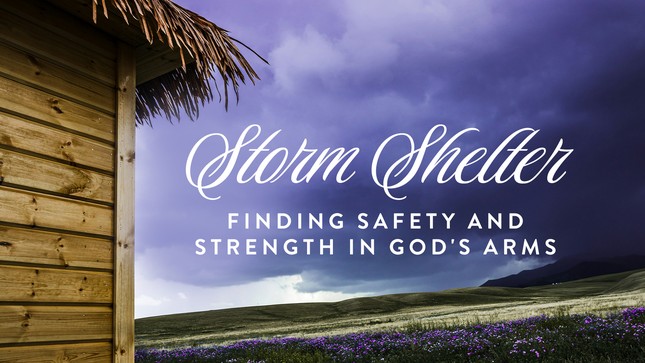
Dannah: If you’re going through an emotional storm right now, I hope you’ve been praying along with Nancy DeMoss Wolgemuth. That interaction is part of a series called "Storm Shelter." Also, please, if you’re thinking about suicide, or you’re worried about someone else, call or text 9-8-8 toll free, any time—the lines are open 24/7/365.
And during this series, we want to help you prepare for storms that may be brewing in your life. Endure: 40 Days of Fortitude is a booklet designed to do that. Each day will lead you deeper into the freedom, fullness, and fruitfulness Christ offers—right here in the middle of the storm. Request your copy today with your donation of any amount. You can give by visiting ReviveOurHearts.com or calling us at 1-800-569-5959.
Before we go, don’t forget that True Woman '25 begins in just nine days. It’s still not too late to purchase tickets. Head to TrueWoman25.com to snag those today. You can join us in Indianapolis or get a group of ladies together and participate virtually from your church or your living room. I hope you’ll behold the wonder of the Word with us on October 2–4. It’s going to be a sweet several days!
Tomorrow Nancy’s back, and she’ll be encouraging you to sing in the storm. I hope you’ll join us for Revive Our Hearts.
This program is a listener-supported production of Revive Our Hearts in Niles, Michigan, calling women to freedom, fullness, and fruitfulness in Christ.
All Scripture is taken from the NIV unless otherwise noted.
*Offers available only during the broadcast of the podcast season.