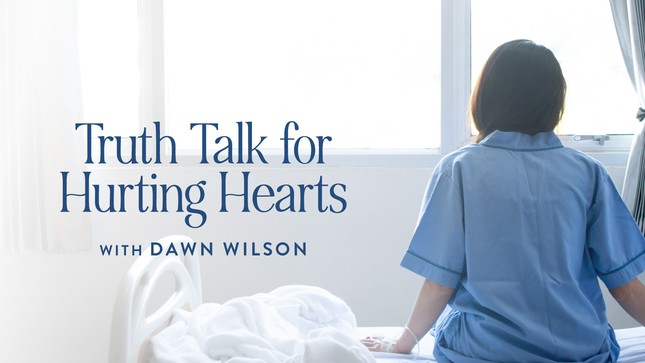

Truth Talk for Hurting Hearts, with Dawn Wilson
Dannah Gresh: For Dawn Wilson, suffering has become a powerful gospel testimony.
Dawn Wilson: So he said, “There's no hope in the world.”
When I said, “You're right,” and then he turned around, looked at me, and I was smiling. “Then, why are you smiling? Here you are laying in a bed; you're sick. Why do you have hope?”
And it was just such a wonderful opportunity . . .
Dannah: This is the Revive Our Hearts podcast with Nancy DeMoss Wolgemuth, author of Choosing Gratitude, for August 1, 2025. I’m Dannah Gresh.
Nancy DeMoss Wolgemuth: If you were lying in a hospital bed, what would your countenance communicate? Sadness? Fear? Frustration? All very understandable, but what about joy? That doesn’t come as naturally, does it?
But Dawn Wilson’s story is proof that it’s not impossible. Her suffering became an opportunity to share …
Dannah Gresh: For Dawn Wilson, suffering has become a powerful gospel testimony.
Dawn Wilson: So he said, “There's no hope in the world.”
When I said, “You're right,” and then he turned around, looked at me, and I was smiling. “Then, why are you smiling? Here you are laying in a bed; you're sick. Why do you have hope?”
And it was just such a wonderful opportunity . . .
Dannah: This is the Revive Our Hearts podcast with Nancy DeMoss Wolgemuth, author of Choosing Gratitude, for August 1, 2025. I’m Dannah Gresh.
Nancy DeMoss Wolgemuth: If you were lying in a hospital bed, what would your countenance communicate? Sadness? Fear? Frustration? All very understandable, but what about joy? That doesn’t come as naturally, does it?
But Dawn Wilson’s story is proof that it’s not impossible. Her suffering became an opportunity to share the gospel. She had a hope that didn’t make sense, and it was her smile that gave her away.
Recently, Dannah Gresh got to sit down with Dawn and learn more about her story.
Dawn and I go a long way back, and that’s another story. But she’s been a researcher here at Revive Our Hearts for many years, and she’s a dear friend.
Now, more recently, Dawn has also become a published author. Her book, Truth Talk for Hurting Hearts, is a beautiful testimony to God’s hand in her suffering. I can’t wait for you to hear from this special friend of mine. Now here’s Dannah.
Dannah: Sometimes life can really turn on a dime. One day can change everything. That happened for you, Dawn. Take us back to 2018/2019. What changed your life?
Dawn: I was on a cruise and just got sicker and sicker. I thought it was just a really bad cold or maybe developing into something else. I came home, went to the doctor, and she called me one day and said, “You need to go to the ER.”
And I said, “You mean Urgent Care?”
And she said, “No, Sweetie. You need to go to the ER.”
I began a journey I never expected. I was diagnosed with multiple myeloma in January of 2019, and it was a total shock. But God’s Word even from the beginning just calmed me.
The Scripture, “What time I am afraid, I will trust in You,” (Psalm 56:3 KJV paraphrased) came to me even as I was getting that diagnosis. And God just comforted me in an incredible way.
I had a stem-cell transplant in 2020 and was officially out of remission from that in 2021. So it was less than two years after the stem-cell transplant, even though we had hoped for five years.
And then God, even further, opened a procedure available to multiple myeloma patients, and I had that procedure in March of 2023. I’ve been in remission ever since.
Dannah: Hallelujah!
Dawn: Yes!
Dannah: We had actually interviewed you and talked to you about this journey. We have a couple of episodes we’ll link to in the transcript of this program. But Dawn, you entered two journeys then. One was a journey to fight cancer with the help of the Lord by your side. And the other was to understand suffering. What has the Lord taught you about the purpose of suffering?
Dawn: I think the most surprising thing is that suffering is a gift, that suffering is not without purpose, and that God allows us to suffer for purposes that we might not understand at the moment.
I call it a gift with a black bow because, certainly, there’s nothing fun about multiple myeloma. But the gift in it is that it caused me to go deeper with God. It caused me to seek Him and to try to understand the purposes of God and His perspective. The perspective on Scripture and on who God is, is what changed me the most.
Dannah: You started praying Scripture. You started finding comfort in Scripture and truth to walk you through this journey. They came to be the titles of the chapters of a book that you wrote to help other people walk through their own journey of suffering.
I’ve got to tell you, Dawn, when I got this book . . . You know, there’s cancer, there’s the loss of a spouse, there’s the loss of a child, there’s . . . You write about a mutual friend of ours who had an eating disorder.
Dawn: Yes.
Dannah: My suffering has been having a sick husband, walking him through sickness the last year or so. When I got the book, the title itself comforted me. So, I’ve got to read this: Truth Talk for Hurting Hearts. I love that! You want to acknowledge the hurt. Right? You don’t want to erase it or pretend it’s not there.
Dawn: Right.
Dannah: But also, you’re not going to let the hurt have the final say. You’re going to go to the truth and get perspective from God. Tell us how we do that. What’s the first step? What was the first step for you?
Dawn: I think the subtitle of the book, Discover Peace and Comfort through God’s perspective . . . It was God’s perspective that changed everything for me. When I was in the hospital the first time, when I was having a stem-cell transplant in 2020, I was just staring at blank walls. That can be very depressing.
There was a white board in my room. Every day I would get up, and I would write a word on that white board, and I’d focus on that word all day long.
I had a Bible there, and I’d look up Scripture that had to go with that word. That just encouraged me. God’s truth was encouraging my hurting heart.
Words like: truth, wisdom, joy, peace, purpose. What’s God’s purpose? And there’s just something about getting God’s perspective. It’s like an alternative vision of how we’re seeing the world.
The voices in the world are so loud, and we tend to operate according to those voices, what the world says is important. But, boy, you get hit upside the head with a disease, and all of a sudden everything can . . . “No, I’m a Christian. What does God have to say about this?” That is what I think is the way He carried me through.
Dannah: I love that! I love that you are vulnerable enough . . . That white board, when I read about it in the book, really touched me because my husband has been sick this year. My brother was sick for just like a week—he had the stomach flu. He came to me and said, “Dannah, please don’t forget this: being stuck at home sick is depressing and discouraging. It’s lonely. I was stuck at home for three days, and it was a suffering. It was a suffering.”
If you’re in that kind of a season for a long time, and you don’t seek the perspective of the Lord, your mind will take you to hopeless places.
Dawn: That’s right, and hopelessness is what our world is suffering from right now.
I remember when I wrote the word “hope” on the white board, a couple of the nurses saw it. That was the fun thing. The nurses and the doctor and the people who cleaned my room, they would see the word, and many times would ask me about it.
But one nurse saw it and said, “Hope. That’s what I need.” But at the time, my mouth and my throat were covered with lesions, so I couldn’t talk. So I just smiled at her with compassion. But later when I could talk, that same nurse was there, and I was able to share with her the source of hope, and it made such a difference.
Dannah: In your chapter on hope, you talk about facing struggles biblically. Why is it so important that we go to the Scriptures for the perspective that we’re talking about and not other sources?
Dawn: Because they’re not going to necessarily lead us in the right direction. There’s a lot of really good advice out there in the world, but not all advice we get in the world aligns with the Scriptures. So it’s transient. It’s not something we can stake our lives on.
One thing I‘ve learned about hope is that it’s not wishful thinking. Wishful thinking is not on a firm foundation, and that’s what we really need. We need the foundation that doesn’t change. The world’s hope is so different than the hope that we have in Christ.
Dannah: That’s so true. Take us to some of the Scriptures that gave you hope when you were feeling . . . when you were in the hospital room writing on that board. What were some of the Scriptures that gave you hope? I mean, you’re right. The worldly thought about hope is, “This is a wish. Hope is a wish.”
Dawn: Yes.
Dannah: But what Scripture verses anchored you on what the truth of hope really is?
Dawn: The one that comes to mind is (I’m not going to say this correctly), “When I am tried, I’ll come forth as gold” (see Job 23:10). It was the idea that God was using suffering as a part of His refining process. That goes back to God’s purposes are so much higher than our purposes.
In suffering, we want comfort. And God says, “No, I’m going to shake you up so I can take you deeper.”
And we want answers, and God says, “No. I want you to trust Me.”
Dannah: Some people are trying to find hope in politics. We’re camping in that. We’re saying, “If the politics are the way I need them to be, I can feel hope.”
Some people are placing their hope in finances. “If my finances are the way they need to be, I can feel hope.” Our health. We put our hope in our health.
Dawn: Yes.
Dannah: But you met a nurse. He was angry and foul-mouthed. And your conversation about hope changed his perspective.
Dawn: Right. He was so upset. And he said, “There’s just no hope in this world.”
And I said, “Right. There isn’t.” But I was able to share with him about the God of hope, and that I have a Shepherd that leads me. He just really calmed down and listened, and was able to actually listen to the reasoning of why he had no hope. He was putting all of his stock in the world, in what he had, and the people he knew. And he didn’t have a framework for God at all. And so his idea of hope was just so nebulous.
When he said, “There’s no hope in the world,” and when I said, “You’re right.” And then he turned around and looked at me, and I was smiling. And that was what he asked me, “Then why are you smiling? Here you are laying in a bed. You’re sick. Why do you have hope?”
It was just such a wonderful opportunity. That’s part of what I’ve seen, too. When you’re going through something, you have an opportunity to share the faithfulness and the goodness of God and the hope we have in Him. He is our hope. That’s what David said, “God is my hope.”
Dannah: Yes. And don’t you think, one of the reasons that we experience suffering (there’s probably a lot God is trying to accomplish) is for us to get to the point where He really is our hope, that our dependency is not on everything else, but Him and Him alone.
Dawn: That’s right.
Dannah: Did you get to that point?
Dawn: Oh, yes. He strips away everything. I remember one day when I was so overwhelmed by the disease and the thought that I might die and my husband would have to go on without me. I was just overwhelmed in my spirit. I was just weeping into my dusty carpet, and just realized that that’s the place that David found himself so often.
So many times in the psalms, he begins with lament. I was lamenting, just lamenting with my face in my carpet. But then David’s psalms always end in praise or rejoicing or an awesome new perspective of God.
I remember laying there and saying, “Lord, that’s what I want. I want to be able to praise You and bring You glory out of all of this. I don’t know how that’s going to happen, but if You can use me, if You can use my testimony about going through this with You, that’s what I want. I might do it imperfectly, but Lord, You see my heart. You see that that’s what I want.”
Dannah: That’s beautiful. How did you see the Lord using your pain to minister to others? I find it so ironic that so oftentimes people like you who are in a hospital bed are the ones ministering truth and hope to the people caring for your body, and you get to care for their spirit. How did you see that unfold in your story?
Dawn: Yes. Well, while I was in the hospital, I had many opportunities to share with people—doctors. I remember one day, the word on my board was “gratitude.” And while I had that on the board, I could hear someone out in the hallway. It was actually a person in another room that was yelling and screaming at a doctor or a nurse or somebody, just basically complaining.
The nurse came into the room, and she saw the word “gratitude” on my board. I was smiling, and we talked a little bit. I heard her go out to the hallway and say, “Now, this woman is grateful.”
And I thought, You know? It’s the little things. We have a part in testifying that only God can do.
And God, not just in the hospital, but I had been praying for years that God would help me to reach out to my neighbors. We have what I call my cookie neighbors. Every Christmas we give cookies to each other—six families. And all of a sudden, when I was sick, they would say things to me like, “Well, how are you getting through this? You look happy. You should be sad.” Things like that.
I had opportunities to share with those people the very thing that I’d prayed for, but it didn’t happen until I started suffering and was prepared, as the Bible says, to give an answer for the hope that’s in me.
And God really ministered to me, too. I remember one time in the hospital, I was giving out and giving out, which is what I wanted to do. I’d prayed, “Lord, use me in the hospital.” But I was just overwhelmed. There was just so much going on in my body this one day. I said, “Lord, I need encouragement myself. How can I keep giving out if You don’t pour in?”
And I was expecting it just to be Jesus pouring into me, but Jesus sent me somebody with skin on. This Ethiopian night nurse, who was just there short term in the hospital, she walked up to me in the bed and said, “I think God wants me to encourage you today.”
I remember my heart just leaped like, “God just answered my prayer immediately!” And my heart was just so shaken that I actually went into AFib.
Dannah: Oh no!
Dawn: All the technicians rushed into the room and said, “What’s going on? What’s wrong? What’s wrong? What’s changed?” I told them what had just happened, and they said, “Well, that kind of sounds like a miracle, doesn’t it?”
Dannah: Oh, wow!
Dawn: And I said, “Yes, it is! God cares about us when we’re hurting.”
Dannah: I’m so glad you say that because it’s easy to listen to your story and think, Okay, Dawn Wilson wrote words of hope and encouragement on a white board in her hospital room. She’s a superstar. She’s a supersaint. But I’m discouraged by my suffering. I don’t want to get out of bed in the morning.
You’re not saying you didn’t have moments like that?
Dawn: Oh, no. Oh, absolutely not. Sometimes in the middle of the night . . . It seems like the middle of the night is when Satan attacks us. That’s when all the lies would come. “Who are you to talk about these things? Who are you? People suffer worse things than you.” Lies that Satan would bring about God, “God is not good.” And so many things in the middle of the night came.
But that’s when the sweetness was, too. I was able to combat that lie with truth, to just say, “Satan, you’re not going to win this one. God’s good, and here’s why.” Those kinds of things.
So, yes, we can get really, really down and discouraged, but choose it. We have to make the choice. It is about choice. Make a choice for hope. Make a choice for patience. Make a choice for peace. We have to cooperate with the Holy Spirit who wants to bring us these things.
Dannah: Yes. I think we testify to the world in a different way when He brings us those things in our suffering. When He brings me peace and joy and hope when everything is going my way and life is just great, that’s not supernatural. That’s just life going well. But when you experience that in the battle of suffering . . .
I think, when you say we have to make a choice, it’s so interesting to me that you used the white board to write these words on and how it ministered to you. It ministered to other people. It reminds me of when Nancy DeMoss Wolgemuth’s husband had cancer, and they took these Post-It notes, and they would write on that Post-It note, “What are we grateful for today?”, and put it on the wall. And by the end of it, she had, like, no wall. All Post-It notes in this one room.
How important do you think it is that we do something like that in our deep seasons of suffering, that we are intentional to put words of truth right in front of us where we can see them and can’t get away from them?
Dawn: Oh, it’s so important. I actually wrote about Nancy’s gratitude room in the book. That was something tangible. We need to do something tangible so we see it, so we hear it.
My co-author of the book, Jamie Adele Wood, is the founder of Discovering Truth Ministries. While I’m fighting multiple myeloma, she’s fighting melanoma. She had so many practical applications. She came alongside of me to write the applications of the book.
And Jamie in many of the applications would say, “Do something right now. Go read this book. Go write this down. Go make a list.” And that’s being intentional. We can’t just expect things to go on and there be a positive change. What can we do? How can we use the Scripture? How can we use a great hymn of the faith? How can we use a book by a godly person to build our responses to our suffering?
Dannah: Yes. It’s not like it just pops out of you. You have to wrestle with it. You have to work through it. You have to rest in it, too. It’s such a complex thing. I think about Elijah when he’s so discouraged. He just runs up on a mountain and has what seems like a pity party, and God actually makes him bread and feeds him.
There are also days in our suffering where we need to rest and receive.
Dawn: Yes.
Dannah: How did you do that?
Dawn: I learned from Job on this. Job went through so many tough things. He said, “Yet, I will . . . Yet I will praise Him. Yet I will trust Him.” And that “Yet I will” has really been a life changer for me.
Like on a day when I wake up and I’m so sick, and I’ve got a deadline, a writing deadline. I’ll say, “Lord, I don’t feel like I can do this, yet I will in Your strength.” That “Yet I will” is the choice we make, but it’s also a choice of faith. We really believe that God’s going to carry us when we choose to do what is right.
Dannah: Habakkuk is kind of like the little Job, smaller book of Job, same sort of circumstances. He said, “Even if . . Even if nothing goes right. Even if, I will still praise the Lord. I will still trust the Lord.”
There are those “Even if” moments where we just stand in it. We say, “There might be destruction all around, but I’m going to stand in this.
Dawn: That’s right, because this battle isn’t over yet. I’m going to be real honest here. I know that in the last days of multiple myeloma, there’s a lot of pain. I’m a pain wimp. I don’t do pain easily at all—never have. And the tendency is to fear and say, “Lord, how am I going to face that?” That “Even if,” “I will” comes into play.
But also, I remember a lesson I learned from Joni Eareckson Tada. I went to a recording session with her and with Nancy, and Joni wasn’t feeling well that day at all. I remember just out of nowhere, she just broke into song. And it just seemed to give her the strength she needed to get through that.
And I thought, Boy, that was a choice. That was an “Even if, I will.” She broke into song. I began to watch her in other situations, and that’s part of her secret. She praises God.
I can’t tell you how many times just stopping when I feel overwhelmed, especially by fear about the future, just stopping and praising God and saying, “Lord, I know You’re in the future. You’ve already gone ahead of me with providential grace. It’s there for me. It’s already prepared for me.”
I don’t have it now, so it doesn’t help to worry now. I don’t have that grace now. I have only the grace for today. So, “Lord, I praise You that You’re going to be there. I praise You that You’re going to help me in that time of desperate need.” I don’t need to worry, just giving that to Him in that moment, it really makes a difference.
Dannah: That’s beautiful. Joni does do that well.
I remember a time early when we were doing a True Woman event, I had a horrible migraine the day of the conference. I was trying to minister to the teen girls. I was doing a workshop with them. This was early—like 2008, maybe 2010, somewhere way back then. I’m laying in the green room. Everybody else is having lunch, and I’m laying in the corner in the green room because I cannot make it to my hotel room.
I’m just, like, “If I eat, I’m going to be sick.” The pain is debilitating. And suddenly I heard singing above me. I open my eyes, and there’s Joni leaning over her wheelchair in my face, singing over me. And she said, “Oh, sweet one, you just looked (I don’t think she even knew my name) like you were experiencing pain, and I know when I worship, the pain goes away.”
And she kept singing over me. What?! Like, “My migraine is nothing compared to what you have bound to that wheelchair, and you’re singing?!” What a lesson it was!
When we sing in our suffering, it teaches the world about the hope we have in Jesus.
Dawn: That’s right. That’s right.
Another thing that’s helped me is when I feel like I’m suffering more than anybody around me, and they don’t understand. What God reminds me is that there are people suffering around the world who are far worse than what I am. I’m thinking about the persecuted church.
One thing that helps me when I struggle with suffering is to stop and pray for the persecuted church—people who are being tortured for their faith. I can’t imagine what that’s like. It’s far worse than my suffering. Just to stop and pray for them, it’s one of those mind-shifting things that’s positive, and it brings glory to God because we’re praying for our brothers and sisters who are in pain and suffering.
I think that’s one of those other positive, intentional things we can do.
Dannah: Yes.
I had a friend who had a very severe battle with anxiety. Her name’s Janet. She was a painter. She found that if she would sit during her debilitating moments of anxiety, when she couldn’t function, didn’t feel like getting out of bed, was fearful of everything, if she would stop and paint a country and pray for the Christians in those countries that she was painting . . . She’d just paint the landmap, the shape of it, the colors, and intercede for the believers in that country. She often picked countries where there was persecution. That it would lift her anxiety. It would just lift it.
I do think when we get out of ourselves . . . We’re told to love God and love others. “Love God; love your neighbor,” right?
Dawn: Right.
Dannah: When we do that well, it’s almost like it’s better than a bottle of Aspirin or the biggest pain killer. It takes your mind off of the hurt, and it puts it onto something. It gives you a purpose, even there in your suffering. Anybody can do that anywhere.
I want to talk to you about the pain, though. You said a moment ago, and I’m intrigued by this, you are mindful that there could be some severe physical pain ahead for you.
Dawn: Yes.
Dannah: How do you give yourself truth talk when that pain taunts you?
Dawn: You have to preach the truth to yourself, or, as Nancy says, you counsel your heart, because if I allow my fear about pain to control me, I can’t function properly as a Christian. God doesn’t want that to control me. He wants the Holy Spirit to control me.
I don’t know, the music is one thing. I know this will sound silly, but laughter. The Bible says we’re to have a cheerful heart—it’s like healing medicine.” It’s a healing salve in our lives.
I look for joy where I can. I think one of the things, too, that’s really helped me when I face fear about pain is just to open my eyes and look around me and realize how God cares for the littlest things—the little birds. I open my eyes to the wonder of creation. Just the wonder of who God is. And if He can take care of that little sparrow, He can certainly take care of me in my pain.
He’ll help me endure it, to get through it, leaning on Him. He’ll help me to have perseverance, to trust Him through the pain. It doesn’t mean the pain goes away. In a sense, the world has a lot of pain. It’s not physical. It’s emotional pain, mental pain, spiritual pain. So many kinds of pain. And we can’t face it alone. We cannot face it alone.
But God gives us a lot of tools. He gives us worship, and He gives us praise. He gives us joy. And we have to learn how to use those tools, and the way you do it is to go to the Word and find out what He says about it and apply it.
Dannah: He also gives us each other.
Dawn: That’s right.
Dannah: We were not meant to suffer alone. He gives us each other. I think when you’re the suffering one, you have to reach out and receive the help. And when you’re not, and you know someone who’s suffering, you have to reach in and provide the hope.
I’m thinking about when you say you’re there in your house, and you’re contemplating that you may leave your husband alone if this outcome goes the way the world says it could go. You said your house was dusty and dirty because you weren’t physically able to clean the house. What kind of practical helps did you experience in the last few years that gave you the hope of Christ?
Dawn: When I was coming home from my stem cell transplant, my family came to my house, and they cleaned everything. I mean everything. Because germs at that point were deadly for me, they took silk plants outside and washed them down. The ceiling fans, they washed the tops of the ceiling fans so the dust wouldn’t fly around.
So many things that we just never get to. We just get the top clean sometimes. They went deep. I remember my daughter-in-law on her hands and knees scrubbing my kitchen floor. Just so many things that they did.
People who brought meals, practical things. You can give gift cards. You can bring meals. At one point when my husband was out of town, I had to get someone to pick me up to take me to where I needed to go. Little things.
We can’t assume that everybody else is meeting a person’s needs. We need to assume that if God brings that person to mind, there’s probably a need that you can meet. The Bible wants us to comfort others as we are comforted ourselves. Everybody’s been through some kind of hurt, so everybody does have a storehouse of what it means to comfort within them. They just need to get into that storehouse and apply it.
Dannah: I love that!
Dawn: I remember one time, too, when I was so concerned, because my husband is my caregiver. When I’m really bad, he’s my ultra-caregiver. I was so concerned for him because I felt like I was seeing him getting burdened down by the whole thing. I said, “Lord, somebody needs to minister to my husband.”
And that afternoon, a neighbor who had just moved in came over. I think he brought a thing of cookies and he was talking to Bob. I remember standing at the door of the garage and watching these two men. And all of a sudden my neighbor put his arm around my husband and prayed over him. I said, “Oh Lord, You just answered my prayer that somebody minister to my husband.” That meant so much to me. I mean, the caregivers in our lives, they need care themselves.
Dannah: Yes.
Dawn: I was so thankful for that. That was the community of God’s family coming alongside.
Dannah: That’s beautiful.
Well, if you’re listening today, we’re hoping and praying that someone is walking beside you. We know you’re not alone. We know that the Lord is with you. In your fire, in your flood, His promise is that He will be there. We hope you hear that in Dawn’s words.
Dawn, I wonder if you would pray over the person that’s listening. Maybe they’re fearing the pain that’s ahead for themselves or maybe someone they love deeply. Or they’re in one of those days where they don’t want to get out of bed, or they’re contemplating the “what if” instead of the “Even if this happens, I will praise Him.”
Would you lift them up to the Lord right now?
Dawn: Father God, we love You, and we know You love us. You are so good to us. You are sovereign and loving and kind, and we can trust You with our pain.
Father, for the person who is hurting today, whether it’s physical pain or a great loss that’s causing emotional pain or spiritual confusion, whatever their need is, Father, You are the answer. You are our hope. Your Word is our anchor, and it’s reliable, and it’s trustworthy. It doesn’t change like the different kinds of advice we might get from the world. Your Word is clear and pure. And it is for us. Father, thank You for the gift of Your Word.
Thank You for the gift of suffering that reminds us how much we need You, how we need to depend on You. Thank You that You are the One who carries every one of our days—from birth to the moment of our death—it all belongs to You. And because You care for us so much, we want to say, “Even if the worst happens to us, Lord, we will trust You. We will. We’re determined to trust You.”
Father, I pray that the person who most needs to hear this message today will have these words sink deep into their heart and that the Holy Spirit would come alongside and comfort and give peace through Your Word. We'll thank You because of Jesus, amen.
Nancy: Amen. That’s the cohost of Revive Our Hearts, Dannah Gresh, talking with Dawn Wilson.
I hope you’ve been able to soak up her wisdom. I know you’ll be encouraged by reading her book and just from observing her life. Dawn is joyful, hopeful, and determined to rely on God’s Word, no matter what.
There’s more information on how you can order a copy of Truth Talk for Hurting Hearts, by Dawn Wilson, at a link in the transcript of this program. You’ll find that at ReviveOurHearts.com, or on the Revive Our Hearts’ app.
Well, can you believe that today is August 1? Our theme for this month here at Revive Our Hearts is: when life gets hard. Now, you may think that should be a theme every month because it does seem there are hard things about life every month. But we’re going to focus on that over these next several weeks.
And even if it’s not the case for us right now, we all have some experience with suffering and grief. And sometimes we just need someone to speak words of truth and hope over us. Dawn’s book does that.
And let me tell you about a sweet, pastoral resource. It’s called A Small Book for the Hurting Heart written by Pastor Paul Tautges. Paul’s devotional meditations will lift up your weary heart, your tear-stained face, and it’ll help you find compassion and hope in the face of Christ.
This month we’ll send it to you when you donate and request a copy. It’s our way of thanking you for giving to this ministry.
To do that, just visit ReviveOurHearts.com, or call us at 1-800-569-5959. Again, be sure to ask about A Small Book for the Hurting Heart when you donate.
Dannah: Are you in need of healing? Next week, Nancy’s walking us through a series called “His Healing Touch.” It’s an encouraging five days for those seeking physical or spiritual healing—which really, is all of us. Please be back for Revive Our Hearts.
This program is a listener-supported production of Revive Our Hearts in Niles, Michigan, calling women to freedom, fullness, and fruitfulness in Christ.
*Offers available only during the broadcast of the podcast season.
Support the Revive Our Hearts Podcast
Darkness. Fear. Uncertainty. Women around the world wake up hopeless every day. You can play a part in bringing them freedom, fullness, and fruitfulness instead. Your gift ensures that we can continue to spread gospel hope! Donate now.
Donate Now