
The Origins of Persecution and God’s People
Dannah Gresh: Despite discomfort, injustice, and even death, the persecuted church is flourishing. How is this possible? Dr. Karen Ellis says . . .
Dr. Karen Ellis: We've got the Word of God, and the enemy knows that that is way more powerful than any weapon, any arsenal because that is what changes hearts.
Dannah: This is the Revive Our Hearts podcast with Nancy DeMoss Wolgemuth, author of Surrender: The Heart God Controls, for September 11, 2025. I’m Dannah Gresh.
Nancy DeMoss Wolgemuth: Our theme here in September is fortitude, endurance. We're exploring what it means to persevere through challenging circumstances. Here on Revive Our Hearts we’ve talked about walking through desert places, times in our lives that feel spiritually desolate and dry. Then we talked about facing discouragement and fear. If you missed any of those programs, you can go to ReviveOurHearts.com and …
Dannah Gresh: Despite discomfort, injustice, and even death, the persecuted church is flourishing. How is this possible? Dr. Karen Ellis says . . .
Dr. Karen Ellis: We've got the Word of God, and the enemy knows that that is way more powerful than any weapon, any arsenal because that is what changes hearts.
Dannah: This is the Revive Our Hearts podcast with Nancy DeMoss Wolgemuth, author of Surrender: The Heart God Controls, for September 11, 2025. I’m Dannah Gresh.
Nancy DeMoss Wolgemuth: Our theme here in September is fortitude, endurance. We're exploring what it means to persevere through challenging circumstances. Here on Revive Our Hearts we’ve talked about walking through desert places, times in our lives that feel spiritually desolate and dry. Then we talked about facing discouragement and fear. If you missed any of those programs, you can go to ReviveOurHearts.com and listen through our archives, or review them on the Revive Our Hearts app.
Over the next two days, we’re focusing on enduring through persecution.
Now if we’re honest, sometimes here in the United State we forget how relevant this topic is. And that’s because, for the most part, we get to worship freely. We show up to our local churches every week without fear. We’re comfortable and safe. But my dear friend Dr. Karen Ellis is here to remind us that the majority of our brothers and sisters around the world face a different reality.
Karen is the Director of the Edmiston Center at Reformed Theological Seminary in Atlanta, where she teaches practical theology courses on Christian endurance in the face of cultural hostility. She’s an advocate for the global persecuted Church, raising awareness, and promoting indigenous leadership in countries where Christianity is restricted or repressed.
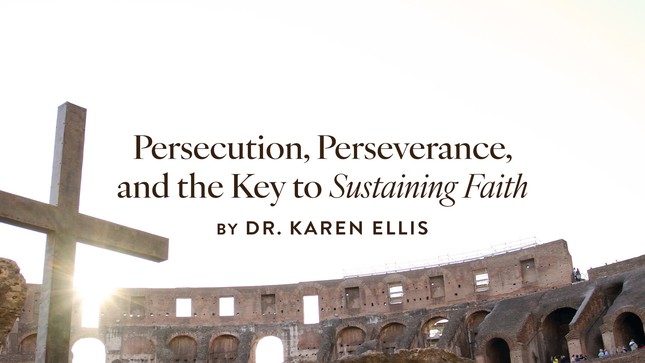
At True Woman '22, she led a session called “Persecution, Perseverance, and the Key to Sustaining Faith.” We’re going to listen to part one of that message today. Karen begins by answering two questions: Who are the people of God? And what makes us different? Let’s listen.
Karen: So I’ve been tasked with talking to you this afternoon about what are the ingredients that make up this thing we call “sustaining faith.” And what is the power in this sort of faith?
My husband and I are part of an educational center that is done out of the Reformed Theological Seminary in Atlanta, and it’s called the Edmiston Center. At the Edmiston Center we study how Christians in history and in the contemporary world live with different levels of restricted religious freedom.
The Edmiston Center helps Christians, pastors, leaders, and lay people understand how Christians persevere under hard circumstances. And that can be anything from soft marginalization all the way to outright persecution.
We’re trying to move from advocacy to education because there’s a really amazing thing happening in and through the Church right now. The Church is beginning to speak to herself across geographic and linguistic lines.
I’m a small cog in the process, but I’ve been blessed to facilitate letters from the Church in China to the Church in Afghanistan. There are actually some churches now in the restricted world who are beginning to write to the Church in Ukraine. And there are folks that are now starting to write from the Church in the Middle East to us here in the West. And they’re publishing. This is really exciting.
Now, I’m not saying that this is the continuation of any kind of the book of Acts. I’m not saying that these are epistles that should be included in the Canon of Scripture. We all agree that the Canon is closed. Right? It’s efficient for everything that we need to do and need to live. Right?
But this is really significant because now the Church is once again starting to speak to herself across all these lines. That’s really exciting. I feel like that’s a really important moment in Church history.
We’re going beyond just sharing the stories of those who live under persecution and under hostility and in restrictive circumstances. Now we’re moving into how do you do what you do? How do you disciple in your context? Why does your church look like the Church in the New Testament?
A lot of this same kind of movement is starting to happen in churches in our rural areas, churches in urban areas. The players who are the persecutors may take different forms and different faces, but they’re still hostile against a truly transformative Christianity, where the people change their affections and their loyalties.
This is a really exciting time to be a Christian. The darker it gets, the more bright the light shines.
After working alongside organizations that serve the persecuted Church, the people I serve are really the ones doing the hard work. I just come alongside and say, “What y'all doing?” But the people I serve understand how important it is to persevere and to present themselves as a people deeply rooted in and yet set apart from all the other communities that surround them.
A lot of people talk today about Christians being countercultural. You ever heard that? But these persevering Christians are not just countercultural. That is, they aren’t existing solely to overthrow their surrounding cultures. What they’re trying to do is nudge their cultures closer to the kingdom of God.
They’re also not apolitical. They’re not withdrawn from the political system. They’re not against politics. But what I like to say is they are actually not countercultural and not apolitical, they’re actually other cultural and other political. They’re formed by a different culture and a different set of politics.
A political and cultural system based on the life, death, resurrection, and glorification of Jesus Christ, on whose shoulders the government will sit one day and will have no end. So they live in places, and they express being other cultural in places where it’s socially difficult, physically dangerous, and, at times, even lethal to be a Christian, whether you’re a Christian in heart or just in name.
Now, before we start to think how hard that must be and how bleak it must be, at the same time, it’s actually the place where your anxiety turns into adventure. I always joke that’s going to be my t-shirt. We’ve got to get that merch going . . . anxiety to adventure. Right?
As our culture is rapidly shifting around us, where is that place where our anxiety becomes adventure? It’s in the place of sustaining faith. And we see the wisdom and the creativity that they regularly display through persevering faith.
A lot of people would think, I think, that in their situation, surviving or maybe even gaining power would be their goal. Right? Because they’re completely powerless. Also interesting is how in the powerless position, the Church doesn’t have the weapons. They don’t have the political power. They don’t have the cultural clout. And yet, so much political power and weaponry is used to keep them down. It’s, like, what weapon do we have?
We’ve got the Word of God. The enemy knows that that is way more powerful than any weapon, any arsenal, because that is what changes hearts.
So, surviving doesn’t become the goal. For the Christian, faithfulness becomes the goal. And out of faithfulness, we thrive. There is a power in powerlessness that emanates from the cross to the margins of our societies.
And we get these questions that come up. In the midst of all of today’s conversations about earthly justice, we start to form questions like:
- How do you live when there is no justice?
- How does the Body of Christ do more than just survive?
- When there is no justice, how does the Body thrive despite her circumstances?
- How can we develop the faith to help those people around us flourish in hard circumstances so that our flourishing becomes a witness to the transformative power of Jesus Christ?
Now, I think that some of you in this room possibly know very well what it is to live under anti-Christian hostility. You know that it’s not glamorous. In its worst manifestation:
- It can be torture.
- It can be forced marriage or slavery.
- It can be imprisonment, unjust imprisonment where you’re now a criminal because you believe.
- It can be homelessness.
- It can be chronic displacement in a less volatile environment.
- It’s job instability.
- It’s isolation.
- It’s being ostracized.
- It’s being put out of your family.
- It is at best being the shame of the culture around you.
But God . . . You see, this is from the perspective of the outsider looking in.
From the perspective of the insider looking out, it’s a very different picture because on the flip side of our persecution lies our faith-filled perseverance. It’s filled with the hope of Christ and His promises in the Word that drives out the fear of man that causes the shame.
It’s love so consuming that we would abandon everything to keep it. It doesn’t boast of itself. And it doesn’t wear suffering as a badge of honor. Rather than saying, “Look at me! Look at how I’m suffering.” It says, “Look at Christ who suffered for me.”
One thing we can learn about persevering Christians is that persecution becomes perseverance in community. And that community exists even when we’re isolated and alone because if God is always with us, as He promised us before He went up to the right hand of the Father, He said, “I will be with you to the very end of the age.” We are never truly alone. So it’s communal always, whether with other believers or with God Himself.
It’s creativity because it’s pain mixed with hope. Human rights organizations acknowledge that 75 percent of the world’s Christians are living under some form of anti-Christian hostility. That makes us the other 25 percent in the freer world. Two hundred fifty million Christians persevering under biblical persecution with a wide range of responses and coping methods and strategies.
There is a lot of talk today about listening to the marginalized voices of the world. When we listen to these voices, this is them. This is a very large marginalized population, globally.
And if we want to understand what informs a persevering faith, for the purpose of this seminar, we’re going to think about three things, at least.
First question is, “Who are the people of God?” Why are we different? What makes us different? What makes us that other culture?
Second question, “What’s our responsibility to each other?”
And the third question is, “How can we develop, not just the faith to endure, but the skills of endurance that go with that faith?”
So, question one, “Who are the people of God?”
Now, come on back with me for a minute. One time my husband was listening to an old-school preacher, country preacher, and he said, “Come with me back to the days before David.”
And the congregation was, like, “Yeah! Yeah! Yeah! Come on! Preach it!”
And then he said, “Come with me back to the days before Noah.”
And they were, like, “Yeah! Come on! Come on, somebody! Come to the days before Noah.”
And the preacher said, “Come back with me to the days before Adam.”
And they’re, like, “Yeah! Yes, the days before Adam!”
And then the preacher said, “Come back with me to the days before God.”
And somebody in the back said, “That’s too far back.” (laughter)
So, come back with me to the days before all this got messed up. I want to reflect for just a moment on where hostility comes from and why it’s so persistent around the world and throughout history. So let’s go back to what we know. We all know this. Right? Just a quick review.
God created everything in the Garden for the man and woman to flourish. Every created thing was dependent on the thing that came before it to survive. You couldn’t have the beasts of the field until there was a field for them to eat. Right? So everything was created in an order so that the thing that comes after it can survive and thrive.
By the time Adam and woman arrive, everything that they need, not just to survive, but to flourish, is there for them. He didn’t need to make anything else for them. This was their sanctuary. This was their safe space.
And God’s intention was for them to flourish and to know shalom. They represented not only the first marriage, and not just the first family. They represent the first people of God, worshiping, living in communion with and under the authority of the One who created them. And we can see them in this kind of double role, representing all of humanity. They’re the first two humans but also representing the first people of God.
Why the first people of God? Because God makes them a promise they can't refuse—not an offer they can’t refuse, like The Godfather—a promise they can’t refuse, a promise that lays claim to their belonging.
If you were to sum up the Bible in one glorious sentence, it would be this: I will be your God, and you will be My people.
Now, He doesn’t say it to them literally, but He infers it. Genesis 3:15 He says, “You cannot mess this up. I will keep you because you cannot keep yourself.”
And He swears by Himself to keep us throughout history. This people that He created for Himself to worship Him. He’s a covenant-keeping God . . . come on. So as people worshiping the one true God in the sanctuary that He prepares for Him.
They’re the people of God. They’re the people of the promise. And they’re the first people of humanity, carrying both promise and disappointment in their loins.
And God swears by Himself no matter what happens, this flourishing that we’re experiencing, this shalom, this peace, and this communion will be not just kept for us but made even better at the end of all things. There’s a declaration, “It was very good.” It is quite different from, “Behold, I’m making all things new.” It’s quite different from, “Now the dwelling of God is with man.”
You know that song . . . I don’t know if you guys remember this gospel song that goes, (singing) “Let’s get back to Eden, sit on top of the world.” I’m like, I don’t want to go back there! I don’t want to go back to Eden. There’s sin back there. The trajectory of the Bible is always forward.
Do you ever wonder what that snake was doing there if it was very good? It might have been very good, but it wasn’t perfect. Perfect comes with Christ in glory. So, the trajectory of the Bible is always forward, always towards God’s intent for our flourishing.
So, okay, back to the Garden. Enter Satan. Here he comes. “Let me holler at you. Come here. Did God really say . . .?”
And so the first people of God end up being deceived by the entity that does not want them to flourish. It does not want them to do well. It wants them to be thrown in the Lake of Fire, which was what was supposed to happen, but God had mercy. Right?
- Ultimately, it wants to oppress them.
- It wants to destroy their trust.
- It wants to confuse their worship.
- It wants to thwart their wisdom.
- It wants to destroy their relationships.
- It wants to distort their way of thinking.
- It wants their children.
- It wants to frustrate their housing opportunities–you know, that’s the day man lost his property. He got kicked out of the Garden.
- It wants to eliminate their ability to work.
- It wants them and everything that was set up for their flourishing to be destroyed.
So by the time we get to Revelation, that serpent is a full-blown dragon. No longer troubling the first two people of God, but troubling all of God’s people.
So much so that this is the moment when John the revelator sees the Lamb open the fifth seal. He sees under the altar all the souls of the faithful who’ve been slain for the Word of God and the word of their testimony. They cry out with this loud voice, “How long do we have to suffer? How long do we have to suffer?”
Just one generation after our first parents, things escalate very quickly. And after that, the argument over who we will worship and how we will worship goes bananas. We get the first murder.
The division sown between the people of God and the people hostile toward those who want to worship rightly and those who don’t. Brother murders brother. We go straight from disobedience to outright murder.
Was this just a battle between two brothers? I say no. This was a spiritual battle. Let’s call this the religion of Cain vs. the worship of Abel. Or, the religion of self vs. the worship of God. Worshiping my way vs. worshiping God’s way. And out of the religion of Cain grows this destructive hatred toward the people of God because they want to worship rightly.
What happened in and outside of the Garden, because we’re out now. Once we get to Cain and Abel, we’ve been booted out. What happened in the Garden was an all-out tactical assault against those to whom God had made the promise, “I will be your God, and you will be My people.”
Cain vs. Abel. Cain takes the way of his mother and father. Abel takes the way of the cross.
Cain says, “Abel, if you’re gone, if you’re wiped off the face of the earth, my worship will be acceptable. I’ll remove the competition.”
Cain seeks dominance. Abel seeks faithfulness.
And here’s something curious. Oh, praise Thee, God! I’m so glad they didn’t make me be God. I wouldn’t have done it this way. Here’s something amazing: Even in this, God is merciful to Cain.
We’re all Cains. God is merciful to Cain, the persecutor. His ways are not our ways.
Our ultimate enemy is not people. It’s the one who has been the enemy of Christ and Christ’s people from the beginning. But this underscores the major and basic pattern of the world today. The difference is only in how it gets carried out. And so the beat of oppression continues on and on and on.
Throughout the line of history, Satan attacks the people of God in the Garden and deceives them.
The first child, Cain, persecutes his brother in the first act of persecution—violent persecution against the people of God.
And so it is today.
The old people used to say, “Say ought to match do.” And the resentment against Abel that Cain had was because his ethics, how he obeyed God, and his epistemology, what he knows about God, matched. Say ought to match do.
Satan loves it when our "say" and our "do" don’t match. "Have great theology, but behave any way you want."
All the oppressed people on or throughout history are actually types of the original oppression of the people of God. Satan despises those who walk that line where their "say" matches their "do."
Now, not everyone who is oppressed is a part of the people of God. Oftentimes in restricted countries, there are other communities that are just as oppressed as the Christians, but that doesn’t mean their oppression isn’t real. As a matter of fact, that’s what makes Christians robust human rights and civil rights activists, because we all understand we’re made in the image of God and worthy of the protection of life.
Not everyone is made in the image of Christ. It’s biblical to make this distinction because it’s a distinction that God Himself makes. While on the one hand God is patient with us, not wanting anyone to perish, but everyone to come to repentance—the imago dei is respected. But at the same time, precious in the sight of the Lord is the death of His saints. It’s the image of Christ.
A biblical understanding of persecution resists being defined by ethnic groups, tribes, genders, causes, or any human division. It is defined by alignment and identity with the Person of Christ but still maintains the importance of our unique cultures, our ethnicities, our historical placements—why am I alive in 2022 and not 1822? This would be a really different conference if that were the case.
It doesn’t erase those things. I like to say I’m African American by divine design. We have a rich history that harmonizes with much of the Bible, and our creativity and our resilience. So do many other ethnicities throughout history. God’s ethnic diversity is on full display in the invisible Church, in the underground Church, with all our joy and redeemed pain. The invisible Church and the underground comes alive in vivid technicolor. This is who we are.
All the talk about inclusion today, the Body of Christ is the most radically inclusive community on the face of the earth. And God has made it so. So we who bear the image of Christ and long to worship rightly after the pattern of Abel, we’re different throughout the Bible. We’re different throughout history.
Even in how we address the wrongs against us. We’re another culture altogether. Historically, the invisible biblical Church doesn’t seek dominance. She seeks righteousness. She seeks faithfulness. She seeks truth. Her method is God’s method: love unto flourishing and not destruction.
Nancy: That’s Dr. Karen Ellis, talking about the faithfulness of the global church. Those facing persecution aren’t merely surviving; they’re flourishing. I don’t know about you, but that gets me fired up. It makes me excited and thankful to be a part of this global body of believers.
Now, maybe you’re facing some level of persecution today. That could look like discrimination at work or strained relationships. You might be feeling lonely because the people around you know you’re a follower of Jesus and they ignore you or mock you for it. Whatever the case, God is asking you to persevere. He’s asking you to be faithful.
Our team has put together a booklet for you called Endure: 40 Days of Fortitude. We want to help you walk daily with Jesus, drawing grace for each step. Through Scripture and encouragement, you’ll be inspired to stand firm in Him. We’d love to send you a copy to say “thank you” for your gift of any amount this month. To give, visit ReviveOurHearts.com or call us at 1-800-569-5959. When you do, be sure to request the booklet Endure: 40 Days of Fortitude.
Tomorrow, we’re hearing more from Karen Ellis. She’ll be talking more about what our responsibility is to each other as members of the single, global church, and I’m excited for us to think about that together. Please be back for Revive Our Hearts.
This program is a listener-supported production of Revive Our Hearts in Niles, Michigan, calling women to freedom, fullness, and fruitfulness in Christ.
*Offers available only during the broadcast of the podcast season.
Support the Revive Our Hearts Podcast
Darkness. Fear. Uncertainty. Women around the world wake up hopeless every day. You can play a part in bringing them freedom, fullness, and fruitfulness instead. Your gift ensures that we can continue to spread gospel hope! Donate now.
Donate Now