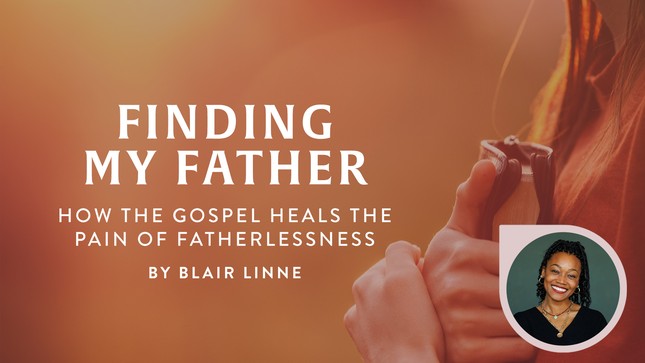

Fatherlessness and a Daughter’s Heart
Dannah Gresh: Blair Linne says her earthly father’s absence led her to believe her heavenly Father would be distant, too.
Blair Linne: I viewed God as just a Judge who pardoned my sin, but not a Father, not a Father who’s tender, who loves me, who cares for me, who sings over me, who has graciously chosen me—chosen me!
Dannah: This is the Revive Our Hearts podcast with Nancy DeMoss Wolgemuth, author of Adorned, for August 14, 2025. I’m Dannah Gresh.
Nancy DeMoss Wolgemuth: Our theme for the month of August is “When Life Gets Hard.” Sounds like that could be a theme for a lot of months, right? Our hope is to approach your suffering, your difficulties by gently applying God’s Word to the various scenarios you may encounter. Today we’re going to look at one specific type of suffering.
The pain of fatherlessness—that’s …
Dannah Gresh: Blair Linne says her earthly father’s absence led her to believe her heavenly Father would be distant, too.
Blair Linne: I viewed God as just a Judge who pardoned my sin, but not a Father, not a Father who’s tender, who loves me, who cares for me, who sings over me, who has graciously chosen me—chosen me!
Dannah: This is the Revive Our Hearts podcast with Nancy DeMoss Wolgemuth, author of Adorned, for August 14, 2025. I’m Dannah Gresh.
Nancy DeMoss Wolgemuth: Our theme for the month of August is “When Life Gets Hard.” Sounds like that could be a theme for a lot of months, right? Our hope is to approach your suffering, your difficulties by gently applying God’s Word to the various scenarios you may encounter. Today we’re going to look at one specific type of suffering.
The pain of fatherlessness—that’s a tender subject for many I know. The statistics suggest that here in the U.S. one in four children are growing up without a father in the home. So if you've not suffered this pain personally, it’s likely that you know someone who has.
Let me say, "I am Ssoglad you’re here." Today, we’re going to listen to part 1 of a message Blair Linne gave in a breakout session at a recent True Woman Conference, sponsored by Revive Our Hearts. Blair is a Bible teacher, an actor, and a spoken word artist. And she’s also the author of Finding My Father: How the Gospel Heals the Pain of Fatherlessness. If you’ve experienced an absent earthly father, Blair understands. She gets that, and she had some powerful wisdom to share based on her own experience. Let’s listen to Blair Linne.
Blair: If you have a piece of paper, if you have a pencil or pen, I’m going to start us off with a question. It’s something I want you to think about and write down.
I want you to consider what adjective you would use to describe how you feel when you think about your earthly father. What’s the adjective that you think best describes you and how you feel about your earthly father?
I want to encourage you to write down your words without judging yourself. Just know no one is going to grade your words. I just want you to try and be as honest as possible. I know in a room like this, there is probably going to be a diverse group of words that will be written down.
For some of you, you may experience joy. When you think about your earthly father, you think about joy. You think about protection, and you think about provision, and you think about gratitude.
I know that there are going to be others here, when you think about your earthly father, you might think about feeling abandoned. You might feel shame or grief, confusion or pain. Maybe you feel exhaustion or distrust.
I know some might feel disgust or hatred or contempt. Maybe you feel numb. Maybe you feel indifferent or detached or calloused or paralyzed.
We all have our words. Words communicate our feelings. Often our words are just buried deep in our hearts, never to escape.
God can handle our feelings. God knows them already. And the truth is, what you’re feeling right now is probably what someone else in this room is feeling. You’re not alone. I’ll say that. Until we allow what we feel on the inside, whether good or bad or all in-between, until we allow it to be brought to light, we won’t know the extent to which fatherlessness has affected us.
I think that this is a topic, fatherlessness, is a topic that’s rarely spoken about. In my book, I call it the “elephant in the room.” We know it’s a problem. One in four children right now are being raised in a home without a father. I’m not even just talking about your biological father—without a step-father, without an adoptive father. One in four children are in a home like that now.
It’s one of the most significant social problems facing us, and yet there’s not a collective movement to shift this epidemic that we see, that I see. But God . . . So God has spoken about fatherlessness, and He demands the Church do something about it.
I want to talk today to the daughters in the room, the daughters who are here dealing with fatherlessness. And then, at the end, I also want to talk to the daughters who are walking side by side with their sisters who are dealing with fatherlessness. You want to know how to best support and come alongside those who may be dealing with pain.
I don’t have to tell you that life can be hard. I think sometimes the chapters of our lives as they unfold, and sometimes it catches us off guard. If I had a clue how my life would unfold, I don’t know if I would have laughed, like Sarah, or just wept because things are hard, things are difficult.
Sometimes it’s hard to reconcile these hard truths. We can struggle with the father that we desire to have from the father we actually have. I want to encourage you to deal with what’s before you today. We have to deal with what is actually true, even if it’s hard. We can take those hard truths, those true realities of what it means to live in a fallen world, and we can learn to cast them over to our God.
My story is about physical absence, the physical absence of a father.
My mother and my father actually were never married. When my mother found out she was pregnant with me, they weren’t even dating. She was going to abort me and ended up talking to a Baptist minister which convinced her otherwise.
She decided she was going to give me up for adoption. She was already a single mother. My sister was four at the time. And so, I just think the weight of what does it look like to be a mother of two children and unwed really weighed on her. She was going to give me up for adoption. She had a c-section, and she said after she had me, I just stared at her. And so, the Lord somehow worked in that, and she decided to keep me.
But life was hard. My father, at the time, would, I remember . . . Well, I don’t quite remember, but I was told when I was very young, there were times I would go over to his house. There were times he would bring big bags of candy to me and my sister and my cousin.
When I was three, my mom moved us across the country. She moved us to California—from Michigan to California. There really wasn’t much of a relationship there with my father. There always seemed to be just a barrier or a wall up.
I remember around nine or so him calling on the phone. We might talk once, maybe twice a year, for about five minutes. And during those conversations, I remember I often wanted to just say, “I know that this is not the way that this should be. I long for more,” even at nine. But I was too afraid to share that with him because I felt like if I opened up and shared that, maybe the little bit of time I had with him would go away, and so fear just kept my mouth muzzled.
It wasn’t until nine years later that I had the courage, at eighteen, to communicate with him and say, “You know, I am really struggling, and I’ve been affected by your absence, and I’ve been afraid.”
I was having a conversation with him, and I just thought, I just can’t have another conversation without communicating how much I’m suffering because this isn’t a relationship. Like, we don’t even know each other. I don’t know your interests. He didn’t know my interests. And so, I just kind of blurted it out. Like, “This is hard. I’m struggling. I’m afraid. But I’m just going to get it out.”
I thank the Lord for that conversation. I will say, he did try to make more of an effort after that conversation when I was eighteen, but it was still hard. I talk more about my story in my book, but my story is more about that physical absence.
I do know, though, that there are others of you here who, your father lived in the home with you. You may be dealing with the emotional absence of a father or the spiritual absence of your father. He’s there, but he’s not there. Right? The statistics don’t deal with that.
Maybe you dealt with something even worse. You had a father who was in the home, but he was emotionally or physically or spiritually or even sexually abusive.
I have a friend who, from the age of nine to thirteen, she was sexually abused by her own father. At thirteen, he impregnated her. She was forced to get an abortion, and her dad completely denied it.
One in five women have been sexually assaulted. I think sometimes we talk about sexual abuse today, and because we want to protect our children from the stranger, we want to be so careful about the stranger, which is right and good. But 93% of children who are victims of sexual abuse, they know their abuser. It’s someone they know, someone they’re familiar with.
I know that there may be a sister here in this room, and you’re carrying a hard truth that maybe no one knows about. My prayer has been that you will be set free today, that today will be the beginning of a new journey. I know that it’s a process. I have not personally experienced sexual abuse. I’ve experienced spiritual abuse. But I know with all abuse, there is a process.
But the truth is, we are not bound by the sinful choices of our fathers. And so, it’s not enough, even with those one in four children, or if you’ve experienced fatherlessness, it’s not enough to just say, “Fathers, get back to the home.” I think this issue with fatherlessness goes beyond that because, as I said, a father could be in the home and could actually cause more damage if he were in the home than if he were not in the home.
It has to be more than that because many of our fathers are lost. They don’t know what a father is because they don’t have a heavenly father. Our fathers need a Savior. Our fathers need to know that there is a heavenly father who has given them purpose and actually will hold them accountable for their sin.
Unregenerate fathers, I think they’re so used to following that first human father, Adam, when he sinned. They’ve lost the truth of who they are actually called to imitate. We don’t know what a father is anymore.
First Timothy 5:8 says that, “If anyone does not provide for their relatives, and especially for members of his household, he is denied the faith and is worse than an unbeliever.”
According to the Bible, a father, a human father is to be a shadow. A human father is to shadow. It’s a male parent. He is made in the image of God.
- He is to be the head of his household.
- He is to work and provide.
- He’s responsible for training his children.
- He’s to make sure not to provoke his children to wrath, but to raise his children up and to nurture them in the nurture and admonition of the Lord.
- He should be the first man his daughter loves in purity.
- He’s called to care for his family in a spirit of gentleness, to display and model for his daughter what she should look for in a man.
- He is to instill blessing and identity in his children and to model, not perfectly, but in faith model God the Father.
So this is what a father is to be. When an earthly father doesn’t model God the Father, it leaves room for the father of lies to slither in. And so Adam’s sin, we see in the Scripture, affected Cain’s sin. It just trickles down and trickles down, all the way down that genealogical line to us, to our fathers, and then to us.
Fathers are important. Fathers matter. I say in my book how I believe that fathers are under attack. We have believed the lie, Satan’s lie, that mothers matter, but fathers are dispensable. Like, it’s not really about the fathers; it’s about the mothers.
But I believe Satan knows if he can execute the man, that there will be several caskets following behind that man. If our fathers are lost, it affects so much about us. It affects our identity. It affects how we interact with others. And it affects how we interact and see God.
Another question I want you to write down and consider is: What lies have you believed as a result of your earthly father’s absence? What lies have you believed as a result of your earthly father’s absence?
I know I have believed many lies. Maybe we’ve believed the lie that we need to have a man’s attention in order to feel special because we haven’t had our dad’s attention. Or, I think the other side of it is believing the lie, “I don’t need a man. I’m good.” So we’re militant in our singleness.
Singleness is beautiful. Don’t get me wrong. But it’s beautiful when it’s done in faith. I think it’s pretty ugly when it’s done in fear.
Maybe we’ve believed the lie that our value is in our performance. So, if we’re really good, then maybe they’ll stay. Maybe they won’t abandon us if we’re good enough. That means that we view our worth in our looks or in our worth or in our education or in our wealth. “If I have it together, then they won’t leave me. I’ll be okay. I’ll make them stay.”
Maybe we have a distorted body image or chronic dissociation or chronic depression or self-abuse or boundary confusion as a result of the lies that we’ve believed.
It doesn’t take long to realize that behind all of these lies is a fear. There can be this unaddressed trauma fed to us by the father of lies because our father was absent.
I say in my book that we’re both victims and rebels. I’ll explain what that means: victims because we’ve been victimized by other people’s sin—all of us have in one way or another. Rebels because we often choose to rebel against God with our own sin.
Victimization is never an excuse for rebellion, though. We’re not responsible for what happened to us as children. We are not responsible for the choices our parents made. Not at all do we hold any responsibility for the choices they’ve made. Our father’s absence is not our fault. It wasn’t because of something we did. We’re not the center of our parents’ choices.
So the women in the room who’ve had their fathers in their home, it wasn’t because they were better than you or they didn’t sin. It had nothing to do with them. Your father’s absence had nothing to do with you. Our parents made a choice that we can’t change.
But we are responsible, though, for what we do with our pain as we grow into young adults and adults. So as hurtful as the decision that your dad or your mom made, eventually we’re going to have to wake up one day, and we’re going to have to decide: “You know what? I’m not going to be a victim. I am going to live victoriously.”
I want to think a bit about this victorious life. I think about it in two categories. I think we have to address the vertical, and then we have to address the horizontal. Our heavenly Father, that’s the vertical, and then our earthly father, that’s the horizontal.
I want to start with our heavenly Father.
For many years I started my prayers off with, “Our Father who art in heaven.” I was taught that prayer, like many of you were taught that prayer. However, the idea of God actually being my Father, I didn’t reconcile that with how I thought God felt about me in the day to day. I knew humanity was born into sin, but I ran away from God.
There are at least two ways to run from God. You can run away from God through immorality, or you can run away from God through morality. I ran away from God through morality. That’s kind of what I gravitated towards—legalism, moralism, self-righteousness, thinking that, again, perfectionism could justify myself before God.
When I realized that I was serving the father of lies by clinging to those things, I then acknowledged, “I personally needed a Savior.” I needed someone outside of myself—a sacrificial lamb. I needed the Son of God to die for me and resurrect for me in order to make me God’s child.
As I agreed with God’s Word, I began to cry out to God, and He saved me. However, when I trusted in Christ as my righteousness, I kind of projected my earthly experience onto my spiritual experience. I knew God saved me, but I thought, Oh, He’s merely tolerating me. I don’t know if He really loves me.
I viewed God as just a judge who pardoned my sin, but not a father, not a father who’s tender, who loves me, who cares for me, who sings over me, who has graciously chosen me—chosen me.
I thought God did not want to be near me because my earthly father didn’t appear to want to be near me. That changed once I began to open up the Scripture. I began to see God’s character not through the lens of my pain and my brokenness, but through His pledge and through His beauty.
I saw His faithfulness. I saw His consistency. It blessed me.
Nancy: That’s Blair Linne, who spoke at a breakout session at True Woman '22. She’s inviting women with absent fathers to consider, “How has this absence affected my view of God—my heavenly Father?” It’s an important question, and we’ll unpack it more tomorrow. There’s information about how you can get a copy of Blair’s book, linked in the transcript of today’s program at ReviveOurHearts.com.
Now if today’s message resonates with you and you’d love to hear more from Blair Linne, she’ll be with us in Indianapolis for True Woman '25 in October. I am so excited to marvel at God’s Word alongside this sweet friend. If you’d like to hear from Blair in person, you can still register to join us. Visit TrueWoman25.com to sign up today.
Dannah: And Nancy, Blair has also been working on a special project with Revive Our Hearts—a new podcast!
Nancy: That’s right! As you may be aware, I’m busy these days, recording a year’s worth of programs where we'll be taking what I like to call “a helicopter ride” through the entire Bible.
Dannah: It’s not a hike.
Nancy: Not a hike, but a pretty detailed overview of the Scriptures—Genesis to (as my husband likes to say) the maps. From one end of Scripture to the other. That project is “Wonder of the Word.” And here on Revive Our Hearts we’ll start with Genesis chapter 1 in January of 2027, Lord willing. And we’re working hard to translate those programs into multiple languages, as well
Here’s where Blair comes in. She’s helping us record an audio-only podcast that will come alongside Wonder of the Word. It’s called “Wonder of the Word Highlights.” Each episode is only a few minutes long, so they’re more bite-sized. But still nourishing! I like to think of Wonder of the Word Highlights as an appetizer for the main course, to help listeners have a good takeaway thought, and to make them want to hear more.
Dannah: Well, let’s listen to an example of an episode of Wonder of the Word Highlights, featuring you, Nancy, and Blair Linne.
Blair: This is Wonder of the Word Highlights with Nancy DeMoss Wolgemuth. I’m Blair Linne.
We’re walking with Nancy through the whole Bible. We began by looking at the beauty of creation and the wonder that humans were made in God’s image. But by the time we get to Genesis 6, we see that everyone on the entire planet had rejected God.
Nancy: “The Lord saw that human wickedness was widespread on the earth and that every inclination of the human mind was nothing but evil all the time.”
Blair: So God decided to judge the evil on the earth. Chapter 7 says, “The floodgates of the sky were opened, and the rain fell on the earth forty days and forty nights.”
Nancy: Noah, however, found favor.
Blair: In his mercy, God called Noah to build an ark to escape a worldwide flood.
Nancy remembers watching a dramatic presentation of this story at Sight and Sound Theater in Missouri.
Nancy: And when you come back from intermission and the lights come up, you find that the seats in the auditorium are now in the ark.
And then you start to hear the rain on the outside of the ark. And the patter of the rain becomes a torrential downpour. And you can hear as the waters start to rise, the people outside the ark screaming out in desperation as they are about to perish.
And I can remember as I was sitting there that day, just overcome with the sense of what it meant to be in the ark. And I just kept saying to myself, “I’m safe in the ark. I’m safe in the ark. I’m safe in the ark.”
Blair: Our day is a lot like Noah’s. Every inclination of the human mind is nothing but evil all the time. My mind thinks up evil. I know yours does too. We are all sinners, and we all deserve God’s wrath.
But God sent His Son to live a perfect life, die in our place and give us His righteousness.
Nancy: Christ is our ark, our safe place, our place of safety, our refuge from the wrath of God and even as those floodwaters beat up on Him there on the cross, we are safe in Him from God’s judgment.
Blair: So when you put your faith in Jesus, you can say:
Nancy: “I’m safe in the ark. I’m safe in the ark. I’m safe in the ark.”
Blair: This was just a highlight from Nancy’s teaching series, The Wonder of the Word. You can follow along with the whole series on the Revive Our Hearts podcast, or watch the teaching on video. Visit ReviveOurHearts.com to learn more. Then join us again next time, here on Wonder of the Word Highlights.
Wonder of the Word Highlights is a production of Revive Our Hearts, calling women to freedom, fullness and fruitfulness in Christ.
Dannah: Again, that’s a sneak peek at an upcoming resource, Wonder of the Word Highlights, from Nancy DeMoss Wolgemuth and Blair Linne. It will be translated into many languages, so that women all around the world can be fed.
Nancy: It is a privilege for me to be studying God's Word from cover to cover. I look forward to doing that with you in the days ahead. And it’s only possible because friends like you give. I’m so grateful for each person who says, “I value this ministry. I align with the mission of Revive Our Hearts, and I want to partner financially.” If that’s where you are, if you’d like to invest in the mission of Revive Our Hearts, you can make a donation at ReviveOurHearts.com, or call us at 1-800-569-5959.
Dannah: And when you give a gift of any amount, we’ll send you A Small Book for the Hurting Heart by Pastor Paul Tautges. It’s our way of saying thank you for partnering with us through your generosity. Again, contact us at ReviveOurHearts.com or 1-800-569-5959.
Tomorrow, we’ll listen to the rest of Blair’s message. She covers the doctrine of adoption, forgiveness, and spiritual family. I hope you’ll join us. Please be back for Revive Our Hearts.
This program is a listener-supported production of Revive Our Hearts in Niles, Michigan, calling women to freedom, fullness, and fruitfulness in Christ.
*Offers available only during the broadcast of the podcast season.
Support the Revive Our Hearts Podcast
Darkness. Fear. Uncertainty. Women around the world wake up hopeless every day. You can play a part in bringing them freedom, fullness, and fruitfulness instead. Your gift ensures that we can continue to spread gospel hope! Donate now.
Donate Now