
In 2018, as part of her personal devotional life, Nancy began journaling through the Bible: one page, one paragraph, one verse at a time, starting in Genesis 1. Five years and thousands of hours later, she reached the end of Revelation! She called those hours her “happy place”—and looks back on this exercise as one of the most life-giving experiences of her Christian life. Join Nancy as she shares tips for effective notetaking and Bible reflection she learned through the process.
Running Time: 63 minutes
Transcript
Robert Wolgemuth: I'm Robert Wolgemuth. I have been Nancy's husband for almost exactly ten years. It's true. (applause) Thank you. I'm the one who should be applauding, believe me.
So in December, Christmas of 2017, Nancy got a special gift from a friend, and it was a Bible. Now, it's interesting. You would think that Nancy has a lot of Bibles. She really does, but this was a special kind of Bible. It was actually published by Lifeway. It had wide margins left and right, so you opened it up, and on the right and on the left it was probably like two inches, which is a lot.
So I’ve got to tell you something. When Nancy and I see each other in the morning, we don't say good morning. We say, “Oh, goody.” I'm serious. We grown ups talking like that. It's true. You know, it's easy …
Robert Wolgemuth: I'm Robert Wolgemuth. I have been Nancy's husband for almost exactly ten years. It's true. (applause) Thank you. I'm the one who should be applauding, believe me.
So in December, Christmas of 2017, Nancy got a special gift from a friend, and it was a Bible. Now, it's interesting. You would think that Nancy has a lot of Bibles. She really does, but this was a special kind of Bible. It was actually published by Lifeway. It had wide margins left and right, so you opened it up, and on the right and on the left it was probably like two inches, which is a lot.
So I’ve got to tell you something. When Nancy and I see each other in the morning, we don't say good morning. We say, “Oh, goody.” I'm serious. We grown ups talking like that. It's true. You know, it's easy to get into such routines in your home that you don't celebrate much anymore. So that's just kind of a tip you can write in your notes. Robert says, “Say ‘oh goody, or oh boy.’” That also works when your husband walks in the room.
So January of 2018 Nancy opened this journaling Bible, and she began to write. Now we're still in bed. This is TMI, right? I usually get up before Nancy does, but on this particular day, we got up about the same time, like New Year's Day, 2018. She's starting to write in the margins of this Bible. I don't know if you've seen Nancy's handwriting, but you almost need a microscope to see it. Anybody remember microfiche? You had those readers? Nancy can actually go directly to microfiche with her own hand. It's so tiny. So she's writing in the margins of this journaling Bible.
And I said, “What are you writing?”
And she said, “Well, just thoughts that come to my mind, ideas, reflections on the text.”
So I'm watching her do this day after day, week after week, month after month. You might know that I'm in the publishing business, and my primary career for the last fifteen years has been to represent authors, to connect authors with publishers. So somebody sends you a manuscript, you find a publisher to publish it. I've been an agent pulling those two things together.
So I'm looking at this Bible that Nancy's writing all these notes in. And my first thought, this is not a very spiritual thing to say, but was marketing. So I said to her, “Do you think women around the world would be interested in what you're actually writing in the margins?”
And my humble wife kind of shrugged and said, “I don't know.”
She's not usually wrong. This time she was wrong, because I think the answer is an absolute enthusiastic “yes!” So I didn't say much about it. This is the ultimate discipline, because for two years, I watched her do this. And finally, after two years, I couldn't stand it, so I made a contact with publisher, friend Lifeway, who publishes the CSB Christian Standard Bible. I said, “You might be interested in seeing Nancy's Bible, because she's got the journaling Bible that one of your colleagues sent her, and she's writing in the margins. I think someday that could be a journal, a devotional Bible, a study Bible, something like that.”
So we met with him. You should have seen his face when he saw this Bible with all these tiny handwritten notes in the left and the right margins. A really fun, quick side story on that. Years ago, forty years ago, Nancy had a friend contact her. And this particular friend, a bright woman, well educated, but not walking with the Lord, but she needed some work. So, Nancy is a journaler. Who's a journaler here already? Oh, good for you. So Nancy had stacks of journals. She always had wanted them to be digitized. She had given those journals to this friend and said, “I'm going to pay you to digitize all of these. Make documents out of them.”
And so she did that. All right, go forward thirty years. That woman's fifteen-year-old daughter needed some work. So Nancy started to take screenshots on her phone of the journaling that she was doing in the margins of this Bible. And that young lady, the daughter of the woman who thirty years ago had actually been transformed by taking Nancy's journaling notes and putting them in computer, that young lady started this process.
So every few days, Nancy would take a shot, send Karia the shot. Karia would stroke it in. After five years, Nancy finished. You might not be surprised by this, but this is a very diligent, disciplined firstborn woman. I testify to the truth of what I just said, and so that Bible. Those notes actually turned out to be 700,000 words. Yeah. The Bible itself has 750,000. Nancy didn't feel like she could go higher than 750, that would kind of like not be right. So someday, in fact, right now, we're thinking maybe 2028 maybe 2029 or 2030, that will be a devotional Study Bible with Nancy's notes throughout. That material is actually being edited right now.
But before that Bible came out, we got the idea of actually publishing a journaling Bible that's the CSB, clean, wide margins with Nancy's notes. I mean, she has not extensive, but on, like on every spec spread, she'll have a prayer that links to the text that's on those pages. So Lifeway published this journaling Bible. How many of you already have one? Oh, look at the hands. I hope we brought enough copies. But it is one of the most exciting things that Nancy's ever done, because it's an invitation for women to journal in their Bibles, to write in their Bibles. We have these journaling Bibles here.
So we've invited Nancy to come and talk about the whole process of journaling, especially journaling in your Bible. I think you're going to be excited to hear what she has to say. I hope you're inspired by the opportunity that you're going to have to make these Bibles your own. Who cares what else anybody would have written? Nancy or whatever? The prayers? What's really important is what the Lord says to you as you read His Word and then write notes in the margins.
I'm going to introduce you to somebody that needs no introduction and then just walk off the platform. She does need an introduction, because this is my wife of ten years, and she's my precious girl. Fact, I wore a t-shirt yesterday that said, “I love my PG,” that's “precious girl.” I'm her DH, she'll tell you what that means.
So, let me pray. Lord Jesus, we realize the sobriety of this. We're talking about getting copies of your Word, listening to Your voice, being moved by the Holy Spirit, and then making notes, writing in the margins for us for our edification, for our encouragement. Maybe someday those Bibles will be passed down to children and grandchildren, maybe great grandchildren. So thank You for my precious girl. Thank You for Nancy, bless her. Thank You for these women who are here. I pray that You would inspire them, maybe in a new way, to get into the Word to maybe even journal, take notes, and hear the Holy Spirit speak in a clear voice. So we love You. We worship You in Jesus name, amen.
So now I'm going to kiss the speaker, and you can't say no.
Nancy DeMoss Wolgemuth: Thank you, precious. I didn't know Robert was going to say any of that, and that's all in my notes. We're actually recording today for a two-day podcast on this subject to air on Revive Our Hearts. So, do you mind me repeating some of what he just said? That way you will never forget it. But we've got to do something first.
I've been wanting to for days to do this in this conference, and I couldn't find any other place to put it, so we got to do it. Now, would you stand with me. I'm not a song leader. I'm not a guitar player. I'm not a keyboard player, but I would love for us to just sing that little chorus,
The B-I-B-L-E,
Yes, that's the book for me.
I stand alone on the Word of God,
The B-I-B-L-E.
Now for those who've never heard that song . . how many of you never heard that before? Quite a few. So now you’ve got it. If you can spell Bible, you can sing that. So let's do it all together this time.
The B-I-B-L-E,
Yes, that's the book for me.
I stand alone on the Word of God,
The B-I-B-L-E.
You went to the same Sunday school. I did. See if Shane and Shane could include that tonight.
Well, what a joy to see the number of women interested in this subject, the joy of Bible journaling. Some of you, perhaps, have never done this before, and you have a jillion questions. Or maybe you've been Bible journaling for a long time and you would just like to get some tips or hints to help you continue doing that in a more meaningful way. So this is going to be a little bit more of an informal session.
I just want to share some of my own journey and some of what I've discovered and am discovering along the way. I keep learning about God's Word and about the value and the joy of journaling in and with my Bible. But as Robert shared, it was an amazing gift that was given to me at the end of 2017 when a precious friend gave me a notetaking Bible of the Christian Standard Bible that was a version, that was fairly new at the time. I had heard about it. I had never read it.
I like reading through different translations of the Bible from time to time. And let me say, by the way, for those of you who feel like you have one Bible with all your notes and all your underlining and you never want to change to another Bible or another translation, that's fine. But something I have found in sixty-plus years of reading the Bible is that for me, it's been a real sweet thing to switch Bibles.
Frequently, I have a whole row of Bibles on a bookshelf in our bedroom that I have been through, from, I think my earliest ones are probably from like junior high. I do mark them up. I use them heavily, but I use them for two or three years, some a little bit more than that, but I like starting with a fresh Bible from time to time, just because I see the pages in a fresh way. You may not want to do that, but that's been an advantage to me as I'm coming to love God's Word.
So when my friend gave me the notetaking Bible in the CSB translation, I was eager to try out the new translation. I thought I would read through it once, and then probably go back to the translation that I had been using for a number of years. As I began to read, I opened those pages, and I saw those wide margins. I've always written in my Bible. We're going to talk about that in a few moments, because that's something not everyone is comfortable doing, but I have.
In fact, I remember when I was a child, my dad encouraged us to underline in our Bible. So I would underline, underline, underline, underline. And he finally said to me, “Honey, you might just want to try underlining the things that you're not so interested in because there's so much underlining in there.” But it was just a way for me of engaging with the text, even from childhood.
I can remember a pastor friend of an evangelist, a friend of my dad—actually the man under whose ministry my dad came to faith in Christ. He was visiting in our home, and he saw one of my Bibles with my little tiny handwriting. He said he was a Russian Jewish Christian Baptist evangelist. He saw my little writing, and he said in his very thick Russian accent, “Young woman, you want to write larger, because when you are old, you will not be able to see all those notes.” Well, now I am old, and I'm still writing small. But thankfully, the Lord has blessed me with good eyesight. So far, I can still read this. Not many other people can, but I can.
So, I've been accustomed to writing in my Bible and making notes. I would love writing cross references. I would read something and it would remind me of something I had read in another part of the Bible. In fact, I prefer personally (this is not a conviction) Bibles without the cross references in the margin or on the bottom, because I like to come up with them myself. Maybe that's a firstborn thing, but I like to as I'm reading through the Bible, I like to think back to, “Where did I see this?” or “Where did I see a reference to this?” or “Where was that referred to?”
So I'm reading in Leviticus, what does that remind me about something I read in Hebrews or somewhere else? So that's making me think and engage with the Bible. I would write those references down. I would write short little prayers. These are in many Bibles over the years.
So I was accustomed to writing in my Bible. There was never enough room, and I wanted to be able to engage more. I would write my notes, pondering about and meditating on the Scripture in another journal or notebook or something like that. That's what a friend had transcribed for me years earlier. So I was in the habit of Bible journaling, but it was a joy to do it in a different way with a journaling Bible. We'll talk about the difference between those in just a moment.
So I opened to Genesis 1, January 1, 2018. And it's, “What do I write?” Like there's so much you could write on Genesis 1. You could write a book, or books on Genesis 1. It's a really important chapter in the Bible. It's so foundational, so what am I supposed to write? I found myself a little intimidated. I'm mentioning that because we surveyed some women on Facebook a week or two ago and just said, “What has been your experience with Bible journaling? And what questions do you have? What have you enjoyed about it?”
One of the things that came back from so many people was, “It's intimidating to know what to write, what to put down,” and “I don't want to mess up my Bible.” I had many of those same feelings, because it's a brand-new, beautiful Bible. I didn't want to do it wrong. Some of you firstborns, many of you have similar thoughts. So we'll talk about some of those apprehensions.
But I began to just write as I would seek the Lord. “What do you want me to see in this passage today?” To make it a conversation with the Lord, which is really what we aim toward in our devotional life, our quiet time. We're listening to God speak to us through His Word, by His Holy Spirit, and then we're responding.
As I began to write, I would take my time. I wasn't in a hurry. I didn't say how long I'm going to take to do this. In fact, I did the Old Testament in two years, but it took me three years to do the New Testament. I had to add a lot of pages because I was running out of space in the journaling Bible. I think in Romans 12 I wrote like something like 8,000 words or something. That's crazy. But there were no deadlines, there was no hurry. There was no thought of publishing these notes. This was not intended to be read by anybody else.
It was time with the Lord, and I began to think of that time as my happy place. It became such a joy for me. When Robert and I would get together over dinner or whatever, I would be sharing, “Can you believe I just saw this today?” There was an excitement growing about what I was discovering, the joy of discovering the Word of God. So, I came to really appreciate the Christian Standard Bible, which, if you're wondering about that, has a lovely combination of being accurate, true to the original languages and the text, but also being very readable and accessible.
There's a whole range of Bibles. Some are very accurate—just word for word, literal translation. But the way it is worded can be a little more wooden or a little harder for modern readers. Then you have some translations or even paraphrases that are much more thought for thought, not quite as accurate to the original text, but it can be read by a third grader. Then you have some wonderful translations that do their best to . . . These are English translations I'm speaking of, but the same philosophy is true in other languages, where you want that blend of it's true, it's faithful, it's accurate, it's not adding the translator’s interpretation to the text. But they're also using syntax and language that we speak today.
So I found the CSB to be readable and accurate. Now, I'm not a Greek or Hebrew scholar, so I'm just telling you to the best of my understanding, that is what I found. So, I have actually transitioned to the CSB. There are other good translations. I don't want to say it's the only one. There are other very good translations. But I've been really thankful now to be partnering with the publishers of CSB. I just want people reading the Bible, and I want them engaging with it. So that partnership has been a sweet thing, and I'm now primarily teaching from the CSB.
I will often reference another translation for a particular verse, but so I commit it to you from that standpoint, if you're looking for a new Bible. In the process, I was posting on social media occasionally about my journey of Bible journaling. I would post some photos, like the one Robert just put up on the screen. I love doing everything I can to engage women with the Scripture. So I share that on my journey, not because I was eager for them to read everything I wrote on those pages, because some of it is like, it's not complete sentences. Some of it's just bulleted thoughts.
I've come back and found some things I wrote there that I don't even agree with anymore. So nothing you or I write in our Bible is inspired. None of it's inerrant, none of it's infallible. What's inerrant and infallible and inspired is the text. So that's what we stick to. But this is our engaging with the text. And you say, “Well, maybe it's not all perfect. Maybe it's not all right.”
If you're a mom and you have a four-year-old who writes you a letter and it's got messy handwriting and things crossed out and bad grammar and misspellings; are you going to say, “You should have done better than that?” No, you're thrilled that your child wanted to write you a letter. You know that when they're in fourth grade, or when they're fourteen or they are thirty-four, they're going to write differently as they grow up. But you're very welcoming of what they have to offer at that juncture.
So if you're new to the Bible, if you're new to Bible journaling, maybe you're not really comfortable writing things out. You say, “I'm not a writer.” This is not a professional skill we're talking about here. It's okay to be young at this, to be new at this. I've been studying and reading the Bible for over sixty years, and I'm constantly learning new things. I learned new things about the Scripture listening to Pastor DeYoung preaching last night. I'm going, “Why did I never think of that?” Thank you. That was beautiful. Part of me is going, “I don't give up. Keep pressing.” We know now we see dimly as through a glass that’s dark. What our eyes cannot see fully, what all that God's Word means. But one day we will see completely, clearly, beautifully, because we will see Him face to face. We will know Him now in a way we can't fully do. We will know Him then in a way we can't fully do now.
So let me just in the moments we have together, I wish we were kind of sitting in our living room and we could be having a conversation about this. I'm trying to pull out some of the things that women posted on that Facebook inquiry I did a couple weeks ago. If I could just be sharing my heart with you, and some ideas that I hope will be helpful to you. I want to just briefly talk about the what is Bible journaling, and then the why, some of the blessings and benefits. And then what I know is a place a lot of us like to start, and that's with just some tips for doing it. And we'll get to some of those. There are many more of those than what I'll have time to share here that are in the opening pages to the new CSB notetaking Bible, the Revive Our Hearts edition. So if you pick that up, you won't need to take notes on everything I say today, because much of this will be in there.
But we have to start with the what and the why before we get to the how. Because if we just do the how without knowing why we're doing it, we're going to maybe get discouraged and give up. So what is Bible journaling? Bible journaling is writing, whether you do it digitally or with an actual pen. It's journaling. It's writing as you read God's Word.
Now, there are other kinds of journaling. There's journaling your thoughts, your emotions, what happened in your day. Those things occasionally will appear in my Bible journaling as I'm going through something that a particular text speaks to me about. When that's in my journal, my notetaking Bible, I'll put a little p with a circle, which means, if anybody's transcribing this, this is private, like, don't publish this. But mostly, there's other ways to journal your day, your experiences. Have kind of a diary.
This is writing about God's Word as I read God's Word. Bible journaling or Bible notetaking —same thing—is a tool. It's a tool. It's a way of meditating on Scripture and engaging more deeply with it. There are a number of ways of meditating on God's Word. Writing isn't the only one. It may not even be the most important one, but I have found it to be a very helpful one.
The goal is not to fill up the lines on those in those margins. The goal is not to have something that can be photographed as beautiful handwriting or something that could be published. The goal is to get into God's Word and get God's Word into you. I find if I'm writing as I'm reading God's Word, I'm reading it and I'm thinking about it. I'm processing, and I'm mulling it over, and then I'm writing what is on my heart as I read it. If I did this the same passage the next week, I would probably write something different. But I'm processing. I'm meditating on the Word of God, Bible journaling, notetaking.
If this is something that is maybe a little foreign to you . . . I see a lot of people in this conference, and I lot of people in church as they're listening to the messages. They've got a pen and a paper and a notepad, and they're making notes. Why do you do that? Well, you're taking it in. You're trying to capture key points of what's being said. You're trying to capture the main takeaways. You're not trying to get every word that's being said, but you may want to go back and review what it is that you heard.
Even if you have piles of those notebooks that you've taken sermon notes in and you never go back and review them, you're learning more if you're using multiple senses as you listen to a sermon or as you read the Bible. If you just listen—and listening is really important—you're going to take in a certain percentage of what's being said, but you have other things going through your mind too. Am I right? But if you're writing as you're listening, you're using another sense, and you're going to take in more. You're going to be actively engaging with what you're hearing.
So Bible journaling is writing as you read God's Word. We'll talk about what kinds of things you can write. But then, just as a sub point there, that's Bible journaling. What is a journaling Bible? That's not the same as Bible journaling. What is a journaling Bible or a notetaking Bible? Bible journaling is a tool for meditating on Scripture. A journaling Bible is a tool for Bible journaling. Do you get that? Would it help if I said it again? So Bible journaling is a tool for meditating on Scripture, and a journaling Bible is a tool to help you do Bible journaling.
So there's nothing sacred. There's something that's very sacred about this Book, but about this particular brand or type of Bible with margins and lines, it's just a tool. It's a resource. If it's helpful to you, use it. If it's not, do something else. But make sure you're doing whatever you can to get into the Word and get God's Word into you.
Now, some people have said, “I can't bring myself to write in my Bible.” Just be honest, there's no sin in this. Are there some of you who have felt or do feel that way? It's just hard for you. If you felt that way, maybe you wouldn't be in here. But we have some. I know many have expressed that. Some have said, “I prefer doing it in a notebook.” To which I say, “Great. Do whatever helps you connect with God's Word.” You don't have to use a special Bible with margins and lines in it. You can use a spiral notebook or a separate notebook or a journal or a digital journal. I've done all of these over the years with great blessing. But for me, using the CSB notetaking Bible . . . This is actually the second one. The first one you can see it over there in the resource center. But journaling this way in the Bible has been a fresh experience for me. Anything that freshens your walk with God is a good thing.
It's been a different way of engaging with the text as I'm making notes right next to the text. So for me, that's been huge in my life, in my meditation on God and His Word. It helps me connect my notes more directly to the text. Now, there are notetaking Bibles available today in other translations. Say this is the translation I'm going to use. Chances are they have a notetaking or journaling Bible available.
I'm very thankful for the ones that are available through CSB, the Christian Standard Bible. It has been a joy to partner with our friends at CSB, which also is a one of the sponsors for this event, this True Woman conference, to produce a special edition CSB notetaking Bible Revive Our Hearts edition. We have three beautiful cover options. The contents are the same in all three—the floral one, the denim or blue one, and the leather. Two are hard cover, and then the green sage is a kind of leatherette. They're beautiful inside and out. They're wonderful to hold and handle, and inside you'll find those suggestions for Bible journaling.
You'll find some samples from my notetaking Bible pictures of those. You'll also find 150 prayers that I wrote as I was journaling through the Bible interspersed. It'll give you an idea of how you can write your own prayers. The prayers that are in there, I've edited them in such a way that they aren't just mine, but they can be yours too. You can make them your prayer, but then write your own prayers as you're engaging with the text. So those prayers are another helpful tool in Bible journey.
And again, if you've never tried it before, I'm going to encourage you to try. And, try if you've done it before, maybe something you hear today will help freshen that up for you.
So, what are some of the benefits and blessings of Bible journaling? And let me just highlight a few of those. It affects how you read the Word if you're journaling, if you're taking notes as you're reading the Bible—whether it's in the Bible or in a separate notebook. It changes the way you read the Bible, how you take it in.
Let me read to you what a few woman wrote to us in that Facebook. People said:
- It helps me slow down, meditate, reflect on, and pray through Scripture.
- It helps me to understand and retain.
- It's helped me linger longer in the Word. [I love that!]
- It has really helped me in my faith.
- There's something about taking notes in your Bible that cements truth in your mind.
- When I take time to write down what God taught me, I give it more thought as I write it out in words, and the lessons stay with me longer.
- I had never done Bible journaling before. Receiving the Revive Our Hearts Notetaking Bible, since I'm a newbie, I read the hints in the front of the Bible and dug in. It really has changed the way I study God's Word. It makes me slow down and connect with what I'm reading. I found it a rich way to study God's Word.
Amen. Mission accomplished! That's the goal. So, it changes the way that you read, but it also becomes a record of what God has taught you, of your spiritual growth, of His dealings in your life. One woman said:
Journaling is a wonderful way to go back and see where I've grown, what the Lord has taught me, and how He's been working in my life over the years. Since becoming a Christian forty-three years ago, I started a Bible journal, which also contained my prayers. I still have all of them. It is quite something to pull out the journals that I wrote as a young, twenty-one year-old believer and see the journey that unfolded over these years. It is a record of my walk with the Lord, and my grown children and grandchildren will be able to refer to them when I go to be with the Lord.
So, it's a record for your own heart of what he has taught you. It's also a way to record your responses as you read God's Word, including prayers, your submission to the Word of God, your commitment to obey Him. It's a way to write that down which holds you more accountable. “God, by Your grace, I'm saying, ‘Yes, Lord,’ to what You have said in Your Word.”
And then here's another why. It's not the most important one, probably, but it's a sweet one. That is that this Bible or journals where you've done Bible journaling, they become a treasure to share with others, including future generations. One woman said:
My plan is to journal through the Bible for each of my grandchildren and give my journal and notes to them. My mom had a Bible with large margins for notes. After she passed away, my dad, who was not yet a believer, read her Bible with the notes. I think it had a great influence on his salvation.
I mean, who would have thought? Would that woman have thought when she was making those notes? She knew that she had an unbelieving husband. Was she writing those to be a gospel tract for him? Probably not. But that's how God used that. Here's one. This woman said:
From the time I was in elementary school, I observed my parents writing in their Bibles. [You may have young children right now, and you don't think about how maybe they're watching you engage with God's Word.] This had a big impact on me. I've been keeping notes in my Bibles since at least junior high. My parents are no longer alive, and I have inherited their Bibles. What a blessing it is to have their notes. My goal is to have multiple Bibles with notes when I die, so each of my children gets one. God's Word is a treasure, and I hope my children will treasure this inheritance from me one day, more precious than any other inheritance you could leave for them—a godly life, a holy life, faithful life, and a record of your relationship with God in His Word.
Well, let's go in the remaining time we have to some tips and points about the "how." That's the thing I've heard from many women in social media posts in response to the question we asked recently. It’s summarized maybe by this woman who said, “I haven't tried yet because I don't know how to do it.” And good for her for saying that I want to try it, but I just don't know how to do it.
So I'm going to start by telling you this, and I want you to remember this. For some of you, it may be the one thing you most need to remember about this session. You ready? Write this down? There is no right way to do Bible journaling. I'm going to say that again: there is no right way to do Bible journaling. Can you say that with me? There is no right way to do Bible journaling. Believe it.
I'll give you some ideas and some suggestions, but please don't go home and try all of these at once, or all of the things that you read in the beginning of the Revive Our Hearts edition. That will overwhelm you. Pick an idea or two and try that, and then move on to a different one later. I'm actually doing Bible journaling in a very different way today than I was doing during those five years. So change it up as the season of your life dictates.
And remember, even as you're in the same Bible, the different genres of the Bible—the poetic books, the history books, the prophecies, the New Testament epistles—lend themselves to different kinds of journaling. So it doesn't all have to be the same.
Now, I mentioned a moment ago this first big hurdle for a lot of people is being afraid to write in their Bibles, and afraid of not being perfect in what they write or what it looks like. Many women said this, so I think I need to camp on it for a moment. This lady said, “I got myself a journaling Bible for Christmas, but I haven't been able to write in it yet. I just keep looking at it and think that it looks too neat and clean. I have the ROH new notetaking Bible and would love to start journaling, but honestly, I'm intimidated, and unfortunately have the need to be perfect mindset.” Probably no one else here has that.
“It's something I'm interested in,” someone said, “but the feeling of needing it to be perfect holds me back. Just got the ROH notetaking Bible. Some of my hesitation is wanting to be perfect, or fear of not being deep enough. What if I make a mistake, mess it up?” “I'm overwhelmed with the thought of messing up a beautiful Bible with my horrible handwriting.” And I could go on and on. We got so many of those.
Part of me says in response, “I get that.” I have barely legible handwriting myself, but I'm going to say, dive in anyway. Try it anyway. Get started. The joy of processing, meditating on the Word in this way will overcome those fears. But I want to say something else that may relate to other areas of your life as well. If you're one of those people who says, “I can't bear to mess it up or not to be perfect,” I want to say gently, “Get over it.” There may be a bigger issue here thinking that we have to be perfect, or thinking that we can be perfect, or thinking we should be perfect, or stressing because we can't be perfect.
Those kinds of things will keep you in bondage. There is something self-centered about that potentially, maybe not in your heart, but there may be some. Only Christ is perfect. Put your eyes on Him. He's not looking for your sentences to be perfect in the handwriting or in what it says.
I have a picture here of a Bible of a dear friend of mine who's now in heaven, Evelyn Christensen. There weren't notetaking Bibles back in those days. She was an intercessor, a woman of prayer. She taught many thousands of women how to pray. When she went to heaven, her staff sent me a picture of a page from her Bible. I have it framed in our ministry office. I'm looking at it—what a mess. That doesn't look perfect to me. But it looks like a woman who engaged with God's Word, loved the Word and went back to it again and again. She didn't do all those notes at one time. It's from frequent repeated use. So if you're concerned about being messy, just remember Evelyn Christensen's Bible.
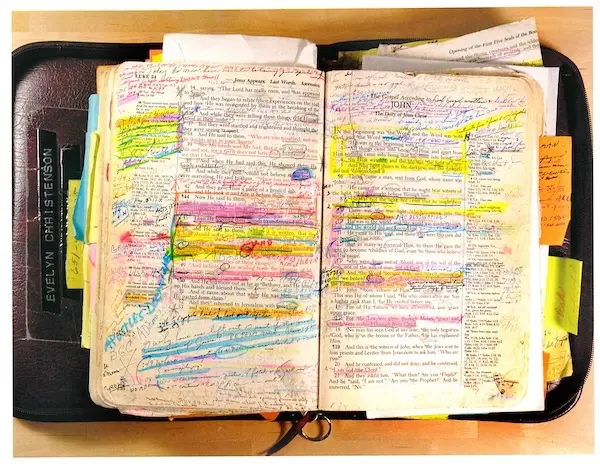
I don't have a picture of my Bible here to show you. There is lots of scratching out, lots of messes, lots of parts that are really hard to read. It's messy at points. But I just decided it's not going to be about my perfect penmanship or my perfect sentences. It's going to be about me meeting with the Lord. If you ever get to the point where you think what you're writing is amazing, then you've got an issue. Just remember that what we write is not the amazing thing. It's what we're writing about that is amazing.
So your journal entries in the Bible or in a journal near the Bible, they don't need to be fancy; they don't need to be neat; they don't need to be long; they don't need to be polished; they don't need to be edited. I'm an editor by trade. That's what I do, kind of for a living—editing, writing. I often have to tell myself, “Let it go” when it comes to Bible journaling. Don't think about somebody else's eyes being on this. It's not about you. It's not about your writing. Let it go. What you're writing is not intended to be published. The goal is to get to know God and to let His Word shape and change your life.
Now, as you get started, you've got this beautiful Bible. And by the way, if you could see in this one, there's lots of mess in there, because I'm grappling with things as I'm teaching through the Bible. And if you want to see some mess, you can come look at this.
But before you start writing anything, ask the Lord to speak to you by His Holy Spirit. You may want to write down a prayer along that line and then read the Word, read the text. It may be a longer portion. It may be a shorter portion. You may want to put it under a microscope and stick in one verse or paragraph or chapter for a long time. If you go over on the next page, that's okay. If you're a perfectionist, get over it. The goal is to meet with God.
Sometimes you'll take a helicopter view, which is you're looking at big portions of Scripture from up high. Sometimes you'll take a hike. When I was journaling five years through the Bible, that was more like hiking. But now, as I'm teaching through the Bible, I'm doing more of a helicopter ride. They're both beneficial. Sometimes you need the faster pace, and sometimes it’s better to slow down.
In my Bible journaling, I will put a date wherever I start writing so I can go back and remember. If I'm out of town, I will often put where I was at that point. Otherwise, I assume that it was at home. Now, as we're encouraging women to read through the Bible together next year in 2026 (which I hope you will do), that's a fairly rapid pace. It's a lot to read to get through the Bible in a year. That's kind of a helicopter ride. You can do it. If you haven't signed that banner on the wall yet, I want to encourage you to consider doing that. But I'll tell you this, if you do that with women around the world in '26 you won't have a lot of time to write a lot on each page.
So if you're taking a slower pace, you can write more. If you're taking a faster pace, you may write less, and that's fine. Just capture highlights, try to get the big picture, and you can go back another time and take a slower approach. Don't be in a hurry. There's no deadline. The goal is not to fill the empty space, but to let God fill your heart and your mind with His Word.
As you read, remember that this is a two-way conversation with the Lord. You're listening to God speak. You're reading humbly, thoughtfully, prayerfully. You're taking it in. You're digesting it. You're processing it. You're mulling it over. You're meditating. You're trying to understand. Then you're taking notes as you read about what you're reading. But you not only want to listen to what God says, you want to respond to God. And we'll see both of those in these tips.
Some woman said, “I'm not fancy with what I write, and sometimes it's just a sentence or two.” To which I say, “No problem.” Did you remember that there's no right way to do Bible journaling? Can you say that there's no right way to do Bible journaling? But as you do it in whatever means, I encourage you to keep it simple. Now, there's more simple and there's less simple. You can get more complicated if you want, but at least if you're starting or you're just needing freshness in your time with the Lord, keep it simple.
Here's some ways you could do that. Now, if you write these down, don't try and do them all. Pick one and try that. Sometimes it may be just copying Scripture in the margin or in your separate journal, just actually writing out the Scripture by hand. There's something that helps me process the Word of God as I write it out. Now, you probably won't do the whole thing, but key verses or paragraphs, you may just want to write those out. You may want to paraphrase, which is to write it in your own words. It makes you think about what you just read.
You may want to do something some people have called the SA method. It's not fancy; it just means summary and application. So summarize, what's this paragraph or this section or this chapter about could just be a sentence or two. Then an application, a takeaway, and again, that can be short. How did this chapter speak to you personally? What does God want you to do about what you just read? If you go through the whole Bible doing that, a couple sentences about each chapter, you will have a chapter by chapter overview, simple overview, of the whole Bible. That's simple. You can do that. I've challenged teenagers to do that over the years.
As a way to get started in meditating on Scripture, I would encourage you to write out prayers as you read, as you respond to what you've just read. Let me suggest that there are five different kinds of prayers. There are more than this, but five different ones that I've used in my notetaking Bible. And I'll just give them these names to help you with your memory.
First, there are thank You, Lord, prayers. That's praise; thanksgiving for something. Thank You Lord for . . . Thank You Lord for something you read. “Thank You Lord that You are holy. Thank You Lord that You are kind. Thank You Lord that You are merciful.”
Then there are yes, Lord, prayers. That's a prayer of agreement, of surrender, of obedience. “Lord, I agree with You. This is hard for me, but yes, Lord.” Get your white hanky there, and you can wave that when you write your yes, Lord, prayer.
There can be oh, Lord, prayers. That would be a prayer of confession. “Oh Lord, I haven't been obeying this. I have sinned against You in this way.” Confessing. You can write that out. Doesn't have to be long. It can be short.
There can be help, Lord, prayers. That would be a request for yourself. Help me, Lord, with something that's prompted by what you've read. Help me to forgive this person as you're reading about the importance of forgiveness. Make a request for yourself. “Help me to trust You when I am afraid.” Take the Scripture, make it into a prayer.
Then, please, Lord, prayers. That would be a request for someone else—maybe for the child or grandchild that you're doing a journaling Bible for. Prayers that you write for that person you love.
One woman said, “I struggle to consistently journal due to time. I have a Scripture memory system that I do every day, a prayer journal, Scriptures that I pray, and I'm usually doing a Bible study of some sort, along with my read through the Bible plan. I would love tips on how to fit it all in and be more consistent.” Here's my tip: you can't fit it all in. Don't try. You can't do it all at once. There are seasons, so pick the one that's on your heart at that point, or the two or three, but not four or five, unless that's all you have to do in your life, in which case that would be a great season of life.
So start it simple. Keep it simple. If you want to go a little deeper, let me give you a few thoughts about that, but could I just repeat, there's no right way to do this. So as you read, consider three things.
First is observation about the text. What does it say? You say, “Well, that's obvious.” Well, it may not be obvious. Some if you don't write it down, you may skip over it. So make observations.
- What does it say?
- How would you title this chapter or the passage?
- How would you outline it?
- Is there a key verse that captures the essence of the passage?
- Is there a key theme?
- Is there a key word?
Look for repeated words and phrases—maybe circle them or highlight them or mark them in a different way. I've done this in Psalm 119 over the last several weeks, the repeated words and phrases. So, I'm seeing what's emphasized.
Summarize what you've read. Be inquisitive. Ask questions about the text.
- Who wrote this?
- Why did they write it?
- Who's speaking here?
- To whom are they speaking?
- Who are the main characters?
- What are the major events?
- When and where did they take place?
- What happened before?
- What happened after?
I'm going to speak tomorrow, Lord willing, on Luke chapter 24. I've been meditating on that chapter over the last number of weeks. Just asking those kinds of questions about the text is so helpful. You may want to use a Bible dictionary or traditional dictionary to to define key words that may not be as familiar to you. What other Bible verses refer to something similar to what you are reading in that text? What are the things you've never realized or noticed before? Write down things you want to be sure to remember, questions you have that you still don't know the answer to. Jot down the question and maybe come back to it another time when you're going through God's Word as you read other parts of Scripture that may shed light on the question you had earlier.
Let me give you a couple of examples. One example is here in Acts. This is just out of my notetaking Bible when I came to Acts 13. Sometimes I will do little bits of poetry. When I say poetry, I mean that loosely, because they don't rhyme, but just ways of remembering or recording what that text says. So here was my summary of Acts 13:
Disciples sent
Word preached
Jesus proclaimed
Forgiveness offered
Many believed
Others opposed
Disciples persecuted
Word spreadp
Preaching continued
Disciples joy-filled
Church grew
Now, I can look at that and that can give me a summary of Acts chapter 13. So, those aren't even complete sentences, but that's the kind of thing I recorded from time to time in the Scripture. So observation . . . what does it say?
And then interpretation . . . what does it mean?
- How does it fit into the big picture of Scripture—creation, fall, redemption, and restoration.
- What did the author want his original readers to understand?
- What does this passage teach you about God? about humans? about yourself? about sin? about holiness? about Jesus? about the gospel?
- What does it teach you about the Christian life, etc?
- Are there particular insights that stand out to you?
If your hand's about to break from trying to capture all this, get a copy of the notetaking Bible, the Revive Our Hearts edition, and it will be spelled out for you.
One woman asked, “When you are journaling, do you use commentaries and dictionaries, or do you just let the Lord lead your thoughts?” Well, the answer kind of is yes. I try to read first and meditate on it prayerfully myself, taking in the text. But when there are places where I'm confused, I'm not sure I've got this right, or I'm wanting more insight into it, yes, I will use study Bibles and some commentaries. I don't use any big, fancy ones. I use pretty simple ones, sometimes Bible dictionaries.
But I'm also asking the Lord to lead my thoughts and to show me what He wants me to see. But if I'm not sure, it sometimes helps to say, “Is there a reliable, faithful student of God's Word?” Because if I'm the first person ever to see this in this text, it's probably wrong. Keep that in mind.
So observation, interpretation and application, what should I do?
- Are there any promises here for me to trust?
- Are there any commands for me to obey?
- Are there any warnings for me to heed?
- Are there any examples for me to follow or not to follow?
And as part of application, write down your response to the text. Make it personal—praise or gratitude for something you've read, an action or attitude you need to confess, a step of obedience you need to take, someone you need to forgive, a promise that you're choosing to believe, someone you could encourage with what you've read, a truth you want to share with someone else, etc. The Spirit will direct your response if you let Him.
We need Word and Spirit. The Word without the Spirit can lead to death. That’s not the Word's fault and not the Spirit's fault. This is not an academic exercise. This is wanting to know Him and respond to Him in the power and by the illumination of His Holy Spirit.
Now, let me just give you a couple of examples from my own original time journaling through the Bible. I want to read you what I wrote at the very beginning, Genesis 1, and then what I wrote at the very end, Revelation 22, just to give you an idea. I'm a writer, so you're going to write differently than I do. But I just want to give you the feel of what I was thinking and how I was responding.
So Genesis 1, this is where I started. “We stand at the beginning of a new year.” Now keep in mind, I've read Genesis 1. I've been thinking about it. So everything I wrote here is in relation to something in the text of Genesis 1.
God is here. [In the beginning God . . . that's what made me write "God is here."] He always has been. He always will be. Apart from Him, all of life and earth is shapeless, meaningless, futile, empty, and dark. But in Him is life and light. His Spirit hovers over this earth. He speaks light into the darkness of our world. He creates, He orders, He separates, He defines. It is good. What He declares happens. What He ordains comes into being. There are no obstacles to His power. Nothing can withstand His purposes. Sitting here in early morning darkness, snow covering the ground outside [that wasn't in Genesis 1] . . .
I pray for the hovering ["the Holy Spirit hovered over the face of the deep. I pray for the hovering,] creating, ordering, illuminating, defining, work of Your Spirit in my life this year. When You speak, may I respond. [“And God said,” that's all through Genesis 1, so this is my prayer. When You speak, may I respond.]Do Your good . . . [It was all good. I saw that it was good. I said] Do Your good work in and through me, bringing flourishing beauty and growth. Fulfill all your holy, eternal purposes in our world for the glory and fame of Your name.
That was my entry on Genesis 1, on January 1, 2018. Then when I got to the very end, five years later, plus a few weeks extra, the last verse of Revelation of the Bible, “The grace of the Lord Jesus be with everyone. Amen.” Here's what I wrote just about that verse.
The closing verse of the New Testament is heaven's answer to the curse found in the last verse of the Old Testament, Malachi 4:6. The grace of God has come to earth in the person of Christ, bringing salvation for all who repent and believe, overcoming sin's dreadful curse. How great is our God; we worship You. May we walk in that grace through every step of our pilgrimage on this planet until we see Him. Amen and Amen.
I've had the joy since CSB notetaking Bible, Revive Our Hearts edition came out, of sharing it with a number of friends. One thing I've loved is giving it to some teenagers. I have a picture here of one of the first teenagers I gave it to. I gave it to her mother to take it home to, I won't say her name. But she and her mom are here at the conference. This is a picture her mom sent me like an hour later. I love this . . . a teenager. She was fourteen at the time, sitting huddled over the Bible studying. I love, love, love this. That's why we did this.
I gave a notetaking Bible, not this exact one but a different one, to another young friend for her twelfth birthday a year or so ago. I wrote a letter to her and enclosed it in that Bible. And here's a part of what I said to her, which is what I would like to say to you today.
God promises a blessing to those who read His word, Revelation 1:3. As you read, ask God to give you understanding. Ask Him to reveal Himself, His heart, and His ways to you. He will do just that. I hope you will use this special edition of the Bible to write or draw things that stand out to you as you read. For example, observations about the passage, key thoughts or words from each chapter, a summary of each chapter, a summary of each chapter, things you learn, things you want to be sure to remember, prayers, praise. I pray this Bible will be a record of your journey with the Lord over these next years.
I still have Bibles I used when I was your age. It is a joy to look back over them all these years later. I look forward to seeing how God continues to work in and through your life as you seek Him in His Word. That is my prayer for you.
Lord, thank You for the wonder of Your Word. Thank you for the privilege of reading it in our own language, which millions of people in the world, hundreds of millions of people in the world can't yet do? You have spoken through Your Word, through Jesus Christ, and by Your Holy Spirit. You enliven and quicken that Word to our hearts today.
I’m just thinking about what would happen if hundreds of women seated here today would, whether it's in a notetaking Bible, or a journaling Bible, or some other instrument, would begin to engage with the Word in more meaningful ways, to meditate on it, make it personal. We become what we behold. May we become like Jesus as we behold You in Your Word. I pray in Jesus’ name, amen.


