

The movie Titanic is about the Titanic, but it’s not really about the Titanic.
The Life of Pi is about a guy on a boat with a tiger, but it’s not really about a guy on a boat with a tiger.
The Hunger Games series is about kids fighting one another to the death for sport, but it’s not really about kids fighting one another to the death for sport.
Animal Farm is about animals running a farm by themselves, but it’s not really about animals running a farm by themselves.
Sometimes the most obvious meaning of a plot is both the right and the wrong meaning. If you read Pilgrim’s Progress and come away with only a nice (albeit strange) story about a young man on his way to a faraway city, or if you read The Lion, the Witch, and the Wardrobe and see only with the exploits of four misplaced children in a fantastical land, you’ve missed the larger—and more important—point of both stories.
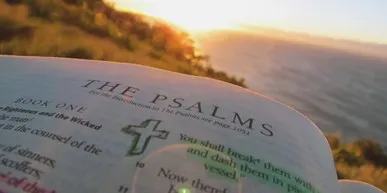
Likewise, if we read Psalm 1 and think only of ourselves, we’ll understand some of its meaning but we’ll be missing out on a less obvious—and vitally important—dimension of what it teaches.
Not a Checklist
Until only recently I thought of Psalm 1 as a poetic checklist:
Don’t walk in the counsel of the wicked? Check.
Don’t stand in the way of sinners? Check.
Don’t sit in the seat of scoffers? Check.
Delight in the law of the LORD? Check.
Okay. If I’m honest, I don’t follow any of those instructions perfectly. Not even close. My checkmark is definitely written in pencil. But you get the idea. We often treat Psalm 1 as a list of virtues to put on (vv. 1–3) and the scary “or else” for those who fail to do so (vv. 4–6).
Yet that interpretation reduces this precious psalm to a liturgy of legalism.
More than a checklist, Psalm 1 is a beautiful portrait of the one truly blessed Man: Christ Himself. Understanding this psalm through the lens of the Savior adds richer and fuller depth to an already cherished passage of Scripture.
A Picture of Christ
Psalm 1 begins by painting a picture of the “blessed” or “happy” person. Our modern parlance has sold this term short. We may think of a happy person as someone who is peppy and perky all the time, with a smile plastered on their face. This type of happiness seems phony and superficial. Or, we might think of “blessed” in terms of the #blessed trend from a few years ago when people tacked the hashtag onto everything from their kids’ perfect report card to their pumpkin spice latte to their new kitchen remodel. This version of “blessed” limits the term and seems not to leave room for suffering, and certainly not to anyone known as the “Man of Sorrows.”
However, the biblical term “blessed” carries much more significance than any of that. This word refers to having the “good life” or the “enviable life.” Yet in God’s economy, that life isn’t achieved through mansions, models, or millions. Rather, it’s achieved through kingdom living—an upside-down model set forth in Psalm 1 (among other places) and perfectly lived out in Jesus Christ Himself.
Careful About Company
The company that Jesus kept can leave us scratching our heads. He dined with sinners, ate with tax collectors, reached out to lepers, and repeatedly made enemies of the religious elite. At first glance, that seems to contradict what Psalm 1 would have us do:
How happy is the one who does not walk in the advice of the wicked
or stand in the pathway with sinners
or sit in the company of mockers! (v. 1)
While Jesus often moved toward sinful people, He never compromised the truth. Always the Teacher, Christ confronted and corrected worldly thinking. He did this with the woman at the well (John 4), Zaccheus (Luke 19:1–10), and Matthew the tax collector (Mark 2:14). By His own admission, Jesus did not come to call the “righteous, but sinners to repentance” (Luke 5:32). So while He did interact with the ungodly—as the only righteous Man in a world full of sinners, He could hardly avoid it—He never allowed Himself to be influenced by the wisdom or philosophy of the age.
Devoted to the Word
John 1 tells us that Jesus is the Word, establishing a profound connection between the Son of God and the Scriptures. But the tie doesn’t stop there. Throughout the Gospels, Jesus demonstrates unwavering devotion to the written Word of God.
We see it when He is twelve years old, sitting among the teachers in the temple, listening, asking questions, and astonishing them with His understanding (Luke 2:41–47).
When tempted by Satan after His baptism and lengthy season of fasting, Jesus counters each temptation by quoting the Word, even telling Satan that man does not live by bread alone but by every word that proceeds from the mouth of God (Matt. 4:1–11).
When the scribes and Pharisees demand a sign of His deity, rather than performing a miracle, Jesus points them to the story of Jonah and the great fish (Matt. 12:38–42).
After His resurrection, the risen Savior walks with two disciples on their way to Emmaus and interprets the whole Old Testament, showing them how He fulfills it all (Luke 24:13–27).
Clearly, Jesus delighted in the Word, meditated on it, wielded it to thwart the lies of the enemy, relied on it when challenged by the Pharisees, and taught from it to make sense of current events to His followers.
How We Fit In
So, if Psalm 1 is really all about Jesus, the perfect “blessed Man,” you may be wondering how exactly you fit into the equation.
That’s the most beautiful part.
Because Psalm 1 describes the Savior, it also describes me—and you, too, if you’re a follower of Christ. The doctrine of union with Christ teaches us that through the gospel, the righteousness of Christ has become ours (2 Cor. 5:21). In Christ, our old selves are crucified (Gal. 2:20) and we’ve become brand-new creations (2 Cor. 5:17). What does that new creation look like? We could turn to many New Testament passages to answer that question, but we can also look to Psalm 1.
Because I’m united with Christ, His devotion to truth and aversion to worldliness is mine (Psalm 1:1). I can walk among the sinners, scoffers, and wicked without turning in to listen to their sales pitch for worldly wisdom.
In Christ, His Word becomes my delight (Psalm 1:2). The eyes of my heart are opened to “behold the light of the glory of the Gospel of Christ” (2 Cor. 4:4). I begin to understand the rich treasures of the Word and can say with the psalmist that His Word is sweeter to me than the finest honey (Psalm 119:103).
In Christ, I’m rooted, grounded, and secure (Psalm 1:3). I’m tethered to the Vine Himself and can bear much fruit as I abide in Him (John 15:4–5). I no longer have to fear when hardship comes because my leaves will stay green and my fruit will only grow stronger, sweeter, and more mature (Jer. 17:7–8). I am “rooted and built up in Him and established in the faith” (Col. 2:7).
Finally, in Christ, we discover what true prosperity is. Our affections are set on things above (Col. 3:2), our eyes are fixed on the Author and Perfector of our faith (Heb. 12:2), and we endeavor to lay up treasure not here on earth where it’s subject to corruption, decay, and theft, but in heaven, where it will reap eternal reward (Matt. 6:19-21).
Psalm 1 is about you, but it’s not really about you. First and foremost, it’s about the Savior. And in revealing Him, it reveals to us a beautiful, kingdom-oriented life that belongs to us because we are united with Christ.
It’s a great place to jump in. Whether you’ve been reading with us or are just getting started, you can join right where we are as we read through the Bible together—one day at a time—seeking to know God more through His Word.
Start with us today and experience the beauty of God’s faithfulness unfolding in everyday lives.
Join us right where we are. 📖✨





Join the Discussion