
Three Gifts Suffering Gives
This episode contains portions from the following programs:
"Suffering: An Avenue for Grace"
"The God I Love: A Lifetime of Walking with Jesus"
------------------------
Dannah Gresh: Psalm 84:11 says, “The Lord God is a sun and shield; the Lord bestows favor and honor. No good thing does he withhold from those who walk uprightly.”
Beautiful verse! It’s poetic. Hopeful. And we love good gifts, right?
But what about . . . when we’re suffering? What do we do with this verse when we’ve experienced loss, grief, or some other trial, and it feels like God has most certainly withheld good from us?
Been there. Done that! You too?
Yeah, that’s hard to grapple with.
When we feel the tension between God’s promise—"No good thing does he withhold from those who live …
This episode contains portions from the following programs:
"Suffering: An Avenue for Grace"
"The God I Love: A Lifetime of Walking with Jesus"
------------------------
Dannah Gresh: Psalm 84:11 says, “The Lord God is a sun and shield; the Lord bestows favor and honor. No good thing does he withhold from those who walk uprightly.”
Beautiful verse! It’s poetic. Hopeful. And we love good gifts, right?
But what about . . . when we’re suffering? What do we do with this verse when we’ve experienced loss, grief, or some other trial, and it feels like God has most certainly withheld good from us?
Been there. Done that! You too?
Yeah, that’s hard to grapple with.
When we feel the tension between God’s promise—"No good thing does he withhold from those who live uprightly"— and our lived experience—you’ve lived with wisdom but things keep just getting messed up . . . you’ve lived in purity but God has not provided a life partner . . . you’ve lived with patience, but the dreams you have are just not coming to be—that can create questions in your heart, and you’ve got to address it.
Is God serious when He promises He hasn’t withheld anything good from us?
Today, we’re going to wrestle with this question together. I’m your host, Dannah Gresh, and you’re listening to Revive Our Hearts Weekend.
Well friend, we know that God is no liar. It’s just not in His character.
Numbers 23:19 says, “God is not man, that he should lie, or a son of man, that he should change his mind.”
That really could not be clearer. When God promised not to withhold anything good from us, He must have meant it.
You know who does lie, though? Satan. Jesus calls him the father of lies. If anyone wants you to believe God’s holding out on you, it’s him. So let’s defy him by looking at three good gifts God is giving us when we’re suffering. They may not feel like gifts today, but that’s where faith comes in. Sometimes we have to take what we know to be true about God and choose to believe it. To rehearse His promises with a heart that trusts, even when we don’t fully understand. That’s what we’re gonna do now.
Here’s gift number one. Suffering gives us a platform. A platform to proclaim the gospel. It’s not an easy gift to be entrusted with,but it’s purposeful, and God calls it good.
Nancy DeMoss Wolgemuth is going to tell us more about this gift. She shared a series on the True Woman Manifesto several years back, and one of the affirmations in that document goes like this: “At times we are called to suffer for doing what is good for the sake of the gospel and the advancement of Christ’s kingdom.” This was certainly true in Paul’s life. His suffering became a platform for the gospel, and his example gives us a vision for how our own suffering might do the same. Let’s hear what Nancy has to say about that.)
Nancy DeMoss Wolgemuth: Now, let me take you to another passage where I want to spend the rest of our time. Philippians chapter 1.
We’ve seen that suffering is unavoidable, even for those who do what is good, serving the Lord. As we come to Philippians 1, the apostle Paul gives us some wonderful insights about suffering, and these insights give us perspective that help us endure faithfully to the end.
You know the context here. Paul is imprisoned in Rome for preaching the gospel. He is guarded day and night, 24/7, by members of the Imperial Guard. He’s also dealing with critics, with opponents in the ministry.
As I was trying to meditate on this passage, I was thinking about the things that Paul might have been justified in feeling or thinking in those circumstances. Paul could have felt trapped. He could have felt resentful or bitter. He could have felt anxious, frustrated, angry, restless, impatient, discouraged, depressed, defeated.
He could have viewed those circumstances as a huge setback, an obstacle. “God called me to preach Christ, but here I am in this prison, and I have nobody to preach to, nobody to listen. I have no hope of getting out of here.” He could have viewed this as a huge setback to the gospel ministry.
But to the contrary, Paul has a perspective that challenges us in our prison cells, in our places of suffering. He says in verse 12 of chapter 1: “I want you to know, brothers, that what has happened to me . . .” What had happened to Paul? He’d been arrested; he’d be imprisoned; he was being held there against his will; he was being guarded by these Imperial Guards. “What has happened to me has really served to advance the gospel.”
Far from being an obstacle or a setback, this has resulted in the gospel going forward. “What has happened to me has helped to advance the gospel.”
Now you never would have written the script this way. If you wanted to say, “How do we get the gospel out?” you wouldn’t have said, “Put its chief spokesman in prison.” But in God’s economy, it was Paul in prison, among other things like writing letters like Philippians, that resulted in the gospel being advanced.
That word advance means "to go before an army, or to clean out debris." "What has happened to me—my circumstances—have gone before the army of Christ and His Truth and have cleaned out the debris, to make the passage smoother for the gospel to advance."
This says to me, to us, that our suffering is purposeful. It has value. It is not meaningless. It is not random.
Now, it’s purposeful in a lot of different ways. It’s purposeful in our own lives. Suffering sanctifies.
Psalm 119:71, the psalmist says, “It is good for me that I have been afflicted, that I might learn your statutes.”
Often times we don’t see that when we’re in the middle of affliction, but afterwards, we can see, “Yes, that really was good for me. I needed what I learned through that experience.”
So it’s purposeful in our own lives, but there’s an ultimate purpose of suffering that makes it oh so worthwhile. If we could only get this, and that is for the sake of the gospel and the advancement of Christ’s Kingdom.
That’s what we read in this part of the Manifesto: “At times we are called to suffer for doing what is good for the sake of the gospel and the advancement of Christ’s Kingdom.”
Paul is saying, “This is all that really matters to me—the advancement of the gospel.” He says, “If I know the gospel is being advanced, I can endure anything. I can endure prison. I can endure these guards. I can even endure death if necessary if people are coming to know Christ and becoming a part of His Kingdom.”
So he says in verse 13:
It has become known throughout the whole imperial guard and to all the rest that my imprisonment is for Christ.
It’s for Christ! Boy, think about it. It gives you a whole different perspective on whatever you’re going through if you can say, “My imprisonment, this season of my life, this challenge, this painful circumstance, this pregnancy, this menopause, this child, this financial issue, this—fill in the blank—is for Christ. I’m going through this for Him so that His gospel can be advanced.”
Ask yourself as you think about whatever trials you may be facing at this season of your life, big or small—if they’re small now, you’ll have some big ones later, so get in practice while they’re small—ask yourself, “How could this—fill in the blank—that I’m going through be used to make Christ known and to advance His Kingdom?”
I was on the phone last night with someone who is going through difficult circumstances in her life. I was just kind of full of this passage and I was sharing with her what I had been seeing in Philippians—that our suffering is valuable, that Paul says what has happened to me has served to advance the gospel.
This woman says to me, "I can see that Paul's imprisonment was used to advance the gospel, but it's really hard for me to see how what I'm going through can be used to advance the gospel.
That’s the perspective we need, that it can and it will advance the gospel if we’ll let it; that our imprisonment, our suffering, our circumstances are for Christ.
He says in verse 14:
And most of the brothers, having become confident in the Lord by my imprisonment, are much more bold to speak the word without fear.
So now you have not just Paul preaching without fear, but you have others who’ve seen how he has suffered, and they’re emboldened to preach the gospel themselves. What made them bolder? What helped them to speak the gospel without fear? You’re talking about the Roman government where, to preach the gospel could be "off with your head." What made them bold?
They saw the way that Paul endured hardship, not giving in to anger, bitterness, fear, depression, discouragement. They looked at that, and they saw Christ magnified in his life, and they said, “This Savior is worth living for. He’s worth dying for. I can choose to represent Him without fear”—because of Paul’s imprisonment.
Dannah: That’s Nancy reminding us that our suffering is an opportunity to adorn the gospel of Jesus Christ. When we live with courage and gladness in the middle of loss, grief, or some other trial, what we’re really saying is, “This Christ I love is worth everything to me. I would be glad even if all I had was him.” We’re declaring that this gospel we believe is the real deal. Christ really is our hope in life and in death.
So that’s our first gift in suffering: a platform for the gospel.
Our second gift is a sweet one. It’s God’s grace, His comfort that meets us and helps us to endure.
Christie Allen, a professor at Midwestern Baptist Theological Seminary, likes to say this—lean in, it’s gonna be good: "When we miss out on grief, we miss out on comfort. We experience God’s tenderness uniquely in suffering, and this is a privilege."
We get to testify to a God who comes close. Psalm 34:18 says He is near to the brokenhearted. Psalm 147:3 says He binds up their wounds. We wouldn’t experience God’s comfort so intimately if we didn’t first experience pain.
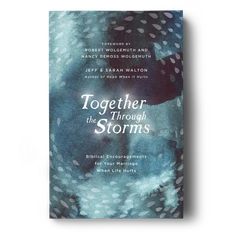
Sarah Walton learned this through a time of intense suffering. Let me just give you a little rundown of what she and her family have experienced:
- An ongoing battle with chronic illness, Lyme disease for Sarah and the kids. Can you imagine? All of them!
- A neurological disorder and mental health challenges in their oldest son.
- Drained finances, because most treatments for Lyme are not covered by insurance.
- An injury in Sarah’s late teens that led to five ankle surgeries . . . difficulty walking.
- Job loss. Sarah’s husband Jeff was an orthopedic trauma consultant that was constantly on call. He needed to quit his job to help his family. He took a 70 percent pay cut.
I have that sort of “are we there yet” feeling when I remember their story. But it just keeps going.
- I mean, Jeff was laid off after all of that!
- And yes, their marriage has suffered, to the point they wondered if they were going to make it.
But God! God met Sarah in this whirlwind of suffering. Here she is to share about that.
Sarah Walton: For me, knowing and experiencing the comfort of Christ has been my lifeline! It has been what has carried me through this long hard season. I remember actually talking to my mom one day; she has been such a sweet gift to me, to be able to come honestly. She has a sweet balance of encouraging me and keeping my eyes on the truth while grieving with me.
I remember talking to her and just sharing how difficult it is to serve and to care for my son after episode after episode of really difficult, scary things that I don’t know how to handle and that leave me feeling very hurt. I don’t know how to continue to care for him when after that he comes and says, “Mommy, can I have a snack?”
In my emotions I want to say, “No! I don’t want to see you right now!” And so I asked her with weariness and discouragement, “How do I sacrifice for and love someone who so often treats me like an enemy, when I’m pouring myself out and I’m giving everything I have . . . and then that’s what I receive back?”
And she looked at me with this sweet compassionate look and she said, “Sarah, because Jesus knows what that feels like. He endured it all for you and me. You are being given such a tangible opportunity to walk in the comfort and strength of Christ to love and serve your child even at great cost to yourself. You are sharing in Christ’s sufferings! He promises to walk with you through it, and because of His sacrifice, He will redeem it all!”
Ever since that day that truth has just stuck with me and comforted me and encouraged me more times that I can count. It has helped me rely on the strength of Christ in those moments where I think, Everything in me wants to respond this way, but I can resonate with Christ in this moment. And He was able to faithfully respond to His enemies in a way that can empower me to do the same and help me love my child in this situation.
On days when I’m struggling to walk, or I can’t participate in activities with my children, and I see that awful face of disappointment, I allow myself to acknowledge that, “This really stinks! This is hard!”
I’m sad and I can struggle with it, but then I remind myself that this is the road God has chosen for me. He’s called me to walk it, and He promises to give me the grace and the strength to walk down it. It’s not because I’m strong enough, but because my weakness makes me lean into His strength, and my grief makes me lean into His comfort.
In the moments that I feel so helpless, as I watch my son struggle and my other kids struggle in ways that just feel so devastating to a mom who wants to help and wants to help relieve things, I have to remember that Christ is there with me.
He knows and He loves my son and my other children more than I ever could. He knows my pain; He knows their pain. And even in the chaos, somehow He is in control. He has carried me through moments that have left really deep painful scars and memories, but I am so comforted by the fact that He’s at work in ways that I can’t see!
And so frequently He gives me nuggets of, “This is what I’m doing. I may not be answering your prayers in the way you’re asking Me right now, but I have something greater for you.” He so frequently does that and is so faithful in it.
Andrew Murray said,
In Him you see a thousand times more giving you than you have lost. See how God took from you only in order that you might have room to take from Him what is so much better!
So, sisters, what pain or loss are you facing right now? I just want to encourage you that Christ has been there and He will walk with you through it. The pain of loss can feel really crushing at times. I’m not going to deny that.
But there’s nothing greater in those moments than the comfort of Christ, who is the only One who can fully understand what you’re walking through, what you feel like, and He is the only One who can provide what you actually really need!
Paul knew this from experience, and I am learning it more and more every day. Would I like to have my health, see my child free from the illness that causes so much pain in his life and our lives and others’ lives? Yes!
Do I wish I could wipe fleas off the face of this planet? You bet I do! Do I desire for my children to not have to suffer at such a young age? That grieves me. Yes, of course I do. But I can say with Paul, “Whatever gain I had I count as loss for the surpassing worth of knowing Christ Jesus my Lord” (Phil. 3:7).
I grieve my losses often, but Christ’s presence has become so much sweeter. My sin is a daily battle, but I now grasp the gift of the gospel in a whole new way. I feel my weakness and pain of what may never be in my life, or what I’ve lost, but I have experienced the strength and comfort of Christ like I never would have otherwise! I’ll close with one of Charles Spurgeon’s favorite quotes:
Your faith prospers when everything is against you. Your faith increases with every trial. No flowers wear so lovely a blue as those that grow at the edge of a glacier, no stars shine so bright as those that glisten in the polar sky. No water is sweeter than that which springs in the desert oasis. No faith is so precious as that which lives and triumphs in adversity.
Friends, eternity is coming! Amen, right!? It’s where all of our tears are going to be wiped away and every loss we’ve experienced in this life will pale in comparison to the eternal riches and glorious presence of Christ!
But until then we can trust that God will take what is meant for our harm and use it to make us know and to reflect more of Him. And we can praise God that He can take even our most painful losses and He can turn them into eternal gain.
Dannah: Amen. Sarah Walton there, sharing about the gift of God’s comfort. It’s a gift only suffering gives, and it’s really, really good.
Well, that brings us to our third and final gift, and I’ve saved the best for last. Number three: suffering gives us more of God. When sorrow overwhelms us, God meets us not only with comfort, but with Himself.
I can’t think of anyone better to speak to this than Joni Eareckson Tada. When she was seventeen, Joni was in a diving accident that left her paralyzed from the neck down. And now, decades later, she’s got a powerful testimony. She’s not a wallowing woman who believes God has withheld good gifts from her. Instead, she’s filled with joy. At a True Woman breakout session, she sat down with Nancy and shared transparently about her suffering and the God she’s come to know so deeply. They had such a good conversation, and I’m excited to listen to part of that now. Here’s Nancy.
Nancy: You mentioned self-pity. There's probably no one else in this room who ever struggles with self-pity. Was that a battle just early on or is that something that has been recurring temptations, something you've had to deal with along the way? Forty-five years is a long time to deal with some of the limitations that you have. Does that crop its head up again in your life?
Joni Eareckson Tada: Oh, absolutely. You know, Luke 9:23, Jesus says, "Any man who would come after Me must take up his cross daily and follow Me." And frankly, girls, I'll confess, every morning when I wake up, especially now that I'm in my sixties and that I deal with chronic pain, it is so hard. I mean, I've told this story before, but I'll relay it again.
I will wake up in the morning, Nancy, and I will be lying there with my eyes closed. And you know how you can set your attitude for the day right in those few seconds when your eyes are closed and your head's on the pillow? You know how it is. You're just thinking about the day and all the appointments and things you have to do, and you are kind of like setting your attitude for the day.
Well, I'll tell you, I'm fighting a battle, a cosmic battle, because I just don't know how I'm going to make it to lunchtime. God, I can't stand this routine. I've got girlfriends coming in here in a few minutes, and they are going to give me a bed bath, they are going to do my toileting routines, they're going to cinch on my corset, they're going to pull up my pants, they're going to get me dressed, sling me in a wheelchair, push me to the bathroom, brush my teeth, blow my nose. Oh, God, I am so tired of this.
I don't think I can go on. I have no strength for this. I cannot do quadriplegia, but I can do all things through Jesus Christ as You strengthen me. So give me Your strength. Would You please get me up this morning, Jesus? Live through me. Yes.
Nancy, when I was at my worst pit of self-pity, it was so horrific. I don't want to go back there. It's so terrifying. I don't want to go back to that kind of depression and self-pity. So every morning it's a desperation to need Jesus and require Him.
And you know, the cross that I take up daily is not my wheelchair. For that matter, your cross is not your irritating husband or your irksome mother-in-law or your dead-end job. No, those are not our crosses to bear.
Our cross, okay, let's define that real quick. When Jesus took up His cross, He was dying for the sins that you and the rest have committed, okay? So when we daily take up the cross, we are dying to the sins that He died for on His cross.
My cross to bear is not my wheelchair; it's my attitude about my wheelchair. It's your attitude about your dead-end job or about your irksome mother-in-law or your irritating kids. It's your attitude. This is what I've got to put to death.
So in the morning when I'm setting my attitude, while my eyes are still closed, "Oh, Jesus, I need You. Please give me Your grace. I require You urgently. May Your mercy come meet me and help me get out of bed and give me Your smile for the day." And girls, that is the Christian way to wake up in the morning. That's the biblical way to wake up in the morning.
Don't be ashamed of the affliction, right, Nancy? Don't be embarrassed by the limitation. Boast in the affliction; boast in the limitation; glory in the infirmity. Because it's the sheep dog snapping at your heels that drives you down the road to Calvary every single morning, needing Jesus desperately. Oh girls, wake up tomorrow morning needing Him desperately, and you can't go wrong.
Nancy: You wrote a book a number of years ago called The God I Love, and it was something of your spiritual journey. I love the title. That's why we titled this breakout session "The God I Love" and wanting to hear of your spiritual journey. What are some of the characteristics of God that you have grown to love that have nurtured you and walked you through this journey? What is it you love about Him and why?
Joni: What a good question. Thank you for asking that question.
I love that God is so merciful. He is so merciful with me. I am such a sinner. I will touch on that a little bit when I speak tonight, but I am a stubborn woman. I am highly competitive.
Yesterday when we were in a prayer circle with the other speakers before the conference began, and Dan Henderson invited us all to go around our table and confess our sins, oh, my goodness. I mean, I'm thinking of all the idols that I've got in my life, if not the Food Network, then food. Just, you know, I have to break myself of these idols.
God is so merciful, and I think that's what I love about Him most. He is exceedingly patient with me, and He hears the cry of the afflicted. That's another thing I love about Him. I mean, sometimes when I'm on my bed paralyzed and it can be so claustrophobic. It really can. It can be so tight and you feel panicky, because gravity is my enemy when I am lying down in bed—and I will groan and cry if I'm in pain, "Oh Jesus, Jesus save me."
And He does. His presence is so near and sweet and tender and poignant and personal, where He just gives joy sent straight out of nowhere but heaven. And I think I love His mercy; I love He hears the cry of the afflicted; His heart is toward those who hurt, the wounded. He heals up the brokenhearted.
When I get to heaven, I'm going to be so happy to hold His nail-scarred hands. And He will recognize me—I know He will—from all those times I came to Him hemorrhaging human strength. I'll feel His nail scars, and I'm so grateful that I will be able to say to Him, "Thank You. Thank You for the grace You gave when I was in that wheelchair on earth. Thank You."
He'll know I mean it because He will recognize, I know He'll recognize me from having stepped into the fellowship of sharing with His sufferings and not complaining about it. I just can't wait to say thank you for the grace You gave, and I'm so happy to know that this wheelchair has won me that access, that closeness, that sweet personableness.
Yes, we know Christ, but to know His heart, to get that close against His breast, I just cannot wait to—it's going to be a wonderful day.
Dannah: A wonderful day indeed. That’s Joni Eareckson Tada telling us about the God she loves. Her suffering has given her the gift of intimacy with Him.
If you’re suffering today, I hope this conversation has been encouraging to you. It’s okay to acknowledge that this is hard. But even in hard circumstances, God has not broken His promise to you. He isn’t withholding good from you. Instead, He’s giving you the unique gifts that only come through suffering. And when you feel His nail-scarred hands, you’ll be able to say like Joni, “Thank You for the grace You gave me.”
If this episode resonated with you, we’d love to point you to A Small Book for the Hurting Heart by Pastor Paul Tautges. It’s got fifty bite-sized readings to help you sit in the healing balm of God’s Word. When Nancy endorsed it, she said, “These meditations will lift up weary hearts and tear-stained faces and help them find compassion and hope in the face of Christ.” Right now, when you make a donation of any amount, we’ll send you a copy to say thank you for your generosity. Just be sure to ask for it when you go online to give. You can visit ReviveOurHearts.com to do that.
Well, today we talked about suffering as a broader term, but next weekend we’re honing in to talk about depression and despair. And as always, we’re looking for the hope Christ offers even when darkness closes in. I hope you’ll join us.
Thanks for listening today. I’m Dannah Gresh. We’ll see you next time, for Revive Our Hearts Weekend.
This program is a listener-supported production of Revive Our Hearts in Niles, Michigan, calling women to freedom, fullness, and fruitfulness in Christ.
*Offers available only during the broadcast of the podcast season.