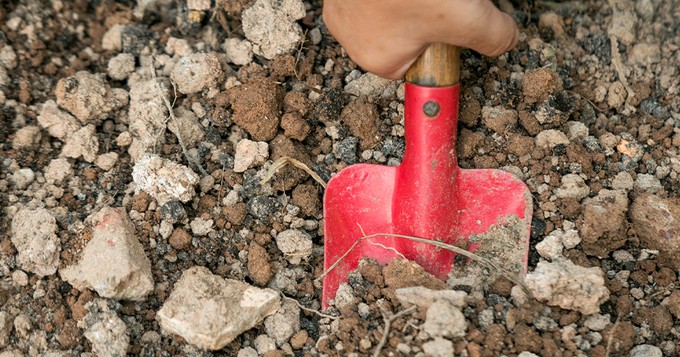

“If I never see another rock again, it will be too soon.”
Earlier this summer, my husband and I joined four other adults and sixteen teenagers to help landscape a Bible camp in northeast Ontario that will primarily serve kids from First Nations reserves in Canada. Just a few summers ago, this camp was completely covered by forest. No humans had ever lived, camped, or picnicked on the site before God providentially allowed it to become a ministry camp.
Needless to say, it was pretty rough. In order to plant sod, the ground had to be cleared of rocks, sticks, and other debris that would hinder growth. So, why not have a bunch of teenagers with young backs and eager spirits do the dirty work? We knew from the outset that we were signing up for a week of un-glamorous work, and we got exactly what we anticipated. Our days were primarily filled with two jobs: splitting/stacking wood and picking up rocks.
Each morning, the camp director would assign us an area of the camp where we would pick up rocks, sticks, stumps, and roots until the ground looked pretty good. We could stand back and see a real difference. Meanwhile, a skid steer was at work grading another area of the camp (usually one we had already tackled). Each time the tines went through the dirt, more rocks, sticks, and debris came to the surface. It wasn’t rocket science to figure out our next task—pick up more rocks.
Each day followed this same pattern, and by the end we could see genuine change. However, we also didn’t want to look at the ground because we knew what we’d inevitably see: more rocks. Though each of us rock-pickers probably felt some frustration doing an endless job, we also recognized how just four days of work completely reshaped the campgrounds. What looked like a disaster zone when we arrived looked ready for sod (or close to it) when we left.
Keep Working, One Rock at a Time
In the days since I returned from Canada, I’ve been reflecting on rock-picking as a metaphor for sanctification—the process by which Christians, slowly but surely, are transformed into the image of Christ (Rom. 8:28–29). The Holy Spirit continually reveals more and more “rocks” in our lives that need to be removed. By His grace and the power of the gospel, we can address these areas.
A decision here and a change there, and pretty soon we think our lives are in tip-top shape. But then the Bobcat starts up again, and more rocks are dragged to the surface. Over and over, we repeat the process. Sometimes it feels futile, frustrating, and fruitless—that is until you see a “before” picture. Sometimes God graciously gives you a moment where you can see how far you’ve come. Though the work may never be finished, you realize that growth has taken place.
If we were to try to draw a picture of how spiritual growth should be, we’d probably draw something like the growth chart the doctor shows at your child’s wellness visits: dots that follow basically the same upward trajectory at somewhat even levels. However, while that may work out for physical growth, spiritual growth isn’t nearly so neat.
Biblical counselor David Powlison famously compared spiritual growth to a man walking up the stairs with a yo-yo. The yo-yo has a general upward trajectory, while still experiencing ups and downs. Sometimes you look down and see only a few rocks and sticks but feel pretty good; other days (most days), debris seems to litter the entire landscape.
Our task is to keep working, one rock, one stick, one root at time. We are called, along with the Holy Spirit at work in us, to “work out [our] own salvation with fear and trembling” (Phil. 2:12).
Use Your Team
To tell the truth, I didn’t really enjoy rock-picking. Monotonous, repetitive jobs aren’t my style. But somehow digging up stumps and roots buried deep in the ground and grabbing handful after handful of rocks wasn’t so bad when I was part of a group.
Twenty-two people from my church traveled to Canada—a sizable number—but we weren’t the only rock-pickers at camp that week. We had the privilege of joining forces with youth and sponsors from two other churches as well. In total, more than forty teens and adults could be seen scattered around the campgrounds, clearing it of stones and sticks that would wreak havoc on the blades of a lawn mower.
Though the job usually seemed daunting, when we all worked together, we could finish a section relatively quickly. Our strength in numbers made for a successful week.
While the analogy isn’t perfect, sanctification also works better with a team. As followers of Christ, we’ve been given not only the unspeakable privilege to join with the global Church but also the responsibility (and privilege) to link arms with a local group of believers.
These brothers and sisters have their own set of rocks and sticks to pick up, but they can also come alongside and help as I try to pick up the rocks in my own fields. Paul used a better (and probably clearer) metaphor:
Brothers and sisters, if someone is overtaken in any wrongdoing, you who are spiritual, restore such a person with a gentle spirit, watching out for yourselves so that you also won’t be tempted. Carry one another’s burdens; in this way you will fulfill the law of Christ. (Galatians 6:1–2)
Although burdens can refer to loads not caused by sin, the context of this verse is that the burdens we’re to help others bear are directly connected to an enslaving sin. The work of sanctification works best in teams.
Sometimes, it’s a lifeline. Jude, the brother of Jesus, uses yet another word picture for the necessary teamwork involved in spiritual growth. This time it’s clear that collaboration in sanctification is a matter of life and death:
Have mercy on those who waver; save others by snatching them from the fire. (Jude 1:22–23)
We need each other. Sure, sometimes we get it wrong. We don’t reach out to bear the burden when we should. We fail to take the log out of our own eye before going after a brother or sister’s speck. Or we might not receive the mercy, patience, or gentleness we think we deserve.
However, we must remember that while we each run our own race and deal with the rocks in our own fields, we don’t run (or pick them up) alone. Don’t abandon your teammates, and don’t let them abandon you. Stay plugged in to your local church, even if it’s not perfect.
Let us consider one another in order to provoke love and good works, not neglecting to gather together, as some are in the habit of doing, but encouraging each other, and all the more as you see the day approaching. (Hebrews 10:24–25)
Like picking up rocks in the Canadian forest, sanctification is a lot of work. Sometimes it feels dull, monotonous, fruitless, and unending. But keep on working: change is happening. And don’t underestimate the power of the team working alongside you!
Register now—and come expectant.
Join the Discussion